Current status…getting there

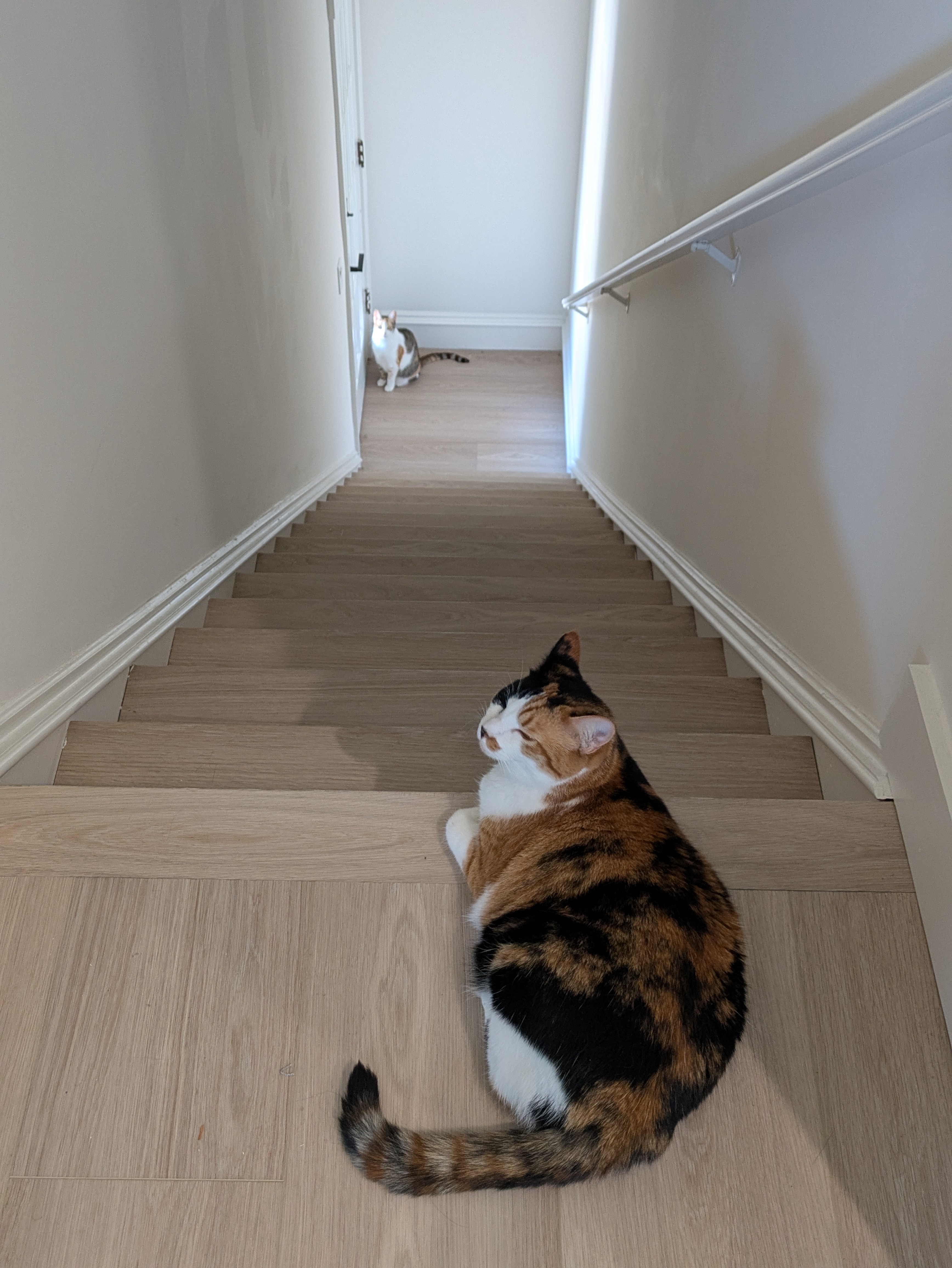
It’s been a week and change at the new place and we’ve settled in for the most part, adjusting and rearranging where necessary. The cats took the change in location pretty well, I think partly because we constantly change things up for them to keep things interesting for them. They particularly love the front stairway, because a) it echoes and b) they love going down and running back up! It’s going to be a while before it really sinks in that this is our new home now, but I’m enjoying it so far.

I’m back at the PC and working on the Trilogy Remaster project, and hope to find more time to work on Theadia when and where I can. As always, I’ll try to keep up with the blogging but I’m not going to worry too much if I don’t get around to an entry or two during the week. My longhand writing work is now hanging out in the garage, safely in one of the plastic storage tubs on the new shelves for easy access.

Still, it feels great to be back to work with the writing!

A fresh start

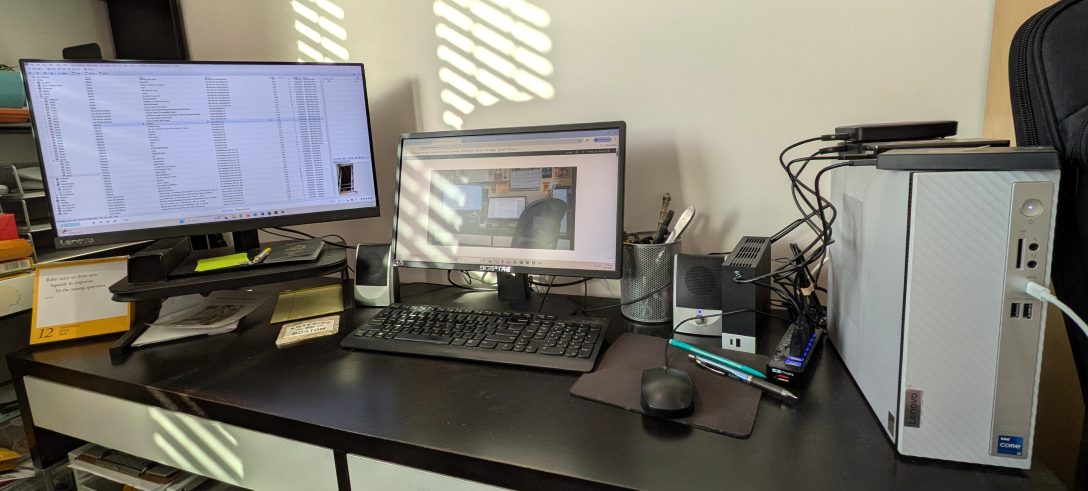
It’s been a couple of days since we settled into our new place, with nearly everything unpacked and put away. We’re still organizing as we go of course, but for the most part it’s all where it needs to be or at least close by. And both cats have been monitoring and supervising every step of the way.

I made the decision early on to keep a lot of my stuff down in the garage storage until further notice so as to not crowd everything in our now-shared office. This means that most of my notebooks, early writings, journals, and so on are down there, still easy to access but locked away. It occurred to me that I don’t need them immediately. Not to worry, they’re in closed plastic bins and out of harm’s way. [And besides, my juvenilia has definitely seen worse storage times.] Whenever I finally get around to restarting the scanning project, they’ll be ready to go.

In the midst of all this, I realized that this gives me the opportunity for a completely fresh start here in the new office. When you’re living in the same place for over fifteen years, it’s kind of hard to go cold turkey on some of the habits and processes you’ve become so used to. So instead of trying to find where I left off with all of that journaling and longhand writing and so on, I’m just going to start a new moleskine notebook. Spend a little more time just enjoying listening to music instead of obsessively collecting and organizing it. Pick up those art supplies and have some fun during downtime. And most importantly, instead of finding a place to put up my whiteboard schedule (and not wanting to damage these pristine walls on day one), I’m just going to try my hand at working without one.

This doesn’t mean abandoning my two current projects, of course. I’ll need to pick up where I left off with the Trilogy Remaster, and I still need to finish off Theadia and start in on its revision and eventual publication. Those two have been at the front of my mind ever since we started this whole moving house chaos two months ago. Give me a day or so and I should be back on track!

Do I know where I’m going to go from here? Not entirely…but I’d like to think that’s a good thing. I’ve given myself a clean slate as it were, and I definitely need to allow myself to experience those more often.

Editing and tidying up

I’m just shy of the halfway point in the Great Trilogy Remaster for A Division of Souls, which is a very good thing. That should leave me quite a lot of time on the back end to give it one more ‘bedtime reread’ (where my mistakes seem to make themselves the most visible) before releasing it out into the world come September.

It’s been ages since I’ve allowed myself to get this close to the Mendaihu Universe to the point where all the right things resonate. I’m using this to my advantage, because this means I know exactly what I was trying to do with the book. This also means that I know exactly where I didn’t quite pull that off. Anytime I find a moment that feels a bit rushed or confusing, too repetitive, or a potential continuity problem, I’m fixing it right there and then.

It’s also a different process than I’ve been used to since I first completed and released the third book in 2017. Whether it’s due to the writing styles or the shorter lengths, my later standalones went through a somewhat different process. I didn’t feel I had to immerse myself that deeply. Not that that was a bad thing, but over the years I began to miss that. Over the next few years I proved to myself that I could write econo, and enjoyed it just as much…but I missed the intensity of the deep dive. The full immersion.

I know, I know…I’ve brought this up a few times here already, but it constantly weighs on my mind while I work on this remaster. Writing the trilogy was such a powerful and life-changing event for me in that my writing chops escalated considerably within the span of just a few years, and it only got better once I started the original revision and self-publication process. Coming back to it again at this time feels like picking up where I left off, and hopefully I’ll be moving ever forward.

Deep dive

That’s what I’ve been calling it lately: the process I used when originally writing the Bridgetown Trilogy. And it all started because I felt I hadn’t gone far enough with The Phoenix Effect.

By the time I was writing True Faith in 1995, I felt I at least had gotten the hang of the science fiction genre, and had gotten even further two years later with TPE, but at the same time I knew there was something wrong. There didn’t seem to be any issue with the universe I was creating, and I definitely felt that writing dialogue was one of my stronger creative traits…but it still felt off.

It didn’t take me long to figure out that it was the prose itself.

The problem was that my novel didn’t sound like one. It sounded more like an extremely detailed outline. And that had always been a problem with my work then…I thought I had some really neat ideas, but I was definitely failing in the execution of them. There was plenty of action, but my novel read more like a descriptive ‘A happens, B reacts, C happens, D causes a shift, etc.’ and less of an actual story. I resonated deeply with this tale about underground hackers, spiritual magic and otherworldly kinship…but none of that resonance was coming through at all.

So by 2001 or so, while working on TPE‘s revision and slogging my way through its sequel and getting nowhere, I realized that I needed to do something about it. I wanted to do better. I needed to do better. So one afternoon I decided I was going to completely rewrite it. I mean, start from scratch. Tell the whole dang story from Nehalé’s awakening ritual to the end, and do it right.

The only way I knew how to do this at the time was to do a deep dive. Instead of writing in that old outline style, I was going to make damn sure that every single scene resonated with me. It was a bit like method acting, to be honest: become the novel. Figure out why Nehalé did what he did. Understand the actions and reactions of Caren and Poe and everyone else. And don’t just be flippant about it; those actions and reactions were also part of the story, because it was who they were, and the consequences of their actions were also part of it.

By the time I’d gotten about five or six chapters in on this new version, I’d realized I’d only gotten through maybe two chapters of The Phoenix Effect, and this was EXACTLY what I’d been aiming for. So I just kept going, and eventually wrote myself an almost complete trilogy by the spring of 2005.

*

I bring this up now for two reasons:

One, after completing and self-publishing the Bridgetown Trilogy, I knew I had more to learn. I could definitely write doorstop epic novels at that point, now I wanted to prove to myself that I could ‘write econo’ (hat tip to The Minutemen, heh), so I started writing much shorter standalones. I’m quite proud of them all, especially Diwa & Kaffi, which I still feel is my best book to date. Even despite the urge to write the fourth book in the Mendaihu Universe, I wanted to stick with shorter works until I felt confident enough.

Two, it was the writing of the still-unfinished Theadia that made me realize that perhaps I was ready to do another one of those deep dives. This is another book I resonate deeply with…and like the trilogy, another book I feel isn’t quite there yet because it too needs a deep dive. Over the course of 2024 I tried the rewrite method, but somehow it still doesn’t feel complete yet. I still haven’t gone deep enough.

Fast forward to January 2025 and I’m focusing on the Trilogy Remaster and also revisiting the several sounds and words that surrounded its original writing, and I’m struck by another resonance that I’d almost forgotten about: this was how deep I’d gone with the trilogy! It had become a part of my life then, socially and creatively, and I loved every minute of it, and that was something that had been missing from my writing life for far too long, even before the revival of the trilogy in 2009.

As I’d mentioned briefly in last week’s blog entry, I feel I’ve come full circle, having learned several things along the way, and now I’m ready to cast the anchor and say this is where I belong. This is the style I love the most, yet it’s a style I haven’t allowed myself to return to. Or more to the point, I’d almost completely forgotten how to get back there in the first place, and it took several things falling perfectly into place for it to return.

Does this mean that my future novels are going to be epic in length? I can’t answer that because other than MU4 and Theadia, I don’t know where my next ideas might come from. But I can safely say that those two projects, at least, will be a return to the deep dive.

Searching for words

I’ve finally gotten myself into the daily habit of playing a round of playing Squaredle, an online word search game. I’ve always been a sucker for a good word search (I have a few issues of Penny’s Finest Word Seeks on my desk here in Spare Oom) as I find it both distracting in a positive way, and a good use of brain focus, something I’ve been trying to fix for some time.

I’ll be honest, one of the main reasons is because otherwise I find myself doomscrolling on social media during my break times at the day job. I’ll completely admit that I fall way too easily into that trap, and I’ve been needing to escape it for a while now. I tend to hyperfocus on various things and this game is at least something that gets my mind moving and not my blood pressure. I used to do the same thing back during my college years, buying those same word search magazines from the local CVS as a way to dial back the stress of academia. And now that I think about it, those pre-writing session games of FreeCell did the same job of calming my head and helping me properly shift focus.

Whatever works, yeah?

And speaking of searching for words, while working on the Trilogy Remaster I found myself dusting off my copy of Barbara Ann Kipfer’s Flip Dictionary for the first time in ages, a reference book I’d used several times during the writing of the three books. It was an amusing and pleasant reminder of how much I enjoyed going that extra step of trying to find that perfect word that made my prose just that little bit more exciting. I think I used it during the writing of my other books, but not nearly as much as I did the trilogy, and I’m curious as to why. Perhaps I knew what words I needed, but maybe it was also part of my “writing econo” idea I’d had, keeping the prose a bit more simple and less flowery.

I think what I’m trying to get at is that I feel like I’ve been coming full circle lately in terms of writing. I’ve tried all sorts of different formats, lengths, styles and even reference material, and now I feel it’s time for me to return to the ways I love the most.

It’s part of the learning process, I suppose, and I do love the idea of constantly evolving, but I think I’m also at the point where I can safely put down an anchor and say this is where I belong.

Revisiting Bridgetown…?

The Trilogy Remaster continues on schedule (slightly ahead, actually) and I’ve been allowing myself to revisit the created world as I approach each scene. In the past I may have been one to react with ‘oh yeah, I wrote this one in the Belfry on a super cold winter night while listening to Sea Change‘ or something like that, but this time out I’ve been asking myself: why did I write this scene? Not in a pessimistic way, mind you (those would have an oh gods before the question, heh). I’m asking it in reference to the story as a whole.

Which is kind of interesting, considering that most of this trilogy was semi-pantsed. While I had a pretty good idea of what direction I wanted the story to go in, I never planned ahead more than maybe three or four chapters. However, that was part of the creative process I had at the time: my focus was on the evolution of the characters, and how their interactions provided the actions (or reactions) that followed. The story wasn’t just about the reincarnation of a deity, it was about how different people reacted to that. And that was something that had been set in stone since 1997 when I started The Phoenix Effect.

I think that’s partly why I found it so hard to get MU4 going for the longest time (ten years, coincidentally!), because I’d forgotten about that part of this story’s creation. So….if I’m going to revisit Bridgetown once more, I can’t just write a NextGen-style story. It has to have its own focus on character evolution. And just like the original trilogy, I already know what needs to happen. I just need to figure out how its events will affect the cast. It may take time, but I’m willing to work for it.

*

As an aside, please note that the writing of this post was temporarily interrupted by Jules who demanded my attention.

Trilogy Remaster: slow but steady

So it’s been a few days since I’ve started the revision work on A Division of Souls, and it’s going a lot smoother than I’d expected. I mean, I’m so familiar with the trilogy at this point that I know exactly what I was trying to do with it. I’ve mainly been tightening up the prose, changing up a few words where I get repetitive, and occasionally breaking up long paragraphs to fix the pacing. And fixing one thing that always bothered me since its first release: that first chapter (Nehalé’s awakening ritual that starts the story) is actually a prologue, so I labeled it such.

So what does it look like so far? Well, I’m about halfway through chapter one (formerly chapter two, where we first meet Caren and Poe, along with several of the other important characters), and I’m fascinated by how easy it was to make only slight changes to make it fit my current writing style. I was most of the way there already, I think — by the time 2015 rolled around, the novel was a decade and a half old and I’d been rereading it multiple times for at least three years. But I’m quite happy with how it’s working out so far, and at this rate I should most likely hit my re-release deadline!

Meanwhile, and semi-related to the book, this showed up on my YouTube feed and it’s quite amazing. Hayley Williams has always said Failure was a huge influence on Paramore, so it’s great to see the two duetting on one of my favorite songs of theirs.

Keeping deadlines and rethinking priorities

It’s not Theadia I’m worried about, actually. It’s A Division of Souls. Against my better judgement, I’m going to try to get the “remastered” version of my first novel ready for an early September release for its tenth anniversary. That gives me about nine months to get my butt in gear and get it done. Can I do it?

Well, I’m reasonably sure I can do it, at any rate. It’s not as if I’m completely rewriting the whole thing! As I’ve mentioned before, this revision that I’m calling a ‘remaster’ is merely updating a story I’ve spent several years on, and want to update it so it fits my current level of quality. I’m not embarrassed by it, but I can definitely see places where I could have done a lot better work on it.

At the same time, I worry that Theadia will fall by the wayside again. That won’t happen if I don’t let it, of course. I just have to shift priorities. Besides, I want to do that novel justice, and right now it still feels like it still contains a lot of gaps that need filling. [I mean, aside from its still being unfinished at this time.] The two projects are very similar in scope, I think. Both are Big Stories with an extended cast, featuring events that affect not just the main characters but everyone around them.

Both are also stories where I wanted to make some kind of statement. The Bridgetown Trilogy is about listening to and trusting the true spirit within — in short, trusting yourself, your instincts, and your emotions. Theadia is about wanting to do the right thing not only for your own benefit but for others — in short, understanding the consequences of your actions. And I feel that for both statements, I can’t really allow the stories to be half-assed.

This is definitely going to stress me out a bit in the next few months, but if I take it day by day, keep to my deadlines and stay focused, I shouldn’t have anything to worry about.