MU Chronology: to the warehouse

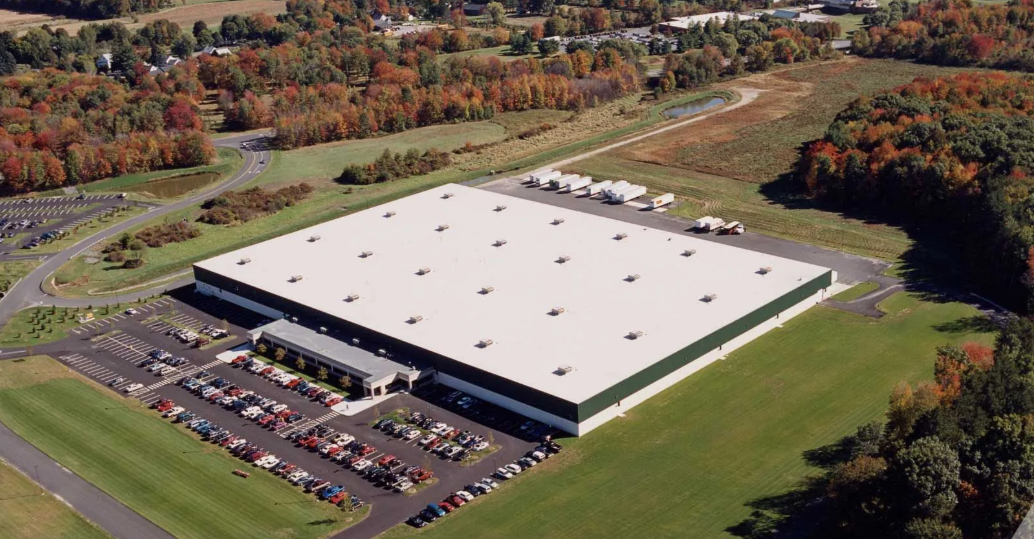
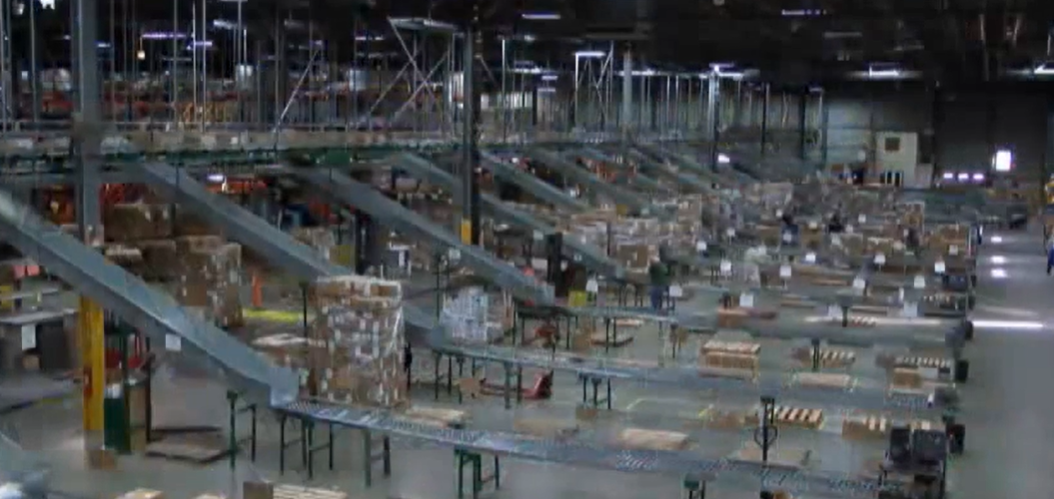
The above is the main Yankee Candle warehouse building, which opened up for business in April of 2001. My friend Bruce and I were some of the first people offering to test out the brand spankin’ new equipment before it all went live. It’s a huge building that was built to centralize the shipping, receiving, order fulfillment and storage departments all under one roof. We worked in shipping, which is in the top left corner of this picture (where all those trailers are parked in back), with eighteen bays if I recall. The entire right side of that building from this view is multi-level pallet storage, with the receiving docks in the rear as well. I worked in this building from April 2001 up until I left in March of 2005.

This is also the main inspiration for Moulding Warehouse in the Bridgetown Trilogy. I’d actually come up with the idea for that warehouse at our older building south of there on an inventory day during my brief second-shift days, but it was here that I’d solidified the idea and expanded upon it. I remember early on that I pulled a few building managers aside and asked about the specs, explaining my idea of turning the storage bays into a sort of multi-level cubicle hotel of sorts. They were rather amused by my creativity but confirmed that it could actually work as the framework was solid and buried deep into the concrete floor. [Note: the building’s name in the trilogy comes from XTC member Colin Moulding, one of my many Tuckerizations in this universe.]

While revisiting the MU chronology recently, I further realized that the date I started working in this building does in fact line up with when I wrote those scenes about the awakened converging upon Moulding Warehouse and Nehalé Usarai worrying about keeping everything under control. I remember taking my time on A Divison of Souls for fear of rushing it like I had with The Phoenix Effect, so while I was definitely working on it nearly every day from this point onwards, I was hitting probably around five hundred words to begin with. I’d slowly expand on that over the course of writing it, and by the time I started The Persistence of Memories I was aiming more towards a thousand. My favorite thing to do during slow moments of my shift was taking a bit of scrap paper and working out the next few scenes (often with one of those many boxes we shifted as a temporary desk), so that when my nightly writing sessions began I could start immediately.

And for a sense of its vastness, below is a shot of my department from the upper level of the shipping/receiving offices (itself an inspiration for the warehouse mezzanine scenes in the trilogy) from a video I found online sometime ago. Our job was to build pallets from the boxes that came down those chutes, wrap them up in plastic (the wrapper machines were underneath the chutes) and get them into the trailers (the bays are at the wall out of shot to the right). This seems to be filmed in the summer when it was relatively light, as this area would be filled to the brim and full of chaos during the Q4 holiday season. It would take us a good couple of minutes to walk from our department to the front of the building when we left for the day. This is why Moulding comes across as an incredibly large warehouse where several characters could either find privacy or gather together in large numbers with room to spare.
It was certainly an exhausting and very noisy job at times, especially during the holiday season, but at the same time it was an enjoyable one that kept me constantly moving instead of sedentary. I was blessed by the fact that it gave me all sorts of time to think about my writing with very little interruption, and a schedule that provided me with a broad length of personal time to work with. It’s an extremely productive benchmark that’s been tough to reach ever since, but these days I’ve been doing pretty good at getting close.

More on the MU chronology

As part of this ongoing Trilogy Remastering project, I’ve been trying to nail down some of the start dates of the books. I’ve long had a habit of timestamping my work (especially longhand, though I sometimes forget to do so when it’s straight to Word), so the accuracy is pretty good most of the time. I have the start and end dates of Books 2 and 3 confirmed. However, I was still using MS Write when I started writing A Division of Souls and those files don’t always provide what I need. It always bothered me in later years that I could never quite nail down when that first book was started, other than remembering that it took around a year and a half to write.

Recently, however, I think I got a bit of clarity on it. A rough listing so far:

8/7/1998 — The Phoenix Effect (longhand version) stopped
8/19/1998 — The Phoenix Effect (PC version) completed
8/25/1998 — Keepers of the Wards (first aborted TPE sequel) started
5/5/1999 — Keepers of the Wards stopped
Summer/Autumn 1999 — work on revision for The Phoenix Effect, submission to various agencies
12/9/1999 — The Veil (second aborted TPE sequel) started
2/22/2000 — The Veil stopped
4/23/2000 — The Mihari* (first aborted rewrite of The Phoenix Effect) started
6/??/2000 — A Division of Souls (second rewrite of TPE) started (originally titled The Mihari: The Division of Souls)
8/??/2000 — Plans to leave HMV, start looking for new job (early August)
8/12/2000 — Interview for job at Yankee Candle (Saturday open-house)
9/??/2000 — Official final day at HMV (possibly 1st or 8th)
9/11/2000 — Start job at YC
11/??/2000 — Switch from 2nd to 1st shift at YC (7am-3pm, shifted back one hour by early 2001)

That last entry is important. Because of that early end time, I quickly realized that I could utilize those afternoons to do my comic book and CD runs in the Amherst/Hadley area (a quick twenty minute trip down Route 116 from Deerfield on Wednesdays), come home and relax for a bit, have dinner with the family, then work on Division for a few hours in the evenings. That would become my constant writing schedule for the next few years until I moved out in March of 2005.

The above timeline sounds about right, as I’d had the idea to completely rewrite TPE from scratch during the spring and summer of 2000 during my last months at HMV. I was just loath to actually go through with it until I knew that alternate routes wouldn’t work, and I’d been dealing with a lot of day job stress at the time. I didn’t want to overburden myself if I didn’t have the spoons.

This plan, however, became a long-game plan to fully change how I wrote. I suppose these days you could use the word ‘vibe’ to describe what I’d been doing; I’d come up with interesting ideas but I was still focusing on the mood of the story rather than the prose or even the lyricism of it, and it was painfully obvious that it wasn’t working. I went into ADoS with the idea that my prose should have more heft and personality instead of the Hollywood bombast. I also went in knowing that this might take a while, but I was willing to put in the time and the work.

That obstacle of working second shift at YC did put a damper on things a bit, as I wasn’t always able to get any work done in the morning and early afternoon before work, which frustrated me. But when the offer to switch came up I immediately went for it. And for the next four years I worked on that long-game plan, writing the trilogy and getting better at my craft.

**

[* – Yes, The Mihari was the original title of the trilogy, a word cribbed from a Japanese pocket dictionary back in 1997 that means “to watch over”. It’s the original name of the Mendaihu, with the Shenaihu having the Japanese word misuteru instead, meaning ‘to abandon’. I knew it was shameless appropriation even then, but for now it was just an anime-inspired placeholder until I came up with something better. The terms Mendaihu and Shenaihu are relatively recent, created in 2011 when I started work on the initial revision for its eventual self-publishing.]

Falling into place

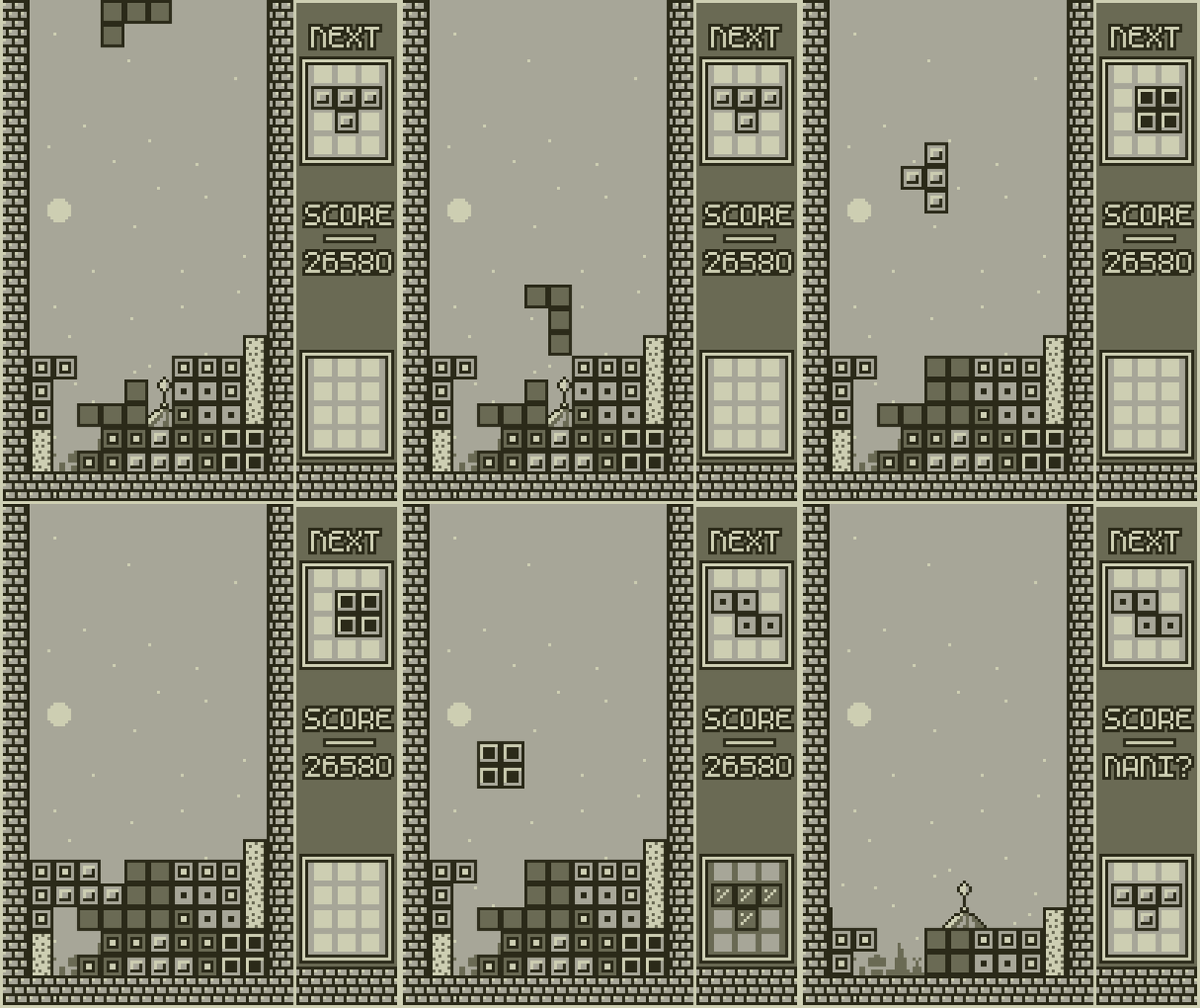
“I didn’t play all Tetris all those years for nothing.” It’s something I’ve said to my customers at my shop when they marvel at how I manage to completely fill their shopping bags and yet still keep them reasonably light. You’ll notice that I’m looking at the items on the belt, scribbles of algebra floating around my head just like in the meme, working out what can go where before I even pick it up. It keeps me entertained and makes the shift go by quicker.

But it’s just how I’ve trained my brain to think when I have to do a task (or in some cases, write a novel) that has numerous moving parts. It’s one of my favorite things to do, actually — thinking a few steps ahead, looking at what I’ve been given and how I can make it work a few steps further on. And in terms of writing, it really comes in handy when I have to think through an idea and debate how it might affect the story or the characters in the future. That, in turn, helps me plan out more of the plot direction. It’s how I worked out the Bridgetown Trilogy with its several plot threads and expanded cast!

But yeah, sometimes it just works really well for me in Real Life, whether it’s planning out an errand or a project, or simply bagging things for my customers.

Finding a writing process

[NOTE: The below is mostly from my 750Words entry from yesterday, but I felt it worth sharing here.]

We were talking the other day about Your Name — one of my all time favorite movies — and how, when we went to see it in the theater in Japantown awhile back, I was reminded of just how perfect a movie it was. Every part of the story has meaning, is there for a reason, and is woven into a rich tapestry. It’s a perfect example of what I like to call ‘they’ve done their homework’. There are very few movies, books, and music that resonate with me that deeply (The Fragrant Flower Blooms with Dignity is a current one, of course) but as I’d said to A yesterday, I always saw that movie as a benchmark for me to achieve with my own writing. I doubt I’ll ever reach the levels of Makoto Shinkai, but it gives me a firm goal to work towards.

I think that’s close to where I reached with the Bridgetown Trilogy, and especially with The Persistence of Memories. It wasn’t just a perfect storm of positive personal life, great music and a wave of unbridled creativity. Those things of course fueled it, but it wasn’t entirely borne out of it, now that I think about it.

I’d gone into the trilogy with a few things on my mind:
–This would be the end result of a long-simmering project dating back to 1993, so I did not want to do a half-assed job of it.
–I had such a deep well of ideas for this created universe dating back to the same time, and I did not want to waste any of it.
–I was at a day job at a warehouse where I didn’t have to waste much-needed brain power problem solving (the most pressing things I had to think about were building pallets neatly and correctly, where to stage them, and how to get them to fit onto the truck), which meant that I could spend most all of my waking hours focused on my writing.
–I knew that if I stopped and ‘took a few days off’ I’d get lazy and miss even more writing days, which was part of my undiagnosed ADHD issues, so I purposely drove myself to hyperfocus on the writing instead…while also ensuring that I kept it fun for myself. It was a balance between wanting to reach word count and becoming super excited about wanting to keep this story alive.

And to tie in with what I was saying above: this was a story where ‘I did my homework’. The further along I went with it, the deeper and richer it became. And the wild thing is that most of this happened in my head, because I was really not that much of an outliner! Like I’ve said numerous times, the most I ever planned out with the trilogy was maybe three or four scenes ahead, or maybe one or two chapters ahead, and even then it was less an outline than a vague list of beats to hit as I came up with them.

All the while, I was keeping multiple character threads going in my head. Caren and Poe were focusing on two things: balancing their own spiritual awakening while protecting Denni; Anton knew he wasn’t in charge but had to make it look like he was; Natianos believed he was pulling the strings but didn’t expect Denni and Saisshalé to take over; Nehalé was going through a crisis of faith; and so on and so on. This is why the scenes are set up as they are: they focus mostly on the important character in that particular scene, fully and with deep immersion. The other characters might have been in the scene as well, yet I would only focus on their reaction (or non-reaction) in a later scene. Everything and everyone was interwoven into this story, but I had to see the separate threads going.

Looking back on it, it’s kind of amazing that I did that with my first professional novels. I did it to a much lesser extent with the standalones, but that’s because they didn’t need that much intensity. It was a process I came up with on my own, one that worked for me, and one I still use to some degree. In fact, I’ve been contemplating following my own example with another attempt at rewriting Theadia. The only reason I’d stepped away from that process was because the Trilogy had been such an incredibly long project that I needed to try something small and compact — both to give myself a mental break and to see if I could pull it off.

Like I said, I don’t expect to hit Shinkai levels of perfection, but I remain inspired to at least ‘do my homework’ and write the best work I can.

Jumpstart, restart

I’m still feeling a bit frustrated with the Theadia project, but the plus side is that I’m finally making an effort to put more work into it after a month or so of being stalled.

One thing that’s been bothering me for a while now is that there are several characters and side plots that are integral yet I’m not giving them enough stage time. This in turn has had a cascading effect in that I can’t quite finish the story because there’s too much of it still missing. This is why I’ve been taking the time to think about how I want to approach this project going forward. I’m still interested in it, and I think it’s worth the work, but clearly it’s going to take a lot more than powering through and filling in the gaps later on.

This is why I initially realized this project was going to be a duology. At least two books, at any rate. I had to stop thinking of it as a standalone and more as a multi-book story, like the Bridgetown Trilogy. Even though it centers on its two main characters, I still need to tell the stories of the other characters they interact with, because theirs is just as important.

This is also why I’ve been thinking about doing a second rewrite. I admit the first rewrite was less of one and more of an extremely detailed reread/major edit hybrid, which did help the story a little bit but in the end didn’t help it enough. [I also admit that part of the reason that happened was my inability to follow through was due to Real Life things going on at the time that needed more attention.] I’m still planning on taking a page from the Belfry Years when I took The Phoenix Effect and rewrote it as the trilogy, only this time I’m going to take it much more seriously.

And ultimately, this is why I’ve been spending the last week or so giving my creative outlets a much needed jumpstart. In order to give enough attention to this, couldn’t just force myself to start over again. I had to return to exercising those creative muscles, getting them back into working order. Thus the return to the 750 Words site, the return to journaling and blogging.

I still have a long way to go, but I’m at least in a much better position to take the right steps to get there.

Won’t you be my dictionary, won’t you translate fun

I am absurdly gleeful that I finally bought the twelfth edition of the Merriam-Webster Collegiate Dictionary! I picked this one up at the Barnes & Noble in Corte Madera, just over the Golden Gate Bridge, on our way back from a visit to Petaluma. The last edition I owned was the tenth, which I bought back in 2003 at that bookstore in Harvard Square that I used to frequent. [This was the one at 30 Brattle Street across from the small plaza, just around the corner from Million Year Picnic. It’s a stationery store now.]

I often think about that store, even though it’s been gone for years now. I found a lot of really great stuff to read there. It was part of my weekend jaunt into Boston and Cambridge in the summer, hanging out near the Pit, people-watching and listening to the street musicians, hitting Newbury Comics and Million Year Picnic and HMV and that store before taking the Red Line back up to Alewife Station where my car was parked. This was back when you could park there all day for a super small fee. It was the perfect place to keep your car during Boston day trips like these.

I’d take these trips every now and again in the mid-90s after moving back home, often on Saturdays when I wasn’t working at the record store, but they became more frequent during the early 00s, at least once or twice a month. This was during the peak Belfry Years when I was writing the trilogy, which meant that those bookstore visits were a mix of revisiting my recent past with a lighter heart, looking for inspiration in the science fiction section, and wanting to learn more from writing reference books. Two reasons I remember buying that book there: a) the price sticker had the store name on it, and b) I bought it in early 2003, and on that day the store was playing Beck’s Sea Change album, which I’d been obsessed with even then. I distinctly remember having it hand while browsing, a customer a few aisles away quietly singing along to ‘Lost Cause’. I’ll think about that store every time I listen to that record.

That dictionary got one hell of a workout over the next several years. Cracked spine, worn edges, dented cover, slight water damage and all. When I heard the latest edition was in fact out late last year, I finally retired the old one. It’s somewhere in the garage with the rest of my writing stuff, having kept it down there when we moved house last year. [This is why I don’t remember the store name off the top of my head. Perhaps if I dig it out at some point I’ll edit this entry.]

And now I have a new one, not yet used, shrink wrap just taken off, already placed on my black bookshelf next to my copy of Kipfer’s Flip Dictionary, ready to go at a moment’s notice. Sure, I could use MW’s website — which I do every now and again if I need a quick confirmation that I’m using a word correctly — but sometimes it’s fun just to pull out this big book and do some old-school referencing without any pesky pop-ups or online distractions.

Getting there

I’ve still got a long way to go before Theadia is finished and let out into the wild, and right now the last thing on my mind is a deadline. I mean, I’d like to see it out at some point this year, but I’m not going to push it if it ain’t gonna move any faster. I’ve always pictured the writing process of this project as similar to the Bridgetown Trilogy, in that I’d keep up with it but I would never actually rush it at any point. It would get done when it got done.

There’s also the fact that I’m also purposely seeing this as…well, not a final project, but a last one before I put my writing aside for a little while. Which is kind of ironic, considering that I’d conceived it at one of the most stressful times of my life when I’d come to a crossroads and had no idea where I was going next, both personally and creatively. It began in desperation and ends in peace. In a way, that’s one of the themes of the book, which is why it’s taking so long: this is not a theme that’s easy to write, especially when one of the plot lines is the build-up to a possible galactic war. Everything has to unfold just right or it won’t work.

Does this come across as final? Maybe? I’m not really seeing it that way, to be honest. There’s definitely no finality in this decision of mine to step away from writing for a bit. If a story idea resonates with me enough, then sure, I’ll give it a go.

I merely want to see what other creative outlet resonates with me at this time in my life, is all.

Book Sale: FREE E-BOOKS!

OH HEY IT’S THAT TIME OF YEAR AGAIN!

Come one, come all for some free e-books! Smashwords and Draft2Digital are having their End of Year Sale! 

ALL SEVEN of my books are here for free until 1 January! You know you want ’em!

Yes, this includes:
—A Division of Souls (The Bridgetown Trilogy, Book 1) [2015/2025] [Now available in its remastered edition!]
—The Persistence of Memories (The Bridgetown Trilogy, Book 2) [2016]
—The Balance of Light (The Bridgetown Trilogy, Book 3) [2017]
—Meet the Lidwells! A Rock ‘n’ Roll Family Memoir [2018]
—In My Blue World [2019]
—Diwa & Kaffi [2023]
—Queen Ophelia’s War [2024]

[The above links open to each book’s main download page for your convenience.]

—Do you love an epic metaphysical sci-fi adventure? Try the Bridgetown Trilogy!
—A big fan of music memoirs? Meet the Lidwells is a fictional nod to one of my favorite genres!
—Enjoy magical girls and time travel fantasy? Try out In My Blue World!
—In the mood for a nice Ghibli-esque hopepunk story about best friends? You’ll love Diwa & Kaffi!
—Looking for a fantasy story about self-discovery? Queen Ophelia’s War is for you!

Thank you for reading!!

And now for the next step…

I am just a few short(ish) chapters away from completing this current revision of Theadia, which means two things. One, my next step in completing this novel is to go back again and fill in all the ‘WRITE THIS LATER’ scenes I blocked out. This one’s going to be a bit tricky, as a lot of them will feature a character that’s just as important but only works indirectly with the two main characters. They know of each other, but they’re never seen in the same room, let alone on any kind of communication device. He’s not the kind of character I normally write, either, but he’s just as important to the overall story, so I’m going to have to work out just what I want and need him to do.

The second thing? Well…I’m going to have to finally figure out how I’m going to end the dang thing. I’ll admit this is similar to how I had to deal with finishing The Balance of Light…that is, I kinda-sorta have an idea of how it ends, but no set plan on how to get there. In order to make it work, I’m going to have to take the time and plan it out so I can nail the landing. Which means I’m probably going to have to give it a few more re-re-re-rereads like I so often do. Hey, whatever works, yeah?

This novel’s history is rather similar to the history of the Bridgetown Trilogy in certain ways. I’ve returned to the ‘extended ensemble cast’ for starters, and it’s also a story that’s been given a from-the-ground-up worldbuilding process (minus a conlang this time out, though a few characters do affect a certain patois, somewhat inspired by a similar setup on the tv series The Expanse). It’s also a story that’s had a bit of a hiatus for varying reasons due to Real Life Stuff. I think this is partly why I have a soft spot for this project — it’s something I’ve worked on for an extended time and with patient care. It’s not a novel I can phone in.

It’ll be worth the wait, though.

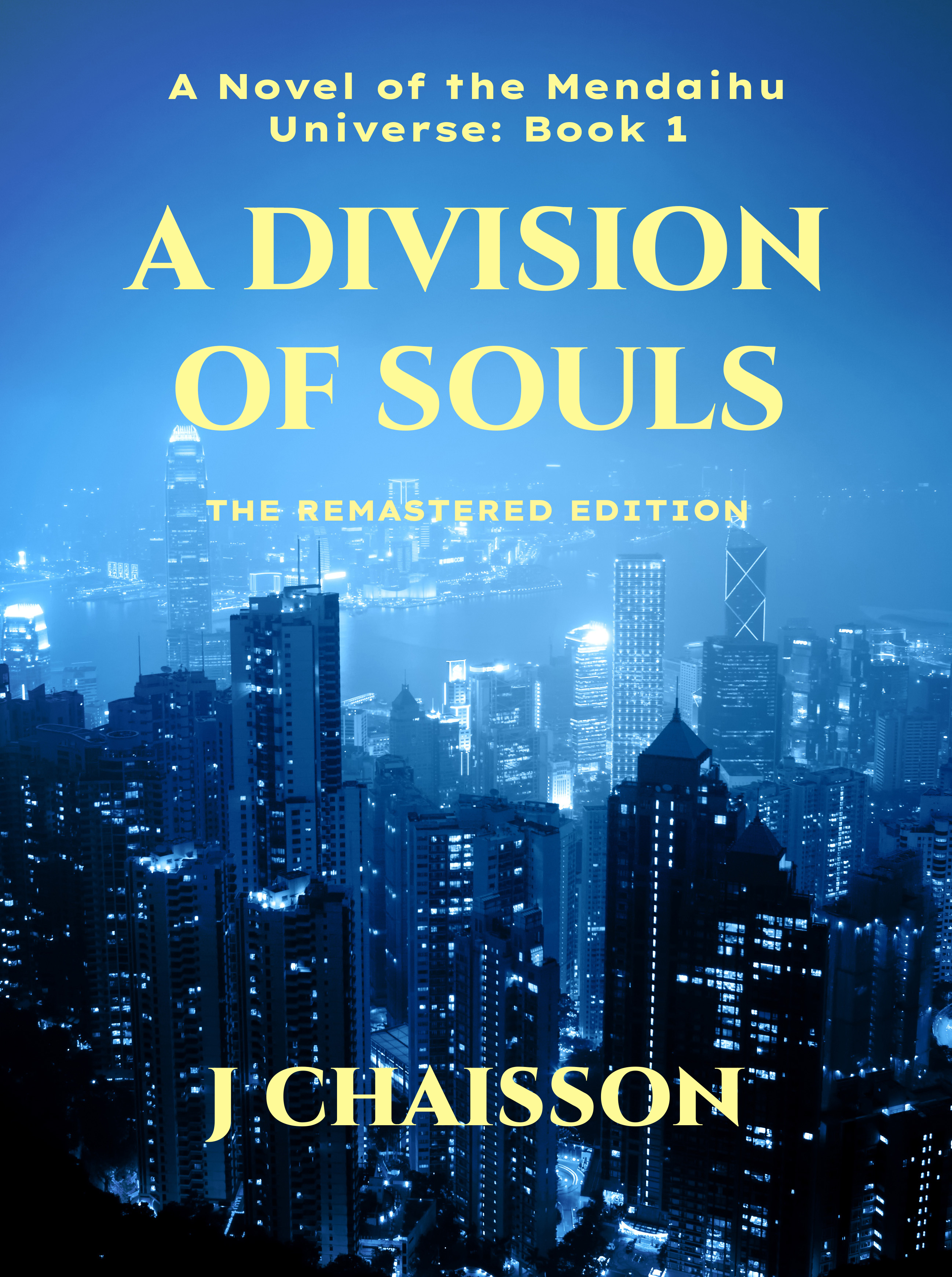
Update: Now available for pre-order!

And it has a cleaner and nicer cover as well! The more I sat with the cover I posted last week, the more I thought I could still do better. While the font I’d used wasn’t all that bad, it didn’t quite sit right with me, so I played around with it for a few days until I came up with something simpler yet classier. I feel this one stands out a lot better, as does the title which stands out a lot more.

So anyway: the new remaster is available for preorder at Barnes & Noble, Kobo, Apple, and of course Smashwords, and will be available elsewhere hopefully very soon, for only $2.99!

BUT WAIT, THERE’S MORE! I will also be making this book available in physical form via POD on Draft2Digital, most likely within the next few weeks! All I’m waiting on is a copy of the proof so I can see how it looks before I sign off on it. [The physical book price will be somewhere in the area of $22.99, I believe.] I’ll keep y’all posted!