
Songs from the Eden Cycle 2: Annotated

This volume was made not long after I came back from the long distance road trip to visit my friend. The first one came out so well, and I was really getting into writing Phoenix at the time, that I wanted to make another volume. This volume was also made mostly in the back room of the record store, grabbing songs both from my own collection and from the CDs we were selling. [I may have opened one or two just to copy some songs, then to shrinkwrap them back up afterwards.] There are a few songs from the original Vigil song list here as well. I was willing to embrace some of the much earlier ideas I’d had for the project that fell by the wayside when I worked on True Faith.

It’s also interesting how this and the next volume feel a bit disjointed, and I think it’s partly because I was making a lot of the mix up as I went along. It was less about grabbing a bunch of songs I already wanted on there and more along the lines of stuff I happened to be listening to at the moment mixed in with stuff in my collection I’d been listening to since ’95. A good portion of it is less about specific scenes or ideas and more about the mood and the vibe I was looking for at the time. This one does work, although it’s not nearly as strong as volumes 1 or 4.

Songs from the Eden Cycle, Vol 2.

SIDE 1

  1. George Harrison, “Isn’t It a Pity (Version One)”. If I recall, I think this one just happened to pop up because there had been an open copy of All Things Must Pass that needed shrinkwrapping, and as I hadn’t listened to it in ages (I had it on vinyl), I thought it would be fun to revisit it. I’d always liked this track, dire though it was, and somehow I felt it fit in with the mood of the book, specifically how the newly awakened felt disconnected from everyone. It’s also a classic example of the ‘slow build’, a technique I’ve always loved in music.
  2. The Smashing Pumpkins, “Tonight, Tonight”. I’d picked up Mellon Collie not long after it came out, and even though I felt it was a bit bloated, there were some great tunes on it, and I really liked this one. It’s the exact opposite of the previous track: a celebration of freedom, in this case the freedom given to the newly awakened.
  3. Depeche Mode, “Home”. I was listening to Ultra quite a bit at this time as it was already one of my favorites of the year to date, and the mood of the album fit my current writing project perfectly. There weren’t any specific scenes connected to this song other than a vague idea of Poe’s connection with Kai, who at this point was still a recently awakened character instead of the Mendaihu agent she became in A Division of Souls. He wanted to provide her with comfort and a place to belong.
  4. Beck, “The New Pollution”. This continues the above idea, a freshly awakened spirit feeling vastly out of place and trying to figure out their new world. “She’s alone in the new pollution” to me sounded like being given a decision: do I remain a victim, or do I make the best of it instead? I think I was also going through the same thing on a personal level at the time.
  5. Tori Amos, “Little Earthquakes”. This dates back to my post-college Boston days when someone had played it over the air on the college station in a way to grieve a lost friend. In a way it also ties in with the above idea of victim versus victor instead… to me it’s also a song about going through all sorts of personal shit, and needing to be strong about it. Something that kind of fit me on a personal level as well.
  6. U2, “Gone”. Another track from Pop, this ties in with the above as well, as to me it created an image of coming to terms with loss, and with putting so much into something and getting diminishing returns. In a way that was how my connection with my ex played out so I channeled that into the story as well: finding a reason to let go and move on. “Didn’t want it that much anyway.”
  7. Live, “White, Discussion”. I’d been a fan of the Throwing Copper album since it came out, and I quite liked the epicness of this, especially the way it doesn’t so much end as die out slowly. I also remember it showing up in the Virtuosity movie during my time at the movie theater in Somerville. I took the original idea of this song about constant debate about right vs wrong yet actually doing nothing to fix the problem, and turned it into something tied in with Phoenix. In this case, the bigotry the newly awakened would most likely have to deal with, whether now or in the future. That had always been a plot idea: bigotry against The Other, and those who are all talk and no action about it. I suppose that’s always been in a lot of my stories at the time, come to think of it.
  8. Delerium, “Silence”. I absolutely loved this track at the time, and I’m pretty sure I copped the promo copy of the Karma album by then. [I’d also been a fan of Sarah McLachlan at the time.] It got a lot of play on AOR and alternative radio that summer. This ties in with the electronica wave that I felt fit in perfectly with the project; something slightly futuristic and different from the mainstream.

SIDE 2

  1. Sneaker Pimps, “Post-Modern Sleaze [Video Mix]”. Becoming X was getting a lot of play both in the back room and during my writing sessions, as it was the perfect mood music for this project. I’d started looking into more trip-hop, and that was why I’d glommed onto Tricky’s Pre-Millennium Tension as well. This version is a bit beefier than the original album version, so instead of it feeling a bit sparse and lonely, this one feels more like driving through Bridgetown at 2am, which is totally something Poe would do.
  2. Republica, “Ready to Go [US Mix]”. I needed to put in a song with a bit of oomph in it, otherwise this mix was going to be a bit dire. Well, maybe not, as some of my gloomier mixes worked really well! Anyway — this song was still getting a lot of airplay and had that relentless upbeat drive that worked well with the more positive elements of the story idea. The bliss of the exciting parts of cyberpunk, I suppose.
  3. Stabbing Westward, “What Do I Have to Do?”. This one dates back to the summer before I started at the record store, and I always felt this one could be tied in with a scene of the recently awakened ‘rising up’ in some way. Whether that would be a positive or a negative is left up to question. I liked the idea of a character’s drive being seen as both a good and a bad thing, depending on how you look at it. That duality played a big part in this project from here on in.
  4. Sarah Brightman, “Cape Horn”/”A Salty Dog”. This, on the other hand, dates back to my days in 1993-4 living and working in Boston. I’d started listening to Dive quite often on the way to work in the morning, as it had that light pop feel that was both a bit on the retro side and also calmed my frazzled nerves a bit. The first track, basically an intro, samples 1962’s Mutiny on the Bounty before starting the Procol Harum cover. That song itself is of course about the olden days of sailing, but with this synth-heavy version it made me think about spacefaring instead. It reminded me of an anime I’d seen a year or two previous (title long since forgotten) that used the same ‘don’t know when or if I’m coming back’ melancholy during the space launch scenes. This could easily have helped shape the idea I’d had of the newly awakened souls originating from somewhere other than Earth. [The original did in fact come from my New Age reading, but my remembering the song only helped solidify that.]
  5. The The, “Good Morning Beautiful”. I’d recently read that this song was recorded in London after many bottles of booze had been consumed, and it shows, because it’s a song full of disgust and anger, as only Matt Johnson could pull off. While it doesn’t quite tie in with the Phoenix theme, it does lend itself to the antagonism that would arise between the recently awakened and those working against them. I was still big on the idea of spiritual freedom versus religious rigidity.
  6. Elton John, “Believe”. This one also dates back to 1995 when I was still working on True Faith at the time. While a lot of big name alternative and grunge sounds were coming out in the early part of that year, EJ came out with the quieter and darker Made in England, and this was the big single. I remember liking the track quite a lot and latched onto it because it had that “I believe in love” refrain that worked with the Phoenix theme, specifically the connection Poe and Kai were creating. Love conquers all.
  7. Soul Asylum, “Black Gold”. This one on the other hand dates all the way back to the 1993 Vigil sessions! It shows up on the ‘soundtrack’ notes from that time as well. One original idea I’d had was post-apocaylpse, or more to the point a post-war idea in which NewCanta (and Bridgetown, and so on) were created basically after a horrifying world war that wiped out several cities, and several decades later these sprawls were the result. ‘This flat land used to be a town’ hints at that, and this song would work as a sort of soundtrack to those first years as a prefabricated sprawl.
  8. Joy Askew, “Corrine”. This song I first discovered on one of those label promo mixes, and it does lend itself to the idea of coming out of your shell. Tying in with the Phoenix idea, it’s along the lines of “Dear Prudence” in that ‘get out of the box you’ve put yourself in’ way, which was an idea I’d had for Kai.
  9. Phish, “Free.” I’d been listening to the newish album from them and finally getting around to listening to them more often, and I liked how celebratory this was. It ties in with the previous track, uplifting in its own way. Despite all the strife and turmoil the newly Awakened were dealing with, they also knew they had a goal: to free themselves from their binds and be their true selves.

In retrospect, this volume is fascinating in that it really leans heavily on the New Age aspect of the Phoenix project, something I was still somewhat interested in at the time. It’s also interesting in that the third volume, which I’d make a few months later, had a much darker mood to it.

Songs from the Eden Cycle 1: Annotated

Recently I’ve been visiting the early days of the Mendaihu Universe project, specifically when I’d started writing it mid-March of 1997. I’ve talked about the background of this story quite often here, but I’ve sometimes commented about its influences only in a passive way. When I started The Phoenix Effect, it was going to be more dark and intense than its previous incarnation as True Faith. And I can safely say that the primary influences of this version were the movies/series Bladerunner, Gall Force, Bubblegum Crisis, and Johnny Mnemonic, and the Masamune Shirow mangas The Ghost in the Shell, Dominion and Appleseed.

Then of course there’s the music. Nearly all of my writing projects have dedicated mixtapes and/or playlists — yes, even the juvenilia and the trunked ideas — and Phoenix was no different. At the time, this new story was still considered part of a much larger extended universe I then called the Eden Cycle, with vague outlines for several books spanning multiple storylines and eras. [That in itself was inspired by the Star Wars expanded universe.] Mind you, I was still nowhere near the write every day goal I was aiming towards, so by June I was only a few longhand chapters in, sessions squeezed in before my shift at HMV or in the evening after dinner.

The first volume of Songs from the Eden Cycle was created for two reasons. One, I needed all the inspiration I could get, and ‘soundtrack’ mixtapes always worked for me; and two, I was heading out on a weeklong multi-state road trip to visit a good friend of mine, and what better way to think about my project than while I’m on the road? I may have only gotten one writing session in during that trip, but I’m sure I gave that mix a few repeat plays at the time.

Songs from the Eden Cycle Vol 1, created June 1997 (likely later in the month).

SIDE 1

  1. Poe, “Hello [Band Version]”. When I first started making the mixtape in the back room of the store, I knew this was going to be the first track because it had inspired the new direction for the Vigil project. Plus, it’s a banger! I liked that the lyrics were an obvious nod to cyberpunk, and to my ears a nod specifically to Johnny Mnemonic and Neuromancer. At the time, Phoenix‘s plot contained the idea of spirits with the ability to switch bodies, including cybernetic clones. The “phoenix” part of the title then was meant to evoke an idea of being reborn, specifically in a violent way. The opening of Phoenix is almost exactly the same as it is in A Division of Souls, only that the Awakening ritual was originally a catastrophic ‘ring of fire’ explosion at the Tower. [Note: Spotify doesn’t have this version available, so the original album version took its place.]
  2. Failure, “Heliotropic”. There’s no specific scene or idea for this song, only that I was listening to Fantastic Planet quite a bit by this time and this was added more as a vibe than anything else. The heavy and distorted bass and the thundering drums to me evoked a grimy night city scene a la Bladerunner. B-Town was never planned to be all grime and grimness, mind you; just certain parts of it to make sure there’s a visible line between the haves and the have-nots.
  3. U2, “Mofo”. I was also listening to Pop a lot at this time too; I loved the album even despite the critics hating it. I loved the almost non-human sound coming from this song, which hinted at that ‘phoenix’ idea; the story at the time had these newly awakened spirits hiding inside cybernetic bodies just this side of the uncanny valley (another Bladerunner influence).
  4. David Bowie, “Dead Man Walking”. Another “phoenix” idea I played around with: what happens to the original bodies once the spirit leaves and enters a new one? What remains? They were a husk at most, and a possible target for a different and malevolent spirit at worst. [I hint at this in The Persistence of Memories when Caren and Poe meet Saisshalé for the first time.] I was also listening to Earthling quite a bit, pleasantly surprised that I’d finally found a non-greatest hits Bowie record that I really liked.
  5. Psykosonik, “Need to Die”. This CD was given to me by a coworker at the record store who was really into the whole electronica and darkwave thing. He liked it all, even though he was not a clubgoer. This darkwave band was similar to bands like VNV Nation and Front Line Assembly, which I also gravitated towards. I liked this laid back groove and thought this song fit the mix. [Note: I would only find out years later that one of the band’s members, Ted Beale, would end up being the infamous Vox Day. I keep the two as separate as I possibly can.]
  6. Live, “Lakini’s Juice”. Secret Samadhi was their weird album, I think. It was the follow up to the hugely successful Throwing Copper, and while there are elements of their heart-on-sleeve earnestness they’ve always had, it’s a much darker affair. This was the first single and definitely a left turn for them: grimy and gritty and unsettling. I thought it fit the flow and mood of the mix nicely.
  7. Elysian Fields, “Lady in the Lake”. Bleeding Cedar was one of the early promo CDs I’d gotten from the store, and I was taken in by the band’s sultry goth sound. It was like listening to a much darker version of Mazzy Star in a way, feeling like the aural equivalent of a ghost story. While “Jack in the Box” was the single, this was the track that appealed to me. Lyrically it doesn’t quite fit but the vibe is perfect.
  8. Moby, “That’s When I Reach for My Revolver”. Despite my wondering why he decided to cover Mission of Burma for his non-electronic ‘punk’ album Animal Rights, I kind of liked this take on one of my favorite Boston-centric songs, as he manages to retain the meaning and energy of the track. Why here? I think partly because WFNX was playing it a lot at the time and I needed to fill out the last part of Side 1. It does sort of fit the mood of Vigil’s take on the situation: if someone has to take the reins and get shit done, it’s definitely going to be them.
  9. The Verve Pipe, “Veneer”. I’d loved the Villains album and had seen them live at Avalon in Boston in May, where I learned the story behind this dreamlike track — driving alone on a deserted Michigan highway while high as a kite. Hearing it in its proper context made me absolutely love the track. In the context of Phoenix, I think this was how I thought a newly ‘awakened’ spirit would feel: completely out of sorts and confused, maybe akin to being high.

SIDE 2

  1. Richard Einhorn & Anonymous 4, “Exlamavit (from Voices of Light)”. I was obsessed with this album in the latter half of 1996, having heard it on an NPR station as I was driving into Boston one night. Einhorn wrote it as a soundtrack to the 1928 silent film The Passion of Joan of Arc. It intrigued me because it was the first modern orchestral piece that caught my interest, and reminded me of my favorite Dead Can Dance moments. This intro piece fit perfectly with the “ring of fire” moment in Phoenix.
  2. Pulp, “Common People”. This was a good year or two old and I was passingly familiar with it but it hadn’t resonated with me until around this time when I finally got what the band was about. I’d been listening to the store copy off and on and knew this was the big hit. It might not completely fit in with the story idea, but the vibe of distrusting those who mock or hate you fit in perfectly. It kind of fits Vigil’s vibe as well.
  3. Sponge, “Isolation”. I’d also been listening to the Working Class Hero John Lennon tribute album quite a bit at the time. It’s a song about Lennon dealing with the darker side of fame and feeling isolated despite being constantly surrounded. While the original from the Plastic Ono Band album is more plaintive and laid bare, this version is more pissed off, and it works alongside the above song with that feeling of social disconnection. [The tribute album is not on Spotify and is thus not on the playlist above.]
  4. The Offspring, “Gone Away”. This song was super popular on WFNX (does anyone remember the first single off this album?), and it sort of continues the whole feeling of social disconnect, this time from a deeply emotional point of view. It inspired a possible idea of a recently awakened character who felt this deeply yet didn’t quite understand where it was coming from yet.
  5. Filter, “Hey Man, Nice Shot”. There were actually a good couple of songs I thought fit the opening ‘ring of fire’ scene, and this was the more ‘violent’ one I came up with, fitting perfectly with my still-occasional use of Miami Vice style of writing. And I can never pass up a song that perfectly uses the quiet –> LOUD dynamic.
  6. Failure, “Daylight”. Even then I’m pretty sure I saw this song as an “ending credits scene” track, because it has such an epic coda that just builds and builds and leaves you breathless at the end. I’m also sure even then I pictured a hard cut to black when the drums and guitars kick in after the last verse. This is the first of many mixtapes where this song makes an appearance.
  7. U2, “Wake Up Dead Man”. Could this be a denouement scene song after all that? Perhaps? It’s near the end of Pop, after all the louder and bigger songs, and it evokes a feeling of exhaustion after all the pomp and noise. It also fits pretty well after “Daylight” — while the former song is the moment where something life-altering happens in the story, this song is the moment right after when one suddenly realizes what its consequences are.
  8. Jamiroquai, “Virtual Insanity”. I’ll be honest, this was more of an “I need one more song to finish this mix off” song, but it also fits the theme and the flow as another ‘end credits’ track. In my mind it does somehow fit in with the feeling of something life-altering happening, and now here we are having to deal with the fallout.

Not bad for a first volume, and it got a ton of play over the next several years. I’d be making two more volumes by the end of the year, with a fourth and then-final one made late in 1998 when I was working on the transcription and revision. Several of the tracks on these early volumes have had direct influence on The Phoenix Effect. [I will talk more about these in future entries here.]

A few variations would show up over the next few years, but in 2018 I’d revive the Songs from the Eden Cycle series as a way to keep the universe in mind. The most current one is Volume 10, created in late 2024.

Finding a writing process

[NOTE: The below is mostly from my 750Words entry from yesterday, but I felt it worth sharing here.]

We were talking the other day about Your Name — one of my all time favorite movies — and how, when we went to see it in the theater in Japantown awhile back, I was reminded of just how perfect a movie it was. Every part of the story has meaning, is there for a reason, and is woven into a rich tapestry. It’s a perfect example of what I like to call ‘they’ve done their homework’. There are very few movies, books, and music that resonate with me that deeply (The Fragrant Flower Blooms with Dignity is a current one, of course) but as I’d said to A yesterday, I always saw that movie as a benchmark for me to achieve with my own writing. I doubt I’ll ever reach the levels of Makoto Shinkai, but it gives me a firm goal to work towards.

I think that’s close to where I reached with the Bridgetown Trilogy, and especially with The Persistence of Memories. It wasn’t just a perfect storm of positive personal life, great music and a wave of unbridled creativity. Those things of course fueled it, but it wasn’t entirely borne out of it, now that I think about it.

I’d gone into the trilogy with a few things on my mind:
–This would be the end result of a long-simmering project dating back to 1993, so I did not want to do a half-assed job of it.
–I had such a deep well of ideas for this created universe dating back to the same time, and I did not want to waste any of it.
–I was at a day job at a warehouse where I didn’t have to waste much-needed brain power problem solving (the most pressing things I had to think about were building pallets neatly and correctly, where to stage them, and how to get them to fit onto the truck), which meant that I could spend most all of my waking hours focused on my writing.
–I knew that if I stopped and ‘took a few days off’ I’d get lazy and miss even more writing days, which was part of my undiagnosed ADHD issues, so I purposely drove myself to hyperfocus on the writing instead…while also ensuring that I kept it fun for myself. It was a balance between wanting to reach word count and becoming super excited about wanting to keep this story alive.

And to tie in with what I was saying above: this was a story where ‘I did my homework’. The further along I went with it, the deeper and richer it became. And the wild thing is that most of this happened in my head, because I was really not that much of an outliner! Like I’ve said numerous times, the most I ever planned out with the trilogy was maybe three or four scenes ahead, or maybe one or two chapters ahead, and even then it was less an outline than a vague list of beats to hit as I came up with them.

All the while, I was keeping multiple character threads going in my head. Caren and Poe were focusing on two things: balancing their own spiritual awakening while protecting Denni; Anton knew he wasn’t in charge but had to make it look like he was; Natianos believed he was pulling the strings but didn’t expect Denni and Saisshalé to take over; Nehalé was going through a crisis of faith; and so on and so on. This is why the scenes are set up as they are: they focus mostly on the important character in that particular scene, fully and with deep immersion. The other characters might have been in the scene as well, yet I would only focus on their reaction (or non-reaction) in a later scene. Everything and everyone was interwoven into this story, but I had to see the separate threads going.

Looking back on it, it’s kind of amazing that I did that with my first professional novels. I did it to a much lesser extent with the standalones, but that’s because they didn’t need that much intensity. It was a process I came up with on my own, one that worked for me, and one I still use to some degree. In fact, I’ve been contemplating following my own example with another attempt at rewriting Theadia. The only reason I’d stepped away from that process was because the Trilogy had been such an incredibly long project that I needed to try something small and compact — both to give myself a mental break and to see if I could pull it off.

Like I said, I don’t expect to hit Shinkai levels of perfection, but I remain inspired to at least ‘do my homework’ and write the best work I can.

Reflections and Parallels

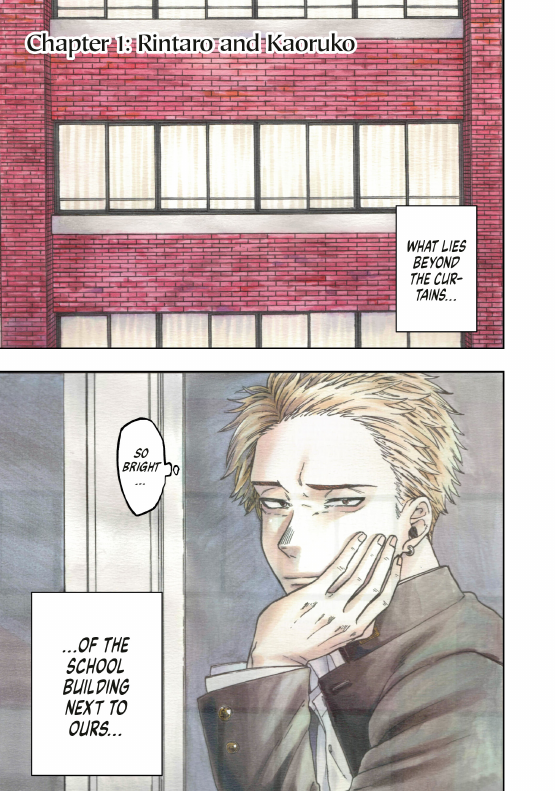
What you see above is the very first page of my current reading obsession, Saka Mikami’s The Fragrant Flower Blooms with Dignity. It’s about two teenagers: the kind-hearted yet often misunderstood Rintaro Tsumugi (above) who goes to a bottom-rung high school, and the petite yet brilliant Kaoruko Waguri, who goes to the posh girls’ school next door. Despite the animosity between the two schools, these two meet and fall in love. It’s not a Romeo & Juliet story, either: this is a heart-lifting story about discovering what lifts one’s heart and working to make it happen with no regrets.

What I notice, however, is the reflection we see superimposed over Rintaro’s face in the second frame. He’s looking through the classroom window at the closed curtains of Kikyo Academy from his own perch at Chidori High, curious about what goes on behind them, as they’ve been closed for almost a decade and for not entirely clear purposes other than there’s been bad blood between the two. It’s an impenetrable wall where he’s not invited nor welcomed, thus the look of frustration and discomfort on his face.

And yet…there’s more to this one page, and this is exactly what I love about this manga. It’s not just a literal setup of what’s to come in the story; there are actually so many more layers to this.

We learn in the next few chapters that Rintaro’s childhood was not all that enjoyable. He was often shunned by his peers, whether it was because of his absurd height or his low grades or his inability to completely fit in and conform, leaving him with nearly no friends. Because of this, he’s chosen to go the exact opposite route, dye his hair blonde, and be a loner. Thus: that impenetrable wall we see in the reflection is not just a literal closure between the two schools, but one he’s put up between himself and the outside world. It sets up one of the most important main arcs of the story: whether he (and Kaoruko) are able to break down both the literal and the metaphorical wall of division. Despite this, he still has a heart of gold: he might feel alone but he never once mistreats anyone, whoever it may be.

There’s also the “so bright…” line. That’s not just a tossed-off line about the sunshine, either. Brightness will also become a recurring theme throughout the series, both literally and figuratively, when nearly every character reaches some kind of eye-opening revelation, discovers a moment of inner peace, or their heart is lifted to a level they’ve never experienced before. The word “dazzling” is used many times in these moments, and those scenes usually contain an element of lens-flare or a lightness of line art as well. This also sets up another extremely important recurring theme of the series: finding a moment — or a person — so dazzling that one can’t help but be lifted emotionally themselves and utterly changed by the experience.

And lastly, the reflection and the parallel: what happens to one person will most likely happen to another later on in the story. And not just the same person, either. For example, we learn that Rintaro’s youth is not that far off from Kaoruko’s best friend Subaru Hoshina, who was taunted mercilessly when she was very young for having silver hair, causing a deep mistrust of boys. These kinds of threads are woven throughout the story in a way that silently reminds you: despite differences, we are all similar in one way or another. Even though the two schools are initially seen as complete opposites of each other with that seemingly impenetrable wall in between, we learn that Kikyo and Chidori really aren’t all that different once you really get to know them. [Even two of the secondary characters, Shohei Usami (Rintaro’s rambunctious buddy) and Madoka Yuzuhara (Kaoruko’s nerdy friend), both initially used as comic relief, are often the voice of reason and emotional stability in their own way, and both state clearly that they really do not hold anything against the other’s school, merely stating that they leave them alone to keep the peace.]

This is one of my favorite tools writers use: the reflection and the parallel. I’ve used it many times over the years and it’s super fun to write. It adds another level to the storytelling that’s not seen immediately, and sometimes you don’t even notice it at all. It’s often during a reread that it becomes apparent, and Fragrant Flower does this frequently and extremely well. Sometimes it’s obvious: whenever a character has a moment of surprised emotional clarity, there’s a single shot of the lower half of their face, their mouth ever so slightly agape. Sometimes it’s personal, such as Rintaro’s wince (which shows up whenever he feels uncomfortable in a situation yet instinctively knows it means something important), or Kaoruko’s soft heartfelt smile whenever she’s caught in a moment of complete emotional comfort or stability. There are meanings behind these moments that otherwise might be easily tossed off.

I suppose this is partly why I’ve been following this series obsessively over the last few months, because in a way I’ve been trying to figure out how Mikami-san lets the story unfold in such a creative way so I can possibly use it in my own writing in the future. I learn something new every time I reread it.

[The Fragrant Flower Blooms with Dignity can be found on the K Manga app, and currently has twelve tankobon volumes available in the US. The first several chapters have been made into a thirteen-episode anime series available on Netflix.]

Currently reading…

I’ll admit that I have become obsessed with reading comics on the K Manga app on my e-reader. It’s run by Kodansha, one of the big manga publishers these days, and I’ve picked up on a handful of series that I’m really enjoying. It’s where I discovered the wonderfully written teen romance The Fragrant Flower Blooms with Dignity, whose main characters Rintaro and Kaoruko have been showing up as pictures and gifs here over the last few months. [I’ve been enjoying that series so much I’ve been tempted to do a mini-series here about it.] Every night when I get into bed, I’ll turn on the app and catch up on a few titles.

The other night, I was thinking: y’know, I have this physical pile of books next to my bed that haven’t been picked up lately, I should probably do something about that as well instead of reading comics every night. But maybe this is part and parcel of my wanting to change up my creative outlets? Over the past several years I’d become super-picky about the novels I was picking up, and even then some of them haven’t been resonating with me as much as they used to. It’s not that they’re bad or that the latest trends aren’t speaking to me, it’s merely that I’m not feeling the spark of excitement like I used to. I’m not as voracious a reader as I was, at least not right now anyway.

So why not see this burst of interest in comics as a plus and not a minus? After all, that’s how I started reading more in the late 90s, isn’t it? During the HMV years when I suddenly decided that I would take those Wednesday drives to the comic book store every week, that sparked off a new love of reading that I hadn’t really had before. What started as a focus on just a few titles bloomed into several, which then expanded into different styles, different genres. And those, in turn, inspired my writing style and ideas.

And somewhere along the lines, I suddenly found myself interested in reading books again. It all felt fresh once more.

So perhaps it’s fine that I embrace this medium again for the time being. Reading comics like Fragrant Flower have reminded me that both inspiration and influence lie in interesting places, and it’s up to me to search for them when I need them. Perhaps now it’s time for me to learn not just the art of visual storytelling, but to learn how to see and understand things in new ways.

Year End: Movies

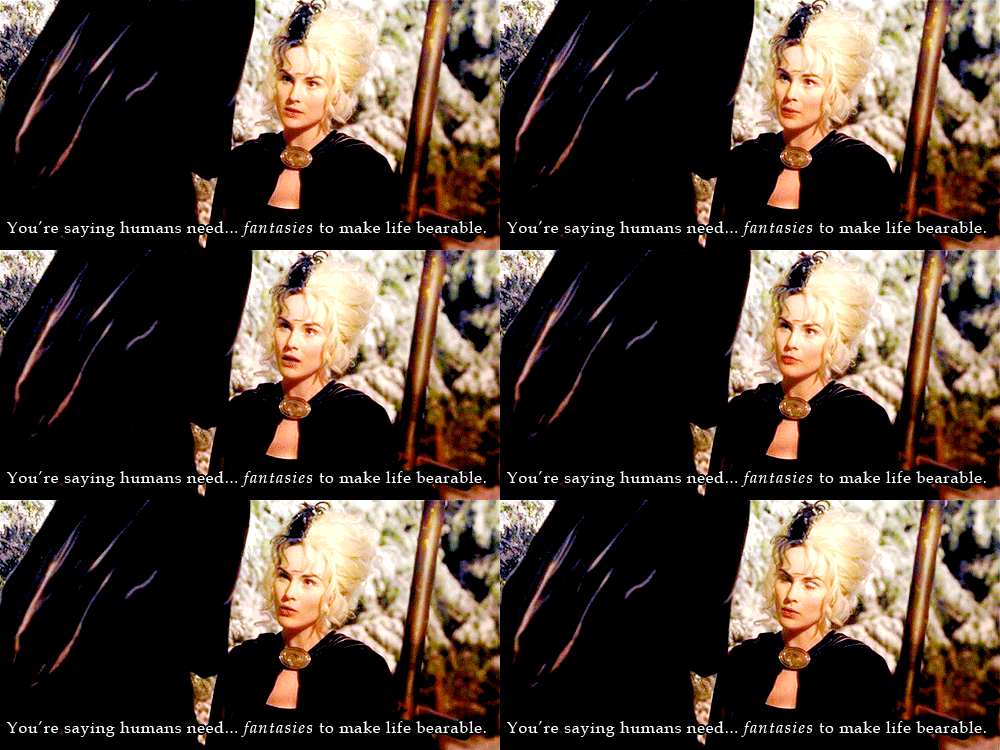
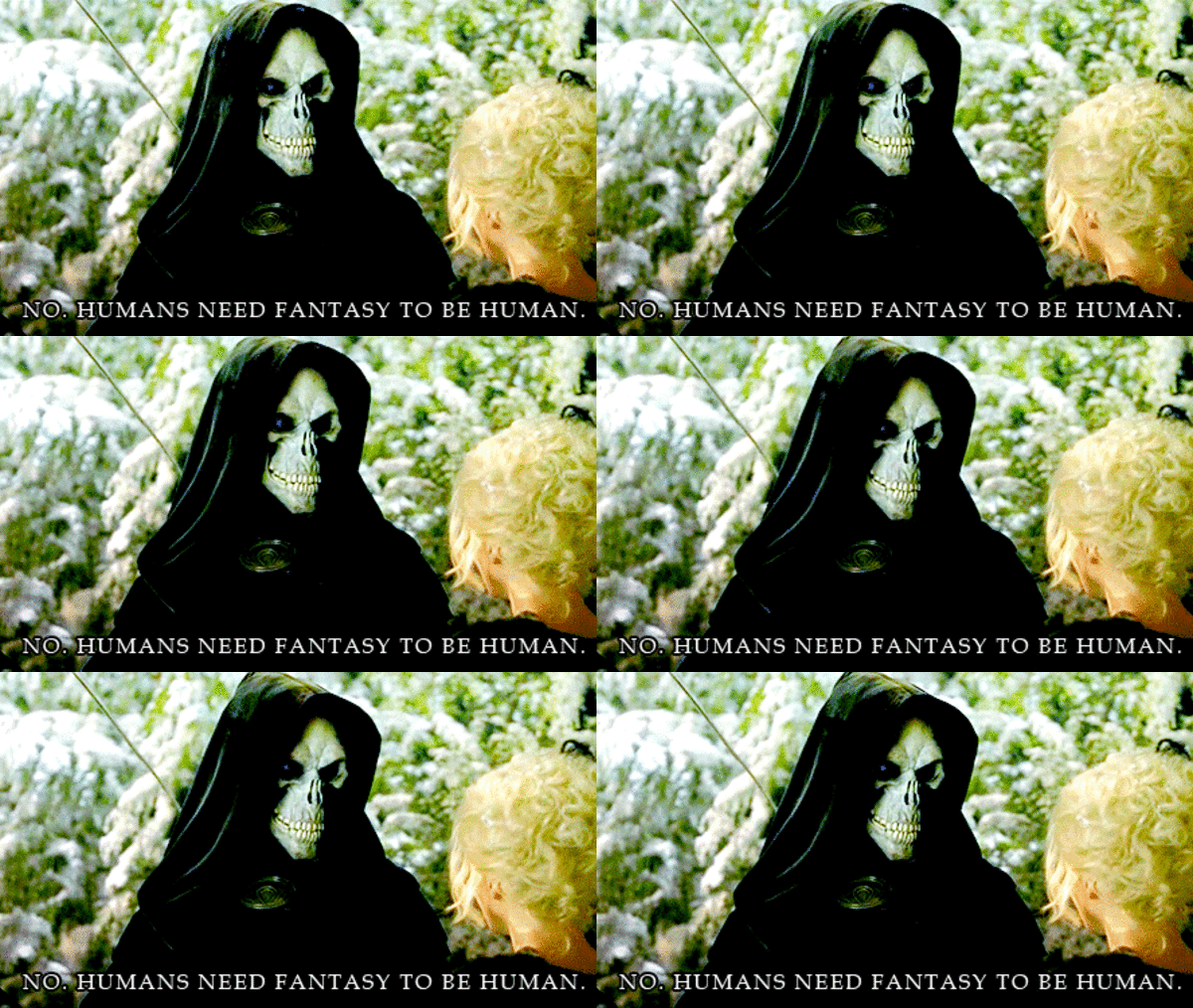
For the last several years, it’s been a holiday tradition for us to watch the wonderful adaptation of Terry Pratchett’s Hogfather, one of our most favorite holiday films. It’s full of great acting, silly banter (“I think my name is Bilious…I’m…the oh god of hangovers”) and brilliant writing. And Sir Terry makes a cameo appearance too!

I hadn’t always been a fan of Pratchett, though I had read a few of his novels in the 90s. I was more of an absurdist in the Douglas Adams vein anyway. It wasn’t until we started watching this one that I finally got his style and been a fan ever since. We’ve watched this one so often that it rivals the number of times I’ve watched certain movies for film class back in college, to the point that I’ve started analyzing it as a writer. I can see how it was written and how it was made, and how each storyline weaves and intertwines with the others, and how each one plays an important role in the main plot.

There’s also the lighthearted Hallmark holiday romcoms that A likes to watch around this time as well. And to be fair, I’ve been wanting to watch my favorite wasn’t-released-for-Christmas-but-is-sort-of-a-holiday-film While You Were Sleeping for a while now. Those kinds of films might be silly fluff, but the good ones are always well-written, often quirky and have a heart of gold. And there’s nothing wrong with that.

Over the last few years, I’ve kind of picked up on that. Remember, I got serious in my writing in the 90s and 00s, which means I was informed by over-the-top bombast of Armageddon and Independence Day, deep metaphysical weirdness like Dark City and The Matrix, along with all those random anime films and manga tankobons I devoured during the Belfry Years. This is precisely why my last several novel releases were much lighter one-offs: I had to learn how to dial it back. Lighthearted isn’t always a bad thing.

Which is why, at the end of the year, I like to take in some of that lighter fluff, just as a reminder that I’m allowed to write that kind of stuff too. Hell, I even have that romcom idea still simmering on the backburner somewhere!

Driving past the pumpkin patches…

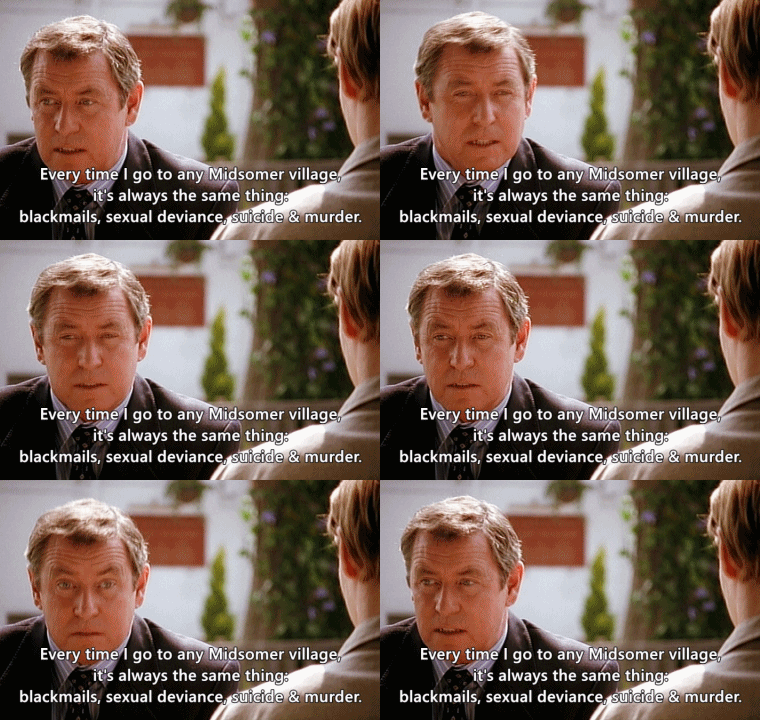
For those familiar with the British mystery show Midsomer Murders, the always enjoyable series loves to occasionally set its whodunit episode at a church fair, a festival, or some kind of social gathering — one of my favorite episodes takes place at what is essentially a comic con. So of course when we drove up to Petaluma north of San Francisco, we drove past a few lots that have turned into pumpkin patches, complete with bouncy castles, haystack mazes, game stalls and all that fun autumnal stuff.

And of course, being who we are, I posited the question: okay, say that pumpkin patch was on Midsomer Murders. Which turned into a fun conversation about a farm owner down on their luck needing to run the patch to make extra money, the ne’er-do-well brother that hates that the owner is selling out, the inevitable death in the first act, and Barnaby (Tom or John, whichever one you choose) brought in to solve the case. [A little later on I switched it up by asking a follow-up: okay, say that pumpkin patch was teh setting for a romcom. Which went off in yet another fun direction.]

This is of course one of the most fun parts of being a writer, I’ll admit — taking something mundane in your surroundings and placing it in a different universe, just to see where it takes you. Sometimes it’ll be a simple trope story like that cozy mystery or romcom, other times it’ll just take off all on its own and drag you with it. Either way, it’s one of my favorite things to do when I can get away with it!

It’s been a strange few weeks…

Rintaro from The Fragrant Flower Blooms with Dignity

…most of which I won’t go into as it’s something that should stay personal, but I’d be lying if I didn’t say it’s doing its best to derail me from my nightly writing sessions. The most I can say is that I’m doing my best to keep that from happening. I just need to balance it all out and keep moving forward.

Meanwhile, I’ve been doing a lot of manga reading lately, though this time via Hoopla and more often on the K Manga app that’s run by Kodansha. One title in particular that I’ve come to currently obsess over is The Fragrant Flower Blooms with Dignity (aka Kaoru Hana wa Rin to Saku). It’s a YA story about two teens from opposite social circles (in this case, a boy from a school full of losers and a girl from an elite academy whose buildings are next door to each other) that fall in love against all odds. It’s quite lovely and heartfelt without being schmaltzy or too slight. It’s a high school story where there’s conflict that doesn’t necessarily have to be dialed up to eleven unless it needs it, and I’ve really come to appreciate that kind of Zen-like style of storytelling. I’ve also learned that Netflix released a thirteen-episode season just recently, which I’m yet to watch in its entirety.

It’s well worth checking out, I highly recommend it.

I’ve also been reading a few other titles both on the K Manga app and elsewhere online. There’s the competitive hip-hop dancing manga Wandance featuring a lonely teen boy with a stutter who meets a girl who inspires him to join the dance club at their high school. There’s the hilariously quirky Smoking Behind the Supermarket with You, centering on an exhausted salaryman who befriends a snarky checkout girl…who happens to also be the amazingly adorable ringer that makes his heart beat. Then there’s the light and enjoyable Laid Back Camp about a group of high school girls who learn the ins and outs (and the hidden joys) of outdoor camping and all it brings. There’s You Can’t Live All On Your Own! about four young women living together in a shared apartment and dealing with the joys and frustrations of post-school adulthood.

I’ll be honest, I’ve been falling behind on my other reading (current book: The God and the Gwisin by Sophie Kim, the second Fate’s Thread book after The God and the Gumiho) so once I’m caught up with this manga binge-read, I’ll finally get back to my To Be Read pile.

Though I will say all this manga is inspiring me with some new story ideas…

The Matrix and the Mendaihu Universes

The Matrix Resurrections, the fourth in the series, came out at the height of the pandemic, released both in theaters and streaming on HBO Max at the same time. It was kind of a weird time for all involved, of course, and while the film didn’t come close to being a financial success (mostly due to said dual release), it did feel like the start of a new chapter. And to be honest, it did kind of make me rethink how I was going to approach the fourth book in the Mendaihu Universe if I was going to write it.

We watched all four in order at that time, as A hadn’t seen movies two or three and I hadn’t seen any of them in ages, and one thing that stuck with me is that they were bigger and stronger influences on my trilogy than I’d remembered. It all lines up: the first movie opened in March of 1999, right about the time I’d been thinking about reworking The Phoenix Effect into what would become A Division of Souls. The second and third movies, The Matrix Reloaded and The Matrix Revolutions, would come out in May and November 2003, right about the time I was working on The Persistence of Memories. I especially appreciated that the side-story anthology The Animatrix came out between those two in June 2003, expanding the universe even more, creating more lore that didn’t exactly tie in with Neo’s story.

I think one of the biggest influences on the Bridgetown Trilogy is in fact the expansion of Neo’s story from the original film to its conclusion. I liked that the second and third movies took what had happened in the first — Neo’s awakening into a rebel fighter against the Matrix and its Agents — and expanded on that. Primarily, asking the question: now that you have the power, what are you going to do with it? That soon became Denni’s personal mantra throughout the Bridgetown Trilogy as well; she was well aware of what she could do, so her own conflict was deciding what she should do.

There are other moments, of course. Not gonna lie, the leather duster and the form-fitting uniform of the Mendaihu Elder is definitely a sly wink at Neo and Trinity’s get-up throughout their own series. Little things like levitation and the ability to wield Light came from direct influence as well. I made them my own by thinking about what this kind of action or ability would look like in my own created universe, and expanding from there.

Back to Resurrections, I would say that movie helped me think more about how to frame the fourth book in the Mendaihu Universe. Again, there’s direct inspiration: Resurrections explores life within the Matrix years later, when Neo has become a distorted myth and its believers have forgotten the true history. While the movie focuses on Neo’s rebirth and Trinity’s reawakening, I plan on having MU4 focus on the myth: what happens when belief in the One of All Sacred evolves and becomes a weapon itself. I had the beginnings of that particular idea after I’d released The Balance of Light, but watching Resurrections helped sharpen that idea into something I could expand upon.

Right now, I’m focusing mostly on Theadia, so this one might not arrive until maybe 2027, but we shall see. I’ve got time and I’ve still got the influences and inspirations to work with.

Future inspiration

A lot of my non-writing things have definitely fallen by the wayside over the years, and I always wish I could return to that. I often complain about that here. And at the end of every year, I make some vague plan to try to do better at it, but never quite follow through. I’ll try for a few days and hit nothing but frustration, and let it go soon after

This year, however, I’ve come to the conclusion that the issue here isn’t quite about being consistent with the whiteboard schedule. I can easily follow that if I put my mind to it; I’ve done it countless times in the past. But sometimes just DO the thing doesn’t quite cut it.

This year I realized that I haven’t been inspired to do it. Think about it: why am I rarely picking up my guitars these days? It’s partly because I’m playing the same damn riffs and bass lines over and over, like I have for the last several years. The last major change I had was when I was doing the Blogging the Beatles and as a side project I taught myself some of their songs, and in the process I learned a few new tricks. But since then I’ll pick it up, play those same songs yet again, then put it down soon after. I’m not trying to be a semi-professional at it like I am with my writing, of course. I just want to expand my repertoire.

The same could be said with my artwork. I do miss doing that a lot, but again: the inspiration is eluding me. It’s been ages since I’ve broken out my pens, pencils and art notebooks, and I think it’s mainly for the same reasons: I keep drawing the same damn things and not trying anything new. Hell, I even miss drawing my maps, but I always end up drawing the same setting over and over!

And let’s be honest, the same could actually be said with my writing as well: I haven’t allowed myself to be inspired to try new fiction projects in a while, either. These last few years have been about finishing the active ones. But with this particular avenue I’ve made some inroads: I’ve been forcing myself to expand my reading habits again. And not just reading more, but leaning heavily on novels that have given me that wonderful I would LOVE to write something like this feeling, which can sometimes be a rare event. And in order to do that, I have to actively look for these books and try them out, whether it’s through trying out a chapter at a bookstore, purchasing them, or borrowing them through Hoopla.

But most importantly, I have to remember this about inspiration: it doesn’t always need to be mind-blowing, heart-moving and earth-shattering. Diwa & Kaffi wasn’t just about me writing a hopepunk story, it was also about me training myself to appreciate the smaller, quieter things in life. Same with me grabbing those Zen-a-Day desk calendars. I must remind myself that it doesn’t always have to resonate so incredibly deep. I swear this comes from being a Gen-X film student in the 90s and soaking in every media outlet that embraced Michael Bay levels of epic action and drama. For years my intake was dialed to 11…and it’s taken me years to unravel myself from that habit. This is precisely why one of my favorite movies of 2023 was Wim Wenders’ meditational Perfect Days, because this was the balance I needed to aim for.

So if anything, if I’m to look for future inspiration, I need to remember to look for the quiet as well as the loud. Whatever resonates the most.