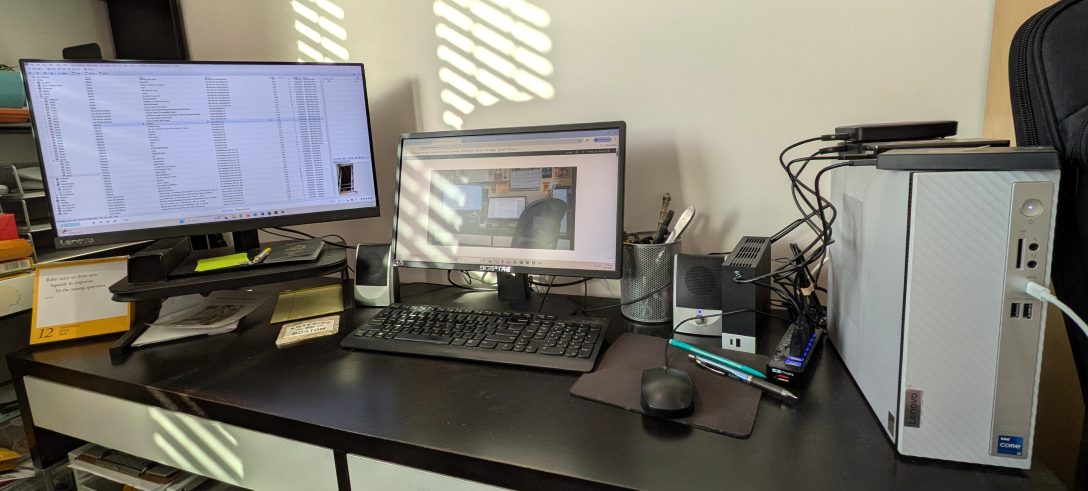
Finding a writing process

[NOTE: The below is mostly from my 750Words entry from yesterday, but I felt it worth sharing here.]

We were talking the other day about Your Name — one of my all time favorite movies — and how, when we went to see it in the theater in Japantown awhile back, I was reminded of just how perfect a movie it was. Every part of the story has meaning, is there for a reason, and is woven into a rich tapestry. It’s a perfect example of what I like to call ‘they’ve done their homework’. There are very few movies, books, and music that resonate with me that deeply (The Fragrant Flower Blooms with Dignity is a current one, of course) but as I’d said to A yesterday, I always saw that movie as a benchmark for me to achieve with my own writing. I doubt I’ll ever reach the levels of Makoto Shinkai, but it gives me a firm goal to work towards.

I think that’s close to where I reached with the Bridgetown Trilogy, and especially with The Persistence of Memories. It wasn’t just a perfect storm of positive personal life, great music and a wave of unbridled creativity. Those things of course fueled it, but it wasn’t entirely borne out of it, now that I think about it.

I’d gone into the trilogy with a few things on my mind:
–This would be the end result of a long-simmering project dating back to 1993, so I did not want to do a half-assed job of it.
–I had such a deep well of ideas for this created universe dating back to the same time, and I did not want to waste any of it.
–I was at a day job at a warehouse where I didn’t have to waste much-needed brain power problem solving (the most pressing things I had to think about were building pallets neatly and correctly, where to stage them, and how to get them to fit onto the truck), which meant that I could spend most all of my waking hours focused on my writing.
–I knew that if I stopped and ‘took a few days off’ I’d get lazy and miss even more writing days, which was part of my undiagnosed ADHD issues, so I purposely drove myself to hyperfocus on the writing instead…while also ensuring that I kept it fun for myself. It was a balance between wanting to reach word count and becoming super excited about wanting to keep this story alive.

And to tie in with what I was saying above: this was a story where ‘I did my homework’. The further along I went with it, the deeper and richer it became. And the wild thing is that most of this happened in my head, because I was really not that much of an outliner! Like I’ve said numerous times, the most I ever planned out with the trilogy was maybe three or four scenes ahead, or maybe one or two chapters ahead, and even then it was less an outline than a vague list of beats to hit as I came up with them.

All the while, I was keeping multiple character threads going in my head. Caren and Poe were focusing on two things: balancing their own spiritual awakening while protecting Denni; Anton knew he wasn’t in charge but had to make it look like he was; Natianos believed he was pulling the strings but didn’t expect Denni and Saisshalé to take over; Nehalé was going through a crisis of faith; and so on and so on. This is why the scenes are set up as they are: they focus mostly on the important character in that particular scene, fully and with deep immersion. The other characters might have been in the scene as well, yet I would only focus on their reaction (or non-reaction) in a later scene. Everything and everyone was interwoven into this story, but I had to see the separate threads going.

Looking back on it, it’s kind of amazing that I did that with my first professional novels. I did it to a much lesser extent with the standalones, but that’s because they didn’t need that much intensity. It was a process I came up with on my own, one that worked for me, and one I still use to some degree. In fact, I’ve been contemplating following my own example with another attempt at rewriting Theadia. The only reason I’d stepped away from that process was because the Trilogy had been such an incredibly long project that I needed to try something small and compact — both to give myself a mental break and to see if I could pull it off.

Like I said, I don’t expect to hit Shinkai levels of perfection, but I remain inspired to at least ‘do my homework’ and write the best work I can.
Reflections and Parallels

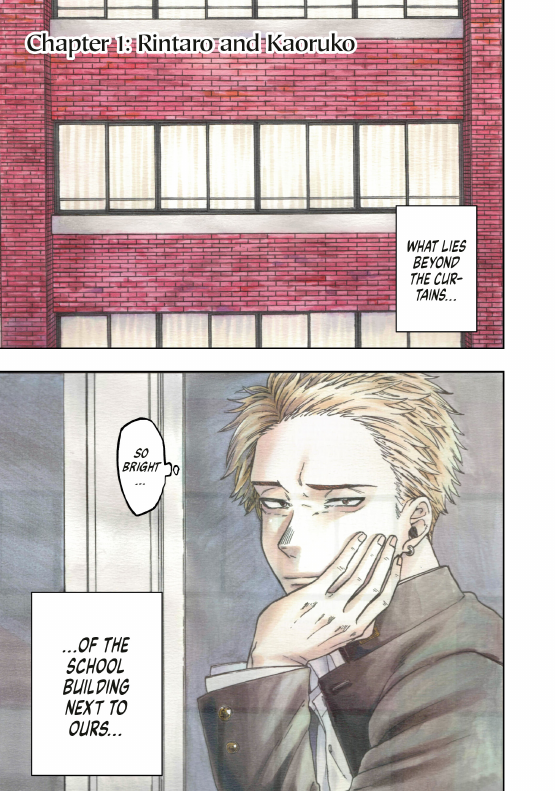
What you see above is the very first page of my current reading obsession, Saka Mikami’s The Fragrant Flower Blooms with Dignity. It’s about two teenagers: the kind-hearted yet often misunderstood Rintaro Tsumugi (above) who goes to a bottom-rung high school, and the petite yet brilliant Kaoruko Waguri, who goes to the posh girls’ school next door. Despite the animosity between the two schools, these two meet and fall in love. It’s not a Romeo & Juliet story, either: this is a heart-lifting story about discovering what lifts one’s heart and working to make it happen with no regrets.

What I notice, however, is the reflection we see superimposed over Rintaro’s face in the second frame. He’s looking through the classroom window at the closed curtains of Kikyo Academy from his own perch at Chidori High, curious about what goes on behind them, as they’ve been closed for almost a decade and for not entirely clear purposes other than there’s been bad blood between the two. It’s an impenetrable wall where he’s not invited nor welcomed, thus the look of frustration and discomfort on his face.

And yet…there’s more to this one page, and this is exactly what I love about this manga. It’s not just a literal setup of what’s to come in the story; there are actually so many more layers to this.

We learn in the next few chapters that Rintaro’s childhood was not all that enjoyable. He was often shunned by his peers, whether it was because of his absurd height or his low grades or his inability to completely fit in and conform, leaving him with nearly no friends. Because of this, he’s chosen to go the exact opposite route, dye his hair blonde, and be a loner. Thus: that impenetrable wall we see in the reflection is not just a literal closure between the two schools, but one he’s put up between himself and the outside world. It sets up one of the most important main arcs of the story: whether he (and Kaoruko) are able to break down both the literal and the metaphorical wall of division. Despite this, he still has a heart of gold: he might feel alone but he never once mistreats anyone, whoever it may be.

There’s also the “so bright…” line. That’s not just a tossed-off line about the sunshine, either. Brightness will also become a recurring theme throughout the series, both literally and figuratively, when nearly every character reaches some kind of eye-opening revelation, discovers a moment of inner peace, or their heart is lifted to a level they’ve never experienced before. The word “dazzling” is used many times in these moments, and those scenes usually contain an element of lens-flare or a lightness of line art as well. This also sets up another extremely important recurring theme of the series: finding a moment — or a person — so dazzling that one can’t help but be lifted emotionally themselves and utterly changed by the experience.

And lastly, the reflection and the parallel: what happens to one person will most likely happen to another later on in the story. And not just the same person, either. For example, we learn that Rintaro’s youth is not that far off from Kaoruko’s best friend Subaru Hoshina, who was taunted mercilessly when she was very young for having silver hair, causing a deep mistrust of boys. These kinds of threads are woven throughout the story in a way that silently reminds you: despite differences, we are all similar in one way or another. Even though the two schools are initially seen as complete opposites of each other with that seemingly impenetrable wall in between, we learn that Kikyo and Chidori really aren’t all that different once you really get to know them. [Even two of the secondary characters, Shohei Usami (Rintaro’s rambunctious buddy) and Madoka Yuzuhara (Kaoruko’s nerdy friend), both initially used as comic relief, are often the voice of reason and emotional stability in their own way, and both state clearly that they really do not hold anything against the other’s school, merely stating that they leave them alone to keep the peace.]

This is one of my favorite tools writers use: the reflection and the parallel. I’ve used it many times over the years and it’s super fun to write. It adds another level to the storytelling that’s not seen immediately, and sometimes you don’t even notice it at all. It’s often during a reread that it becomes apparent, and Fragrant Flower does this frequently and extremely well. Sometimes it’s obvious: whenever a character has a moment of surprised emotional clarity, there’s a single shot of the lower half of their face, their mouth ever so slightly agape. Sometimes it’s personal, such as Rintaro’s wince (which shows up whenever he feels uncomfortable in a situation yet instinctively knows it means something important), or Kaoruko’s soft heartfelt smile whenever she’s caught in a moment of complete emotional comfort or stability. There are meanings behind these moments that otherwise might be easily tossed off.

I suppose this is partly why I’ve been following this series obsessively over the last few months, because in a way I’ve been trying to figure out how Mikami-san lets the story unfold in such a creative way so I can possibly use it in my own writing in the future. I learn something new every time I reread it.

[The Fragrant Flower Blooms with Dignity can be found on the K Manga app, and currently has twelve tankobon volumes available in the US. The first several chapters have been made into a thirteen-episode anime series available on Netflix.]