Finding a writing process

[NOTE: The below is mostly from my 750Words entry from yesterday, but I felt it worth sharing here.]

We were talking the other day about Your Name — one of my all time favorite movies — and how, when we went to see it in the theater in Japantown awhile back, I was reminded of just how perfect a movie it was. Every part of the story has meaning, is there for a reason, and is woven into a rich tapestry. It’s a perfect example of what I like to call ‘they’ve done their homework’. There are very few movies, books, and music that resonate with me that deeply (The Fragrant Flower Blooms with Dignity is a current one, of course) but as I’d said to A yesterday, I always saw that movie as a benchmark for me to achieve with my own writing. I doubt I’ll ever reach the levels of Makoto Shinkai, but it gives me a firm goal to work towards.

I think that’s close to where I reached with the Bridgetown Trilogy, and especially with The Persistence of Memories. It wasn’t just a perfect storm of positive personal life, great music and a wave of unbridled creativity. Those things of course fueled it, but it wasn’t entirely borne out of it, now that I think about it.

I’d gone into the trilogy with a few things on my mind:
–This would be the end result of a long-simmering project dating back to 1993, so I did not want to do a half-assed job of it.
–I had such a deep well of ideas for this created universe dating back to the same time, and I did not want to waste any of it.
–I was at a day job at a warehouse where I didn’t have to waste much-needed brain power problem solving (the most pressing things I had to think about were building pallets neatly and correctly, where to stage them, and how to get them to fit onto the truck), which meant that I could spend most all of my waking hours focused on my writing.
–I knew that if I stopped and ‘took a few days off’ I’d get lazy and miss even more writing days, which was part of my undiagnosed ADHD issues, so I purposely drove myself to hyperfocus on the writing instead…while also ensuring that I kept it fun for myself. It was a balance between wanting to reach word count and becoming super excited about wanting to keep this story alive.

And to tie in with what I was saying above: this was a story where ‘I did my homework’. The further along I went with it, the deeper and richer it became. And the wild thing is that most of this happened in my head, because I was really not that much of an outliner! Like I’ve said numerous times, the most I ever planned out with the trilogy was maybe three or four scenes ahead, or maybe one or two chapters ahead, and even then it was less an outline than a vague list of beats to hit as I came up with them.

All the while, I was keeping multiple character threads going in my head. Caren and Poe were focusing on two things: balancing their own spiritual awakening while protecting Denni; Anton knew he wasn’t in charge but had to make it look like he was; Natianos believed he was pulling the strings but didn’t expect Denni and Saisshalé to take over; Nehalé was going through a crisis of faith; and so on and so on. This is why the scenes are set up as they are: they focus mostly on the important character in that particular scene, fully and with deep immersion. The other characters might have been in the scene as well, yet I would only focus on their reaction (or non-reaction) in a later scene. Everything and everyone was interwoven into this story, but I had to see the separate threads going.

Looking back on it, it’s kind of amazing that I did that with my first professional novels. I did it to a much lesser extent with the standalones, but that’s because they didn’t need that much intensity. It was a process I came up with on my own, one that worked for me, and one I still use to some degree. In fact, I’ve been contemplating following my own example with another attempt at rewriting Theadia. The only reason I’d stepped away from that process was because the Trilogy had been such an incredibly long project that I needed to try something small and compact — both to give myself a mental break and to see if I could pull it off.

Like I said, I don’t expect to hit Shinkai levels of perfection, but I remain inspired to at least ‘do my homework’ and write the best work I can.
Dragon Pilot and thinking outside the box

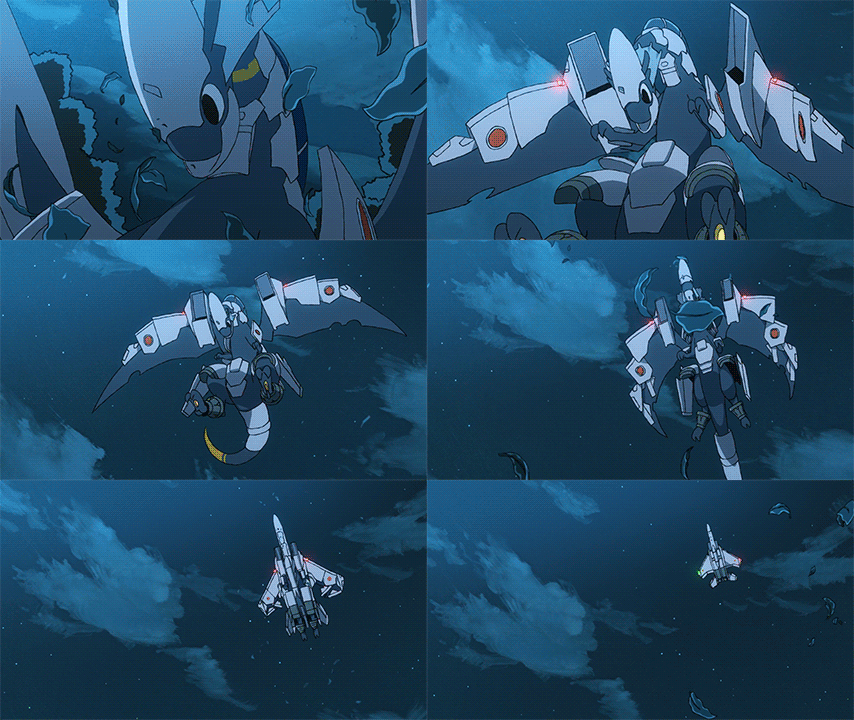
hisone to masotan
Credit: Dragon Pilot: Hisone and Masotan

I’ve said it many times before, this is one of the biggest reasons I watch anime and read manga:  it forces me to think outside the box.

We’ve recently been watching Dragon Pilot: Hisone and Masotan on Netflix, and it’s a hell of a lot of fun.  On the surface it might be one of those fantasy animes that start off cute and fun and eventually turn weird and creepy (one of my favorite storytelling styles, I should add), and there’s enough bonkers humor to sustain multiple episodes, but it’s really wonderfully written.  The short version: four young female air force cadets (and one back-up) are chosen to fly secret planes that are actually ancient dragons hiding under armor that makes them look like fighter jets.  There’s a much darker and stranger story line that kicks in about three episodes in, of course, but on the way there, we’re given the usual shojo silliness: boy trouble, self-doubt and embarrassment, strange and mysterious adults, the power of love, and so on.  I especially enjoy the camaraderie of the special air force team and its leaders, as there’s definitely a Patlabor-esque ‘group of misfits’ vibe going on.  I’m utterly fascinated at how the main plot is unfolding.  While it might just be about the girls training with their dragons, there’s a deeper, more sinister reason for what’s really going on where their lives may be at stake.

It’s precisely this type of story that inspires me to write my own.  I’m always drawn to stories with this kind of creativity, where it pushes me to rethink my own ideas.  The idea of dragons as fighter jets would not have occurred to me at all.  But after watching just the first episode — in fact, a prologue on the first one explains the entire backstory of it to brilliant effect — I was completely sold on the idea.  It was definitely a damn, why didn’t I think of that?? moment for me.

And I know a lot of readers enjoy this kind of creativity as well; after all, Ann Leckie’s Ancillary series, Yoon Ha Lee’s Machineries of Empire series and Becky Chambers’ Wayfarer stories have the same kind of unique and original styles that have given them huge audiences and Hugo nominations and wins.  It’s taking older tropes and making them new again.

I highly recommend checking this series out…it’s really good fun.

Anime Nights

A. and I decided to restart our Anime Nights, something we used to do at our old place in North Beach but hadn’t done in ages since.  I’ve always been a huge fan of anime since the mid-90s, though my watching habits always tend to come and go, depending on how much time I can devote to it and when it’s available. I was a huge fan of Cartoon Network’s Toonami back in the ’00s, and it introduced me to some great titles like Naruto (of which I’m still a fan), One Piece and more. We would also rent out anime through Netflix, checking up on some great titles like Haibane Renmei, Ergo Proxy and Trigun.

I kind of let it go for the last few years, mainly due to wanting to focus on finishing and publishing the trilogy, and also needing to get myself back into a consistent writing habit.  But lately I’ve come to realize that maybe I should at least take a night off and watch more of the things that inspire my writing in the first place.  Maybe in the process I’ll be inspired once more by newer, different stories.

Last night’s viewing, courtesy of Funimation, was finally catching up with Yuri!!! on Ice, which I believe all of our otaku friends have already seen when it was first released not that long ago.  It’s a lot of fun to watch (and I now understand the plentiful shipping that went on back then).

I should also point out this was a great example (one of many) of why I love anime so much: it’s a cartoon series about competitive figure skating. It proves you can write a compelling story about pretty much anything, whether it’s about sports or cooking or high school girls starting a rock group. As a writer, it reminds me that no idea is too weird or too corny or too goofy.  It really is the storytelling that counts.

It’s also made me think about finite serial storytelling. For instance, something like Cowboy Bebop. It tells a specific story over the course of its twenty some-odd episodes and its film, but it also has many shorter stories within the span of each episode. That gave me a lot to think about as a writer; it made me rethink how to interweave the main story arc around several smaller subplot arcs.

[I should add that I recently rewatched an episode while on our flight home from Boston, and realized just how great that show really is; I definitely need to watch it again.]

Then of course there’s my favorite movie of this year, hands down: your name.

I’m totally a fanboy for this film, because a) it’s beautifully made with some absolutely stunning shots, and b) its storytelling is amazingly detailed (I pick up more bits the more I watch it) and woven together in a really creative way. On the surface it looks like a girly ‘star-crossed lovers’ story but it’s not. I’ve watched it three times already this year (twice during our UK trip earlier this year) and I’m pretty sure I’ll watch it again before the year is over, just to study the storytelling.

So yeah…I’m looking forward to watching more anime in the coming months again.  It’s not only fun, it almost always inspires me to come up with new story ideas and storytelling styles.