Reflections and Parallels

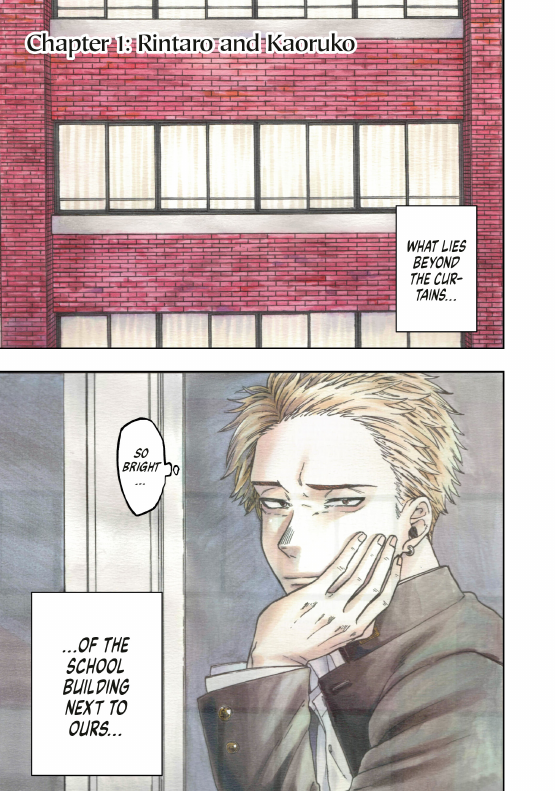
What you see above is the very first page of my current reading obsession, Saka Mikami’s The Fragrant Flower Blooms with Dignity. It’s about two teenagers: the kind-hearted yet often misunderstood Rintaro Tsumugi (above) who goes to a bottom-rung high school, and the petite yet brilliant Kaoruko Waguri, who goes to the posh girls’ school next door. Despite the animosity between the two schools, these two meet and fall in love. It’s not a Romeo & Juliet story, either: this is a heart-lifting story about discovering what lifts one’s heart and working to make it happen with no regrets.

What I notice, however, is the reflection we see superimposed over Rintaro’s face in the second frame. He’s looking through the classroom window at the closed curtains of Kikyo Academy from his own perch at Chidori High, curious about what goes on behind them, as they’ve been closed for almost a decade and for not entirely clear purposes other than there’s been bad blood between the two. It’s an impenetrable wall where he’s not invited nor welcomed, thus the look of frustration and discomfort on his face.

And yet…there’s more to this one page, and this is exactly what I love about this manga. It’s not just a literal setup of what’s to come in the story; there are actually so many more layers to this.

We learn in the next few chapters that Rintaro’s childhood was not all that enjoyable. He was often shunned by his peers, whether it was because of his absurd height or his low grades or his inability to completely fit in and conform, leaving him with nearly no friends. Because of this, he’s chosen to go the exact opposite route, dye his hair blonde, and be a loner. Thus: that impenetrable wall we see in the reflection is not just a literal closure between the two schools, but one he’s put up between himself and the outside world. It sets up one of the most important main arcs of the story: whether he (and Kaoruko) are able to break down both the literal and the metaphorical wall of division. Despite this, he still has a heart of gold: he might feel alone but he never once mistreats anyone, whoever it may be.

There’s also the “so bright…” line. That’s not just a tossed-off line about the sunshine, either. Brightness will also become a recurring theme throughout the series, both literally and figuratively, when nearly every character reaches some kind of eye-opening revelation, discovers a moment of inner peace, or their heart is lifted to a level they’ve never experienced before. The word “dazzling” is used many times in these moments, and those scenes usually contain an element of lens-flare or a lightness of line art as well. This also sets up another extremely important recurring theme of the series: finding a moment — or a person — so dazzling that one can’t help but be lifted emotionally themselves and utterly changed by the experience.

And lastly, the reflection and the parallel: what happens to one person will most likely happen to another later on in the story. And not just the same person, either. For example, we learn that Rintaro’s youth is not that far off from Kaoruko’s best friend Subaru Hoshina, who was taunted mercilessly when she was very young for having silver hair, causing a deep mistrust of boys. These kinds of threads are woven throughout the story in a way that silently reminds you: despite differences, we are all similar in one way or another. Even though the two schools are initially seen as complete opposites of each other with that seemingly impenetrable wall in between, we learn that Kikyo and Chidori really aren’t all that different once you really get to know them. [Even two of the secondary characters, Shohei Usami (Rintaro’s rambunctious buddy) and Madoka Yuzuhara (Kaoruko’s nerdy friend), both initially used as comic relief, are often the voice of reason and emotional stability in their own way, and both state clearly that they really do not hold anything against the other’s school, merely stating that they leave them alone to keep the peace.]

This is one of my favorite tools writers use: the reflection and the parallel. I’ve used it many times over the years and it’s super fun to write. It adds another level to the storytelling that’s not seen immediately, and sometimes you don’t even notice it at all. It’s often during a reread that it becomes apparent, and Fragrant Flower does this frequently and extremely well. Sometimes it’s obvious: whenever a character has a moment of surprised emotional clarity, there’s a single shot of the lower half of their face, their mouth ever so slightly agape. Sometimes it’s personal, such as Rintaro’s wince (which shows up whenever he feels uncomfortable in a situation yet instinctively knows it means something important), or Kaoruko’s soft heartfelt smile whenever she’s caught in a moment of complete emotional comfort or stability. There are meanings behind these moments that otherwise might be easily tossed off.

I suppose this is partly why I’ve been following this series obsessively over the last few months, because in a way I’ve been trying to figure out how Mikami-san lets the story unfold in such a creative way so I can possibly use it in my own writing in the future. I learn something new every time I reread it.

[The Fragrant Flower Blooms with Dignity can be found on the K Manga app, and currently has twelve tankobon volumes available in the US. The first several chapters have been made into a thirteen-episode anime series available on Netflix.]
Currently reading…

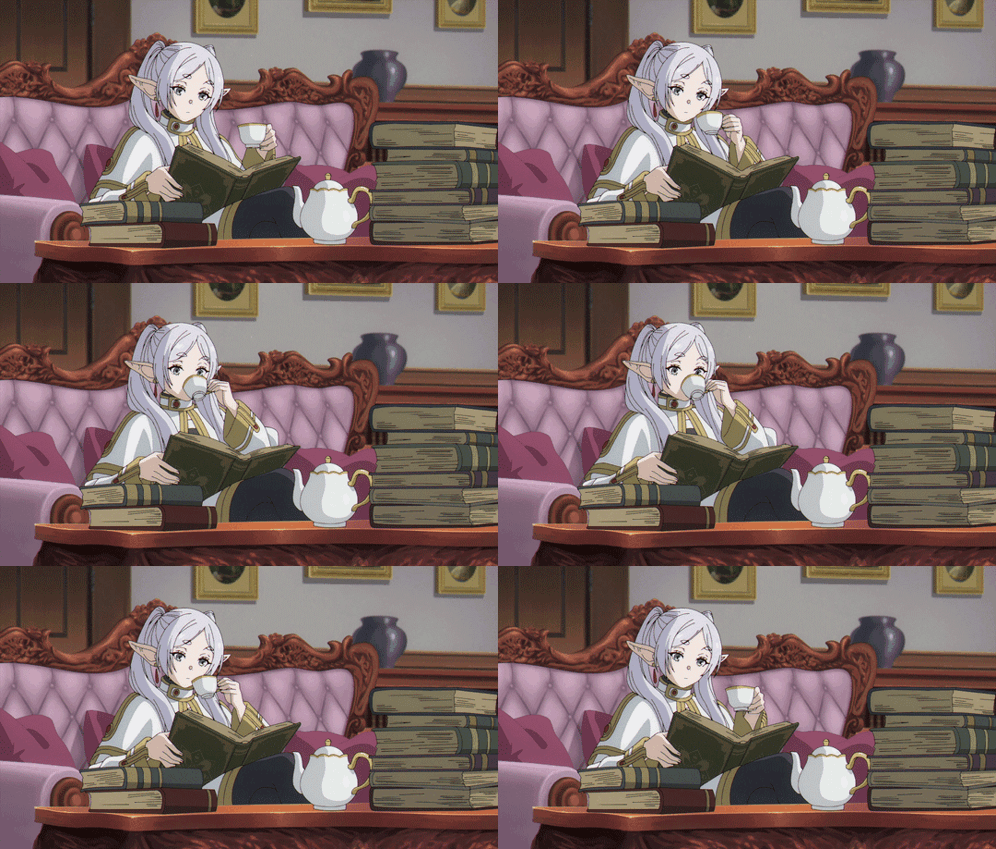
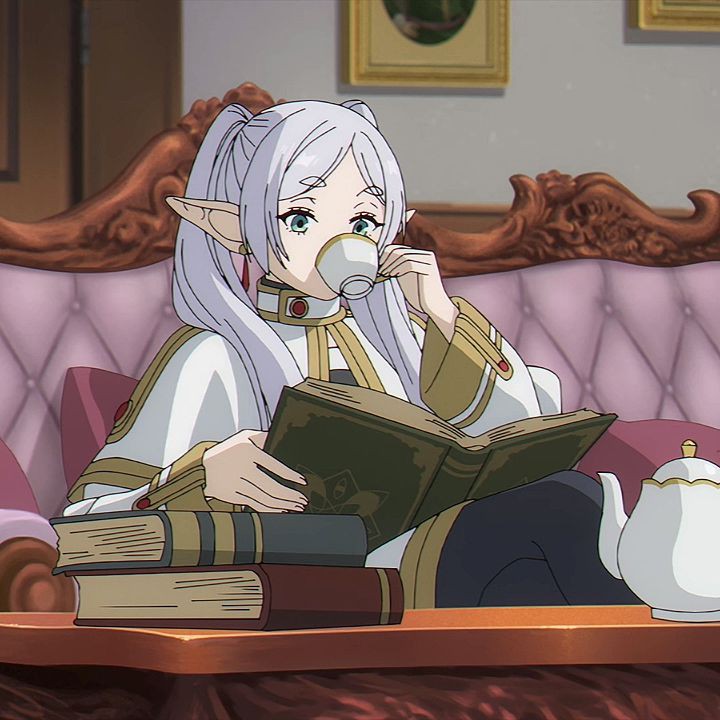
I’ll admit that I have become obsessed with reading comics on the K Manga app on my e-reader. It’s run by Kodansha, one of the big manga publishers these days, and I’ve picked up on a handful of series that I’m really enjoying. It’s where I discovered the wonderfully written teen romance The Fragrant Flower Blooms with Dignity, whose main characters Rintaro and Kaoruko have been showing up as pictures and gifs here over the last few months. [I’ve been enjoying that series so much I’ve been tempted to do a mini-series here about it.] Every night when I get into bed, I’ll turn on the app and catch up on a few titles.

The other night, I was thinking: y’know, I have this physical pile of books next to my bed that haven’t been picked up lately, I should probably do something about that as well instead of reading comics every night. But maybe this is part and parcel of my wanting to change up my creative outlets? Over the past several years I’d become super-picky about the novels I was picking up, and even then some of them haven’t been resonating with me as much as they used to. It’s not that they’re bad or that the latest trends aren’t speaking to me, it’s merely that I’m not feeling the spark of excitement like I used to. I’m not as voracious a reader as I was, at least not right now anyway.

So why not see this burst of interest in comics as a plus and not a minus? After all, that’s how I started reading more in the late 90s, isn’t it? During the HMV years when I suddenly decided that I would take those Wednesday drives to the comic book store every week, that sparked off a new love of reading that I hadn’t really had before. What started as a focus on just a few titles bloomed into several, which then expanded into different styles, different genres. And those, in turn, inspired my writing style and ideas.

And somewhere along the lines, I suddenly found myself interested in reading books again. It all felt fresh once more.

So perhaps it’s fine that I embrace this medium again for the time being. Reading comics like Fragrant Flower have reminded me that both inspiration and influence lie in interesting places, and it’s up to me to search for them when I need them. Perhaps now it’s time for me to learn not just the art of visual storytelling, but to learn how to see and understand things in new ways.

A little night reading

I know, I know…I really should be catching up with my To Be Read pile at night. It’s not even that big at the moment. Instead, I’ve been turning on my e-reader and reading a bunch of comics and manga on the Hoopla app. Yay for the SF Public Library for carrying a considerably large collection! And on top of all that, I’m working through all twenty-six volumes of Charles Schulz’s The Complete Peanuts (I’m currently on volume 11, the 1971-72 comics).

I figure what I’m doing here is not actually avoiding the TBR pile, but just allowing myself to purely enjoy reading, which I sometimes forget to do. I think part of this is due to having gone through a phase some years back where I just felt burnt out by reading only genre, or only music bio, or whatever, added to the fact that I was trying to reach a goal I’d set on GoodReads.

During all this pleasure reading, it occurred to me that this was what I did back in the Belfry days. I’d been hooked on comic books at the time and simply had to follow the monthly adventures of whatever titles I’d bought (including slogging through the last third of Dave Sim’s Cerebus, and you really need the fortitude and patience to slog through everything past the Flight trade, and especially after Rick’s Story). A lot of it I enjoyed, and a lot of it helped shape the kind of storytelling I enjoy writing. But I was also pushing myself to read comics and books that I wasn’t entirely enjoying. I bought a lot that I simply never got around to reading.

So I’m not too worried about those few titles gathering dust next to the bed, because I’ll get to them eventually. In the meantime I’m checking out things that capture my interest and are an easy and relaxing read. I’m trying out different genres and styles and soaking in the storytelling and the worldbuilding. Sometimes the comic’s a silly slice of life, sometimes it’s a quirky oddball fantasy, sometimes it’s a romance.

And in the end, I’m hoping some of this light night reading will inspire some new ideas!

Influences: Strangers in Paradise

The badass women of Terry Moore’s Strangers in Paradise

Back at the start of my post-college days when I was slumming it in Boston, someone suggested I check out this new comic series called Strangers in Paradise. The first cover was a simple but lovely shot of two women in an art gallery: a moody blonde artist and her seemingly innocent dark-haired bestie. Inside was a story of that second woman having the worst luck with men, specifically a lawyer named Freddie Femur. You’d think this is a classic Bechdel-Test-failing love triangle, yes? Well, maybe not. Because there’s a lot more going on than you think with these characters. A lot more.

Katina “Katchoo” Choovanski, the ‘angry blonde’, is the girl literally from the wrong side of the tracks with a past she’d rather keep quiet. Francine Peters is actually not so pure and innocent and just wants a bit of stability. Freddie, of course, wants to be the slimy alpha male but fails badly at it. And somewhere along the line, Katchoo gets a visit from a fourth character: a kind, quiet and nerdy guy named David Qin, who just wants to take her out for coffee and get to know her.

And that’s only the first three issues. What happens in the next hundred-plus issues that were released between 1993 and 2007 is what truly pulls the reader into this wild universe of criminal underworlds, black ops action, political intrigue, hidden pasts, frustrations in creativity, unrequited love, marriage instability, emotional violence, and spiritual redemption. For some of them, life eventually brings them peace. For the others, not so much, but their downfall is always of their own doing.

What I love about this series is that Moore has chosen to make each female character in this universe as badass as possible in their own unique way. Whether they’re trying to escape their violent past or helping someone battle anorexia or coming to terms with their sexuality or merely just learning how to love and trust someone without any strings attached, these women’s stories very rarely fall into trope or stereotype. These are characters with a vibrant back story and an individuality that sets them apart from each other.

Reading Strangers in Paradise helped me learn how to write and understand my own characters, and how to make them interact. Moore will occasionally throw in silly humor, timely pop culture references, and perfect comedic timing, but when things are serious, he doesn’t hold back. From SiP I learned about pacing, about when to utilize a perfect show-don’t-tell plot device, and how different characters should and could interact. I also learned when to subvert a trope to make the story that much better. And most of all, I learned how a simple back-and-forth dialogue can tell the reader a lot more than just what they’re saying, whether by what’s not being said, or by how it’s being said.

I highly recommend giving the series a try! Moore is a wonderful writer, and he’s also a self-publisher!

**NOTE: If you’ve got $30 to spare, head over to Humble Bundle today or tomorrow, as his complete Abstract Studios bibliography is available in pdf form! If you miss out, check out his work at his Abstract Studios website!**