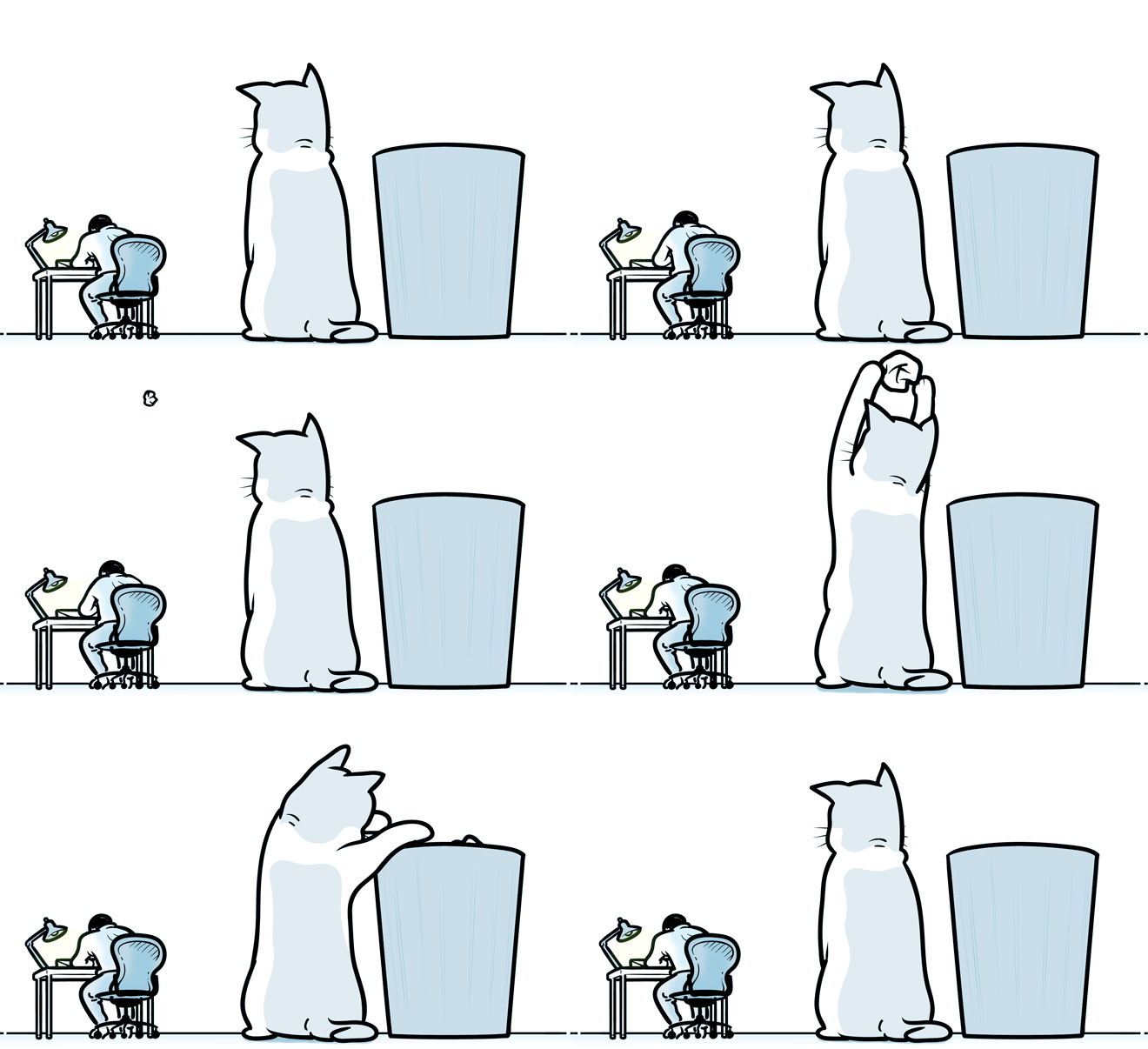
Into the bin it goes

Looks like my plan to expand on a few scenes in Theadia isn’t working out as well as I thought. Truth be told, I’m not too bothered by it because it kind of felt more like an experiment than a well thought-out plan. I’m still inserting a few new chapters here and there, but I’m dialing most of it back. Why? Well, sometimes I just have to go with my instinct of something doesn’t feel right to me. The more I inserted, the more it felt like the wrong way to go. Simple as that.

I’ve gotten used to this kind of editing over the years, which means that I’m less worried about having wasted time and spoons trying to make it work. It is what it is, and I can always insert it in abbreviated form somewhere else if the information is important enough. [There is also the fact that the novel is a bit over 180k words and still not complete, so keeping it reined in is probably for the best.]

Editing and revising as I go has been part of the overall process for me for ages now. In fact, I prefer that style because it keeps me from writing too many rambling scenes that don’t lead anywhere. It also makes the whole process go by faster, in that it gives me a clearer vision of where the story should lead, as well as what early scenes need fixing or replacing. This has also helped me let go of scenes (and projects!) that need to be put in the bin.

That said, this does clear up my schedule for 2026 a bit, which is a plus!

Almost six years…?

Has it really been almost six years I’ve been working on Theadia…? More to the point, how is it that I’m not freaked out that I’m still working on this one project and NOT feeling like a failure for taking so dang long?

To be honest, however, I think it comes with maturity and patience. The obvious reason I was able to turn around my last few novels so quickly was that it was actually a two-year, two-project schedule: one written while working on the editing and release of another. [It also helped that those novels were not epic projects like the Bridgetown Trilogy or Theadia, but shorter stories that didn’t need several hours of prep, work and so on.] Still, I’m glad to say I’m on the back end of this one and I hope to get it out to y’all on the back half of this year.

It’s interesting, though, comparing it to the time I spent working on the Mendaihu Universe. Back during the Belfry days I purposely didn’t give myself a set deadline because I knew this trilogy would be done when it got done. On the one hand I did kind of feel like I was lagging behind every other writer my age out there who was already seeing their works in print, but on the other hand I often reminded myself that I was doing this for me only. Being a successful (or even semi-successful) (or even having some random readers at that) was a goal, but not THE goal. I focused on wanting to tell the stories I wanted to tell, and allowing myself to do it the way I wanted to do it.

These days I don’t really mind that it’s taking me this long to release this story, because I know that doing it right means not rushing it.

Year End: Moving On

Sure, I could use the classic phrase I’m too old for this sh*t in regards to some of the more frustrating things that have happened over the past year. But really, I’m not nearly as cynical as that. Despite being firmly Gen-X, I never completely slid into full-on cynicism because I always felt it was an easy way out: writing something off by saying it was never good in the first place. It just didn’t ring true to me.

It’s true, I’ve had a few frustrating things happen here and there this year, and yes, I may have overreacted to some degree. But I’m not writing any of that off, far from it. I’m just choosing to acknowledge it and move on. Not every single event in my life needs to be a conflict that needs to be faced or resolved. Sometimes it just is what it is, and I have to adjust accordingly. I might have to make some changes, but they will be changes made my way and not out of frustration or necessity.

If anything comes with age for me, I think it’s that I’ve refined how I utilize my sense of patience. Back in my 20s I used to semi-joke I was cursed with a tremendous amount of it, primarily because it was the only reaction I could have most of the time, whether due to finances, emotional reaction, or just the situation I found myself in. Some years later I learned how to voice those frustrations, and at times I could be too vocal about it. It took me a while to find a level that wasn’t pathetic or reactionary.

It was all about balance, really. And that’s how I’ve been living since then.

Right now I know there are some things I can fix, and other things I can’t. But I know I am not chained to the places or situations I find myself in these days. It’s a matter of being able to think outside the box instead, and figuring out how to sidestep that particular obstacle and still move forward. It’s true, much of this I’ve inserted into the various characters in Theadia; many of them are just tired of doing it the old way and failing every time, and are looking for alternate ways to resolve their various conflicts. Thus their repeated mantra: if you could…would you do the right thing?

I think in 2026, this is how I’m going to try to think about my writing. While I still have a few things on the backburner waiting to be started, I’m feeling as though I’ve kept a lot of them there not out of a severe case of the Don’t Wannas, but more out of a rational sense that they may not be worth working on at this time. They might be good stories, just that I’m just not feeling the excitement about them. I’m pretty sure I’ll be finally trunking them for good pretty soon.

It’s time to move on.

I’ll be honest…

I think one of the biggest things I’m nervous about with Theadia is not the dog fights, nor is it the physics of flight (both air and space) or even the science of how wormholes work. I’m playing as fast and loose with them as most other writers do. As long as there’s a consistent logic to it, and as long as I keep it within reason, then we’re golden.

It’s the fact that I could never get my head around the correct use of military rank.

Yes, silly, I know, especially since I have all the internet and multiple genre novels at my fingertips if I want to use them as guidelines. And considering some of my older relatives (including my dad) were in the armed forces for a time, you’d think I’d have had some kind of understanding about it. I just never quite got around to it.

I suppose before I release this out into the world I should have at least one talk with someone knowledgeable about it to some degree, at least to say “okay, here are the characters, are these the correct ranks I have for them, or should they be something different?” Put it this way: I have these characters doing exactly what I want them to; it’s not their jobs I’d need to fix, then, but whatever rank or title they have. I’m basing this story’s Space Force on a rather helpful and legitimate list I found online, so I can at least make an educated guess.

As long as I get it right before publication!

Prepping for (re)release…

Okay, so what I really need to do, now that the trilogy remaster is underway, is to start selling it. I’ll be honest, I’ve been a bit lazy in that respect over the last couple of titles, but it’s clearly obvious that run it up the flagpole and see who salutes follows with but no one ever does.

When I first released A Division of Souls in 2015, I went the extra mile and found myself a few avenues to self-promote, and it did reasonably well for a little while. In this case, I have a few ideas that might work, or at least might push the novel where it needs to go to be seen. Perhaps utilizing Publisher’s Weekly‘s ‘Booklife’ section which focuses on self-published titles, for instance.

I suppose the worry is how much it’ll cost, but if I play my cards right and understand what avenues I’m working with, I can definitely pull of a least a small percentage of wider attention and keep it within a modest budget. Considering I’m doing this all DIY, I’ve always kept in mind that if I can take care of certain parts on my own (such as the cover layout and whatnot), then I’ll do it to save money.

In the meantime, I’m looking forward to seeing who enjoys the new and updated version!

Back to widescreen

I’ve been doing yet another reread of Theadia lately, and aside from the fact that the story hits a little close to home in terms of the current political climate (granted, it was started around the same time as the back end of the Fuckwit’s previous administration, so no surprises there), I think it holds up rather well. Considering I’d spent the last few years writing and releasing novels where the the focus was mainly on the characters and utilizing minimal settings, I wanted to return to the widescreen feel of big cities and large crowds.

I was worried that I’d forgotten how to write such things to be honest. I had to remember how I’d pulled it off with the Bridgetown Trilogy: the population had to frequently be a part of the story, whether directly or indirectly. With Theadia, the inspiration I chose for this was the numerous protests and marches that took place between 2017 and 2021, and again recently. What kind of story would I have to write where the main characters’ drive is the same as the citizens where they live? They couldn’t be keyboard warriors, but they couldn’t rely on blissful ignorance in hopes that their problems would go away either. The drive of every character is in the repeated line: if you could…would you do the right thing? I had to give them ability to go against authority, but I also had to give them personal reasons to do so.

This is the kind of story that’s more than just about the main characters, that’s for sure. With the Bridgetown Trilogy, the main characters were essentially the glue that held the Awakening of the One of All Sacred from falling into disarray, and their drive was to ensure that happened…but their personal drive was to ensure that Denni survived it all.

Theadia follows this in its own way, in several different ways: Althea’s refusal to let outside influence ruin her life, Claudia’s deep sense of family and community, Dani’s distrust of those in charge who should not be, Maris’ anger towards those deliberately driving high command into chaos, and so on. That’s the kind of widescreen thinking I needed to use for a story like this.

It’s exhausting to write, sure, but it’s also exhilarating and one of my favorite styles.

Deep dive

That’s what I’ve been calling it lately: the process I used when originally writing the Bridgetown Trilogy. And it all started because I felt I hadn’t gone far enough with The Phoenix Effect.

By the time I was writing True Faith in 1995, I felt I at least had gotten the hang of the science fiction genre, and had gotten even further two years later with TPE, but at the same time I knew there was something wrong. There didn’t seem to be any issue with the universe I was creating, and I definitely felt that writing dialogue was one of my stronger creative traits…but it still felt off.

It didn’t take me long to figure out that it was the prose itself.

The problem was that my novel didn’t sound like one. It sounded more like an extremely detailed outline. And that had always been a problem with my work then…I thought I had some really neat ideas, but I was definitely failing in the execution of them. There was plenty of action, but my novel read more like a descriptive ‘A happens, B reacts, C happens, D causes a shift, etc.’ and less of an actual story. I resonated deeply with this tale about underground hackers, spiritual magic and otherworldly kinship…but none of that resonance was coming through at all.

So by 2001 or so, while working on TPE‘s revision and slogging my way through its sequel and getting nowhere, I realized that I needed to do something about it. I wanted to do better. I needed to do better. So one afternoon I decided I was going to completely rewrite it. I mean, start from scratch. Tell the whole dang story from Nehalé’s awakening ritual to the end, and do it right.

The only way I knew how to do this at the time was to do a deep dive. Instead of writing in that old outline style, I was going to make damn sure that every single scene resonated with me. It was a bit like method acting, to be honest: become the novel. Figure out why Nehalé did what he did. Understand the actions and reactions of Caren and Poe and everyone else. And don’t just be flippant about it; those actions and reactions were also part of the story, because it was who they were, and the consequences of their actions were also part of it.

By the time I’d gotten about five or six chapters in on this new version, I’d realized I’d only gotten through maybe two chapters of The Phoenix Effect, and this was EXACTLY what I’d been aiming for. So I just kept going, and eventually wrote myself an almost complete trilogy by the spring of 2005.

*

I bring this up now for two reasons:

One, after completing and self-publishing the Bridgetown Trilogy, I knew I had more to learn. I could definitely write doorstop epic novels at that point, now I wanted to prove to myself that I could ‘write econo’ (hat tip to The Minutemen, heh), so I started writing much shorter standalones. I’m quite proud of them all, especially Diwa & Kaffi, which I still feel is my best book to date. Even despite the urge to write the fourth book in the Mendaihu Universe, I wanted to stick with shorter works until I felt confident enough.

Two, it was the writing of the still-unfinished Theadia that made me realize that perhaps I was ready to do another one of those deep dives. This is another book I resonate deeply with…and like the trilogy, another book I feel isn’t quite there yet because it too needs a deep dive. Over the course of 2024 I tried the rewrite method, but somehow it still doesn’t feel complete yet. I still haven’t gone deep enough.

Fast forward to January 2025 and I’m focusing on the Trilogy Remaster and also revisiting the several sounds and words that surrounded its original writing, and I’m struck by another resonance that I’d almost forgotten about: this was how deep I’d gone with the trilogy! It had become a part of my life then, socially and creatively, and I loved every minute of it, and that was something that had been missing from my writing life for far too long, even before the revival of the trilogy in 2009.

As I’d mentioned briefly in last week’s blog entry, I feel I’ve come full circle, having learned several things along the way, and now I’m ready to cast the anchor and say this is where I belong. This is the style I love the most, yet it’s a style I haven’t allowed myself to return to. Or more to the point, I’d almost completely forgotten how to get back there in the first place, and it took several things falling perfectly into place for it to return.

Does this mean that my future novels are going to be epic in length? I can’t answer that because other than MU4 and Theadia, I don’t know where my next ideas might come from. But I can safely say that those two projects, at least, will be a return to the deep dive.
Revisiting Bridgetown…?

The Trilogy Remaster continues on schedule (slightly ahead, actually) and I’ve been allowing myself to revisit the created world as I approach each scene. In the past I may have been one to react with ‘oh yeah, I wrote this one in the Belfry on a super cold winter night while listening to Sea Change‘ or something like that, but this time out I’ve been asking myself: why did I write this scene? Not in a pessimistic way, mind you (those would have an oh gods before the question, heh). I’m asking it in reference to the story as a whole.

Which is kind of interesting, considering that most of this trilogy was semi-pantsed. While I had a pretty good idea of what direction I wanted the story to go in, I never planned ahead more than maybe three or four chapters. However, that was part of the creative process I had at the time: my focus was on the evolution of the characters, and how their interactions provided the actions (or reactions) that followed. The story wasn’t just about the reincarnation of a deity, it was about how different people reacted to that. And that was something that had been set in stone since 1997 when I started The Phoenix Effect.

I think that’s partly why I found it so hard to get MU4 going for the longest time (ten years, coincidentally!), because I’d forgotten about that part of this story’s creation. So….if I’m going to revisit Bridgetown once more, I can’t just write a NextGen-style story. It has to have its own focus on character evolution. And just like the original trilogy, I already know what needs to happen. I just need to figure out how its events will affect the cast. It may take time, but I’m willing to work for it.

*

As an aside, please note that the writing of this post was temporarily interrupted by Jules who demanded my attention.

Trilogy Remaster: slow but steady

So it’s been a few days since I’ve started the revision work on A Division of Souls, and it’s going a lot smoother than I’d expected. I mean, I’m so familiar with the trilogy at this point that I know exactly what I was trying to do with it. I’ve mainly been tightening up the prose, changing up a few words where I get repetitive, and occasionally breaking up long paragraphs to fix the pacing. And fixing one thing that always bothered me since its first release: that first chapter (Nehalé’s awakening ritual that starts the story) is actually a prologue, so I labeled it such.

So what does it look like so far? Well, I’m about halfway through chapter one (formerly chapter two, where we first meet Caren and Poe, along with several of the other important characters), and I’m fascinated by how easy it was to make only slight changes to make it fit my current writing style. I was most of the way there already, I think — by the time 2015 rolled around, the novel was a decade and a half old and I’d been rereading it multiple times for at least three years. But I’m quite happy with how it’s working out so far, and at this rate I should most likely hit my re-release deadline!

Meanwhile, and semi-related to the book, this showed up on my YouTube feed and it’s quite amazing. Hayley Williams has always said Failure was a huge influence on Paramore, so it’s great to see the two duetting on one of my favorite songs of theirs.

Clocking in

I was thinking the other day about how I sometimes have a problem with getting started and/or staying with my writing sessions. Quite often I’d blame distractions like the internets or my music library, or having a case of the Don’t Wannas. But after several years of trying to work through all that and getting nowhere, I realized that perhaps I’m looking at it from the wrong angle. So I started thinking: what was it that I did back in the Belfry days in the late 90s/early 00s that made my writing sessions so successful?

Sure, I had the same distractions then as now, but I still managed to work through them. It’s not the drive, then. It’s something else.

And then it occurred to me: I treated my writing sessions like ‘going into the office’ back then. That was the One Simple Trick that helped me approach the sessions with more seriousness. No matter what I did during the day, the session would start at seven pm sharp and often end around nine. A few minutes spent deciding what to listen to, maybe a game or two of FreeCell, but then it was Time To Work. Clock in and do the job until it was time to clock out. Once I established that habit and stuck to it, it worked perfectly for almost four years with almost no issues.

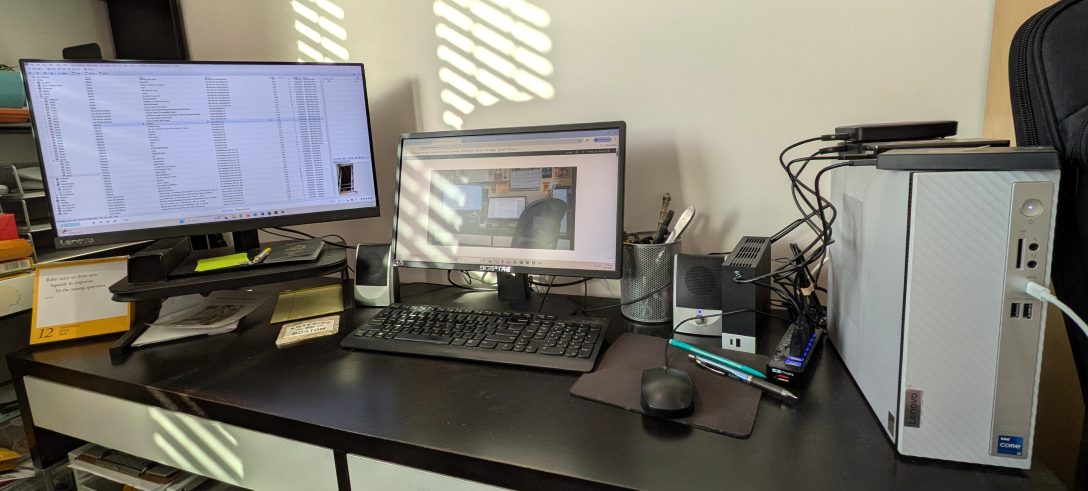
I realized that perhaps the problem these days isn’t so much the drive but the focus. So starting this week, I’ve been trying my hand at reviving that mindset: come 7pm, it’s time to clock in here in Spare Oom. Throw on some music, and get the session started. I’ll allow certain minimal distractions (like visiting cats, for example) but my main focus should always be on the primary writing project. Think of it once more as ‘going into the office’ instead of just the back room.

I’m allowing myself not to be perfect about it, of course. Changes in work schedule, other real life stuff going on, whatever. I’ll even accept that I might be having an off day. As long as I make this process consistent in the long run!