Searching for words

I’ve finally gotten myself into the daily habit of playing a round of playing Squaredle, an online word search game. I’ve always been a sucker for a good word search (I have a few issues of Penny’s Finest Word Seeks on my desk here in Spare Oom) as I find it both distracting in a positive way, and a good use of brain focus, something I’ve been trying to fix for some time.

I’ll be honest, one of the main reasons is because otherwise I find myself doomscrolling on social media during my break times at the day job. I’ll completely admit that I fall way too easily into that trap, and I’ve been needing to escape it for a while now. I tend to hyperfocus on various things and this game is at least something that gets my mind moving and not my blood pressure. I used to do the same thing back during my college years, buying those same word search magazines from the local CVS as a way to dial back the stress of academia. And now that I think about it, those pre-writing session games of FreeCell did the same job of calming my head and helping me properly shift focus.

Whatever works, yeah?

And speaking of searching for words, while working on the Trilogy Remaster I found myself dusting off my copy of Barbara Ann Kipfer’s Flip Dictionary for the first time in ages, a reference book I’d used several times during the writing of the three books. It was an amusing and pleasant reminder of how much I enjoyed going that extra step of trying to find that perfect word that made my prose just that little bit more exciting. I think I used it during the writing of my other books, but not nearly as much as I did the trilogy, and I’m curious as to why. Perhaps I knew what words I needed, but maybe it was also part of my “writing econo” idea I’d had, keeping the prose a bit more simple and less flowery.

I think what I’m trying to get at is that I feel like I’ve been coming full circle lately in terms of writing. I’ve tried all sorts of different formats, lengths, styles and even reference material, and now I feel it’s time for me to return to the ways I love the most.

It’s part of the learning process, I suppose, and I do love the idea of constantly evolving, but I think I’m also at the point where I can safely put down an anchor and say this is where I belong.

Scanning the longhand stuff

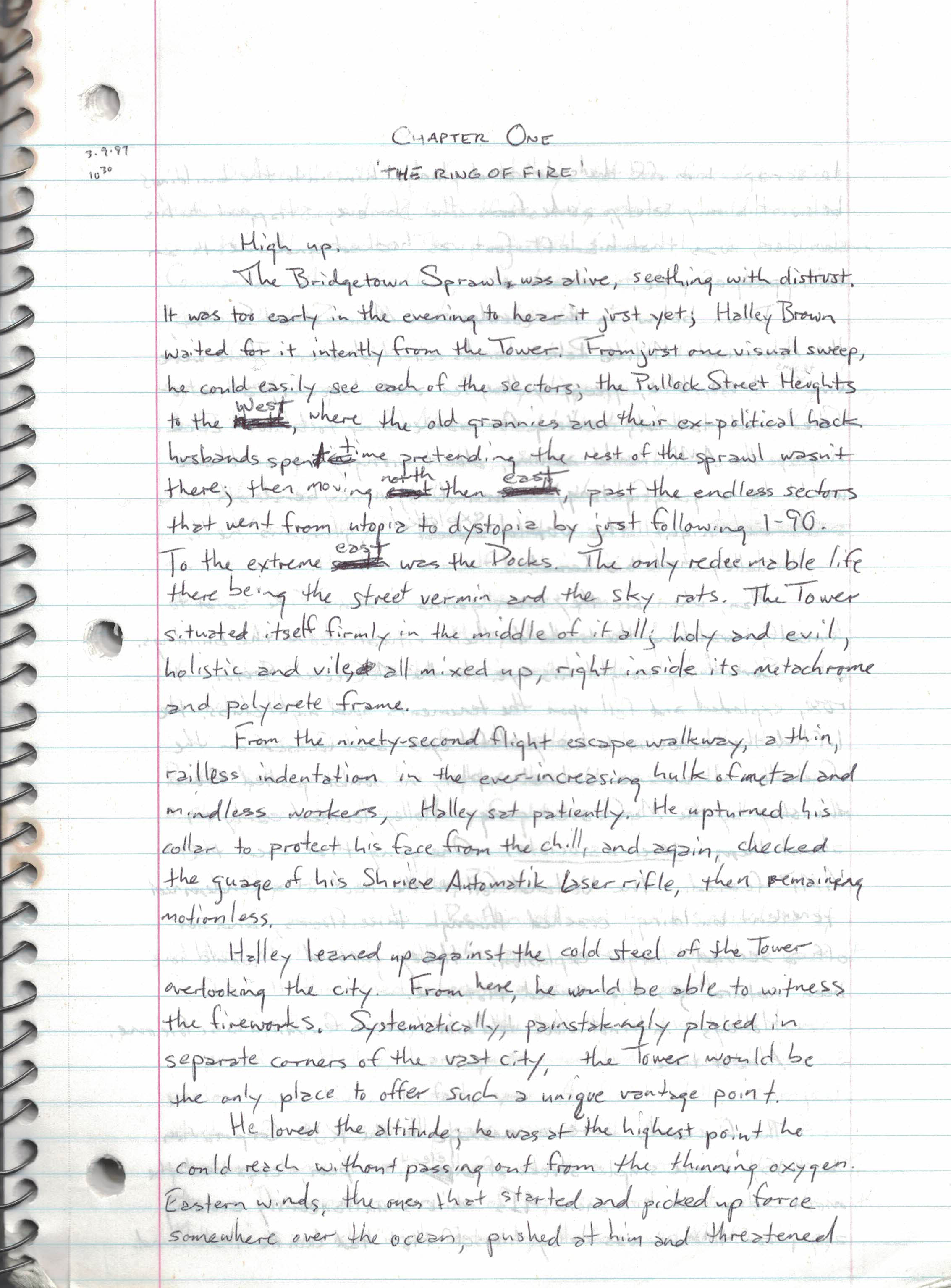
I’ve been meaning to do this for ages, and I may as well start doing it now, considering I have a brand spankin’ new scanner/printer to do it with. And since I’m working on the Trilogy Remaster, why not start with the longhand version of The Phoenix Effect?

I of course have endlessly waxed poetic about my time writing this in the food court of Solomon Pond Mall while I waited for the record store I worked at to open. I’ve also talked about how I consider this novel the turning point in my writing career, where I found my style and acquired the ability to write consistently instead of ‘when I was in the mood’. And about how this was the start of my almost-daily sessions down in my parents’ basement that lasted for almost nine years.

I’m scanning a chapter at a time into pdf form and saving it to my Dropbox, considering that’s the safest route. I may even eventually scan the completed typed version, which currently only exists as inaccessible MS Write files. This first chapter was surprisingly long at nineteen handwritten pages, and I’m pretty sure the first five or so were rewritten from an earlier and much rougher draft (probably no earlier than a few weeks at most) that must be kicking around somewhere.

Why do this at all, you ask? Well, why not? I’ve been wanting to revisit all this stuff at one point or another, and it’s easier to read a pdf on my PC or ereader than it is to dig most of this stuff out of their dusty corners where they currently reside. And besides, I think it would be fun to have all of this stuff in one easy place.

Will I eventually scan my other work? Sure, why not? I’ve got all sorts of longhand and pre-MS Word work, trunked and otherwise, that I haven’t revisited in years. It may be of no one else’s interest but my own, but I think that’s a perfectly fine reason to do it anyway.

Cat breaks

It’s been… (does math) …about two and a half years since Jules (and soon after Cali) joined our household in October/November 2022, and I for one am still endlessly happy coming home from work to see those two ridiculous cats perking up as I come through the door. [Well, they perk up at any sound that comes from the forbidden hallway, but still.]

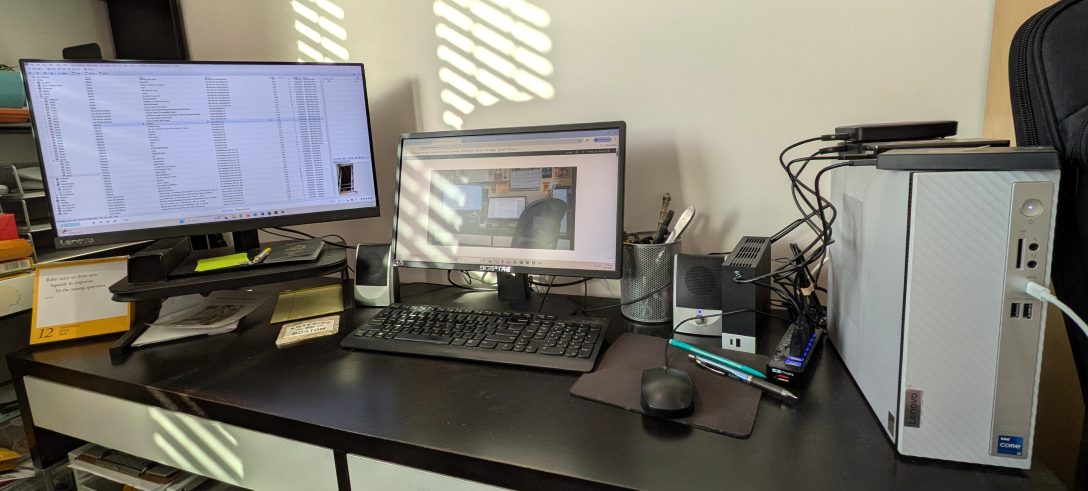
Both of them still come into Spare Oom to visit me when I’m at home and have the day off. Cali (she’s the smaller and lighter-colored of the two pictured below) has recently been taking to jumping on my desk and completely blocking my view of my monitors, and Jules (the bigger and darker-colored one) will come in to bat-bat the various things in the room — including my pant leg — in order to get my attention.

These cats, I tell you.

They’re one of the few distractions while I’m writing that I will allow with zero guilt afterwards. Give them some pettins, play with them for a few minutes (their favorite toy at the moment, believe it or not, is a paper bag handle…my coworkers have been supplying me with them for months now at no charge), watch them ekekekekek at the birds outside, follow them into the kitchen to top off their kibble bowls. I’ll be honest, they even lifted my spirits the morning the election was official. That’s how powerful cats are.

I’m still debating whether or not Grizelda the Maine coon will play an important part in the climax of Theadia, but chances are very high that she’ll at least be in the scenes. I wrote a lot of her early scenes well before we adopted these two goofballs, but the revised version of the novel certainly had some help from them!

Revisiting Bridgetown…?

The Trilogy Remaster continues on schedule (slightly ahead, actually) and I’ve been allowing myself to revisit the created world as I approach each scene. In the past I may have been one to react with ‘oh yeah, I wrote this one in the Belfry on a super cold winter night while listening to Sea Change‘ or something like that, but this time out I’ve been asking myself: why did I write this scene? Not in a pessimistic way, mind you (those would have an oh gods before the question, heh). I’m asking it in reference to the story as a whole.

Which is kind of interesting, considering that most of this trilogy was semi-pantsed. While I had a pretty good idea of what direction I wanted the story to go in, I never planned ahead more than maybe three or four chapters. However, that was part of the creative process I had at the time: my focus was on the evolution of the characters, and how their interactions provided the actions (or reactions) that followed. The story wasn’t just about the reincarnation of a deity, it was about how different people reacted to that. And that was something that had been set in stone since 1997 when I started The Phoenix Effect.

I think that’s partly why I found it so hard to get MU4 going for the longest time (ten years, coincidentally!), because I’d forgotten about that part of this story’s creation. So….if I’m going to revisit Bridgetown once more, I can’t just write a NextGen-style story. It has to have its own focus on character evolution. And just like the original trilogy, I already know what needs to happen. I just need to figure out how its events will affect the cast. It may take time, but I’m willing to work for it.

*

As an aside, please note that the writing of this post was temporarily interrupted by Jules who demanded my attention.

Trilogy Remaster: slow but steady

So it’s been a few days since I’ve started the revision work on A Division of Souls, and it’s going a lot smoother than I’d expected. I mean, I’m so familiar with the trilogy at this point that I know exactly what I was trying to do with it. I’ve mainly been tightening up the prose, changing up a few words where I get repetitive, and occasionally breaking up long paragraphs to fix the pacing. And fixing one thing that always bothered me since its first release: that first chapter (Nehalé’s awakening ritual that starts the story) is actually a prologue, so I labeled it such.

So what does it look like so far? Well, I’m about halfway through chapter one (formerly chapter two, where we first meet Caren and Poe, along with several of the other important characters), and I’m fascinated by how easy it was to make only slight changes to make it fit my current writing style. I was most of the way there already, I think — by the time 2015 rolled around, the novel was a decade and a half old and I’d been rereading it multiple times for at least three years. But I’m quite happy with how it’s working out so far, and at this rate I should most likely hit my re-release deadline!

Meanwhile, and semi-related to the book, this showed up on my YouTube feed and it’s quite amazing. Hayley Williams has always said Failure was a huge influence on Paramore, so it’s great to see the two duetting on one of my favorite songs of theirs.

Not the only one

Some days I have to actively remind myself that I don’t always have to shoulder every single burden on my own. I’ve been doing pretty good with this at the Day Job, especially since I have an absolutely terrible habit of thinking “I’d better do this because no one else will” when it comes to things that desperately need doing. I don’t have to always be the one to answer the store phone. I can send someone else to do the sweep logs. I can always ask for help if I feel overwhelmed. Some days I forget this and take on far too much, but other days I’ll divvy up the responsibilities equally.

This is also something I need to remember while writing and revising Theadia, considering “I’d better do this because no one else will” is actually a recurring theme in that book. There is a time and place for that kind of thinking, and it can be a great motivator…but at the same time, one really must be aware of their own limitations and ask for help when needed. I’d like to think most of the characters in this novel have gotten pretty good at that, though they’re not perfect. Althea has a habit of reacting loudly and vociferously when something angers her, while Claudia’s reaction to that tends to do the opposite, growing quiet and bottling it up. Over the course of the book they learn that they’re not alone in this rebellion they’ve chosen to kick off, and others in their tight circle are willing to assist without question.

I believe part of this, and this concerns both my novel and my own life, is having finally learned to trust myself to a deeper level. If I trust myself enough to understand my limitations, I can learn to trust others to pick up where I’m unable to continue. And in both writing and life: this gives me the strength and the clarity to think ahead a few extra steps. If I know x is going to happen soon, I’d like to prepare myself for y and z and anything else I expect will arrive in due time.

I’m letting myself rest mentally and emotionally…but I’m also aware of what comes next and how to act. And sometimes that’s the most important thing to remember.

Keeping deadlines and rethinking priorities

It’s not Theadia I’m worried about, actually. It’s A Division of Souls. Against my better judgement, I’m going to try to get the “remastered” version of my first novel ready for an early September release for its tenth anniversary. That gives me about nine months to get my butt in gear and get it done. Can I do it?

Well, I’m reasonably sure I can do it, at any rate. It’s not as if I’m completely rewriting the whole thing! As I’ve mentioned before, this revision that I’m calling a ‘remaster’ is merely updating a story I’ve spent several years on, and want to update it so it fits my current level of quality. I’m not embarrassed by it, but I can definitely see places where I could have done a lot better work on it.

At the same time, I worry that Theadia will fall by the wayside again. That won’t happen if I don’t let it, of course. I just have to shift priorities. Besides, I want to do that novel justice, and right now it still feels like it still contains a lot of gaps that need filling. [I mean, aside from its still being unfinished at this time.] The two projects are very similar in scope, I think. Both are Big Stories with an extended cast, featuring events that affect not just the main characters but everyone around them.

Both are also stories where I wanted to make some kind of statement. The Bridgetown Trilogy is about listening to and trusting the true spirit within — in short, trusting yourself, your instincts, and your emotions. Theadia is about wanting to do the right thing not only for your own benefit but for others — in short, understanding the consequences of your actions. And I feel that for both statements, I can’t really allow the stories to be half-assed.

This is definitely going to stress me out a bit in the next few months, but if I take it day by day, keep to my deadlines and stay focused, I shouldn’t have anything to worry about.

Against the grain

Against the grain
That’s where I’ll stay
Swimming upstream
I maintain against the grain

–Bad Religion

Sure, it might not help me sell a ton of books, but that’s never truly been my writing goal, only a nice dream to have. The fact that I know I have a few hundred copies of my seven novels out there, and that I have a small but loyal following here on my blogs? That’s good enough for me.

I know my work isn’t for everyone. It doesn’t quite fit in to What Sells or What’s Popular. But again, that’s never been my goal. I write what I want, how I want, and when I want. And that is what I’ve wanted.

And maintaining that bit of nonconformity in everyday life is also something worth embracing.

How old is this printer, anyway…?

While doing my usual Sunday PC cleaning with the usual updates, cleaners and tune-ups, I’ve suddenly learned that my printer is no longer talking with my computer. I’m not sure if it’s a broken driver, screwed up settings due to cats using it as a perch, or just that it’s quite ancient in terms of tech years. I’ve updated all the drivers so it doesn’t seem that’s the issue. The printer seems to be stuck forever on a ‘receiving data’ notification on its tiny LCD screen, even after several reboots. The USB connector also feels kind of loose as well so I’m wondering if the hardware is just worn out.

Which makes me wonder…how old is this printer, anyway? Per this blog’s archive, it’s at least a decade old, having been picked up either in December 2014 or January 2015. It’s seen a lot of use, and it’s served me well. It’s finally time to buy a new one.

It also made me think about how often I do use it these days, and the answer is not all that much. Compared to back in the Belfry days when I’d print out a chapter as soon as I finished it (for offline editing and revision, of course) and once more when I wanted a crisp and clean copy, the only times I print out something here is when I need a mailing label or when A needs something for work. And these days I don’t need to print out a project if I’m ever thinking of submitting it somewhere, when most publishers prefer the digital copy anyway.

The old one is an all-in-one printer/copier/scanner and I find those very useful for various reasons, so that’s what I’m buying again. Tempting though it is to get a color printer, I don’t think I’d have much use for it, so monochrome it is. I might have to remember to turn the thing off when it’s not in use so Certain Cats don’t accidentally screw it up when they step on the LED screen on their way to/from the window. [I should start doing that anyway to save on energy and wear.] Brother aged this old model out years ago of course, so I’ve chosen a similar model that does pretty much offers the same things.

And speaking of scanners, I’m thinking this will give me the impetus to finally digitize my longhand work. I’ve been meaning to do that for years and keep putting it off, but given that I now have more time and inclination, perhaps it’s time. A lot of the longhand stuff is of course my juvenilia, but there’s a lot of trilogy-related stuff out there as well that hasn’t been put into pdf form, including the original rough draft of The Phoenix Effect. There are also printed versions of early works (like True Faith) that I can no longer access as I’d used MS Write for them and WRI files don’t translate to Word all that well. It would actually be kind of fun to pull all of it together so I can revisit it all on my e-reader!

Amusingly enough, the new printer should arrive on or around my birthday on Wednesday, so I’m thinking of this as a present to myself. Here’s to hoping the new one lasts as long as the old one did!

Clocking in

I was thinking the other day about how I sometimes have a problem with getting started and/or staying with my writing sessions. Quite often I’d blame distractions like the internets or my music library, or having a case of the Don’t Wannas. But after several years of trying to work through all that and getting nowhere, I realized that perhaps I’m looking at it from the wrong angle. So I started thinking: what was it that I did back in the Belfry days in the late 90s/early 00s that made my writing sessions so successful?

Sure, I had the same distractions then as now, but I still managed to work through them. It’s not the drive, then. It’s something else.

And then it occurred to me: I treated my writing sessions like ‘going into the office’ back then. That was the One Simple Trick that helped me approach the sessions with more seriousness. No matter what I did during the day, the session would start at seven pm sharp and often end around nine. A few minutes spent deciding what to listen to, maybe a game or two of FreeCell, but then it was Time To Work. Clock in and do the job until it was time to clock out. Once I established that habit and stuck to it, it worked perfectly for almost four years with almost no issues.

I realized that perhaps the problem these days isn’t so much the drive but the focus. So starting this week, I’ve been trying my hand at reviving that mindset: come 7pm, it’s time to clock in here in Spare Oom. Throw on some music, and get the session started. I’ll allow certain minimal distractions (like visiting cats, for example) but my main focus should always be on the primary writing project. Think of it once more as ‘going into the office’ instead of just the back room.

I’m allowing myself not to be perfect about it, of course. Changes in work schedule, other real life stuff going on, whatever. I’ll even accept that I might be having an off day. As long as I make this process consistent in the long run!