
It’s 2024! Welcome to the new year!
What do you have in store? What plans do you have? Any changes in your life?
Whatever it may be, I wish you the best of luck!
It’s 2024! Welcome to the new year!
What do you have in store? What plans do you have? Any changes in your life?
Whatever it may be, I wish you the best of luck!

First things first: END OF YEAR BOOK SALE!
Want some free e-books? My novels are currently available as ‘name your price’ (yes, even free if you want!) over at Smashwords until the end of the year! That’s all three books in the Bridgetown Trilogy, Meet the Lidwells!, In My Blue World, and my newest, Diwa & Kaffi, available in all formats. Go on, you know you want them!
*
This past year definitely felt like a year where I’d put a lot of things to rest. I let things go, things I had to let go of. Made my peace with my past. Disconnected from people and things I felt were toxic, a distraction, or a bad influence. Learned to stop spiraling. Killed off a hell of a lot of old ghosts and habits. Dialed it back. I’d certainly planned it that way from the beginning, to be honest, because I knew I was fully ready to do it. It was time to let them all go.
The plan was to do this throughout 2023, so that when life restarts in 2024, I will truly have a tabula rasa.
Or maybe not exactly a tabula rasa, but a starting point for a new and better life. I mean, I’ve been hinting at that for a few years now, haven’t I? This is the point in time I’ve been working towards for the last several years. It took a lot longer than I’d thought and I had a hell of a lot more to purge and let go of than I’d realized, but I’ve finally seen the end of that. I’ve been spending the last several weeks ready to go and just…
…well, not waiting, but allowing myself a bit of Zen-like peace before I begin anew.
We’ll see where this takes us.
See y’all in 2024!
First things first: END OF YEAR BOOK SALE!
Want some free e-books? My novels are currently available as ‘name your price’ (yes, even free if you want!) over at Smashwords until the end of the year! That’s all three books in the Bridgetown Trilogy, Meet the Lidwells!, In My Blue World, and my newest, Diwa & Kaffi, available in all formats. Go on, you know you want them!
*
Anyway! Resolutions.
I’ve looked at a few of my year-end posts from the last couple of Decembers, and I’d like to think that I’ve made good on quite a few of them over the last year or so. I’ve shaken off a lot of the lingering fears, fixed a lot of bad habits, and given myself a much healthier outlook mentally and emotionally. It was a long time in coming, but I’m glad I’ve finally gotten to where I wanted and needed to be.
Because this means I can move forward with a lot less fear and distraction now.
So what do I have planned for 2024?
Well, writingwise I plan to return to cons! I’ll be at BayCon in Santa Clara on July 4-7 and I hope to be on a few panels and maybe even a few readings. It’s been a good few years since I’ve put myself out there — partly for obvious health reasons, what with Covid and all — but mask in hand and multiple vaccinations, I’ll be ready for it.
I have one, maybe two novels I’d like to release as well, Queen Ophelia’s War and Theadia. Depending on which one gets done and ready first, I will let you all know as soon as they’re ready. And I have one or two entirely new projects I’d like to work on as well. It feels great to be working on projects again after the various delays and hiatuses, to be honest.
But what about the everyday, nonwriting stuff? Well, some of that will remain offline I suppose. I’m making a concerted effort not to be so terminally online via social media, as that’s been the biggest time-suck over the last several years. Most of 2023 was spent relearning how to balance my life both on and offline to a level I’m comfortable with. [It also helps that a certain social media site has been deteriorating at an increasingly rapid pace over the last several months. I’ll be locking down my feed there at the end of the month and hanging out mostly at BlueSky and Threads come 1 January.]
Anything else? Well, I still have a few more days to go before the end of the month here at Welcome to Bridgetown, so I’m sure I’ll be talking about it more soon enough.

[Image courtesy of Saekano]
If there’s one thing that always worries me about writer’s block, it’s that I’m terrified that I’ll lose interest and nothing will inspire me to write. Outside inspiration has often been a big driver for me: coming up with In My Blue World while listening to ELO, Meet the Lidwells! from reading a ton of music biographies, and so on. But sometimes I’ll go through a spell of nothing quite resonating with me, and I always find that worrying. It’s like I want to write, but I don’t know what to write about.
I mean, it’s not as if something has to completely inspire me, far from it. But the issue, I think, is that it would often tie in with my state of mind at that moment. I’ve had low points in my life where I just stopped writing for months at a time. I’ve had busy points in my life where I just didn’t have the time. I’ve had rebounds where I was ready to write again yet had to relearn how to do it to my own satisfaction.
In writing Diwa & Kaffi, however, I realized that waiting for inspiration to strike might be good if you’re surrounded by that well, but sometimes you just have to push through and find it for yourself. Allow yourself to latch onto something unexpected. Stretch out and get out of your comfort zone a bit and see what resonates. I never thought I’d write a space opera but here we are with a nearly-complete story entitled Theadia. I never thought I’d write a romcom but that seems to be on the docket for 2024.
And that’s what I’m planning to do in the new year: go some place I haven’t been before, just to see what happens.

[Picture source: Neon Stargzing by Zerahoc from DeviantArt]
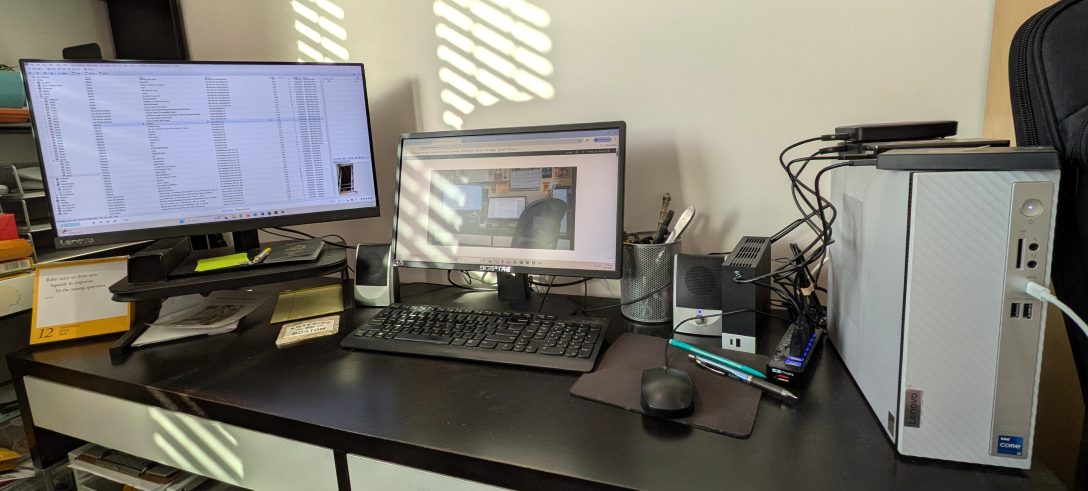
Yes, even despite my newish PC being out of commission for a bit, things have been good here in Spare Oom and elsewhere. I’ve used this time to detox for a little bit; shutting things down, taking a breather, whatever it takes to be where I need to be.
I’ve received notice from Lenovo that said PC has been fixed and will be on its way back to me with a projected return of Just Before Christmas.
I’ve initiated the eventual closedown of my Twitter account (I won’t deactivate, but will merely have it in lockdown with the occasional ‘you can find me elsewhere’ post) and have started showing up on Threads and BlueSky with the commitment to being more vigilant about curating my feeds.
I haven’t obsessed over my music library — including these last few New Release Fridays — with the reminder that they’ll still be there when I get my PC back, and I don’t necessarily have to have it on drop date.
I’m still sliding into a few old distractions, but I’m doing so willingly, whether it’s watching a few goofy videos on YouTube or whatever, but I’m backing away at the first twitch of okay, that’s enough, time to get back to work. And that length of time is so much shorter than it used to be.
I’m actively not reading the internets during breaks at work, instead writing notes in a small notebook I carry around, or working through a few games in the crossword puzzle magazine I’d bought recently.
Today I tried an outtake of my future project Sheila Take a Bow that came out a hell of a lot better than I’d expected it to, so I don’t feel as tense about starting that at 750Words come the new year.
I’ve also chosen to to do a ‘soft restart’ of Queen Ophelia’s War because it’s better to attack these problem spots now instead of down the line, that way I’ll have less to worry about in the near future once it’s done and ready to see release.
So yeah, I’d like to think that things are positive for me right now while getting ready for 2024, so I’m happy about that.

As mentioned over at Walk in Silence, plans have gone just a bit awry this week due to multiple unexpected PC issues, thus sending the new one to the shop and the old one out of closet storage for temporary work. I’m finally catching up on writing work, though access to my music library isn’t all that doable right now. I’m just going to wait until the new PC returns.
Which got me thinking about what’s been bothering me this year: distractions. I’ve been too easily distracted in various parts of my daily life despite my wanting to avoid them. Staring at my phone during work breaks and elsewhere. Carrying around a small notebook to write some of my thoughts I may have but forgetting to do so. Pulling the usual ‘I’ll do it after I finish looking at this for a few minutes’ which invariably wastes a good half hour. Making life choices but putting them off for one reason or another.
I mean, I’m not trying to be one of those crunch-obsessed people that always has to be working every single waking moment, far from it. I’m totally fine with taking time off for fun things and enjoying life in various ways. I’m just tired of being passive and distracted, is all.
Which lends to the other half of this blog title: detachments.
Things I don’t want to do anymore. Things I don’t want anymore. Things I don’t need to be anymore. Letting go of what no longer works and moving on to something new. And right now I know what new directions I’d like to go in. This is about my writing, but it’s also about the personal as well. Life changes are always exciting and terrifying in equal measure to me, because I love the idea of trying out new things on my own and I’m also afraid of completely fucking it all up if it doesn’t work. But if I’ve learned anything in 2023, it’s that I’ve made my peace with some extremely personal things in my past, enough that I have the strength and the will to leave them behind now. To detach from that part of my life once and for all and look forward.
The one thing that’s kept me from doing so in the past is self-made distractions. It’s getting that dopamine rush of playing with my music collection or watching dumb videos on YouTube or reading the latest dumbass thing on social media. Deciding to make needed changes in my life but never getting around to the follow through. I hate that I’ve always been passive about it and yet I do it anyway because of that small rush, and then I feel frustrated for wasting time afterwards. And if I’m going to succeed in stopping those distractions and excuses, I need to detach.
And I’m now at a point where I’m strong enough to do that. And I’ve already started stepping towards that goal.
It’s time to say goodbye to parts of my old passive life once and for all, and embrace the new.
Even if it is terrifying.
So. Do I have anything big planned for 2024? Good question.
If you’re talking about writing, sure. I’m hoping to get Queen Ophelia’s War finished and ready for mid-year release, as I’ve mentioned previously. And maybe Theadia as well a little bit later, if I get it prepared in time.
But what about personal things?
I’d mentioned very briefly here that one of my new resolutions is to Slow the F*** Down. Part of this is related to the Day Job, in which I’d fallen into the same damn habit I’d always had with most of my day jobs over the years: always trying to finish everything as quickly as possible. And in this case, considering that I’m back in retail, it meant being a fast checker, helping out as many people as possible, and always stressing out when the lines were long. I fell into the trap of thinking I’d better do it because no one else will, and I’d end up just making more work for myself in the process. I’d finally admitted that maybe I don’t need to be like that, considering nearly everyone else I work with goes at their own (often much slower) speed. Doing this all the time only led to exhaustion and certain managers wondering why I would seem overwhelmed.
I’ve since chosen to Slow the F*** Down at the Day Job, and I’m feeling a lot happier about it. I’ve adjusted responsibilities somewhat and admitted there are times when I should ask for help. I’ve found that there are situations that are Not My Problem. And I’ve admitted there are times when I’m just making more work for myself, whether by overthinking it or giving myself overly high expectations. In the process, I’ve learned to shift certain responsibilities to others when needed, and understanding that, unlike the Former Day Job, there isn’t an OMFGNOW deadline.
I suppose there’s more to it than just the Day Job and the Writing Career going on here, but I don’t have the words for it just yet as I’m still trying to get it straight in my own head. There is indeed a bit of final rewiring of thoughts and emotions going on lately, and that in itself has been a long-game process over the last couple of years that I think is finally coming to a close. A lot of it is about self-confidence and self-trust, but it’s also about reining in those overly high expectations that I’d just mentioned.
So if anything, I think 2024 is going to be about Where I’m Going and Where I’ll Be.
This past year has been a bit different than the past few on multiple levels. I went through a wave of not reading much of anything at all besides manga, graphic novels, and my own works in progress. I put considerable distance between myself and social media. I put a lot of projects aside to let myself focus on the one that needed the most attention. And of course I put my blogs on temporary hiatus.
Not that any of this was particularly a bad thing. In fact they were good things. I needed a mental and emotional vacation to put myself on stable ground once more. I wanted to give myself some time to relax without several looming deadlines, while simultaneously balancing them with the Day Job and its stable yet occasionally fluctuating schedule. I wanted to readjust my life and take it day to day instead of several events and things at once. And most of all, I wanted to get rid of all those distractions so I could remember what I needed to do to focus on said works in progress. Both Theadia and Queen Ophelia’s War are all but done rough-draftwise (they’re missing their endings but I know what to put there), so I disconnected from nearly everything else to focus solely on their revisions.
On a more personal level, I suppose I’d been needing to do a disconnect for some time, considering how many distractions I’d been dealing with. A lot of them were of my own making, whether they were of the ooh shiny or the don’t wanna variety, and given how easily I can fall into both, it was a matter of returning to the old mantra that has yet to prove me wrong: just shut the f*ck up and DO it already. It’s not the dislike of the project or the action, it’s the avoidance of getting started. Once I do start, it’s smooth sailing, simple as that. [Okay, maybe not that smooth and simple, but you get my drift.]
So to answer the entry’s title: where I am, (and) where I’m not?
I am writing and/or revising daily these days, and the output fluctuates. Sometimes it’s a full chapter and other times it’s a few paragraphs, and either one is just fine by me. I’ve been doing some personal writing on the 750Words site to help push me in the right direction. I am about a quarter of the way through revising Queen Ophelia’s War, which is not bad for about a month’s consistent work. I am planning on picking up Theadia once this one is done, or close to done. I am thinking of doing a bit of social media culling and reimagining in the new year. And I am happy where I am in my personal life and writing career!
I am not trying to push myself by doing too many things at once, which can sometimes lead to the return of the don’t wannas. I am not forcing myself to write on demand like I may have in the past, though I am also not sitting here doing nothing while waiting for inspiration to strike, either. I am not letting the Day Job interfere with my writing time, and I am quite proud of that fact. And I am not giving up writing any time soon.
There are other more personal things I am and am not doing, but that’s for another entry!

Oh hey I still have this blog, don’t I? Yes I do!
Hi all, just checking in to let you know that I’m still here, still doing a lot of revision work on Queen Ophelia’s War, and it’s coming along quite nicely. I have a long way to go, but I’m going in the right direction and that’s what really matters. And while I haven’t been blogging, I’ve been thinking about what I’ll be doing here and at Walk in Silence in the coming weeks as 2023 winds down.
Right now my plan is to return here in December to start my end-of-year thoughts and reviews. Whether that will be at my regular twice a week schedule or just once a week depends on a few things.
Firstly, it depends on how busy I am at the Day Job — it is holiday season and I am in retail, after all — and one of my new resolutions is to Slow the F*** Down. [More on that in a future post.] I survived last year’s Q4 quite handily and my commute is still eight blocks long, so I should be able to do two a week. I’m purposely not holding myself to it however, because I don’t really need to force myself now, do I? One a week is a comfortable and doable goal.
Secondly, it depends on how busy I am with work on Queen Ophelia’s War. I’m still planning on this one being my next e-book release to get back on my one-book-a-year release schedule. While I don’t have a set deadline for it at this time, I don’t want to be spending forever on it, either. I still have work on Theadia and a few other open projects as well that are waiting in the wings.
That said, I’ll try to aim for December 1st as my return for this blog. See you then! And thanks for stopping by!
Oh hey there! I’m going to be taking a short hiatus from the blogging to get some work done on Queen Ophelia’s War, as I’m falling behind and seriously need to get caught up. Not sure how long this will be, but hopefully not for too long. Maybe a month or so? At least until I’ve gotten myself into a better writing schedule for it.
I’m also limiting my footprint on the birdsite these days so if you want to find me online, I’ll most likely be popping up every now and again on BlueSky instead. [I have a few invite codes if anyone is not yet on there and might be interested!]
See you soon!
 Welcome to Bridgetown