Right now I’m about two-thirds of the way through the reread of Theadia and I’m happy to say that it stands up quite well despite me having never written a space-related story before. [I’d call it a space opera but you’re not going to see any super heavy tech nerdery going on here, and that’s on purpose.] It could certainly use a bit of tidying up and of course it needs a full ending, but I’m glad to say it’s still in the running for one of my next projects!
I could say the same for Queen Ophelia’s War as well. [In case you missed it, I changed the name slightly for reasons.] That one definitely needs a completely new beginning but once it gets to the start of Act II it really shines and works great to the almost-end. And yes, I need to finish this one as well. I’m thinking this might be the very next project as I feel closest to this one right now. I know exactly what’s needed and how to make it work the best way possible, and that’s a rarity.
So what about MU4, you say? Well yeah, I’m going to need to come back to that as a long term project. And yes, I’m going to be doing another reread of the Bridgetown Trilogy to refamiliarize myself with the universe — and maybe pick up a few story beats that I can use in the new book as well. I know this one’s going to take some time so I’m not going to rush it.
But yeah…I still may not be doing any writing right now, but I’m getting there.
Massive Attack’s 100th Window came out in early 2003 when I was writing The Persistence of Memories, and the track “What Your Soul Sings” was the standout track for me; it was the first time I’d heard Sinéad O’Connor’s voice in some time, even though she’d been dropping albums here and there.
The message of the song — listen to and trust your inner self, it knows what it needs and wants — resonated deeply for me, and it became one of the most important central themes of not just TPoM but the entire trilogy. It’s what keeps Denni from faltering and doubting herself. It’s what keeps Caren moving even when she feels lost. It’s what keeps Poe focused on what he truly believes in. Every character learns that their true anchor, what keeps them from spiraling into chaos and doubt, is the calm soul within.
Even today I keep it as a sort of personal mantra, one I occasionally need to remind myself of: follow what makes your soul sing.
Thank you for the music and the vision, Sinéad.
Don’t be afraid Open your mouth to say Say what your soul sings to you
It’s a trick I learned from working on music history chronology: sometimes things just make a bit more sense when you put it all in the correct order. How one thing ties in with another, perhaps influences something else, all while putting it in a clearer context.
Not counting that bit of extracurricular fun I had in fifth grade, my poetry and lyric writing started sometime in the early months of 1988. The IWN had been completed and its sequel started, and I’d also just finished a very silly John Hughes-influenced screenplay (also my first completed one) in the fall of 1987, and to top it off, I’d just bought myself a cheap bass guitar for $25 downtown and was about to teach myself how to play it. [There were two to choose from, and the other one was shaped like an Uzi submachine gun — no, I’m not kidding — so I grabbed the headstockless one instead.]
I kind of fell into writing poetry because I wanted to try something different. I also wanted to start a band and would be doing so at the start of 1988. With that plan in mind, I figured I’d also need to start writing some song lyrics as well. I latched onto my favorite influences at the time: the goth wordplay of The Sisters of Mercy, the oblique artiness of Wire, the doom and gloom of The Cure and the quirky love songs of Depeche Mode.
The first couple of attempts weren’t all that serious, but I wasn’t taking my assignment all that serious to begin with. I wanted to have fun with it! Most of it would be written in notebooks and on scraps of paper, written in my bedroom. By late summer of 1988, however, I came up with an idea: what if I take one of these numerous notebooks I have in my room — say, this Mead composition book that I rarely used for school to begin with — and started writing in it?
But that was still a few weeks away. Right now I had more pressing things on my mind: my best friends from high school — the ones who were all one year ahead of me and had graduated that May — were about to head out of town and off to college. That hit me pretty hard, and not just because they were all going away…I’d always been the ‘last’ in one way or another. The youngest sibling, the youngest in my extended relations of numerous cousins, one of the last kids of my age in the neighborhood. Usually last picked in gym class as well, of course. It was not so much a sense of abandonment as it was a profound sense of being left behind because I wasn’t allowed to catch up. That would haunt me for quite a number of years.
And it would be the impetus of a lot of my poetry, lyrics and fiction writing around that time. I found solace in listening to music and losing myself in my creativity for a few hours. That composition book would be where I’d bleed out whatever was going on in my head. And I’d also given myself one rule: no boundaries here on the page. If I felt safe in writing something heartbreaking, or horrifying, weird or embarrassing or even hilarious, then I wouldn’t hold myself back at all. My first attempts were sketchy and slight at best, but by the winter of 1988 I’d found the voice I’d needed. I just needed to keep going.
Revisiting these poems now, so many years later, I’ve been able to put this all to rest and in its proper order. I can look at these with emotional distance and appreciation. Putting these in their proper order and context, without holding back on any memories or subsequent clarity that might arise, has indeed brought on both in abundance. Answers finally given, clarity finally achieved.
All this rereading of my finished novels, WIPs and backburner projects has also kicked off more rereading, this time of my early longhand writing. Right now I’m going through some of my old chapbook poetry and lyrics, transcribing some of them and making personal notes. Why? Well, why not?
One of the reasons for doing this now is that I’m conducting a writing experiment. I’m assigning myself to work on something every day, without fail. I’m assigning myself simple things like doing some fun Walk in Silence (the book) work on 750Words and this poetry transcription. Easy writing that would take less than an hour out of my day. That was the impetus: I wanted to see if I could do a full month in a row. I started on June 1, kept on going, and I haven’t missed a day yet, so that’s nearly two months right there. Not bad at all, really. I see no reason why I should stop now.
I’ve mentioned before that I’d assigned myself a transcription project back in the summer of 1995 and into spring of 1996. I’d done it then as I’d finally had access to a computer and wanted a digital copy of my juvenilia for safe-keeping as well as for easier access. [There was also the fact that I’d done it as a distraction to avoid falling into a self-loathing spiral due to my failure at staying in Boston, but that’s another story.] That was the last time I’d done it to any considerable extent. This has become a bit of a problem in the present time, because a lot of that work was written using the MS Write program which no longer exists, and WRI files don’t translate well at all to Word or Notepad. I have the printouts…but I’d really like to have the digital versions once more.
Why am I doing this instead of writing novels, you ask? Well, I’m getting there. The rereads of the current work are preparing me for the novel projects. Refreshing my memory of the novel projects I’d like to work on next. And I still have a ways to go before I’m fully ready. It’s prep work.
It’s also interesting to read words I’ve written that I haven’t reread to any serious extent for nearly three decades. While there’s a lot in there at my most inexperienced, there are also smaller gems: unique ideas and impressive passages that merely needed the work of a much better writer. I had to start somewhere, and I wasn’t afraid to start at the bottom just like everyone else. I’m also finding elements of myself then that explain who I am now.
That’s what’s making it worthwhile: looking back in order to move forward.
Sure, I’ll reread my own work, whether it’s completed and self-published, incomplete and on the backburner, or trunked and best forgotten. I do it rather often, actually, and for various reasons. Since releasing Diwa & Kaffi out into the world, I gave that one yet another once-over, just to see how it looks in epub format. [Quite nice, actually.] After that I reread In My Blue World with the idea of toying with the possibility of writing its sequel. And now I’m rereading what I have of Queen Ophelia (which, now that I think about it, should really be titled Queen Ophelia’s War if I’m going to keep the title at all). I plan to reread Theadia after that.
I’m rereading these three to decide which project I should work on next while also working on MU4. I’m still undecided as to which one to tackle so I’m refamiliarizing myself with the stories to see which one resonates with me the most. Sure, I could come up with a completely new idea if I wanted, but I’m holding back on that because I feel these still have merit, even if they do need a hell of a lot of work.
And that’s the other reason for the rereads: how much work do they need, and is it worth spending the time? I don’t think any of them need a major overhaul, thankfully, and the newer ideas just need their outlines fleshed out and the stories written. I don’t count MU4 here, because that’s in an altogether different beast; when I have the time I’ll reread the original trilogy and what I have of 4 because that particular project needs a different kind of immersion.
It’s a lot of work and it surely eats into my GoodReads numbers, but I’ve found that this is part of a larger process that works really well for my projects — it’s just enough immersion into the created world so that I can easily slide back into it and move forward.
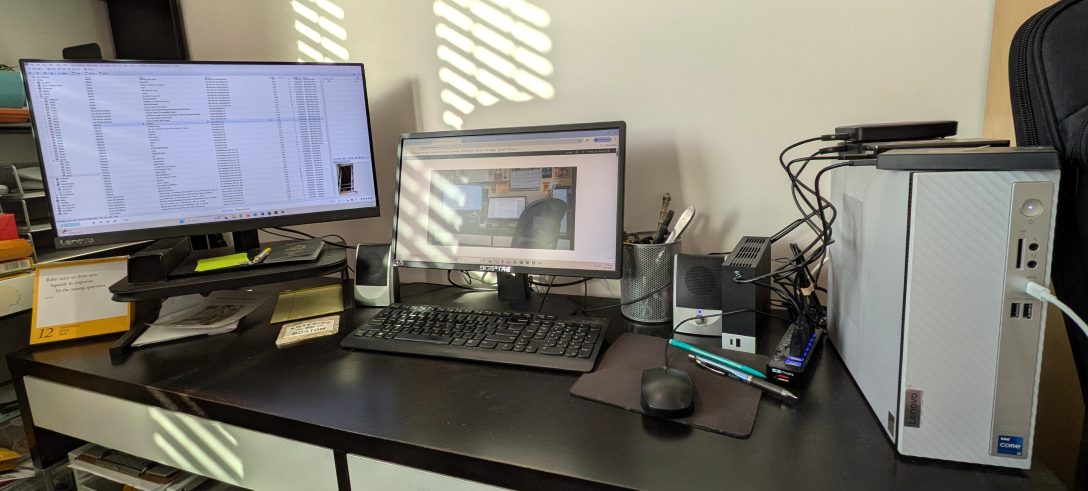
The new PC is up and running here in Spare Oom, and I’ve been spending my free time setting up the apps and programs I use the most. As I did with the restore of the older computer, I’m trying to keep it minimal. Do I really need this program taking up space? Do I even use that app anymore? There’s a handful of Must Haves, of course — Office 365 for the writing and MediaMonkey for the tunage, along with the couple of security apps — but I’m fine with not uploading certain programs unless I actually need them. This PC also has a much smaller footprint and I’m fine with that, but I may need to figure out a new setup for my externals, which are currently and precariously balanced on top of it at the moment.
And in a shocking move, I’ve decided to not set up Dropbox locally for reasons of finite hard drive storage space, meaning my writing is pretty much solely on its cloud. Mind you, I already have a copy of the folders on an external that I set up a day or so ago, so I can just do a manual ‘save as’ whenever I finish my writing session.
Either way, I’m glad that I made the move. Now I just need to get writing again!
The Spare Oom PC is finally starting to show its age. Which is actually not surprising at all, since I’ve had this one for four years. It’s seen a lot of use between August of 2019 and now: music streaming and playing, novel writing, movie watching, Plex servering, internetting, job searching, 750 Words posting, blogging, and more. That’s a hell of a lot of words, music and visuals. Recently the PC has been consistently rebooting overnight, possibly due to a system failure, and the internet connectivity seems to drop out a lot when I’m multitasking online. It’s still a workable PC when it’s not acting up, but it’s only a matter of time at this point.
So on Saturday we ordered me a new replacement PC. I’m sticking with Lenovo this time, partly because this current one (an ideacentre 720, which is no longer made) stayed with me for so long with minimal problems for the longest time. I’ve mentioned before that my PCs usually last about three years before they start acting up, and four is actually a record for me! The new one is an ideacentre 3i which is a slight upgrade in terms of processing. It’s a bit smaller in storage space, but I’m okay with that considering that pretty much everything important to me lives on multiple external drives. It also doesn’t have a cd/dvd drive, but that’s okay too because I have a portable one of those as well that also reads blu-rays.
Meanwhile, as I wait for the new PC to arrive I will be shifting whatever’s left of the important stuff (photos, documents, and so on) to an external and/or to Dropbox for safekeeping. This means it might take me a little longer to Get Back To Work as I proposed on Friday, but it’s worth the wait.
Okay, I really need to get back to writing MU4 and thinking about other projects, now that Diwa & Kaffi is out in the wild. I can certainly do my bit with self-promotion (such as it is) but right now I’m not writing anything at all, and that’s not going to get me back on my yearly release plan! I’ve got a few ideas in mind, finally a few days and some brain space to figure them out, so let’s get crackin’.
And hi, all of you who’ve been picking up my books this month from Smashwords! Glad you could join in! And thank you so much for choosing my novels for your e-reading pile! I hope you enjoy them! If you have any comments or questions regarding them, by all means feel free to drop them here!
Hi there! If you’ve come by because you’ve just picked up my new ebook Diwa & Kaffi, then you will no doubt be unsurprised that I in fact made a mixtape/playlist for the book! I’d posted this a short while ago, but I’d like to reshare this with the added commentary on each song and how they fit in with the novel itself. There’s a lot of love and hope in this mix, and I hope that it lifts you up as well.
1. The Sound of Arrows, “(Opening Titles)” 2. The Sound of Arrows, “Stay Free” These songs open the band’s Stay Free album, but in Diwa & Kaffi they would actually appear at the very end of the story — literally the very last scene — and would be used during the ‘ending credits’ montage of my imagined film version. I had the entire sequence played out in my head even before I’d gotten about halfway through writing the novel, so when I say I knew exactly how the story ended early on, I wasn’t kidding!
3. U2, “Get Out of Your Own Way” This is a universal theme of Diwa & Kaffi for every character: sometimes the core of your problems are within, and it’s up to you to find a way to solve them, or at least work past them. This was also a personal theme of mine while I was writing the novel.
4. Ra Ra Riot, “Water” This is a song that I think lends itself to the closeness of many characters in the book. Whether it’s familial, romantic or just simple adoration, there’s always the worry that others will take love the wrong way. I wanted this novel to be about love as something approachable and shapeable, and how freeing and wonderful it is to be allowed to do that.
5. Beck, “Dreams” I heard this track a lot during my Day Job hours and it became one of my favorites of his. I love the vibe of ‘nothing’s gonna tear me down’ and it fit perfectly with the themes of this novel. I can picture this being on the personal playlist of a few characters as well.
6. Elbow, “Firebrand & Angel” Elbow is one of my top favorite bands of the last twenty years and they never cease to amaze and inspire me. This song’s about a special relationship, and while I can see it being about Diwa and Kaffi, I actually see it more about Anna-Nassi and Cole; two oddballs that don’t fit the mold but have found each other.
7. Gang of Youths, “What Can I Do If the Fire Goes Out?” There are a few noisy tracks on here, and this is the kind of stuff Anna-Nassi would definitely listen to when on her own, late at night in her nestroom with headphones on and stereo loud. She’s an extremely emotionally driven character and this kind of track would definitely lift her spirits.
8. The Naked and Famous, “A Still Heart” On the other hand, I can see Kaffi listening to this kind of delicate music. He might be high-spirited especially when flying, but he’d also exude a Zen-like balance when he feels purely at peace with himself and his surroundings. Deep down, this is the kind of character he really is. I can see him thinking of Diwa when this song is on.
9. U2, “13 (There Is a Light)” This is another theme of Diwa & Kaffi: the deep and personal connections between people that go well past friendship and acquaintance. The ability to trust another person not just with their deepest emotions but with their life is certainly rare and worth protecting. You’ll see it between many of the characters in the novel.
10. Embrace, “Love Is a Basic Need” On the other hand, this is another view of that deep and personal connection: keeping and protecting that link with the person you love even though they might be so completely different from you in so many ways. Love isn’t always about finding the perfect match; it can also be about finding the needed match.
11. The Sound of Arrows, “Don’t Worry” In the movie version of this story in my head, this is the song that would play when Diwa and Kaffi are about embark on their first trip to Panooria alone. ‘Out of the nest and into the wild,’ as the mandossi saying goes. They might be nervous about doing something new and exciting for the first time, but they’re comforted by the fact that they’re doing it together.
12. Shame, “Friction” This is totally Anna-Nassi’s song. Noisy and irritable, just like the spirit within her. She can be her own worst enemy sometimes, especially when Cole’s not around.
13. Elbow, “One Day Like This” One of my all-time favorite songs, and one of the most uplifting and inspiring songs I’ve ever heard. I can be in the shittiest of moods (which I was at the time of writing the novel, nearing the end of my time with the Former Day Job) and yet I was able to find at least one thing that could lift my spirits immeasurably. This would be Diwa’s song as he learns just how important his three friends are to him.
14. GoGo Penguin, “Strid” This jazz band’s album A Humdrum Star had been getting heavy play on my PC during my writing sessions, and this one’s one of my favorite tracks from it. I’d consider it a sort of instrumental score for a tense and pivotal scene in the book when Diwa and Kaffi are faced with an unsettling situation, and all that they have to go on is instinct.
15. Eels, “There I Said It” Equally the goofiest and the most tender love song I’ve ever heard, this is totally Diwa and Kaffi’s theme. Their connection runs deep, and yet they’re still characters with embarrassing faults and mistakes and everything else. They’re not perfect, but they love each other anyway.
16. U2, “You’re the Best Thing About Me” And this would be Anna-Nassi and Cole’s theme. Their relationship is about completing and complementing each other, even though they couldn’t be more different from each other. Their connection runs deep as well, but in a very different way than our titular characters; they wouldn’t want to be with anyone else to make them happier because they’ve already found that happiness.
17. The Sound of Arrows, “Beautiful Life” This song is near the end of this mix, but this would actually be the opening theme; this sets the tone with the characters as well as with the setting. It also sets the mood of the novel: it’s not about going on a life-altering journey or a quest for honor or victory, but simply about knowing what you want and having the strength and conviction to reach for it with everything that you have. ‘Go and do what makes your heart sing,’ as the tintrite saying goes.
18. Love Tractor, “We All Loved Each Other So Much” An oldie but a goodie from 1987, it’s a wonderful indie rock instrumental jam that I love. I can hear this being played during the more uplifting moments of the novel. Even the title resonates with our four central characters: they do indeed love each other.
*
Thanks again for reading and listening! I really hope you like Diwa & Kaffi!



 Welcome to Bridgetown