Theadia: Side stories…?

I’ve been thinking over the last few days that while Theadia focuses on a set number of main characters, the world building has grown enough that I can definitely see some minor side stories cropping up over time. And given that Theadia is about protest and rebellion of different sorts and flavors, writing short fiction about those affected by the events within the novel sounds like a lot of fun.

One, of course, came to mind: a young teenager hearing the sounds of rebellion for the first time. What if their reaction to hearing that sort of thing was a parallel to, say, me discovering college radio in the mid 80s? Two different levels of mental and emotional awakening, sure, but it’s hard to resist when the outcome is the same: getting your mind blown for the first time by the idea that there’s a much bigger and better universe out there than what you’ve experienced in your own small regimented world. And that someone’s out there, boldly telling you that you’re not bound by the rules that stifle you — be that rebel if you have to be.

There’s more ideas out there, sure. After all, a lot of this novel is inspired partly by what’s going on in the real world here and now, and how it’s being handled (or not handled) (or handled terribly) by certain people. Everyone’s got that kind of story out there, waiting to be told. And I’d like to know what some of them are.
Making it believable

So one of the things about Theadia is that the Day Job for the two main characters is that of coding. Althea works on system translators and special projects, and Claudia works on transportation and communication hardware. So suffice it to say, they know a bit about how things work under the hood, and that becomes their superpower as the story progresses. I based my approach towards their Day Jobs on my own position at my Former Day Job, in which I’d learned what’s under the hood in e-commerce banking. In effect, their story isn’t just about the technology but also compliance, safety and just plain making sure it doesn’t explode in your face.

Thing is, I’d decided early on that what I didn’t want was for the novel to be one large technology infodump. Some people like that kind of thing — and Cory Doctorow does it really well, perhaps overly so — but I knew I wouldn’t. That wasn’t the kind of story I wanted to write. I’d decided that I’d infodump only when absolutely necessary, and so far that’s only been in a few very important scenes. I wanted to make it digestible to the normal reader who might not want that tech deep dive. That also came from the Former Day Job: having to explain tech to someone who doesn’t have the mind for it.

There’s also the fact that not everyone is a technological genius in their field. Sure, there are those out there who are absolutely brilliant at what they do, but there are also those out there whose approach is more of a ‘crossing-fingers-and-hoping-it-works’. And if I’ve learned anything from the Former Day Job, that’s not from a lack of knowledge but more from the reality that, as I’ve said numerous times over the years, systems are only as smart as those who program them. It’s often a LOT uglier under the hood than you’d imagine. Legacy systems that won’t talk to each other unless they’re linked by translators, coding languages that are so old they probably predate some employees, intellectual properties that refuse to work in tandem, platforms whose navigation feels counterintuitive, and so on. But hey, if they still work, why change ’em, right?

That’s how I make the tech world of Theadia believable. It’s not about the fancy and nerdy hacking but knowing and understanding what’s under that hood…and how to manipulate it when necessary.

On creating new characters midstream

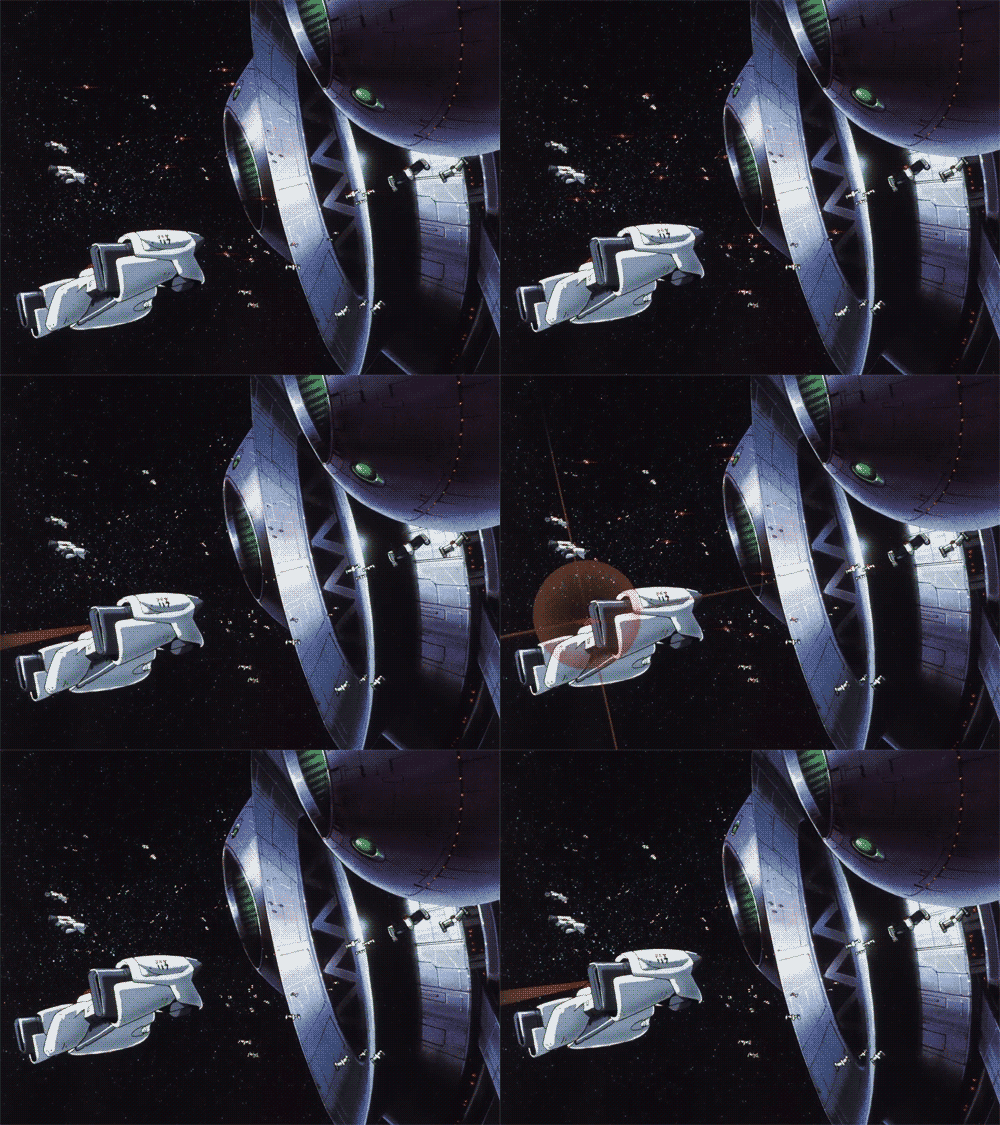
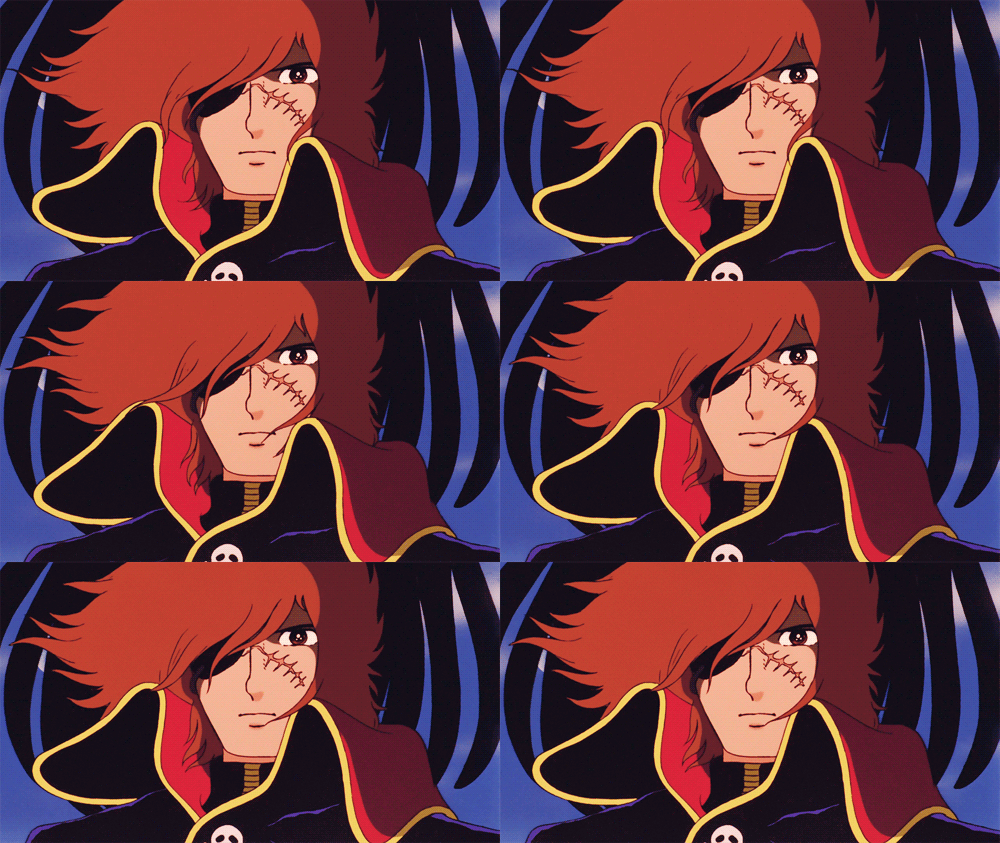
Okay, so Captain Will Dewar in Theadia is definitely not Space Pirate Captain Harlock, but the gif was too good to pass up, heh.

Anyway, I’m kind of stuck on how to write Dewar, as he’s a relatively new character unlike nearly everyone else in the novel. But in the process, I’m reminded that this also happened back when I was writing A Division of Souls; originally Christine Gorecki was merely a name of an old friend that Poe mentioned during a tense moment to ease Caren’s distress. By The Persistence of Memories she’d acquired a major role.

So why Dewar, anyway? Again, he was originally a one-off, someone mentioned in passing during a conversation between a few flight captains, someone known as being gruff and not entirely friendly but someone who could be trusted. As it happens in this particular revision/rewrite, I need to expand his role as someone willing to take extremely dangerous chances in order to help the main characters achieve their goals.

But who is he when he’s not in uniform? What kind of civilian would he be? Well, I kind of see him a bit like Alan Ritchson’s take on the Jack Reacher character: ridiculously well-built, surprisingly intelligent, yet a bit of a quiet loner. He’s not all that easy to rile up, but you don’t want to be in the same area when he is. I wouldn’t say he has a strong sense of justice, but more like a strong drive to ensure the right thing is done, and done correctly the first time. He craves competence.

All this thought and brainstorming, just for a secondary character! Well, this is why I loved writing the Bridgetown trilogy so much: every character in that universe has a backstory and a reason for being there, and that’s exactly the kind of writing work I love doing. [Why yes, I’m definitely anti-AI when it comes to creativity, why do you ask?] While I do have some idea of who Dewar is and what he’s about, I’m still a bit vague on his reasons for being who he is and why he does what he does, and how he relates to the other characters.

Well, that’s something I’ll need to keep plugging away on, isn’t it?

Acceptable Terminology

One thing I’ve been doing with Theadia is playing around with the terminology of things. Considering it takes place at some unknown point in the far future, I’ve decided that I’m going to experiment with some technological terms so that perhaps some of it is anachronistic while other terms are more generalized.

Computers, for example will rarely be referred to as ‘computers’ (the term just feels so 80s in my head even though it’s universal these days) but rather as things like databases, tablets and monitors. The same with phones; the tech has changed just enough in my story that I don’t see them using cell phones as we know them, but more like mini-tablets as we do know them. They don’t take a call but answer hails. My terminology is supposed to hint at familiar devices that have slightly different names and appearances than what we’re normally familiar with. And to be more nerdy: the internets are less about websites and social media (though they do exist here) and more about useful connection points to what you want or need to do at that moment. And yes, that does in fact include reading social sites and reading news feeds. The same, just slightly different. [Part of this is to underscore the way our two heroes view their work and what will happen to them in this story; the tl;dr is that their jobs are such that they understand what’s under the hood here and see their tech in that way.]

Do I really need to do this? Well, not exactly, but it’s part of my worldbuilding that I enjoy playing around with. I did the same with the Bridgetown Trilogy — there were cars (‘transports’) but there were also driverless lorries and such. It’s just part of the background color that makes the story a bit more real and intriguing.

Understanding the (created) world

I’ve come to realize that out of all the moving parts in my novels, I think the strongest and most vivid part of each one is the world I’d created for it. I just find worldbuilding to be my most favorite part of writing a novel. Mind you, I’ve learned not to get too lost in it while writing, but just enough for the reader to have a visual idea of where the story takes place. But I’m not merely using it for a brushstroke or background color…a lot of the time these places are the way they are for a reasons very important to the story.

Such as in the Bridgetown Trilogy, which takes place in multiple locations: Bridgetown itself (a sprawling and crowded metropolis, signifying tension and imbalance), Bann Dassah on Trisanda (a quiet and remote area near an ocean coast, signifying peace and balance), and several other places. Or in the unnamed location of In My Blue World, seen both as a quiet small city (signifying stasis, safety and eventually boredom) and as an overpacked sprawl (signifying movement, excitement and impermanence). The world of Diwa & Kaffi uses a slightly different twist: it generally takes place in several linked areas that are already known by the characters; the role for their world here is in their experiencing these areas on a deeply personal level for the first time.

In both Theadia and Queen Ophelia’s War the worlds continue these ideas: the generally known versus the experienced, safety versus threat, the group understanding versus the vividly personal. It’s one of the most important things I always need to remind myself when writing new novels: I rarely ever want to place these characters in a setting that could be anywhere; the location needs to have some kind of purpose, either directly or indirectly, and often obliquely. It not only makes the story more relatable to the reader, it also makes them feel the same underlying tension the characters are feeling.

Balance…and Barrier

So, you ask. We’ve shown that the Shenaihu are not the antagonists of the Mendaihu in this universe. And yet…who is?

That’s a very good question indeed, because it took me a long time to figure that out myself. In the Bridgetown Trilogy we learn that the two do not necessarily have a protagonist/antagonist relationship, but one of balance. One exists to balance out the other in some shape or form. Both sides had a reason for doing what they do, whether that action is noble or misguided. But the fact remains that there is balance between the two. It is nuanced and often contradictory, but it’s there and that’s how life is. I thought about this early on when writing A Division of Souls as an extension of the Golden Rule: similarity and difference working together peacefully.

This was the question I’d been asking myself: who wants to upset that balance? Whoever that happens to be in MU4 is the real antagonist. The person or group — or even a belief — must have a reason to ensure that the true balance between the Mendaihu and the Shenaihu cannot hold. Which brings up the next question: why would they want to do that?

It occurred to me recently that the answer to that question will not be found in a goal-oriented way. Maybe they are doing this to gain power, but that’s only one of the end results and not necessarily a goal. I started thinking about how in this current political climate, there are those who see progressive movement as a positive evolution, and there are those who see it as a perversion of stasis.

Thus the drive of the antagonist of MU4 (and perhaps whatever comes after it) could be precisely that: a person or a group — or belief — that sees only the perversion and fights to eradicate it. [Which of course begs further thoughts about the balance between those two. But that’s a bit further into this created future.] They want to create barriers that keep this evolution from taking place at any cost.

So far I have two concrete things for this antagonist: a name for the group, and their sigil. And a pretty good idea of how far they’re willing to take it.

Another Day in the Universes

So you may have noticed that I’m leaning hard on the Mendaihu Universe worldbuilding/MU4 plot creation these last few days. Thinking about how this new story will unfold, what new ideas and characters will show up. Getting myself back into the groove of this giant, extended created universe. It feels great to be back.

I’ll need to re-familiarize myself with my Anjshé glossary, having not been immersed in it since 2017. I’ll need to pull the Bridgetown maps back out so I remember where everybody lives and where major events took place. And I’ll of course need to get out my cast list so I remember who’s who and what side they’re on.

But other than that, life goes on in Bridgetown, just as Denni and Poe had hoped at the end of The Balance of Light. The Mendaihu and the Shenaihu are forging a tentative and fragile peace, learning to work together. Life in the Sprawl continues as always, with the best and the worst of intentions. And on Trisanda there is another delicate balance attempting to be forged between the Trisandi and the Gharné, who have finally been given the gift of Return.

It’s just another day in the universes, the future unknown.

World building when you’re not an expert

My new project takes place partly on a space waystation, but I will admit that I am certainly no expert in writing hard SF where such things would be normal. I’m pretty sure I’d need to consult a LOT of people just to get all the technical things correct.

But to be honest? That’s the least of my problems, because that’s not what the story is about. Theadia will be told from the point of view of two of its citizens who live on the bustling waystation, which has its own city, suburbs and cultures. They’re just two working class kids who aren’t all that interested in knowing how to fly a station-to-planetside transport because there’s no reason to. It’s just a form of public transportation for them. They’ve got more important things that concern them.

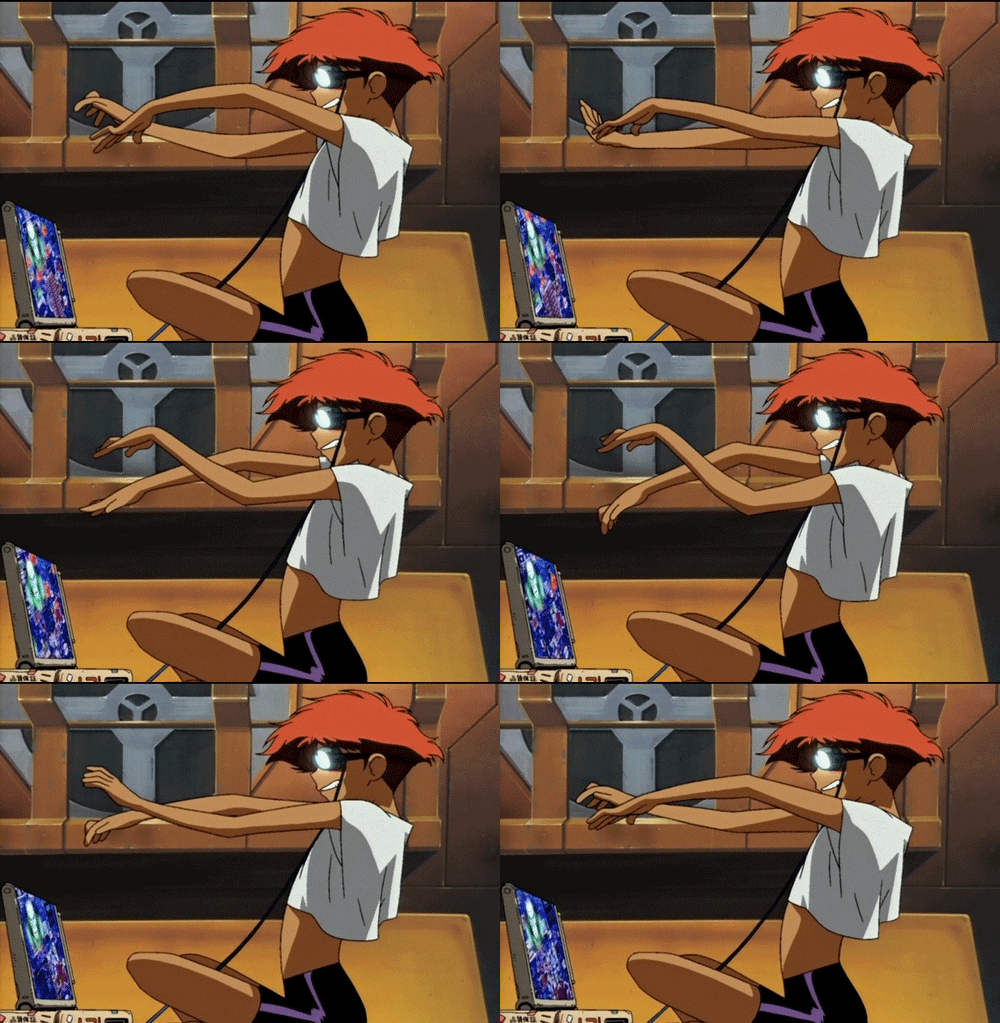
I was partly inspired by the Wayfarers series by Becky Chambers and to a lesser but still influential degree, Ann Leckie’s Ancillary trilogy. There’s also a bit of Cowboy Bebop and Star Wars: Resistance in there as well, among other things. I liked the idea of a local space station/stargate hub being used not so much as a hard sf thriller but mostly as setting. Like Diwa & Kaffi, it’s more about the people within the station rather than the setting itself.

Of course, I do have the usual rules and regulations to follow, even though they won’t be visible in the story itself. For instance, a ship so big and in geosynchronous orbit with its local planet would of course be incapable of reshaping itself and achieving escape velocity as if it was some Robotech warship. There’s also the matter of keeping the balance of on-ship citizenry and visitor count stable, both physically and economically. I came up with similar House Rules when I wrote the trilogy as well; there are some things that can be done, some that can’t, and some that really shouldn’t. These aren’t arbitrary rules, they just make the fictional society, and the story, run a hell of a lot smoother.

Given the few ideas I have for this story so far, I don’t need to worry too much about the technical details. If I need them, well…that’s where additional research and outside assistance will come in. But for now I’m not going to burden myself with it. Right now I’m more interested in creating that on-ship society, its ‘city’ environs and even its traffic infrastructure. Most of the focus will actually be on the two characters and their friends and family anyway.

Theadia might not contain any zero-g chases or bypassing security in air-free cargo holds, but that’s okay…that’s not the story I’m planning on telling anyway. Our heroes are more fiddle-with-the-data anyway when it comes to things like that. Things that you and I might pull off. And that’s the trick, at least for me: sometimes all you really need to do is enough world building to make it realistic for your characters. The rest is just shiny and cool-looking artifice.

Creating Rules of Magic

madoka magica homura
Source: Puella Magi Madoka Magica

One of my favorite things so far in writing In My Blue World has been creating the rules of magic in this universe.  It’s very similar to the process I used when I wrote the trilogy, and it asked the following questions:

  1. What kind of magic do I want my characters to use?
  2. Why would they use it?
  3. What are the limits of its use?

Sounds simple, yes?  But the trick here was to remember: every use of magic must have its reason, and it must have its balance.  In the trilogy, every time Denni used some kind of psychic force, she had to do it for a reason (usually to protect others), and it had its balancing effect (Saisshalé would respond in kind).  This was to show that there was always a price to pay for their actions.

For In My Blue World, I essentially follow the same rules: Zuzannah (aka Zuze) comes from a universe where magic is a natural occurrence and is used in everyday life.  What kind of magic do I want her to use?  She uses this magic energy equally as a creative and destructive force; one of her abilities is to make ‘a tear in the weave’ of the multiple universes so she can jump between them, but for every tear, she must also ‘reweave’ it.  Why would she use it?  She uses it to temporarily escape from a stronger foe.  She also uses it to return and face him once more, when she is more prepared.  What are the limits of its use for her?  Weave-tearing is an extremely rare ability and uses up a hell of a lot of power in the process.  She only uses it when absolutely necessary.  The level and process of magic she’d used in her initial escape was so high and unfocused that it rendered her unconscious for two days.

Using these rules helps me focus on how the plot should unfold.  When she’s in the reality of our other characters, her magic is still there but it works differently.  When she returns to her own universe, her original powers return.  The other characters are also given the same rules: they are introduced to this magic as well, but with their own costs specific to them.

This is why I say that this kind of worldbuilding is often my favorite part of writing a novel.  It’s not just about coming up with neat ideas that I can play around with throughout the novel — though that is a major plus and a hell of a lot of fun — it’s about laying the groundwork for how everything works.  It’s a balance in and of itself, and quite often it suggests more of the plot than you initially expect.

Worldbuilding for the new project

img_20180106_1803486453814687542487755.jpg
Drawing Kaffi the tintrite – not my best work, but better than expected

If anything, I’m sure I’m going to need to study some basic anatomy if I’m going to try to visualize my characters like this.  These images aren’t necessarily going to be in the book…they’re just reference for myself, so I can at least get the basics right.

Kaffi up above is a teenage alien tintrite (pronounced TIN-treet), one of the many different beings that live in the apartment complex that comprises the main setting for my new project.  He’s kind of a dragon/lizard hybrid, long and sleek but also muscly and winged.  He’s an excellent flier, but he’s also reckless.  Teenage immaturity seems to be a universal constant in this world.  Anyway, he’s one of two main characters, the other being his human BFF, Diwa.*

*Note – I had to do a bit of homework to get Diwa’s name right, which is a rarity for me.  Diwa is mixed-race — his father is Caucasian and his mother is Filipino — and I wanted a Filipino name that was a) gender neutral, and b) kind of unique and unexpected.  It means ‘spirit’ or ‘essence’.  I hadn’t expected to find one that fit so nicely with the story, but I’m not complaining!

It’s mainly Kaffi and Diwa’s story (and it’s an enjoyable one about love, friendship and trust), though there are other characters who’ll pop up throughout.  There are humans, mandossi (tallish sleek aliens that are built for running), hedraac (humanoid vampiric aliens), minotaur-ish beings (I haven’t got a name for them yet), and I’m sure I’ll come up with more as the story unfolds.

My idea here was that I wanted to have a world where humans coexist peacefully with all kinds of different beings, so the conflicts in the story weren’t about sentient-versus-sentient but more mundane.  Teenagers trying to figure out who the hell they are and what they want to do when they grow up.  Old men worried about the new generation coming in and taking over.  And how much energy, creativity, and dedication it takes to keep a community active and healthy.  [See, there’s a reason why I keep calling it ‘my Studio Ghibli story’!]

So yeah, you could say I’m having a fun time with this project so far! Now if I can only come up with a decent title for it…