Creative…privilege?

So some AI-leaning techbro this week posted something on social media about artists, writers, musicians, etc., having the unfair advantage of “creative privilege” because they allegedly came to their craft with some gods-given blessing, and it’s unfair that the rest of the non-creative world has to actually, y’know, work at it, and it’s all unfair that we creatives have that advantage.

Or something like that. Either way, he’s currently getting roasted in response.

I’ll be honest, my first reaction to this complaint was that it kind of reminded me of high school. It reminded me of being a non-sports kid in a school where most extracurricular funding went to the boys’ football team, no teacher wanted be an advisor for school plays so there weren’t any, and the funding and printing for the school newspaper got pulled the year before. So me, my friends Kevin and Kris, and a few others, decided to use our creative privilege to edit and put it out ourselves, using Pagemaker on the school’s Mac and the gracious help of the printing class teacher who ran a few hundred copies off on printer paper and collated them for free. We used our creative privilege by figuring out a workaround and doing most of the work ourselves. Sort of self-publishing it, in a way. And it was a success! We kept it going the entire year on a consistent basis, got several other students to write articles, and kept it alive when no one else bothered.

If there’s such a thing as creative privilege, it’s the ability to move past roadblocks and obstacles. There’s no One Right Way or One Weird Trick They Don’t Want You To Know to do it either, because it’s different for everyone. It’s what works for you, and it’s most definitely not just about finding shortcuts, either. Running a complicated algorithm that essentially mashes up other people’s creative works and then slapping your own name on it is a shortcut, and a dishonest one at that. Figuring out your own style and voice takes hard mental and emotional work, and you need to put in that work, because those who see the end result can definitely tell the difference.

A good example: remember those music mashups of the early 00s? Some of them were amusing and entertaining, and I have a collection of them in my music library. But there’s a big difference between what’s known as the “A + B” mashup (one song over the other with minimal separation or creativity) and the actual DJ mixing (seamlessly sliding one song’s separated vocal lines onto the instrumental of another song). This so-called “AI art” and “AI writing” is, for the most part, the former. And it’s not artificial intelligence, despite the label it’s been given. The computer is merely running software and mashing up different parts the user chose, that’s all; any ‘mixing’ is also the computer doing a bit of barebones touch-up. And yes, you can definitely tell the difference.

So my answer? Sure! I’ve got creative privilege, and I’m proud of it because I worked hard for years at it! I may not be raking in the money and the prestige, but I’m still getting the occasional ebook sale and that’s pretty damn cool in itself. That’s all I’ve really wanted.

And I’m sure you can make it happen as well. You just need to do more than run an algorithm, have the computer do the mashup work, and say ‘there, it’s done’.

Getting started…eventually

It’s occurred to me that one of the reasons I haven’t been doing any writing work lately — I mean, aside from focusing on the blogs and some Walk in Silence (the book) work — is that I’ve been working on rewiring my head a bit.

I’ve written here before, many times, that I’ve been too easily and willingly distracted by online things: social media, videos, comics, music, and so on. Over the course of this year I’ve been working on fixing that, and I think I’m finally at the point where I have it all under control. I’m not really giving any of it up, I’m just no longer being passive about it. I’ve been here before, I just want to make it last longer this time out.

So what about these new projects that are just…sitting there, doing nothing? Well, that’s a good question. And I have a plan that I hope will work. It might be a Best Laid Plan or it might actually work, but hey, at least it’s a plan: continue with the compartmentalization strategy.

I’m not assigning myself work here, which is the trap I’ve fallen into before. No, this is merely part of the job of being a writer. So for instance, say I have my first ten minute break of the day at work: my current habit is to head to the break room, have a snack, and screw around on my phone for a few minutes reading social media until it’s time to go back. Sure, it might be just fine on its own…it’s a bit of mental relaxation during a busy day, right?

I’m trying to break myself out of that. Mainly because I’m personally bored with the habit. It doesn’t do much for me anymore. [I mean, unless A texts me a picture of one of our cats. That’s always worth it.] I think about my other coworkers: some of them head outside to the upper parking deck. Some of them do a bit of reading or texting or chat with friends who are also on break.

My plan before was to change it up and go straight into writing something longhand. Hell, I even have a small notebook that fits perfectly in my jacket pocket! But once I’m on break….? Nothing comes. I’m right back there, futzing around online. Which means that I haven’t quite mastered the approach. What I need to do is prepare myself for that ten minute writing session! So how about this: let’s say I’m scheduled for that ten minute break at 10am. So to prepare for that, I can think about what I want to write at that time by, say, 9:45. A fifteen-minute prep time while I’m ringing up customers. I can definitely think about my writing while at the register, I’ve done it loads of times. So by the time I do go on break, I’m ready and prepared to pull out that notebook and do a bit of work!

To change it up, why not change the setting as well? Go up on the roof, head outside, go somewhere for that ten minutes. And I’m sure that by the time I get this preparation down, I can use all that extra time during my half-hour lunch using the same process to add to the word count.

Will it work? Well, who knows? But it’s worth a shot, right?
Getting there one way or another

Every now and again I get to a chapter or a scene that is just not working. No matter what I do to it, no matter what I try, it just…fails. It’s frustrating, sure, but I’ve come to the realization that the true source of frustration lies not in the inability to fix what I have, but in the time wasted going trying to make it work in the first place. Thankfully I don’t let that eat at me too much.

I’m no perfectionist, but I am a writer who trusts their instincts. If this is a scene that just ain’t cutting it, I’ll give it the old college try for a day or so just to see if it’s salvageable. Sometimes it works — I’ll come up with a solution that wasn’t coming to me the day before, or I’ll allow myself some time to work through it in my head first. But more often than not, if it isn’t going to work after a few days, it’s not going to work, period. Cut the offending piece and pasted it in my Outtakes document. [And yes, all of my novels have at least one of those.]

I say this after about three days of trying to write the latest chapter of MU4 and not quite getting anywhere with it. There’s a mood I think works, but there’s no plot, just a few connecting scenes, and that makes for pretty boring prose. My mistake was that I went into the scene unsure where I wanted to go and hoping it would tell me. Sometimes that works, but often times it doesn’t. So what I need to do is cut the whole thing and start from scratch.

It’s frustrating, yes, but sometimes it’s got to be done to move forward.

AI and Writing

I’ll be honest up front with one thing: knowing me and my utter lack of patience, planning and focus in junior high and high school, I’d probably have used AI to write some if not all of my term papers if it had been around when I was a teenager. I’d have known enough to take the end result and revise it so it sounds more like me than a bot scraping info from the ‘net, but yeah, I would have been that student. I might have been one of the smart kids growing up, but the slow rigidity of school education often bored me.

These days however, the only reasons I’d use online AI bots is as a playground. Create silly mash-up picture memes. See what it can do sonically with music as inspiration for my own. Use it for character worldbuilding, just enough to keep it a private reference but not call it official. I’m not sure if I’d ever use it for writing, per se, because that would just be a) cheating, and b) taking all the fun out of what I love doing. I mean, come on: there’s nothing I love more about writing than working through the bits and bobs and swivels and parallels that go into writing a novel. That’s the best part! Why would I want to let a bot do that??

As is usual with a lot of my takes on various things, my feelings on AI these days is complex and often paradoxical. I love it and hate it. I’m fascinated and repulsed by it. I hope that it isn’t completely eradicated but I also hope that we find ways to tame it. I hope that it doesn’t die out as a fad but I’m pretty sure that, like VR in the early 90s, companies will try to monetize it and it won’t age well in a few years. I hope we don’t get a lot of terrible movies about AI (guaranteed to be about either hackers saving the day or bots taking over the world, as they often are), but I do hope screenwriters come up with clever ways to integrate the AI idea into their stories.

I do hope that the fad of creating full-on novels via AI will go away and stay away, however. I do believe that one won’t last long as most professionals are already calling ‘authors’ out on it. [And I do put that in quotes because come on: are you really a novelist if all you do is type out a few prompts and let a computer do the rest?] We’re near the beginning of this particular wave, so it’ll probably take a little longer for it to fade away, but I just don’t see it becoming anything major once that wave crests and starts to retreat.

Real life inspiration

There’s a little bit of real life inspiration in pretty much everything I write, and I’m sure that’s true for nearly every writer. Every story I’ve written does have at least one moment, scene or setting based on reality.

I wrote the Bridgetown Trilogy when I was working at the Yankee Candle warehouse, and while there aren’t specifically any scenes that take place in such a location, it did inspire a few ideas. For instance, the brief mention of Hallera, a planet where people live within instead of on its surface, comes from when I worked second shift and would look out from the dock bays into the deserted semi-darkness of the rear lot at 11:30 at night. There’s also a newer character in MU4 whose day job is working behind the scenes at the Bridgetown Nullport. Several names in the trilogy are Tuckerized from former coworkers in one way or another.

It also explains why the trilogy also had a lot of characters whose day jobs weren’t high-status and they specifically enjoyed Life Outside of Work. Those who were high-status were there for a reason, and their jobs tied in with the story in one way or another. Call me blue collar if you will, but those office job characters never really sounded like much fun to write to me. Even Diana Meeks in In My Blue World, who crunched numbers for a living, didn’t necessarily like her job and it’s barely mentioned.

Being that I live on the much quieter northwest side of San Francisco and currently work at a supermarket, I’m sure that the world of retail might make its eventual appearance somewhere in one of my projects, whether it’s MU4 or something else. One might see retail as drone-like as office work — you’re just another easily replaceable number, apparently — but there’s also a much closer connection to the Outside World that office work doesn’t always provide. Interesting and unique customers and locals become inspirations for characters and background crowds the more you interact with them. Vendors and delivery drivers become secondary characters with unsung but important roles that could help you out of a tricky plot twist. Coworkers once again get Tuckerized as street names and, if they’re interested enough (like many of my YC coworkers were), they’ll ask how the story is coming along.

There’s something about being a little closer to a community at this level that helps me feel more connected to the characters I create. There’s a shine to them that pulls me closer, wanting to know more about their personal lives and how they interact and interconnect with others. It might not be as glamorous or as high-paying as some of my previous positions, but I’ve become rich in other ways whenever I embrace that kind of connection, and that makes all the difference to me.

Twenty Years On: Such Great Heights

I’m planning on doing a “Twenty Years On” of 2003 soon over at Walk in Silence as it dawned on me that I haven’t done one yet, and I got to thinking about how that time between 2003 and 2005 had become somewhat of a transitional year for me, creatively and personally.

I’d been working at Yankee Candle since late 2000 and had The Best Day Job Schedule Ever since early 2001. The Persistence of Memories was a few chapters in by early 2003, and by the year’s end I’d be starting in on The Balance of Light. I was about to buy myself a brand new PC with a lot more memory and power that would not only help my writing but take the next step in mixtape making, burning cds. I was listening to a lot of great music, even playing it with my friend Bruce. My creative output was at the highest peak to date. I was out of debt for the most part and paying only the student loan and car insurance at this point. I hadn’t been in a relationship in years, and I was okay with that. I had a strong circle of friends that were just a drive away now.

Life was pretty good at the time. Not perfect, but a damn sight better than ten years previous.

This is the era that I’m trying to emulate these days. Not ‘copy’ mind you, because I’m really not one of those people to relive the past to make up for present unhappiness. Not anymore, anyway. This is about emulating that same mental and emotional balance that had become my foundation. And I’ve been given a chance to make it happen again.

I think it helps that I’m no longer at a Day Job that so often threatened to disrupt that balance, now at one where I’m consistently happy and connected and not just another number. But you work in retail now!, I hear you say. Isn’t that more stressful than crunching numbers? Far from it. For me it’s a lot less stressful than banking.

But I digress. I’m in a good place in my life again, the road is clear, and I’m able to reach those same great heights again. And I’m going to make it last for as long as I can.

Writing New Characters

Brand new characters are always an intriguing exercise, because I don’t always know where I’m going to be taking them. Some of them, like Caren in the Bridgetown Trilogy, are sort of based on tropes (she was originally a mix of Agent Scully in X-Files with a touch of Captain Kusanagi from Ghost in the Shell but became something altogether different). Others, like Zuze in In My Blue World, are characters I already know inside and out before I even start.

While writing MU4, I’ve been introducing a few new characters into the Mendaihu Universe and it’s true, I’m still working out where they’ll end up by the end. I have an entirely new character, Lizzie Kapranos, whose drive is decidedly not like Caren’s; she knows who she is and where she fits in, so her conflict is the refusal to give in so easily to conformity. [Tuckerization time: she’s named after Elizabeth Bennett from Pride & Prejudice and singer Alex Kapranos of Franz Ferdinand. A fierce free-thinker and a bit of an oddball but not without a sense of humor.] Like Miss Bennett, Lizzie is all about staying true to what she believes in. Also like her, Lizzie will (eventually) admit to being wrong when she makes errors in judgement or action.

This might be partly why my word count has been so glacial these last few weeks, as I work out the scene with all that in mind, but to be honest that’s part of the appeal of writing new characters. I get to learn something new about them, and about the story. Their actions will influence what comes next, whether it’s positive or negative. Another new character, Eika, embodies this to the extreme: she’s the id escaping highly restrictive boundaries and set free. Eika is a chaos element in a way, while Lizzie is the stability element. And both characters are completely aware of that role. In the process, Eika and Lizzie are polar opposites but also the key to Balance. And Balance has always been a big part of the Mendaihu Universe.

Do I know where these two will go, and if they’ll ever meet? Maybe? I’m not sure? But it’s in my mind and it’s a vague signpost further into the story that I’m heading towards. And that’s all I really need.

Twenty Years of MS Word

In writing something elsewhere, it suddenly occurred to me that I’ve been using MS Word exclusively for twenty years now. I believe it was sometime in March or April of 2003 that I bought my first completely new PC off the Dell website. With my own money and everything! I’d been using the previous writing programs that came with Windows 3.1 and 98 — MS Write and WordPad — and I realized this would be an excellent upgrade. This was one of those ‘customize your own personal computer’ specials Dell had and I spent the slightly extra money to have that added along with a decent media player that could play cds and dvds. I wasn’t (and still am not) a PC gamer so all that processing power and speed went to those two apps.

Over the years I’ve heard many pros and cons of Word from the writing community. Some swear by it, others swear at it. I’ve heard many writers suggest other programs and refuse to touch this one. Me? I’ve had nothing but pleasant experiences with it. I don’t think it’s ever crashed once on me (not including when it was actually the PC doing the crashing). As long as I keep up my habit of frequently saving my work (thanks, Dropbox!), all is well. Even now that it’s part of the Office 365 umbrella, It’s worked a peach.

All of my novels from A Division of Souls forwards were written, edited and revised using Word, and it’s even used to do the formatting for their Smashwords editions. I’m using it now for MU4. I’ve learned how to use more of its fiddly editing and formatting functions and they’ve pretty much become part of the tool bar at the top header.

I’ll use a Word-like app for reading on my tablet and e-reader, but I don’t plan on switching to anything else at this point.

Making that connection

The hardest thing about writing MU4 so far has been making a personal connection with my characters. I know what I want from them, and I think I know how I want them to evolve, but getting to those points has been fraught with missing by inches.

I also know, this time for a fact, that I’m not trying hard enough. I’m still suffering through waves of the Don’t Wannas with an equal serving of Easily Distracted. I want to write this novel, damn it all, I’m just avoiding working on it, and I’m starting to piss myself off because of it.

If this means I have to take desperate measures, I’ll do it. I’ve already uninstalled or removed several apps from my phone to minimize distraction during Day Job breaks I should be spending less passively. But though I’ve been doing all my actual writing work at home and I do close my web browsers come writing time, I still have too many distractions. If this means unpinning nearly every shortcut from the Task Bar, so be it. Making it harder to open distraction apps usually works for me simply by utilizing the Out of Sight Out of Mind method, and I’d rather not use one of those ‘won’t/can’t open until forty-five minutes pass’ apps if I can help it.

Still — the issue remains that when I am writing, I’m still not quite making that connection. I’m not connecting on that emotional level I’m aiming for. They still feel too distant. And again, that’s a personal issue I have to work through: I have to let myself establish that level, allow myself to take that deep dive. I know I can do it and I’ve done it before.

Eventually I’ll make that connection I’m longing for. I just need to keep trying.

More on Distraction

Yes, Cali and Jules (see above) are definitely distracting, in a good way. Especially when they get all cute and cuddly and want our attention. But that’s not the distraction I’m talking about.

I’ve fallen behind on my work on MU4 partly because this past week I’d worked mid-shifts at the Day Job for three of the five days, Tuesday through Thursday, followed by two early mornings starting at 5:30am. My brain’s been a little loopy because of it and the most spoons I had was to maybe do a bit of reading of what I had so far.

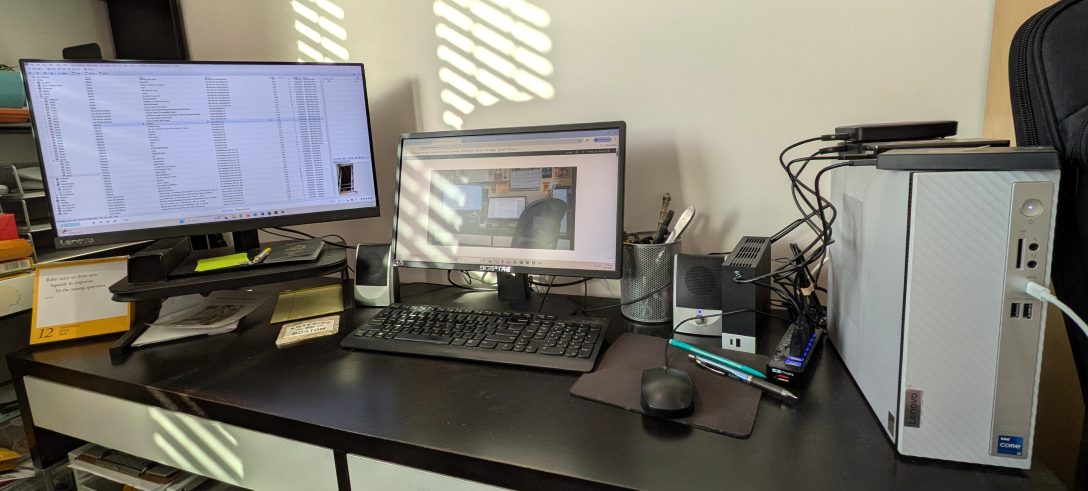
I still have the same distractions I’ve had since we moved out to the west coast, of course — fiddling with the music library, refreshing the social media timelines, cleaning out the email inboxes, things like that — but I’d like to think I’ve gotten better over the last couple of years, especially now that my Day Job isn’t a high-stress brain melter and that I’ve cleaned out the detritus up there. I’d say my worst distraction right now is simple avoidance: purposely finding other things to focus on to avoid doing the actual work. The good thing is that’s an easy thing to combat, simply by shutting down those browsers and starting the work whether I’m ready for it or not.

I find that’s the most common start to a writing session when I’m distracted. Most of the time I am ready for it and the output isn’t all that bad (and when it is bad, I try not to dwell on it for long and remind myself to fix it next session). I’m simply just delaying because I’m trying to get the session mood just right. [Hey, remember during the Belfry days when I used to waste a half hour deciding what cds to listen to? Some things never change, do they?] My workaround has been the same thing since I came up with it in the mid-90s: just shut the f*** up and DO it already.

And that still works to this day.

Hopefully this coming week will be better! My schedule is mostly mornings with a day off midweek, so I should be able to work through the lingering Don’t Wanna’s and make some progress. There probably won’t be any new words, but I can at least revise and improve this newly reinserted chapter and work out how to go from there.