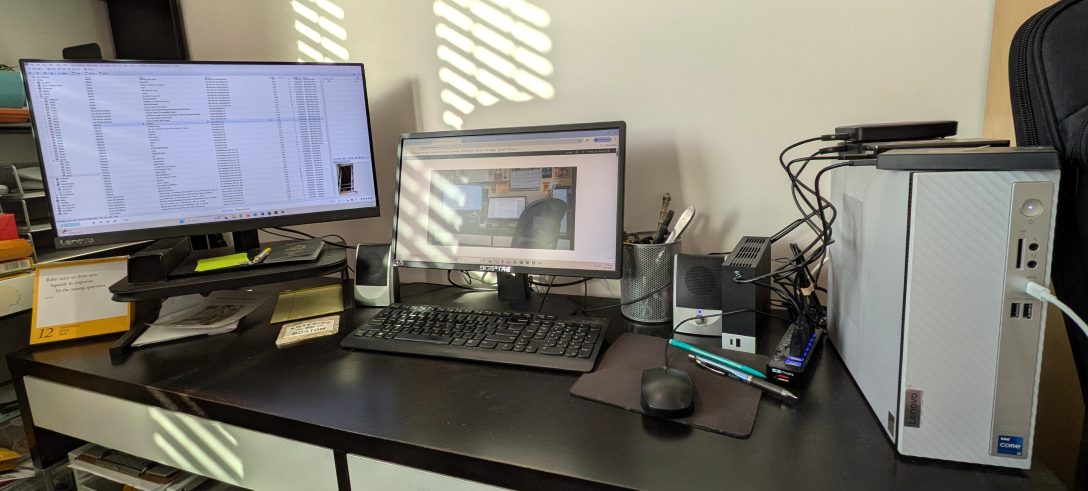
Hrrmm…

Yeah, I think I’m more than a bit out of practice when it comes to writing bigger stories. It’s been far too long since I’ve written in this style, I think. But I’m being patient and hoping that it all works out eventually. It’ll come back to me.

Over this past week I’ve been trying to write an all-new chapter for Theadia that introduces an important secondary character, but I know that this very rough draft is coming out a little, well…rough. I know I could do better, and I’m thinking I might need to give this another go-round before I move on to the next chapter. I think I’m more annoyed that my word count plummeted to about three hundred words a session when usually they’re an easy eight hundred or so. [It doesn’t help that I’ll find myself easily distracted by music and, er, blogging things like this.] But I’m not giving up.

I’m reminding myself that I’ve been in this situation several times in the past, where my word count can fluctuate at any point in time, where I might struggle to get a single scene done one day and breeze through another one the next. It’s just how the writing biz is. And no, I’m not going to use AI to help me, as this is actually my favorite part of writing! Heh.

I’ll get through it, one way or another.

On being unconventional

I’ve said this before: Theadia is an unconventional hard-SF story. It’s not entirely about the spaceships or the combat or the high levels of tech intelligence. It’s more about the characters that are put into that world, whether they want to be there or not. I’ve also said this before as well: Theadia is about doing the right thing when no one else is bothering. But what it’s not is completely uber-serious or heavy on the military grimdark and the perils of deep space.

I love writing unconventional stories. They appeal to me and my mindset. I mean, come on: I’ve been listening to indie music since the mid 80s. My favorite stories are the ones that don’t go in the direction you expect. I’m a sucker for books and movies where you can tell the writers did their homework in weaving the plots in all sorts of unexpectedly creative ways. It only makes sense that my own writing leans the same way.

While I’ve been talking about how Theadia‘s sprawl is somewhat similar to the Mendaihu Universe, I’d say characterwise it’s more similar to the Meeks sisters in In My Blue World. There’s certainly a huge world out there (in this case a galaxy) but the story is mainly about these main characters I’m writing. I always love the idea of that dichotomy: a tight focus within a larger landscape. To me it gives the background life, and in the process our leads get to act or react accordingly to it.

I suppose this is partly why I’m still an indie author that’s self-publishing rather than going the pro route. I may have once had rose-tinted dreams about getting my novels released by a big name publisher, but the more I thought about it over the years, the more I realized that avenue felt more restrictive to my own creativity. I don’t know how to write commercial fiction, let alone genre fiction that would sell commercially, and I’m not sure if I’d be able to succeed if I managed to learn.

I just write what I enjoy the most, regardless as to whether it’s highly popular or not. And I’m quite happy with taking that unconventional route.

Prep Work

(Image courtesy of Starship Operators, a fun and unique anime I recommend.)

Whenever I have a spare moment and I’m not focusing on the final preparation of Queen Ophelia’s War, I’ve been preparing for my eventual restart/rewrite of Theadia. Why am I doing this when I have most of the original version written, you ask? Good question, that.

The easy answer is that I’m doing it the same way I wrote the Bridgetown Trilogy. Whatever is about to unfold in this restart/rewrite won’t be exactly the same as that version, just as the trilogy takes what I’d started in The Phoenix Effect and pushed it in a different and much better direction.

The more convoluted answer is that I’ve chosen to expand on several plot points, characters and situations that I’d laid out in the original Theadia. I’ve been finding moments during lulls in my work shift, just like back in the day, to write down my thoughts on how to do this. Certain secondary characters will have a much deeper and richer background and even their own plot lines. While it will still focus on the two main characters — after all, they are not just the instigators of the story but what drives the rest of the main cast — I want to know more about the rest of this universe.

Thus, I’m doing what I did with the trilogy: I’m doing a world building deep dive. Something I haven’t done for quite a number of years. It makes sense for me to do this, considering this is a subgenre I don’t have nearly as much experience writing. [It’s not that I’m a ‘never say no’ writer…I’m more of the ‘I wonder if I could pull this off, let’s try it’ kind.] And if I’m going to do it justice, I want to do my homework.

The current version does work…but there are worrying moments of Handwavium and This Happens Offscreen, and I’d rather not go that route. The best way to fix this, in my experience, is to do that deep dive. I’ll do a bit of research, sure, but I also want this story as believable as possible without getting lost in super-heavy hard-sf techspeak. While it exists, that’s not what the story is about; the project’s focus has always been about the people behind the tech, both the ones who create it and the ones who use it, who may not exactly understand all of it but might at least understand how it works to some degree. [I’ve often joked that this project is my anti-Cory Doctorow story, in which I try to avoid techspeak infodumps as much as I can and still get away with it.]

Will I pull it off? Well, I won’t know until I write it, will I?

Final revision: fix-it notes

Yep. I’m in the final revision of Queen Ophelia’s War — about halfway through the novel, in fact. This is where I’m doing one last reread at the end of the day on my ereader in bed, a pen and pad at my side. I’ve learned that this is where I find most of the small-time errors that I might miss or skip over while working on the PC: use of the wrong word, confusing dialogue tags, missing words…or my worst enemy: word repetition. [I have the occasional bad habit of using the same word or phrase multiple times within the same paragraph. Easy to fix but embarrassing to discover.]

When I’m at this level of revision, I’ll go straight through the entire work from start to finish before I make any fixes. This will allow me the ability to insert notes out of order — if there’s an important moment near the end of the book that needs to be hinted at earlier on, for instance. That will also make the final final revision session that much easier: fixing those small problems and giving it a bit of shine.

Then I’ll be able to sign off on it and prep it for self-publishing!

Breaking out of the comfort zone

(image courtesy of Bocchi the Rock)

I’d almost forgotten what it felt like to push myself out of that comfort zone I’d been in for years. Why was I even there in the first place? Was it about trust? Self-trust? Embarrassment? Worry? One or many of these things? Well. Most of it’s all gone now, at any rate. All I had to do was free myself from the self-imposed chains.

I think the last time I felt this way was when I’d started The Phoenix Effect back in 1997. A new part of my life had started and the road was relatively clear. It was a choice to say yeah, let’s get this writing career started. I can do this, and stick to it. But let’s face it, I hadn’t really adjusted all that much since then. Sure, I had the confidence to self-publish and all that backstage nonsense that goes along with it. But there had to be more. I knew I was holding back.

This is where I feel I’m at now. Pushing myself out of a comfort zone once again, not quite sure where it’ll take me…but trusting myself enough to know what I’m doing. Time to take more chances and look past the boundaries. Knowing I have people who’ll have my back. And knowing how to move forward with minimal blind flailing.

A lot of this will be new to me, but I’m ready for it. And I’m willing to learn.

I’m allowed to make mistakes…

…but I’m not allowed to see every mistake as a failure.

Writing a scene that ultimately does not work for the novel is not a failure. Dealing with inconsistencies and continuity errors is not a failure. Sometimes writing is rewriting and revising and trying a different tack. I’m allowed to be worried that my project is still a mess that needs a lot of work, but it’s not a failure if I’m willing to do that work to make it better, no matter how long it takes.

Putting a novel project aside for a while with the possibility of it being trunked is not a failure. Sometimes the end result is simply not what I’d hoped it would be, knowing that I could do so much better. Or maybe that I’ve just lost interest in the idea now that I’ve let it percolate for a while.

Hitting only a few dozen words a day instead of a few hundred, or even a few thousand, is not a failure — nor is it a mistake. Not giving myself enough time to write every now and again is not a failure. Distraction and wasting time is not a failure, but an issue that can be fixed if I put my mind to it.

I’m willing to make mistakes. Failure, at least for me, is not even trying in the first place.

Creative…privilege?

So some AI-leaning techbro this week posted something on social media about artists, writers, musicians, etc., having the unfair advantage of “creative privilege” because they allegedly came to their craft with some gods-given blessing, and it’s unfair that the rest of the non-creative world has to actually, y’know, work at it, and it’s all unfair that we creatives have that advantage.

Or something like that. Either way, he’s currently getting roasted in response.

I’ll be honest, my first reaction to this complaint was that it kind of reminded me of high school. It reminded me of being a non-sports kid in a school where most extracurricular funding went to the boys’ football team, no teacher wanted be an advisor for school plays so there weren’t any, and the funding and printing for the school newspaper got pulled the year before. So me, my friends Kevin and Kris, and a few others, decided to use our creative privilege to edit and put it out ourselves, using Pagemaker on the school’s Mac and the gracious help of the printing class teacher who ran a few hundred copies off on printer paper and collated them for free. We used our creative privilege by figuring out a workaround and doing most of the work ourselves. Sort of self-publishing it, in a way. And it was a success! We kept it going the entire year on a consistent basis, got several other students to write articles, and kept it alive when no one else bothered.

If there’s such a thing as creative privilege, it’s the ability to move past roadblocks and obstacles. There’s no One Right Way or One Weird Trick They Don’t Want You To Know to do it either, because it’s different for everyone. It’s what works for you, and it’s most definitely not just about finding shortcuts, either. Running a complicated algorithm that essentially mashes up other people’s creative works and then slapping your own name on it is a shortcut, and a dishonest one at that. Figuring out your own style and voice takes hard mental and emotional work, and you need to put in that work, because those who see the end result can definitely tell the difference.

A good example: remember those music mashups of the early 00s? Some of them were amusing and entertaining, and I have a collection of them in my music library. But there’s a big difference between what’s known as the “A + B” mashup (one song over the other with minimal separation or creativity) and the actual DJ mixing (seamlessly sliding one song’s separated vocal lines onto the instrumental of another song). This so-called “AI art” and “AI writing” is, for the most part, the former. And it’s not artificial intelligence, despite the label it’s been given. The computer is merely running software and mashing up different parts the user chose, that’s all; any ‘mixing’ is also the computer doing a bit of barebones touch-up. And yes, you can definitely tell the difference.

So my answer? Sure! I’ve got creative privilege, and I’m proud of it because I worked hard for years at it! I may not be raking in the money and the prestige, but I’m still getting the occasional ebook sale and that’s pretty damn cool in itself. That’s all I’ve really wanted.

And I’m sure you can make it happen as well. You just need to do more than run an algorithm, have the computer do the mashup work, and say ‘there, it’s done’.

Getting started…eventually

It’s occurred to me that one of the reasons I haven’t been doing any writing work lately — I mean, aside from focusing on the blogs and some Walk in Silence (the book) work — is that I’ve been working on rewiring my head a bit.

I’ve written here before, many times, that I’ve been too easily and willingly distracted by online things: social media, videos, comics, music, and so on. Over the course of this year I’ve been working on fixing that, and I think I’m finally at the point where I have it all under control. I’m not really giving any of it up, I’m just no longer being passive about it. I’ve been here before, I just want to make it last longer this time out.

So what about these new projects that are just…sitting there, doing nothing? Well, that’s a good question. And I have a plan that I hope will work. It might be a Best Laid Plan or it might actually work, but hey, at least it’s a plan: continue with the compartmentalization strategy.

I’m not assigning myself work here, which is the trap I’ve fallen into before. No, this is merely part of the job of being a writer. So for instance, say I have my first ten minute break of the day at work: my current habit is to head to the break room, have a snack, and screw around on my phone for a few minutes reading social media until it’s time to go back. Sure, it might be just fine on its own…it’s a bit of mental relaxation during a busy day, right?

I’m trying to break myself out of that. Mainly because I’m personally bored with the habit. It doesn’t do much for me anymore. [I mean, unless A texts me a picture of one of our cats. That’s always worth it.] I think about my other coworkers: some of them head outside to the upper parking deck. Some of them do a bit of reading or texting or chat with friends who are also on break.

My plan before was to change it up and go straight into writing something longhand. Hell, I even have a small notebook that fits perfectly in my jacket pocket! But once I’m on break….? Nothing comes. I’m right back there, futzing around online. Which means that I haven’t quite mastered the approach. What I need to do is prepare myself for that ten minute writing session! So how about this: let’s say I’m scheduled for that ten minute break at 10am. So to prepare for that, I can think about what I want to write at that time by, say, 9:45. A fifteen-minute prep time while I’m ringing up customers. I can definitely think about my writing while at the register, I’ve done it loads of times. So by the time I do go on break, I’m ready and prepared to pull out that notebook and do a bit of work!

To change it up, why not change the setting as well? Go up on the roof, head outside, go somewhere for that ten minutes. And I’m sure that by the time I get this preparation down, I can use all that extra time during my half-hour lunch using the same process to add to the word count.

Will it work? Well, who knows? But it’s worth a shot, right?

Getting there one way or another

Every now and again I get to a chapter or a scene that is just not working. No matter what I do to it, no matter what I try, it just…fails. It’s frustrating, sure, but I’ve come to the realization that the true source of frustration lies not in the inability to fix what I have, but in the time wasted going trying to make it work in the first place. Thankfully I don’t let that eat at me too much.

I’m no perfectionist, but I am a writer who trusts their instincts. If this is a scene that just ain’t cutting it, I’ll give it the old college try for a day or so just to see if it’s salvageable. Sometimes it works — I’ll come up with a solution that wasn’t coming to me the day before, or I’ll allow myself some time to work through it in my head first. But more often than not, if it isn’t going to work after a few days, it’s not going to work, period. Cut the offending piece and pasted it in my Outtakes document. [And yes, all of my novels have at least one of those.]

I say this after about three days of trying to write the latest chapter of MU4 and not quite getting anywhere with it. There’s a mood I think works, but there’s no plot, just a few connecting scenes, and that makes for pretty boring prose. My mistake was that I went into the scene unsure where I wanted to go and hoping it would tell me. Sometimes that works, but often times it doesn’t. So what I need to do is cut the whole thing and start from scratch.

It’s frustrating, yes, but sometimes it’s got to be done to move forward.

AI and Writing

I’ll be honest up front with one thing: knowing me and my utter lack of patience, planning and focus in junior high and high school, I’d probably have used AI to write some if not all of my term papers if it had been around when I was a teenager. I’d have known enough to take the end result and revise it so it sounds more like me than a bot scraping info from the ‘net, but yeah, I would have been that student. I might have been one of the smart kids growing up, but the slow rigidity of school education often bored me.

These days however, the only reasons I’d use online AI bots is as a playground. Create silly mash-up picture memes. See what it can do sonically with music as inspiration for my own. Use it for character worldbuilding, just enough to keep it a private reference but not call it official. I’m not sure if I’d ever use it for writing, per se, because that would just be a) cheating, and b) taking all the fun out of what I love doing. I mean, come on: there’s nothing I love more about writing than working through the bits and bobs and swivels and parallels that go into writing a novel. That’s the best part! Why would I want to let a bot do that??

As is usual with a lot of my takes on various things, my feelings on AI these days is complex and often paradoxical. I love it and hate it. I’m fascinated and repulsed by it. I hope that it isn’t completely eradicated but I also hope that we find ways to tame it. I hope that it doesn’t die out as a fad but I’m pretty sure that, like VR in the early 90s, companies will try to monetize it and it won’t age well in a few years. I hope we don’t get a lot of terrible movies about AI (guaranteed to be about either hackers saving the day or bots taking over the world, as they often are), but I do hope screenwriters come up with clever ways to integrate the AI idea into their stories.

I do hope that the fad of creating full-on novels via AI will go away and stay away, however. I do believe that one won’t last long as most professionals are already calling ‘authors’ out on it. [And I do put that in quotes because come on: are you really a novelist if all you do is type out a few prompts and let a computer do the rest?] We’re near the beginning of this particular wave, so it’ll probably take a little longer for it to fade away, but I just don’t see it becoming anything major once that wave crests and starts to retreat.