
Getting myself back up to speed

I’d used that phrase in my previous post to talk about my ‘little fun personal project’ at the 750 Words site mainly to confirm that I have in fact been doing some writing during vacation this past week. Said project is nothing of major import, just an MU-related exercise where I’m going through the “legacy soundtrack” list as well as my writing chronology list. It’s half putting things in order and half clarifying the dates of events — something I mentioned in a few posts last month.

But the most important reason behind this project is to get myself comfortable with a daily writing regimen again.

Aha! you say. Don’t you already have one? Well, not really. I have a schedule, and a very loose one at that. It’s more of a daily reminder of ‘as long as I do something today’ and that’s it. And right now it’s this ‘little fun personal project’ with a vague reminder to work on the Trilogy Remaster. It’s just phase one of a much more detailed plan going on here.

Over the years, I’ve tried to force myself into a daily writing regimen, and every single time I fail for one reason or another. It’s happened so many times I now call them Best Laid Plans. So this time out I thought I’d come at it from a different angle: I’ve often described my writing process as similar to a musician’s, so I figured that maybe I should do so once more:

Sometimes your sessions need to focus on practicing scales instead of wracking your brain trying to come up with a new melody every time.

In revisiting the legacy soundtrack and the writing chronology of the Mendaihu Universe, I was able to revisit how I was able to pull it off in the first place without trying to emulate it in the present. That was always the weak point: emulation. Trying to relive the moment with vibes, I suppose. No, I had to look at it a different way. What was going on in my life when I wrote the Bridgetown Trilogy? [Answer found: working at the candle warehouse and turning my personal life around.] When did I quit trying to rewrite The Phoenix Effect and start A Division of Souls? [Answer found: June 2000, in the waning months of my record store job.] Why did it work so well then? [Answer found: a stable schedule, positive life events and a dedicated personal work space.]

So the next question is: how can what I discovered here be used in some way with future writing sessions? That is, without it once again falling into ‘trying to relive the moment with vibes’?

Well, that answer’s yet to come, and it hinges on whatever new writing project I work on next. I won’t know until I get there. But what I do know is how to properly implement what I’ve learned recently, and I think (and hope) that will make all the difference.

MU Chronology: to the warehouse

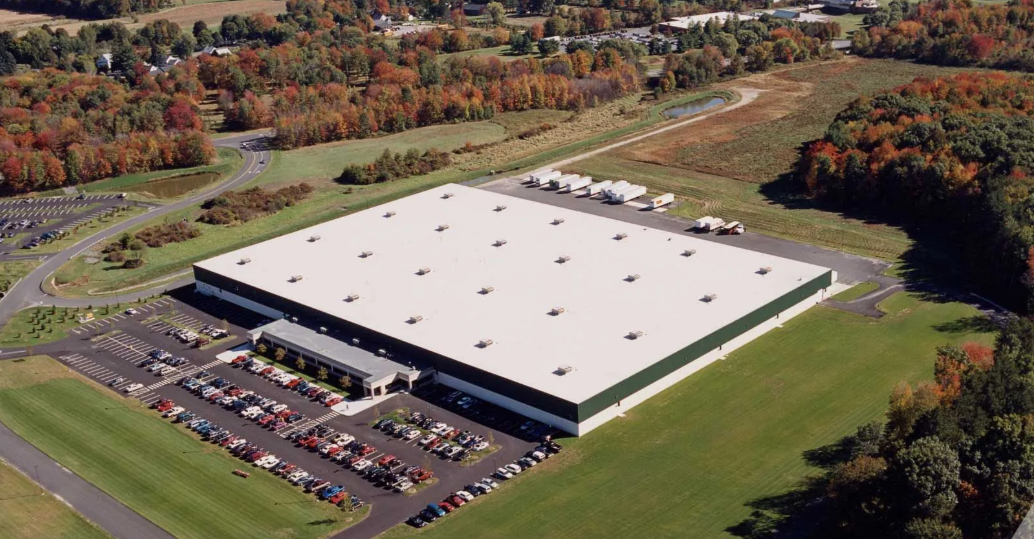
The above is the main Yankee Candle warehouse building, which opened up for business in April of 2001. My friend Bruce and I were some of the first people offering to test out the brand spankin’ new equipment before it all went live. It’s a huge building that was built to centralize the shipping, receiving, order fulfillment and storage departments all under one roof. We worked in shipping, which is in the top left corner of this picture (where all those trailers are parked in back), with eighteen bays if I recall. The entire right side of that building from this view is multi-level pallet storage, with the receiving docks in the rear as well. I worked in this building from April 2001 up until I left in March of 2005.

This is also the main inspiration for Moulding Warehouse in the Bridgetown Trilogy. I’d actually come up with the idea for that warehouse at our older building south of there on an inventory day during my brief second-shift days, but it was here that I’d solidified the idea and expanded upon it. I remember early on that I pulled a few building managers aside and asked about the specs, explaining my idea of turning the storage bays into a sort of multi-level cubicle hotel of sorts. They were rather amused by my creativity but confirmed that it could actually work as the framework was solid and buried deep into the concrete floor. [Note: the building’s name in the trilogy comes from XTC member Colin Moulding, one of my many Tuckerizations in this universe.]

While revisiting the MU chronology recently, I further realized that the date I started working in this building does in fact line up with when I wrote those scenes about the awakened converging upon Moulding Warehouse and Nehalé Usarai worrying about keeping everything under control. I remember taking my time on A Divison of Souls for fear of rushing it like I had with The Phoenix Effect, so while I was definitely working on it nearly every day from this point onwards, I was hitting probably around five hundred words to begin with. I’d slowly expand on that over the course of writing it, and by the time I started The Persistence of Memories I was aiming more towards a thousand. My favorite thing to do during slow moments of my shift was taking a bit of scrap paper and working out the next few scenes (often with one of those many boxes we shifted as a temporary desk), so that when my nightly writing sessions began I could start immediately.

And for a sense of its vastness, below is a shot of my department from the upper level of the shipping/receiving offices (itself an inspiration for the warehouse mezzanine scenes in the trilogy) from a video I found online sometime ago. Our job was to build pallets from the boxes that came down those chutes, wrap them up in plastic (the wrapper machines were underneath the chutes) and get them into the trailers (the bays are at the wall out of shot to the right). This seems to be filmed in the summer when it was relatively light, as this area would be filled to the brim and full of chaos during the Q4 holiday season. It would take us a good couple of minutes to walk from our department to the front of the building when we left for the day. This is why Moulding comes across as an incredibly large warehouse where several characters could either find privacy or gather together in large numbers with room to spare.

It was certainly an exhausting and very noisy job at times, especially during the holiday season, but at the same time it was an enjoyable one that kept me constantly moving instead of sedentary. I was blessed by the fact that it gave me all sorts of time to think about my writing with very little interruption, and a schedule that provided me with a broad length of personal time to work with. It’s an extremely productive benchmark that’s been tough to reach ever since, but these days I’ve been doing pretty good at getting close.

More on the MU chronology

As part of this ongoing Trilogy Remastering project, I’ve been trying to nail down some of the start dates of the books. I’ve long had a habit of timestamping my work (especially longhand, though I sometimes forget to do so when it’s straight to Word), so the accuracy is pretty good most of the time. I have the start and end dates of Books 2 and 3 confirmed. However, I was still using MS Write when I started writing A Division of Souls and those files don’t always provide what I need. It always bothered me in later years that I could never quite nail down when that first book was started, other than remembering that it took around a year and a half to write.

Recently, however, I think I got a bit of clarity on it. A rough listing so far:

8/7/1998 — The Phoenix Effect (longhand version) stopped
8/19/1998 — The Phoenix Effect (PC version) completed
8/25/1998 — Keepers of the Wards (first aborted TPE sequel) started
5/5/1999 — Keepers of the Wards stopped
Summer/Autumn 1999 — work on revision for The Phoenix Effect, submission to various agencies
12/9/1999 — The Veil (second aborted TPE sequel) started
2/22/2000 — The Veil stopped
4/23/2000 — The Mihari* (first aborted rewrite of The Phoenix Effect) started
6/??/2000 — A Division of Souls (second rewrite of TPE) started (originally titled The Mihari: The Division of Souls)
8/??/2000 — Plans to leave HMV, start looking for new job (early August)
8/12/2000 — Interview for job at Yankee Candle (Saturday open-house)
9/??/2000 — Official final day at HMV (possibly 1st or 8th)
9/11/2000 — Start job at YC
11/??/2000 — Switch from 2nd to 1st shift at YC (7am-3pm, shifted back one hour by early 2001)

That last entry is important. Because of that early end time, I quickly realized that I could utilize those afternoons to do my comic book and CD runs in the Amherst/Hadley area (a quick twenty minute trip down Route 116 from Deerfield on Wednesdays), come home and relax for a bit, have dinner with the family, then work on Division for a few hours in the evenings. That would become my constant writing schedule for the next few years until I moved out in March of 2005.

The above timeline sounds about right, as I’d had the idea to completely rewrite TPE from scratch during the spring and summer of 2000 during my last months at HMV. I was just loath to actually go through with it until I knew that alternate routes wouldn’t work, and I’d been dealing with a lot of day job stress at the time. I didn’t want to overburden myself if I didn’t have the spoons.

This plan, however, became a long-game plan to fully change how I wrote. I suppose these days you could use the word ‘vibe’ to describe what I’d been doing; I’d come up with interesting ideas but I was still focusing on the mood of the story rather than the prose or even the lyricism of it, and it was painfully obvious that it wasn’t working. I went into ADoS with the idea that my prose should have more heft and personality instead of the Hollywood bombast. I also went in knowing that this might take a while, but I was willing to put in the time and the work.

That obstacle of working second shift at YC did put a damper on things a bit, as I wasn’t always able to get any work done in the morning and early afternoon before work, which frustrated me. But when the offer to switch came up I immediately went for it. And for the next four years I worked on that long-game plan, writing the trilogy and getting better at my craft.

**

[* – Yes, The Mihari was the original title of the trilogy, a word cribbed from a Japanese pocket dictionary back in 1997 that means “to watch over”. It’s the original name of the Mendaihu, with the Shenaihu having the Japanese word misuteru instead, meaning ‘to abandon’. I knew it was shameless appropriation even then, but for now it was just an anime-inspired placeholder until I came up with something better. The terms Mendaihu and Shenaihu are relatively recent, created in 2011 when I started work on the initial revision for its eventual self-publishing.]