The Matrix and the Mendaihu Universes

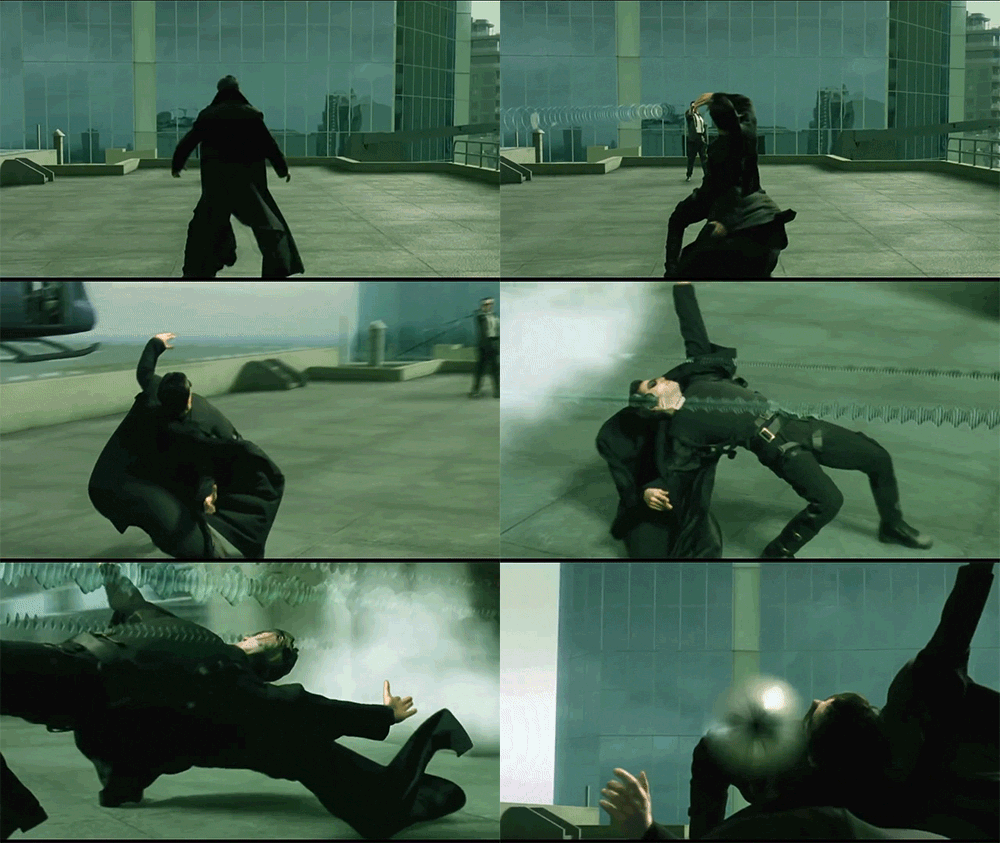
The Matrix Resurrections, the fourth in the series, came out at the height of the pandemic, released both in theaters and streaming on HBO Max at the same time. It was kind of a weird time for all involved, of course, and while the film didn’t come close to being a financial success (mostly due to said dual release), it did feel like the start of a new chapter. And to be honest, it did kind of make me rethink how I was going to approach the fourth book in the Mendaihu Universe if I was going to write it.

We watched all four in order at that time, as A hadn’t seen movies two or three and I hadn’t seen any of them in ages, and one thing that stuck with me is that they were bigger and stronger influences on my trilogy than I’d remembered. It all lines up: the first movie opened in March of 1999, right about the time I’d been thinking about reworking The Phoenix Effect into what would become A Division of Souls. The second and third movies, The Matrix Reloaded and The Matrix Revolutions, would come out in May and November 2003, right about the time I was working on The Persistence of Memories. I especially appreciated that the side-story anthology The Animatrix came out between those two in June 2003, expanding the universe even more, creating more lore that didn’t exactly tie in with Neo’s story.

I think one of the biggest influences on the Bridgetown Trilogy is in fact the expansion of Neo’s story from the original film to its conclusion. I liked that the second and third movies took what had happened in the first — Neo’s awakening into a rebel fighter against the Matrix and its Agents — and expanded on that. Primarily, asking the question: now that you have the power, what are you going to do with it? That soon became Denni’s personal mantra throughout the Bridgetown Trilogy as well; she was well aware of what she could do, so her own conflict was deciding what she should do.

There are other moments, of course. Not gonna lie, the leather duster and the form-fitting uniform of the Mendaihu Elder is definitely a sly wink at Neo and Trinity’s get-up throughout their own series. Little things like levitation and the ability to wield Light came from direct influence as well. I made them my own by thinking about what this kind of action or ability would look like in my own created universe, and expanding from there.

Back to Resurrections, I would say that movie helped me think more about how to frame the fourth book in the Mendaihu Universe. Again, there’s direct inspiration: Resurrections explores life within the Matrix years later, when Neo has become a distorted myth and its believers have forgotten the true history. While the movie focuses on Neo’s rebirth and Trinity’s reawakening, I plan on having MU4 focus on the myth: what happens when belief in the One of All Sacred evolves and becomes a weapon itself. I had the beginnings of that particular idea after I’d released The Balance of Light, but watching Resurrections helped sharpen that idea into something I could expand upon.

Right now, I’m focusing mostly on Theadia, so this one might not arrive until maybe 2027, but we shall see. I’ve got time and I’ve still got the influences and inspirations to work with.

Slowing down and enjoying life

Okay, so I refuse to say that I’m slowing down because I’m getting old. I mean, I am, and my joints aren’t as flexible and springy as they used to be, but I refuse to use that as an excuse to be lazy.

On the other hand, I’ve been making a concerted effort, especially at the day job, where I’m trying to break a long-standing and terrible habit of trying to do everything at once as fast as I can. It’s fine every now and again, but trying to speed through a very long line of customers will only serve two things: a) I’ll exhaust myself faster, and b) I’m doing at least twice the work all my other coworkers are doing. Do I really need to go through my shift constantly stuck going 70 mph while everyone else is doing a much more sedate 45? Do I have to do it all myself when I can easily ask a coworker to help? I guess what I’m looking for is a bit of a Zen balance here. Do what needs doing when it needs doing, but realize what I don’t have to do everything else as well.

The same thing goes with my writing. I think I’ve finally grown out of the mindset that I must Write All The Things Before It’s Too Late. For the moment I’m adding a little bit at a time to my writing schedule and searching for a comfortable working level. After several weeks off due to moving, I’m back with the blogging, and I’ve been thinking about returning to the 750Words site again. I’ve even switched the notebook in my jacket pocket with a sketch pad, with the idea of just drawing purely for the fun of it when I have a moment. And interestingly enough, I haven’t done any longhand journaling for a couple of months, and I think that’s partly because I just don’t feel like I need to.

That’s one of the key things right there: do it only if you feel the need. Just like the day job, I don’t need to do any daily journaling, or get any specific word count. I just want to focus on the Trilogy Remaster, finish off Theadia, and possibly restart MU4 for the nth time. But I don’t feel an unhealthy need to do it right this second. It’s healthier this way, mentally and physically. Believe me, I know from burnout, and I’m aiming to avoid it from here on in.

And besides, we now live just a block away from one of the most famous city parks in the world, so there is zero reason why I shouldn’t be going outside and enjoying said park every now and again.

Deep dive

That’s what I’ve been calling it lately: the process I used when originally writing the Bridgetown Trilogy. And it all started because I felt I hadn’t gone far enough with The Phoenix Effect.

By the time I was writing True Faith in 1995, I felt I at least had gotten the hang of the science fiction genre, and had gotten even further two years later with TPE, but at the same time I knew there was something wrong. There didn’t seem to be any issue with the universe I was creating, and I definitely felt that writing dialogue was one of my stronger creative traits…but it still felt off.

It didn’t take me long to figure out that it was the prose itself.

The problem was that my novel didn’t sound like one. It sounded more like an extremely detailed outline. And that had always been a problem with my work then…I thought I had some really neat ideas, but I was definitely failing in the execution of them. There was plenty of action, but my novel read more like a descriptive ‘A happens, B reacts, C happens, D causes a shift, etc.’ and less of an actual story. I resonated deeply with this tale about underground hackers, spiritual magic and otherworldly kinship…but none of that resonance was coming through at all.

So by 2001 or so, while working on TPE‘s revision and slogging my way through its sequel and getting nowhere, I realized that I needed to do something about it. I wanted to do better. I needed to do better. So one afternoon I decided I was going to completely rewrite it. I mean, start from scratch. Tell the whole dang story from Nehalé’s awakening ritual to the end, and do it right.

The only way I knew how to do this at the time was to do a deep dive. Instead of writing in that old outline style, I was going to make damn sure that every single scene resonated with me. It was a bit like method acting, to be honest: become the novel. Figure out why Nehalé did what he did. Understand the actions and reactions of Caren and Poe and everyone else. And don’t just be flippant about it; those actions and reactions were also part of the story, because it was who they were, and the consequences of their actions were also part of it.

By the time I’d gotten about five or six chapters in on this new version, I’d realized I’d only gotten through maybe two chapters of The Phoenix Effect, and this was EXACTLY what I’d been aiming for. So I just kept going, and eventually wrote myself an almost complete trilogy by the spring of 2005.

*

I bring this up now for two reasons:

One, after completing and self-publishing the Bridgetown Trilogy, I knew I had more to learn. I could definitely write doorstop epic novels at that point, now I wanted to prove to myself that I could ‘write econo’ (hat tip to The Minutemen, heh), so I started writing much shorter standalones. I’m quite proud of them all, especially Diwa & Kaffi, which I still feel is my best book to date. Even despite the urge to write the fourth book in the Mendaihu Universe, I wanted to stick with shorter works until I felt confident enough.

Two, it was the writing of the still-unfinished Theadia that made me realize that perhaps I was ready to do another one of those deep dives. This is another book I resonate deeply with…and like the trilogy, another book I feel isn’t quite there yet because it too needs a deep dive. Over the course of 2024 I tried the rewrite method, but somehow it still doesn’t feel complete yet. I still haven’t gone deep enough.

Fast forward to January 2025 and I’m focusing on the Trilogy Remaster and also revisiting the several sounds and words that surrounded its original writing, and I’m struck by another resonance that I’d almost forgotten about: this was how deep I’d gone with the trilogy! It had become a part of my life then, socially and creatively, and I loved every minute of it, and that was something that had been missing from my writing life for far too long, even before the revival of the trilogy in 2009.

As I’d mentioned briefly in last week’s blog entry, I feel I’ve come full circle, having learned several things along the way, and now I’m ready to cast the anchor and say this is where I belong. This is the style I love the most, yet it’s a style I haven’t allowed myself to return to. Or more to the point, I’d almost completely forgotten how to get back there in the first place, and it took several things falling perfectly into place for it to return.

Does this mean that my future novels are going to be epic in length? I can’t answer that because other than MU4 and Theadia, I don’t know where my next ideas might come from. But I can safely say that those two projects, at least, will be a return to the deep dive.

Ready?

Image courtesy of Suzume

Am I ready for 2025? I’m as ready as I’m ever going to be, I think. Despite whatever nonsense might come my way, despite whatever drama or world event might unfold, I’m ready for it. I’m not expecting everything to be sunshine and roses, but I certainly don’t want to enter the new year afraid. That’s not who I am anymore.

This past year has been a lot about achieving clarity, but it’s also been about allowances. Allowing myself to do the things I want and need to do, both creatively and personally, with no strings attached. I shouldn’t have to feel the guilt, or the fear, or the dread of the outcome, whether actual or imagined. So I feel that the next year should be about taking those steps of my own free will.

I’ve probably overthought any writing plans I have for the new year, and over the last week or so I’ve been unraveling myself from much of it. Overplanning has been my method of procrastination in the past, and I’ve been unlearning that particular habit recently. What plans I do have: I have Theadia to finish and publish, MU4 to start, and the tenth anniversary edition of A Division of Souls to clean up and prep for release. And that’s pretty much it. Whether I’ll try new projects, or focus on other creative outlets, who knows. If it happens, it happens.

It’s time to be a little fearless.

Distraction, or just too busy?

I seem to be running out of time to write lately, and it’s bothersome.

To be honest, it’s not as if I’m overly distracted or simply just procrastinating these days. I’ll still deal with the Don’t Wannas every now and again, but for the most part I’ve been doing good. Just…not giving myself enough time.

Part of it lately is that I’ve been working a few odd hours at the Day Job that get me out around 4pm instead of 2pm, which leaves me with a few hours to hang with A and the cats until after dinner, by which time I end up scrunching multiple things into about an hour and a half of time. And to be honest, that ain’t working.

One thing I should probably do is prep multiple blog entries on the same day like I used to — that can easily be done if I give myself time to think about what I want to write about. And though I truly enjoy using the 750Words site, I think I’m at a point where I don’t need to work there right now. At this point writing there is more about getting those words done than using it for various projects. I’m not abandoning it, of course…I’m merely putting it aside.

The other thing I need to do is lay some ground rules, specifically one: what project(s) needs the most focus right now? In this case, I have two I want to focus on: finishing Theadia and starting the remaster of A Division of Souls. I already have schedule plans for each, so that shouldn’t be a problem. And when I’m done with Theadia then I can finally shift the bulk of my focus on writing MU4.

So yeah, I don’t think it’s distraction, at least not right now. Just needing to rethink my schedule a bit.

Darkness and Light

So on Sunday morning as I was lying in bed, having just woken but too lazy to get up and feed the cats just yet, I started thinking about a new way to approach writing MU4. I’ve written at least three or four different openings, and yet none of them felt quite right. The current one is close to what I need…but the scene itself happens way too early in the story. I needed something to build up to that.

The good thing about lying there and letting my thoughts quietly meander for a bit is that I wasn’t trying so hard to figure it out this time. And that’s when it occurred to me: I needed to return to the original theme of the trilogy in order to move forward. That theme, of course, was balance. One character playing the role of spiritual balance to another. One action balancing out another. One dwelling in darkness, the other in light. This story focuses more on internal balances than spiritual or religious ones, even though those two still play an important part in the Mendaihu Universe.

The focus here, then, is on my two main characters: one whose life is chaos and wishes for order, and one whose life is rigid order and wishes for freedom. Both have a common goal of mental, emotional and spiritual balance, even though they’re coming from complete opposite ends of the spectrum. Which of course inspires the same question I had for Denni and Saisshalé in the trilogy: what is the red string that bonds them together? Are they enemies or are they allies? Are they bound to negate each other’s strengths, or are they to work together to become even stronger?

The good thing about this, even as I lay there with one cat staring impatiently at me and my brain in dire need of caffeine, is that this has gotten me even closer to the story I want to tell here. And that’s what I’ve been waiting for. All I need to do is start it.

In the end it’s just love

I might not be doing nearly as much writing and revising as I should these last couple of weeks, but fear not, I am not avoiding it. Merely just waylaid by Day Jobbery and trying to sort through the plots of two major projects in my head at the same time. And I’m trying not to make it all complicated.

The ending of Theadia might feature several characters doing several different things all at the same time to achieve one singular goal, but the important thing for me to remember is to take it one step at a time. There’s a lot to juggle but if I already know where all the pieces fit into the larger pattern, all I need to do is carefully and patiently put them all together. I learned that with the Bridgetown Trilogy.

And speaking of which, I’m also prepping myself to start (restart?) MU4 which, like the trilogy, has a lot of moving parts and patterns. I’ve worked and reworked them in my head for probably far too long, so I think it’s time to just start writing it. Put pen to paper and move. And to remind myself that despite the darker moments of this particular new project, there must also be moments of incredible light. That’s always been the theme of the Mendaihu Universe: the yin-yang balances of the world around us.

Every now and again I still need to remind myself of that. Not just in my writing projects, but in life as well. The Day Job might be stressful lately, but it also remains a place I’m proud of working at (and that in itself is something I very rarely admit to).

Meanwhile, in Bridgetown…

I’ve got two projects in my head related to the Mendaihu Universe that I’d like to work on once I finish up Theadia. The first one, of course, is MU4. The second one is a ‘remaster’ of the trilogy. I’ve been itching to work on them for a long time now, so as you can well imagine, it’s affecting my focus on Theadia just that little bit. Heh.

A remaster, you say? Well, Next September will be the tenth anniversary of the release of A Division of Souls, the first in the trilogy as well as my first self-published book. And while I think it still holds up really well, I feel like I could revisit it again as an author with a few years and many more books under my belt and make it even better. I don’t plan on any major changes or revisions, mind you. Perhaps a bit of tightening and cleaning up, a few rough patches that I could fix. And maybe some fun extras to add in at the end, like the official soundtracks, some annotations and explanations, that sort of stuff.

And then there’s MU4. That one is just as old, now that I think about it: I started writing some of it longhand while working on prepping ADoS for self-release. It has multiple outtakes and versions that are interesting yet remain unfinished due to focusing on other projects. The story itself is a continuation of the theme of spirituality found in the original trilogy, though this time it focuses on a slightly different angle: what happens when that spirituality is tainted or mishandled.

And that’s a story I think will need a lot more focus and dedication than I can give it while working on other lighter projects. Which means that I’d better get cracking on finishing and releasing Theadia, yeah?

It’s going to be quite the epic project, but I am definitely looking forward to it.

Going deep again…?

Whenever I think about the Bridgetown Trilogy and the Mendaihu Universe, I almost always wonder if I’ll ever get around to writing something with that level of worldbuilding. Theadia certainly comes close, but that project’s a different beast altogether. While it certainly has an ensemble cast and multiple worlds, it doesn’t have its own conlang or its own highly detailed mythos. It’s a big story, but it’s not a part of a bigger universe like the MU is.

The MU is still alive and kicking somewhere in the back of my thoughts, and I still want to write more stories in that universe, but I’ve come to the realization that if I’m going to do it right, I’m going to have to go in deep once more. And I’m perfectly willing to do that once I allow myself to take that dive again. [And I will not complain one bit if that includes the music side of things, mixtapes and all. That was one of the best parts of the project!]

As you may remember, I deliberately chose to bounce away from that kind of thing because, up to 2015, that’s pretty much all I knew in terms of novel writing projects. Everything had to be a full-immersion, years-long intensity, and I needed not to do that for a while. I needed to know how to write something standalone and concise. Partly to prove to myself that I could do it, and partly because I knew that not all of my newer story ideas would translate well into that long of a format.

I knew I’d come back to the longer form sooner or later. I’ve often said it’s a format I truly enjoy writing. But in the several attempts in writing the temporarily-titled-MU4 novel, each time felt like I wasn’t doing it justice. The deep immersion wasn’t there, only a reflection of the past style. I wasn’t allowing myself that level of focus and, let’s face it, obsession. So it kept getting pushed to the back burner.

This will all eventually change, I hope. I’m not sure when, and I’m not sure how. Perhaps it’ll be a change in my writing schedule, better and more creative use of my break times at work, or perhaps it’ll be something else altogether. Who knows? I may even start a new extended universe instead…?

Outside

A lot of my novels spend a considerable amount of time outside, and usually for a reason other than transitioning between scenes. Which is interesting, considering how much time I spend inside in real life, for one reason or another. In Queen Ophelia’s War a lot of it takes place either on wide grassy plains, rolling hills or deep woods; part of it is to evoke a strong sense of natural settings important to the story, but part of it is also to show that what takes place inside isn’t always about safety and security.

I like using the wider world as precisely that: there’s a wider world out there, bigger than what might be going on in front of you. It keeps several characters in check, from feeling completely alone. [I sometimes use the complete opposite of that for emotional punch, too. If you recall my posting of the first chapter of MU4 some time ago, there’s a world beyond what Eika sees, but as far as she can tell it’s completely devoid of any other people, giving a profound sense of desolation and abandonment.]

It keeps the plot from feeling insular, that nothing else happens outside of this one setting. I also get to use nature as part of the plot; in In My Blue World, magic is literally a part of nature in Zuze’s universe. Even in Theadia, which takes place on a planet surface, on a nearby satellite station, and in deep space, all of those locations are important to the plot in one way or another.

Do I go out of my way to write outside scenes? Not always. More often than not, they just end up there, and I’m thrilled when it happens. It means that the scene is important not just to the characters we’re focusing on, but possibly to anyone else out there, just offscreen.