
Rereading My Work

Sure, I’ll reread my own work, whether it’s completed and self-published, incomplete and on the backburner, or trunked and best forgotten. I do it rather often, actually, and for various reasons. Since releasing Diwa & Kaffi out into the world, I gave that one yet another once-over, just to see how it looks in epub format. [Quite nice, actually.] After that I reread In My Blue World with the idea of toying with the possibility of writing its sequel. And now I’m rereading what I have of Queen Ophelia (which, now that I think about it, should really be titled Queen Ophelia’s War if I’m going to keep the title at all). I plan to reread Theadia after that.

I’m rereading these three to decide which project I should work on next while also working on MU4. I’m still undecided as to which one to tackle so I’m refamiliarizing myself with the stories to see which one resonates with me the most. Sure, I could come up with a completely new idea if I wanted, but I’m holding back on that because I feel these still have merit, even if they do need a hell of a lot of work.

And that’s the other reason for the rereads: how much work do they need, and is it worth spending the time? I don’t think any of them need a major overhaul, thankfully, and the newer ideas just need their outlines fleshed out and the stories written. I don’t count MU4 here, because that’s in an altogether different beast; when I have the time I’ll reread the original trilogy and what I have of 4 because that particular project needs a different kind of immersion.

It’s a lot of work and it surely eats into my GoodReads numbers, but I’ve found that this is part of a larger process that works really well for my projects — it’s just enough immersion into the created world so that I can easily slide back into it and move forward.
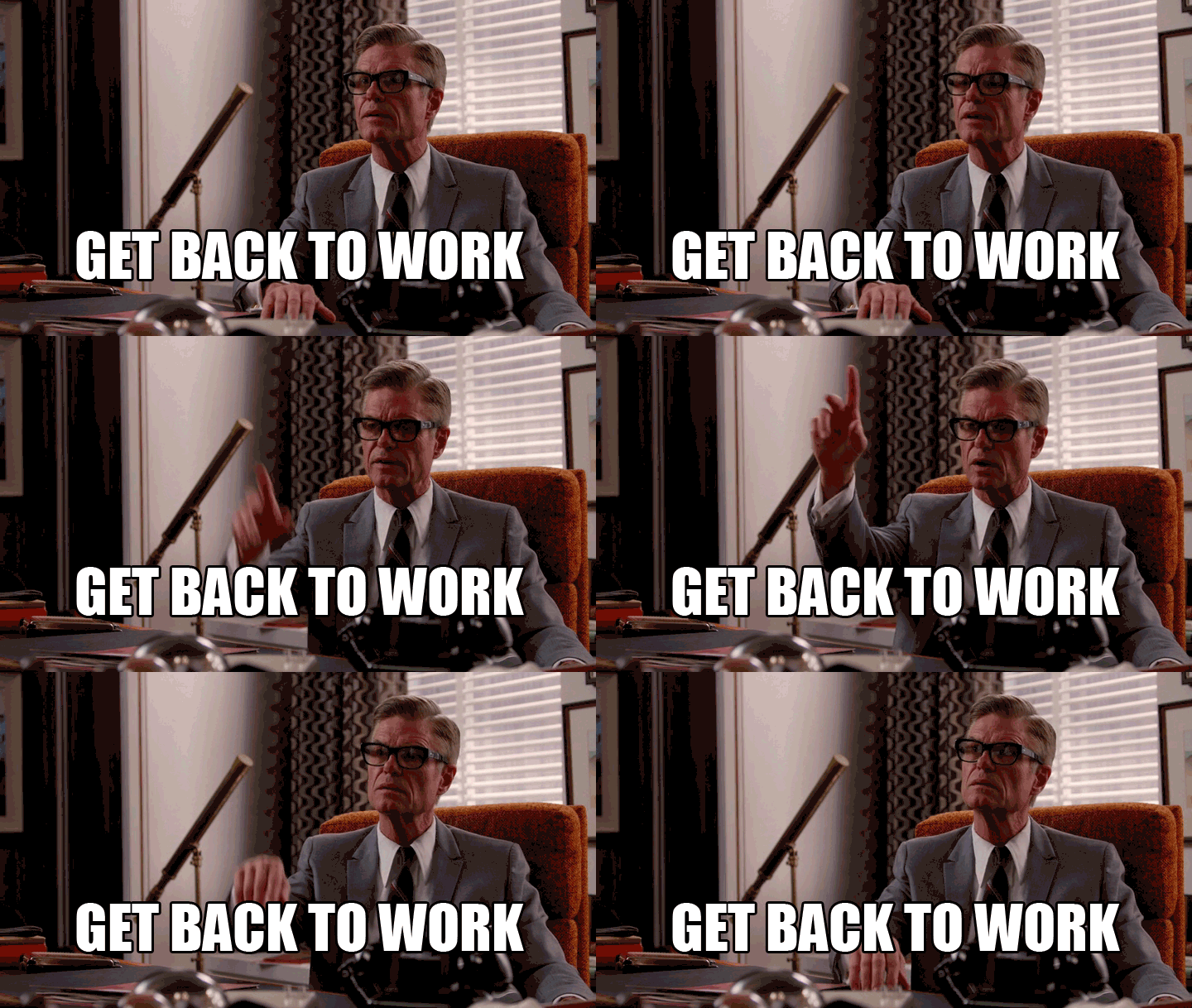
Back to work

Okay, I really need to get back to writing MU4 and thinking about other projects, now that Diwa & Kaffi is out in the wild. I can certainly do my bit with self-promotion (such as it is) but right now I’m not writing anything at all, and that’s not going to get me back on my yearly release plan! I’ve got a few ideas in mind, finally a few days and some brain space to figure them out, so let’s get crackin’.

And hi, all of you who’ve been picking up my books this month from Smashwords! Glad you could join in! And thank you so much for choosing my novels for your e-reading pile! I hope you enjoy them! If you have any comments or questions regarding them, by all means feel free to drop them here!

Tension

I’ll admit I’m having a bit of a problem with MU4 lately. I have some interesting ideas, but my brain seems to be stuck in low-stakes mode for some reason. I don’t blame anything or anyone other than myself for that; I’d put myself in that mode near the start of the pandemic to a) get through it and deal with the Former Day Job and post-FDJ personal stuff, and b) get into the mood that writing Diwa & Kaffi required. Thing is, I’ve been having trouble getting out of that mode ever since.

This is partly why I’m writing MU4, to be honest. If there was any universe that could get me back into the higher-stakes brainspace, it’s the Mendaihu Universe. It’s much easier said than done, however…I like what I have so far, but I REALLY need to start raising the volume, so to speak. I’ve written several scenes that I think are great, but I seem to be stopping short of Big Epic Action almost every single time.

So I think I really need to shake it up a bit. Whatever’s going on with both my new and old characters, I need to do more with them. They need to get in on the action, get stuck in oh shit situations, do things with consequences. Why am I avoiding writing that? Well, it could very well be that Certain Real Life Politics over the last five or so years took a lot out of me and I’m merely avoiding the emotional stress from it and elsewhere, but I can only avoid it for so long.

I need to connect and channel that tension again. Feed it into something creative. I’m good at that. I know I am. I just need to take that step and do it again.

Getting there one way or another

Every now and again I get to a chapter or a scene that is just not working. No matter what I do to it, no matter what I try, it just…fails. It’s frustrating, sure, but I’ve come to the realization that the true source of frustration lies not in the inability to fix what I have, but in the time wasted going trying to make it work in the first place. Thankfully I don’t let that eat at me too much.

I’m no perfectionist, but I am a writer who trusts their instincts. If this is a scene that just ain’t cutting it, I’ll give it the old college try for a day or so just to see if it’s salvageable. Sometimes it works — I’ll come up with a solution that wasn’t coming to me the day before, or I’ll allow myself some time to work through it in my head first. But more often than not, if it isn’t going to work after a few days, it’s not going to work, period. Cut the offending piece and pasted it in my Outtakes document. [And yes, all of my novels have at least one of those.]

I say this after about three days of trying to write the latest chapter of MU4 and not quite getting anywhere with it. There’s a mood I think works, but there’s no plot, just a few connecting scenes, and that makes for pretty boring prose. My mistake was that I went into the scene unsure where I wanted to go and hoping it would tell me. Sometimes that works, but often times it doesn’t. So what I need to do is cut the whole thing and start from scratch.

It’s frustrating, yes, but sometimes it’s got to be done to move forward.

Real life inspiration

There’s a little bit of real life inspiration in pretty much everything I write, and I’m sure that’s true for nearly every writer. Every story I’ve written does have at least one moment, scene or setting based on reality.

I wrote the Bridgetown Trilogy when I was working at the Yankee Candle warehouse, and while there aren’t specifically any scenes that take place in such a location, it did inspire a few ideas. For instance, the brief mention of Hallera, a planet where people live within instead of on its surface, comes from when I worked second shift and would look out from the dock bays into the deserted semi-darkness of the rear lot at 11:30 at night. There’s also a newer character in MU4 whose day job is working behind the scenes at the Bridgetown Nullport. Several names in the trilogy are Tuckerized from former coworkers in one way or another.

It also explains why the trilogy also had a lot of characters whose day jobs weren’t high-status and they specifically enjoyed Life Outside of Work. Those who were high-status were there for a reason, and their jobs tied in with the story in one way or another. Call me blue collar if you will, but those office job characters never really sounded like much fun to write to me. Even Diana Meeks in In My Blue World, who crunched numbers for a living, didn’t necessarily like her job and it’s barely mentioned.

Being that I live on the much quieter northwest side of San Francisco and currently work at a supermarket, I’m sure that the world of retail might make its eventual appearance somewhere in one of my projects, whether it’s MU4 or something else. One might see retail as drone-like as office work — you’re just another easily replaceable number, apparently — but there’s also a much closer connection to the Outside World that office work doesn’t always provide. Interesting and unique customers and locals become inspirations for characters and background crowds the more you interact with them. Vendors and delivery drivers become secondary characters with unsung but important roles that could help you out of a tricky plot twist. Coworkers once again get Tuckerized as street names and, if they’re interested enough (like many of my YC coworkers were), they’ll ask how the story is coming along.

There’s something about being a little closer to a community at this level that helps me feel more connected to the characters I create. There’s a shine to them that pulls me closer, wanting to know more about their personal lives and how they interact and interconnect with others. It might not be as glamorous or as high-paying as some of my previous positions, but I’ve become rich in other ways whenever I embrace that kind of connection, and that makes all the difference to me.

A different view of Bridgetown

It occurs to me that in writing MU4, this is the first novel in this universe that I’m actually writing while living in a large city, rather than in a small town somewhere in New England. [Not that San Francisco is a large city geography-wise, as it’s only 7 x 7 miles, but it is about 815k residents.] When I was writing the original Bridgetown Trilogy, I envisioned the Bridgetown Sprawl very much like a portion of Los Angeles, which I’d never visited let alone seen or researched to any extent. It was just a personal vision of a large city.

Years later, however, I’ve made multiple trips down to LA and lived in the Bay Area for several years, and also visited many other large cities and metropolises. Has this personal vision changed since then? Well, I don’t think so, at least not by much. I kind of understand the idea of distance better, for one. And thanks to my years living in the Boston area, I understand how different neighborhoods look different depending on their own locations, altitudes and so on. For example, I took that into account when I pictured Branden Hill being slightly higher in elevation than Main Street sector, but also less condensed, a mixture of residences and school campuses.

I’m kind of doing the opposite with these first few opening chapters of MU4, which take place in the Wilderlands area just west of Bridgetown. I’m using memories of living back in New England, but I’m also picturing the unincorporated areas and satellite towns here in northern California. A small city like Petaluma, or a cozy small town like Half Moon Bay. It feels kind of strange writing this sort of thing, as I really don’t think I’d have written it if we were living back on the east coast. I feel like I’m doing the exact opposite of what I’d done with the trilogy: writing a personal vision of woodlands and small towns.

Not to fear, though…Bridgetown is definitely going to be playing a big part in this novel as well. I am curious, however, if this vision of city sprawl will be different from before.

New Settings in the Mendaihu Universe

One thing I’ve been looking forward to in writing MU4 is that many scenes take place in locations that weren’t in the original trilogy. For instance, three of the first four chapters I’ve written so far take place outside the Bridgetown Sprawl, specifically in and around a small outpost town west of the city. It has specific ties to the trilogy, but as of now those ties aren’t the main focus.

It’s been fun and refreshing so far to write these characters in this new location. I’d been wanting to write a MU story set in the Wilderlands for ages! While this doesn’t solely take place here, a good portion of it will. This of course means giving the location a distinct layout, perhaps a map or two that I can use for reference, just as I did with Bridgetown. It’ll also have its own set of rules that I will need to follow. This is a special place in the mythology, so what happens here will affect everything that happens after.

Creating the setting has always been one of my favorite parts of writing novels, to tell the truth. Such as the city shared in two different universes/timelines for In My Blue World. The bayside cities and suburbs of Diwa & Kaffi. Even the small New England town of Meet the Lidwells. I love creating layers of this kind of background: its geography, its size and shape, its population. Little things that might not be completely important to the story as a whole, but certainly makes it more real.

Movement

One of the things in the back of my mind while writing MU4 has been that as much as I enjoy a nod to a previous story, the last thing I want to do is open this novel the same way A Division of Souls did. This is partly why it’s taken me a good couple of tries to nail the landing in these first few chapters. The stakes are just as high, but they’re different stakes this time.

I’ve also been reminding myself that this is a universe that is in constant motion. Sure, there are moments of quietness and contemplation in these stories, but that’s when the mind is in motion. This is how I remember writing the previous novels: every session has to have at least one scene where something moves. It can be incremental, or it can be the steadfast refusal to do so, or it can be a rash unthinking decision.

The Mendaihu Universe always had a theme of Balance In Motion; there are a few scenes in the original trilogy where someone says that life is always changing and never static (or something close to it), and it’s up to ourselves whether to move with the changes or stay in one place. Denni’s decision in this case was the one that changed fate: she chose the former, to adjust her role as the One of All Sacred when and where necessary. No former Ones had done ever done that.

So what about MU4, then? Well, without giving too much detail, let’s just say there’s a schism going on: the ones who have adjusted their fates and those who have refused. One of MU4‘s themes is about how far people will follow those paths. There’s dedication, and then there’s extremism. There’s response and then there’s reaction.

I’m just as curious as you are to where all this movement will take us.

Connections

I’ve been thinking a lot about what some of the themes in MU4 might be, and I think one of the most important is about personal connections; the ones we make, the ones we destroy, the ones we wish we had and the ones we protect with everything we have.

I posted a rough version of Chapter 1 some months back, in which a young woman named Eika is dropped off in a deserted town and forced to undergo a solo trial to prove her worth as part of the Order of the Blessed Ones. Her story of connection is about the utter lack of it in her failure to live up to her family’s and community’s expectations. In Chapter 2 we’ll see the connection between two new Alien Relations Unit officers, Lizzie Kapranos and Ruu-Sseikassi Tiiegasi, who will have a somewhat unconventional connection with each other that’s different than Alec Poe and Caren Johnson’s in the previous books. And later on we’ll see an arc about Ampryss and Shirai, and how their connections to their original fates have changed because of the Season of the Ninth Embodiment.

I’ve chosen ‘personal connections’ to be one of the backbones of MU4 (and possibly other related stories) partly because of what Denni Johnson did near the end of The Balance of Light: she pretty much broke all the rules and expectations and sent fate off in uncharted directions. Every detail, every question and every choice is related to what connections the characters make, because that is the only anchor with each other that they truly have.

Of course, this isn’t about strict maintenance of those connections…like I said, it’s also about how they can be destroyed, and why.

But then I’d be giving away too much if I kept going, heh.

Read my EBooks! :)

Yeah, I know. I am absolutely terrible at self-promotion…but then again, there really isn’t any one way to go about it, is there? Maybe I should stop trying to dive into the overcrowded pool of self-published writers trying to get your attention and lean heavy on what comes natural to me: the outsider this is kind of weird but fascinating mystique…? ¯\_(ツ)_/¯

ANYWAY. All five of my novels — The Bridgetown Trilogy (A Division of Souls, The Persistence of Memories and The Balance of Light), Meet the Lidwells! and In My Blue World — are available for FREE at Smashwords this week, so if you haven’t downloaded them already, have at it! You can find them here at my profile page:

https://www.smashwords.com/profile/view/jonchaisson

Besides, those trilogy books are doorstoppers (but a lot of fun!) so by the time you finish reading those, maybe I’ll have finished the fourth book! Heh.