Creative…privilege?

So some AI-leaning techbro this week posted something on social media about artists, writers, musicians, etc., having the unfair advantage of “creative privilege” because they allegedly came to their craft with some gods-given blessing, and it’s unfair that the rest of the non-creative world has to actually, y’know, work at it, and it’s all unfair that we creatives have that advantage.

Or something like that. Either way, he’s currently getting roasted in response.

I’ll be honest, my first reaction to this complaint was that it kind of reminded me of high school. It reminded me of being a non-sports kid in a school where most extracurricular funding went to the boys’ football team, no teacher wanted be an advisor for school plays so there weren’t any, and the funding and printing for the school newspaper got pulled the year before. So me, my friends Kevin and Kris, and a few others, decided to use our creative privilege to edit and put it out ourselves, using Pagemaker on the school’s Mac and the gracious help of the printing class teacher who ran a few hundred copies off on printer paper and collated them for free. We used our creative privilege by figuring out a workaround and doing most of the work ourselves. Sort of self-publishing it, in a way. And it was a success! We kept it going the entire year on a consistent basis, got several other students to write articles, and kept it alive when no one else bothered.

If there’s such a thing as creative privilege, it’s the ability to move past roadblocks and obstacles. There’s no One Right Way or One Weird Trick They Don’t Want You To Know to do it either, because it’s different for everyone. It’s what works for you, and it’s most definitely not just about finding shortcuts, either. Running a complicated algorithm that essentially mashes up other people’s creative works and then slapping your own name on it is a shortcut, and a dishonest one at that. Figuring out your own style and voice takes hard mental and emotional work, and you need to put in that work, because those who see the end result can definitely tell the difference.

A good example: remember those music mashups of the early 00s? Some of them were amusing and entertaining, and I have a collection of them in my music library. But there’s a big difference between what’s known as the “A + B” mashup (one song over the other with minimal separation or creativity) and the actual DJ mixing (seamlessly sliding one song’s separated vocal lines onto the instrumental of another song). This so-called “AI art” and “AI writing” is, for the most part, the former. And it’s not artificial intelligence, despite the label it’s been given. The computer is merely running software and mashing up different parts the user chose, that’s all; any ‘mixing’ is also the computer doing a bit of barebones touch-up. And yes, you can definitely tell the difference.

So my answer? Sure! I’ve got creative privilege, and I’m proud of it because I worked hard for years at it! I may not be raking in the money and the prestige, but I’m still getting the occasional ebook sale and that’s pretty damn cool in itself. That’s all I’ve really wanted.

And I’m sure you can make it happen as well. You just need to do more than run an algorithm, have the computer do the mashup work, and say ‘there, it’s done’.

Into the woods

One of the motifs in Queen Ophelia’s War is the forest. I suppose it could be seen as me channeling my years back in New England, growing up in a densely wooded valley and driving all those tree-lined back roads in the 90s and early 00s. But to be truthful, I think this is more about my visits to the actual nature areas to the north of San Francisco. Muir Woods, Armstrong Redwoods, and the hills between Ukiah and Mendocino. And even the little hideaways in Golden Gate Park, Land’s End and the Presidio nearby.

Sure, ‘entering the forbidden forest’ is a classic fantasy trope, but I’ve always been fascinated by it. More to the point, I’ve loved the idea of a mystical passageway between worlds ever since I first saw that animated version of The Lion, the Witch and the Wardrobe in the late 70s. [This of course is one of the reasons my writing office is called Spare Oom.] The idea that just past the edge of the known is an extremely vast unknown is something I knew as a kid, and I’ve often had dreams about it. With Queen Ophelia’s War I finally decided to latch onto that idea as a whole: it’s not just about entering a different world, but about discovering oneself in the process.

As I’ve said before, I’ve written an almost complete rough draft already that I’d worked on during the height of the pandemic, so now what I’m doing is giving it more life and color. Going deeper into the forest, perhaps. Discovering what’s beyond.

Coming back again

I think I can safely say I’ve come back around to working on Queen Ophelia’s War again. I’ve done a few single pages’ worth of work on them these last couple of weeks. Fine tuning the opening for the most part, just to get my bearings. I’m happy with what I have so far, as this has helped me figure out the pacing and the style I’ll be using throughout. There’s a deliberate flow going on here, much like Diwa & Kaffi: unrushed, but not glacial.

This novel, like Theadia, is new territory for me. It’s closer to a straight fantasy novel than In My Blue World, I think. I read a lot of that genre during the Belfry years of the late 90s and early 00s. I’d always wanted to write it, though at the time I didn’t think I’d be able to pull it off. In my usual fashion, I take the genre and give it my own personal twist: it’s less about the monsters, legends and magic and more about what’s going on within. Why the characters are who they are, and what they need to do to change for the better.

And if all goes well, then I’ll be thrilled to share this novel with you when it’s done!

Understanding the (created) world

I’ve come to realize that out of all the moving parts in my novels, I think the strongest and most vivid part of each one is the world I’d created for it. I just find worldbuilding to be my most favorite part of writing a novel. Mind you, I’ve learned not to get too lost in it while writing, but just enough for the reader to have a visual idea of where the story takes place. But I’m not merely using it for a brushstroke or background color…a lot of the time these places are the way they are for a reasons very important to the story.

Such as in the Bridgetown Trilogy, which takes place in multiple locations: Bridgetown itself (a sprawling and crowded metropolis, signifying tension and imbalance), Bann Dassah on Trisanda (a quiet and remote area near an ocean coast, signifying peace and balance), and several other places. Or in the unnamed location of In My Blue World, seen both as a quiet small city (signifying stasis, safety and eventually boredom) and as an overpacked sprawl (signifying movement, excitement and impermanence). The world of Diwa & Kaffi uses a slightly different twist: it generally takes place in several linked areas that are already known by the characters; the role for their world here is in their experiencing these areas on a deeply personal level for the first time.

In both Theadia and Queen Ophelia’s War the worlds continue these ideas: the generally known versus the experienced, safety versus threat, the group understanding versus the vividly personal. It’s one of the most important things I always need to remind myself when writing new novels: I rarely ever want to place these characters in a setting that could be anywhere; the location needs to have some kind of purpose, either directly or indirectly, and often obliquely. It not only makes the story more relatable to the reader, it also makes them feel the same underlying tension the characters are feeling.

Ready to go again

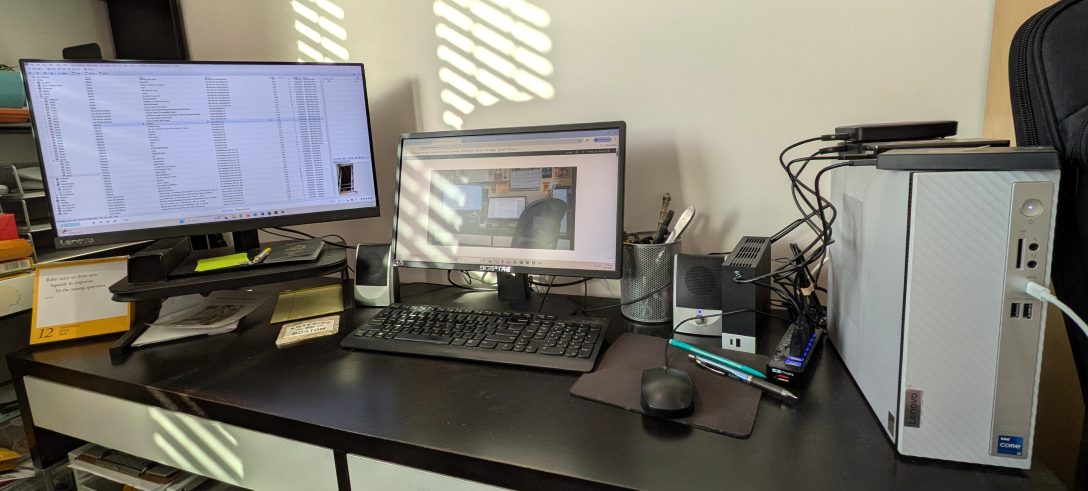
I’ve been away from my WIPs for quite a long time, to be honest. Longer than I’d planned, but I’m okay with that. I had my reasons. But now I’m ready to get back behind the keyboard and set off on another adventure.

It just so happens that I finished up another one of my Great Reread sessions of my own work (for sequel-idea or WIP-finishing purposes) as of last Saturday evening. I finished the session with the Bridgetown Trilogy primarily to psych myself up for writing MU4, and in hindsight that was a good idea. The current version of MU4 that I’m working with resonates with the previous three novels yet stands on its own quite well, and that’s exactly what I was hoping for.

And what about the other projects? Right now I have Theadia and Queen Ophelia’s War on the front burners, and Sheila Take a Bow and Walk in Silence (the book) on the back burners. And I’m fine with that. I’m not worried about not having anything brand spanking new to work on — I think I’ve finally grown out of that particular hang up. I have the stories I want to tell, and I’m ready to start writing them. And if anything new does eventually come along, well, that’s what the 750Words site is for, right?

This also means I’m ready to start reading books again! Yay! I’ve finally gotten past the reading burnout and the indifference of my TBR pile, and I’m looking forward to catching up with what I have. And I’m also looking forward to looking for new titles again, something I haven’t done in quite a while. I don’t get that burnout all that often, but I’m glad in the knowledge that when it does happen, it doesn’t last for all that long.

I’m ready to go again, and I can’t wait!

Dialing it back

I’ve said before that writing Diwa & Kaffi did a number on me mentally and emotionally, but not because it was a hard book to write. On the contrary, it was an immensely pleasurable book to write, even despite the occasional pitfalls and issues I had with it over the couple of years I worked on it. So what happened?

What happened was that I wrote a book where I dialed it back.

My writing, even my juvenilia, has always had that element of emotions at full volume, much like my life for years. It wasn’t real or important unless I was feeling it fully, intensely and completely. It’s just the way my brain had been wired all this time. You can definitely see it in the Bridgetown Trilogy, and even in Meet the Lidwells! and In My Blue World, though in a more muted way.

It was while I was working on Diwa & Kaffi that I realized that not only do I not have to write in that style, I most definitely do not have to live my life that way, either. And that’s what I did during the pandemic while I was unemployed: I dialed it back. It took a long time and I had to do it in increments, but the more I did it, the more I knew this was the right thing to do. The healthier thing to do, physically and emotionally.

In doing this, I allowed myself to make life choices without the overwhelming feeling of yes, but is this what you really want to do? doubt hanging over my head at every moment. I learned that was the main culprit: self-doubt. Not exactly crippling, but definitely strong enough to make me constantly second-guess myself when it came to life decisions. I’d always trusted myself once I took the plunge in whatever decision I made, but it was that initial yes, but what if that was so fucking hard to get past. And to compensate for that, I’d prove I was right by resonating with the decision: fully, intensely and completely.

I started seeing that this was not only unhealthy, but this most definitely was not how most people dealt with this sort of thing. I was constantly jealous of others who could make life-altering decisions with just a ‘yeah, this is what I want’ without dwelling on the decision for years on end and hyper-focusing on the possible outcomes. Why couldn’t I be that way?

Turns out I can. All I had to do was dial it back.

That was part of the reason I wrote Diwa & Kaffi in the first place: I wanted to see if I could write something calm and low-stakes yet still about life-changing decisions. A story that I felt just as strongly about as my other works, but without that unhealthy intensity. That novel was me proving to myself that I didn’t have to live my life dialed up to eleven every waking moment. It was about trusting myself, even if I didn’t know the outcome. And once I finished it, I knew I’d made the right decision.

It scared the shit out of me, finally knowing that I could change, that I could be this person I needed to be with a much calmer demeanor. But the best part? That self-doubt was nowhere to be seen. Sure, sometimes the are you sure? voice is still there, but it’s not crippling. It’s merely reminding me to be smart about my choices, that’s all. I trust myself a hell of a lot more now. Sometimes life just…is. It doesn’t always have to be a Fully and Completely moment every time. And that’s just fine.

I’m sure MU4 will still be intense, as that’s what that universe is all about. And I think my stories going forward will have a somewhat more realistic take on high-stakes issues and intensity, rather than writing another dialed-to-eleven manuscript. Will it change my style any? Who knows. If it does, it does. And that’s just fine too.

Back from vacation

After a change in plans, A and I decided to head up north to Bodega Bay for a few days for some quiet relaxation. For those of you familiar with that town name, it’s where Hitchcock filmed most of The Birds (some of it was also filmed in the super tiny village of Bodega a few miles inland as well), and let me tell you, we saw a LOT of birds during that trip. Not to mention a lot of dairy farmland along the way. It’s actually not as far as I’d expected; it’s about an hour and a half north of us and super easy to get to, which means we may do this again as a day trip in the future.

It’s definitely not a huge ocean resort location; rather, it’s a place for RVs, fishing, road tripping, eating tasty seafood, and hiking. [And visiting some of the more infamous Birds locations.] And for us, a few days of sitting around reading, going for nature walks and driving up the coast to see what’s there. I didn’t do much other than take a lot of pictures, eat great food and catch up on my Bridgetown Trilogy reread. I did bring a few notebooks with me, but as expected, I did not make a single mark in any of them.

After all, that’s what vacations are for, yeah? To take time off from doing stuff you do on the daily? Heh.

Anyhoo…we’re back home with the cats (thanks much to Carter, who cat-sat for us and kept Jules and Cali busy with play, kitty food and lots of pettins) and enjoying the last of the week off by not doing much of anything at all…except more reading.

See you on Monday!