Seven or eight things

One of the hardest parts of wanting to keep a daily habit of writing at 750Words (especially after a long hiatus) is trying to come up with something to write about in the first place. Some days I’m just fine and the ideas come easy to me, but other days I tend to overthink it and get nowhere. I’m also still trying to get out of the habit of using the site to write personal things that really should be offline in my moleskine notebook.

Something I’ve recently come up with to get around that temporary writer’s block is what I’ve been calling “Seven Or Eight Things”. Instead of trying to think of something I could stretch to roughly eight hundred words, I’ll split it up: I’ll write about seven or eight things for a hundred words. There’s no planned subject, I just let the words take me somewhere for a brief time.

Surprisingly, it’s been working even better than I’d expected! Over the last couple of days I’ve been talking about writing plans, thoughts on an album I happen to be listening to at that moment, or working through a creative problem I’m having. A few personal things still pop in, but those entries are actually in the minority this time out, and that’s perfect for what I’m trying to do here. Most of the time it’s something that pops into my head at that particular moment, so it could be anything!

Mind you, this is not a plan set in stone. It’s merely a process I’m trying out where I’m able to approach the daily words easier, but without the added stress of forcing myself to think of something to write about. If anything, it’s a reminder that I shouldn’t be so hard on myself when it comes to creativity. Leave the hyperfocus to the projects that need it; this is merely the warm-up exercise and stretch that I need beforehand.

Filling in the gaps

I am now at the point in Theadia where I have to visit all the WRITE THIS LATER gaps and…well, write them. Thankfully, I planned ahead of time during this last reread/revision, where I wrote out a paragraph or two of each plot point I need to hit for these scenes and chapters. Also thankfully, most of them are scenes featuring a not-quite-secondary, not-quite-primary character, which means I can focus mostly on the action. As you can guess, I wasn’t entirely sure at first how to approach him as he’s not the kind of character I usually write, and that’s mainly why I skipped them. One, so I won’t lose focus on the rest of the novel, and two, by the time I come back to these scenes, I’ll have a better idea of who he is and why he does what he does.

So why am I putting them there in the first place? Well, if I truly felt that I could get away with not putting them in, I probably would have shoehorned a variant version of the scene (or the information it’s relaying) elsewhere and via a more important character, but I don’t feel that’s the case here. This is a character that isn’t part of the tight-knit main character circle, but they do have a very important link with at least three of them that I think strengthens the story’s logic and flow. He’s an insider that helps the mains achieve their goals without actually abandoning his link to his status within the ranks. He’s gruff and cranky but he’s also extremely intelligent and supportive.

I’ll be honest, using the WRITE THIS LATER gap style of writing novels is still a rather recent change in my writing process. I always write in chronological order from start to finish, and I’m always worried that if I skip scenes too often, the multiple interwoven plot threads running through my head will unravel. This changed when I wrote Diwa & Kaffi, however, when during one of the rereads I realized I’d forgotten to add a key scene that would make the logic and flow work even better.

I still use the style quite infrequently, but these days I’m not as nervous about it. As long as I use it for the right reasons and not out of any sense of laziness or ‘just don’t wanna’ avoidance!

Clocking in

I was thinking the other day about how I sometimes have a problem with getting started and/or staying with my writing sessions. Quite often I’d blame distractions like the internets or my music library, or having a case of the Don’t Wannas. But after several years of trying to work through all that and getting nowhere, I realized that perhaps I’m looking at it from the wrong angle. So I started thinking: what was it that I did back in the Belfry days in the late 90s/early 00s that made my writing sessions so successful?

Sure, I had the same distractions then as now, but I still managed to work through them. It’s not the drive, then. It’s something else.

And then it occurred to me: I treated my writing sessions like ‘going into the office’ back then. That was the One Simple Trick that helped me approach the sessions with more seriousness. No matter what I did during the day, the session would start at seven pm sharp and often end around nine. A few minutes spent deciding what to listen to, maybe a game or two of FreeCell, but then it was Time To Work. Clock in and do the job until it was time to clock out. Once I established that habit and stuck to it, it worked perfectly for almost four years with almost no issues.

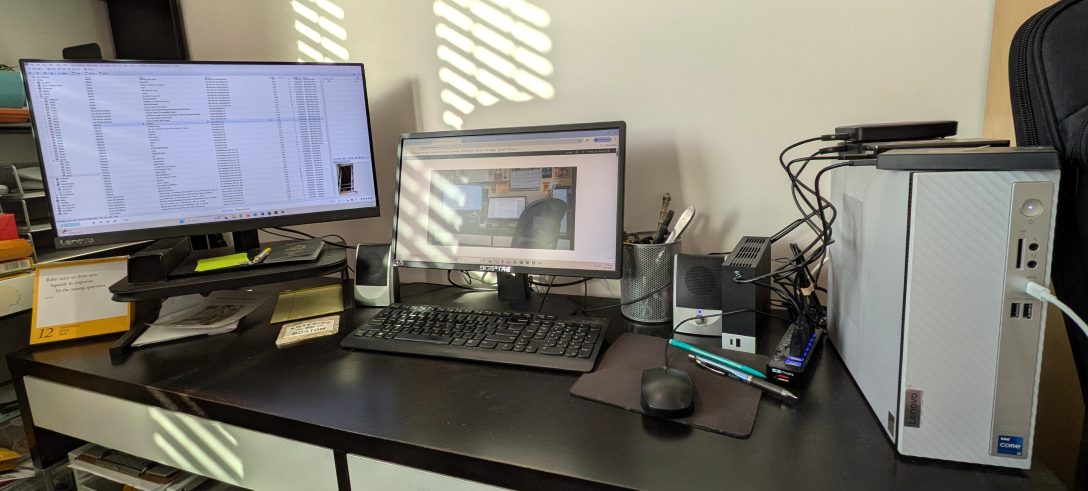
I realized that perhaps the problem these days isn’t so much the drive but the focus. So starting this week, I’ve been trying my hand at reviving that mindset: come 7pm, it’s time to clock in here in Spare Oom. Throw on some music, and get the session started. I’ll allow certain minimal distractions (like visiting cats, for example) but my main focus should always be on the primary writing project. Think of it once more as ‘going into the office’ instead of just the back room.

I’m allowing myself not to be perfect about it, of course. Changes in work schedule, other real life stuff going on, whatever. I’ll even accept that I might be having an off day. As long as I make this process consistent in the long run!

Rereading My Work

Sure, I’ll reread my own work, whether it’s completed and self-published, incomplete and on the backburner, or trunked and best forgotten. I do it rather often, actually, and for various reasons. Since releasing Diwa & Kaffi out into the world, I gave that one yet another once-over, just to see how it looks in epub format. [Quite nice, actually.] After that I reread In My Blue World with the idea of toying with the possibility of writing its sequel. And now I’m rereading what I have of Queen Ophelia (which, now that I think about it, should really be titled Queen Ophelia’s War if I’m going to keep the title at all). I plan to reread Theadia after that.

I’m rereading these three to decide which project I should work on next while also working on MU4. I’m still undecided as to which one to tackle so I’m refamiliarizing myself with the stories to see which one resonates with me the most. Sure, I could come up with a completely new idea if I wanted, but I’m holding back on that because I feel these still have merit, even if they do need a hell of a lot of work.

And that’s the other reason for the rereads: how much work do they need, and is it worth spending the time? I don’t think any of them need a major overhaul, thankfully, and the newer ideas just need their outlines fleshed out and the stories written. I don’t count MU4 here, because that’s in an altogether different beast; when I have the time I’ll reread the original trilogy and what I have of 4 because that particular project needs a different kind of immersion.

It’s a lot of work and it surely eats into my GoodReads numbers, but I’ve found that this is part of a larger process that works really well for my projects — it’s just enough immersion into the created world so that I can easily slide back into it and move forward.

Twenty Years of MS Word

In writing something elsewhere, it suddenly occurred to me that I’ve been using MS Word exclusively for twenty years now. I believe it was sometime in March or April of 2003 that I bought my first completely new PC off the Dell website. With my own money and everything! I’d been using the previous writing programs that came with Windows 3.1 and 98 — MS Write and WordPad — and I realized this would be an excellent upgrade. This was one of those ‘customize your own personal computer’ specials Dell had and I spent the slightly extra money to have that added along with a decent media player that could play cds and dvds. I wasn’t (and still am not) a PC gamer so all that processing power and speed went to those two apps.

Over the years I’ve heard many pros and cons of Word from the writing community. Some swear by it, others swear at it. I’ve heard many writers suggest other programs and refuse to touch this one. Me? I’ve had nothing but pleasant experiences with it. I don’t think it’s ever crashed once on me (not including when it was actually the PC doing the crashing). As long as I keep up my habit of frequently saving my work (thanks, Dropbox!), all is well. Even now that it’s part of the Office 365 umbrella, It’s worked a peach.

All of my novels from A Division of Souls forwards were written, edited and revised using Word, and it’s even used to do the formatting for their Smashwords editions. I’m using it now for MU4. I’ve learned how to use more of its fiddly editing and formatting functions and they’ve pretty much become part of the tool bar at the top header.

I’ll use a Word-like app for reading on my tablet and e-reader, but I don’t plan on switching to anything else at this point.

Making that connection

The hardest thing about writing MU4 so far has been making a personal connection with my characters. I know what I want from them, and I think I know how I want them to evolve, but getting to those points has been fraught with missing by inches.

I also know, this time for a fact, that I’m not trying hard enough. I’m still suffering through waves of the Don’t Wannas with an equal serving of Easily Distracted. I want to write this novel, damn it all, I’m just avoiding working on it, and I’m starting to piss myself off because of it.

If this means I have to take desperate measures, I’ll do it. I’ve already uninstalled or removed several apps from my phone to minimize distraction during Day Job breaks I should be spending less passively. But though I’ve been doing all my actual writing work at home and I do close my web browsers come writing time, I still have too many distractions. If this means unpinning nearly every shortcut from the Task Bar, so be it. Making it harder to open distraction apps usually works for me simply by utilizing the Out of Sight Out of Mind method, and I’d rather not use one of those ‘won’t/can’t open until forty-five minutes pass’ apps if I can help it.

Still — the issue remains that when I am writing, I’m still not quite making that connection. I’m not connecting on that emotional level I’m aiming for. They still feel too distant. And again, that’s a personal issue I have to work through: I have to let myself establish that level, allow myself to take that deep dive. I know I can do it and I’ve done it before.

Eventually I’ll make that connection I’m longing for. I just need to keep trying.

Keeping It Up

So how am I doing a week after stating that I’m ramping up my writing schedule? Not bad at all, actually! I’m averaging around 1000 words each on all three projects, and staying on top of the other things such as daily drawings, personal journal entries, and these here blogs. It keeps me reasonably busy for most of the day with some extra time to catch up on non-writing writing biz things when need be. Quite happy about that.

So how am I pulling this off? By sticking to my daily schedule, closing browsers, and having a bit of a rough outline of the current scene(s) I’m working on. I’m writing Project 1 by 9am, starting work on Project 2 by 11, finishing that off after lunch and working on Project 3 by 2pm. I give myself about two solid mostly uninterrupted hours with minimal distraction other than perhaps acquiring more coffee.

I’m also making it into an immediate-errand-completion-success process in my head. That in itself is important, as that was now I managed to teach myself to get my schoolwork done on time back in the day. I’ll open up only the Word docs I need, and focus only on that until I feel I’ve done a decent amount of work on it for the day. Sometimes it’s around 700 words, other times it’s 1200, but as long as I’m happy with what I’ve completed and left off at, that’s what really matters.

And what about off days? Well, I took Tuesday off from everything for the sole purpose of celebrating A’s birthday and going out for a bit (we went to see Shang-Chi and the Legend of the Ten Rings, which was a super fun film!) and I ensured that I didn’t feel guilty or twitchy about not working. I didn’t even write a journal entry! That’s the other important thing: it’s totally fine for me to take a personal day off from the writing! Taking the day off isn’t the problem for me…it’s trying to shake the feeling that I’m procrastinating and feeling guilty about it. It never quite goes away, but I’ve learned to ignore it.

I have no idea how long this schedule will last, nor do I want to know, because the point is not to think about things like that. The point is also to keep doing it until further notice!

When it sounds right

Image courtesy of Big Hero 6

I’ll be honest, even though I might have created an outline for whatever WIP I’m working on, there’s a pretty good chance that I’m not leaning hard on it, and still trusting myself with whatever sounds right. It’s not the same as pantsing it; that would basically mean I’m sort of making it up as I go along with only a mental map with the barest of details. It’s more like I’ve worked out several levels of what resonates with me.

Put it this way: the outlines/synopses I’ve drawn out for Current Projects A and B were created by thinking of how I want the book as a whole to play out. With Project A, for instance, the focus starts only on one character, Althea, but by the end of the story it focuses on a lot of people, and that’s for a reason: the theme of the story is “when personal events become so much bigger than ourselves”. Having laid that part out in the synopsis, then I start going micro: the events of each successive chapter/scene needs to become bigger somehow (this could be in scope, but also in conflict, or in action, or in how said conflict affects the characters at that point in time). And often I’ll go one or two levels deeper by the end of that scene or chapter: perhaps an event will affect a major character and drive them to action…and their action will in turn affect someone or something else.

It’s this sort of interplay that’s always in the back of my mind whenever I write a novel, and thus is why I often say I go with what sounds “right” to me. It’s how I know when the prose is strained, or that I’ve focused far too long on a small detail, or I’m using the wrong person’s POV, and so on.

And then, interestingly, I’ll do the exact opposite when I’m doing a reread or a revision: instead of focusing on the construction and the architecture that went into making the story, I’ll look at the finished (or in-progress) piece and see how it’s holding up. Am I making these levels of detail sturdy enough? Could this section be shored up and strengthened? Would an added scene work here, and would it make the story even stronger?

The weird thing, on top of all that, though…is that I don’t always know if I’m really pulling it off while I’m writing it. Project A feels a bit like that lately. It’s partly because I’m writing in a setting I’ve never written in before, but I think I’m pulling off to a decent degree because the story itself doesn’t need micro-details to make it work. All I can say is that the story itself seems to be working well so far in rough draft form. It sounds right to me.

And for a rough draft, that’s all I really ask for, to be honest.

No Longer Pantsing

Image courtesy of Haruhi Suzumiya

I’ve been thinking about how my writing style has changed over the last couple of decades, and I think I can finally admit that I’m no longer a pantser. [For those of you unfamiliar, this of course refers to ‘flying by the seat of your pants’ — meaning that I used to be a writer that barely plotted ahead and just ran with whatever came to mind at that moment.] I’m actually just fine with that, to tell the truth.

Pantsing used to work just fine for me, especially back in the 90s and early 00s, when my main issue was spending far too much time hyperfocusing on whatever scene I was trying to write, and I needed to break out of that somehow. This style worked because it forced me to choose what I wanted to write and run with it. In the process, I’d get a full scene done super quick because I was finding it all out as I went.

Nowadays, though? I’ve become a huge fan of working out complete synopses! I haven’t quite nailed full outlines just yet, but I’m sure I’ll get there soon enough if I keep this up. Writing these synopses out means that I can come up with a solid main plot and maybe a few side plots that will serve as the structure and backbone of these stories. This in turn cuts down on time where I’m sitting here, staring at the screen trying to figure out where I want to go next. I’ve gotten really good at playing out the story a scene or two ahead, so the writing session is really me working from Point A to Point B. The synopses helps me work through that.

Perhaps I’m getting a bit too excited about this, as I’ve managed to work out four or five projects ahead, what with all these synopses I’ve been writing lately, but really, I’m not seeing a major problem with that, other than prioritizing them…and that’s where the whiteboard and daily schedules come in. It’s a matter of “okay, I need to do prose writing work for Project A this morning and Project B this afternoon” and maybe playing around with the world building of Projects, C, D and E when I want some light and fun work at the end of the day. The main idea of all of this is giving myself future projects to work on, or something else I can work on in tandem with whatever is currently going on. It’s so I can have multiple titles on hand to offer while submitting, really. [Jumping into the pro submission biz is another subject entirely, and I’ll be blogging about that soon enough.]

This is what I meant earlier about having good distractions. All this is keeping me busy and productive. I may have been able to pull this off as a pantser back in the day — I mean, I was too broke to do anything else, plus this was also back during my dial-up years so I wasn’t online nearly as much either — but things in my life have changed enough that it only makes sense that my writing process evolves along with it.

As long as I’m going in the right direction, as I often say!

On Writing Transitions

I’m currently at the final quarter of this recent revision go-round for Diwa & Kaffi, which means that hopefully within the next couple of weeks, I’ll be able to get back to my new writing projects again. Yes! I am definitely looking forward to it!

The transition between Writer Brain work (that is, creating new words and ideas from scratch) and Editor Brain work (revision and rewriting words and ideas that already exist) can be tough sometimes, especially when I’ve been doing one or the other for an extended period of time. The transition between the multiyear process of revising, prepping and self-publishing the Bridgetown Trilogy and the start of a completely new project (in this case, Meet the Lidwells!), took a lot of time for me to get used to.

My original plan after releasing The Balance of Light was actually to write the next book in the Mendaihu Universe, but after several false starts, I realized that what I really wanted to do was try my hand at writing shorter standalone stories. The trilogy books are doorstoppers, I’ll admit, so I wanted to learn how to write econo, to borrow a Minutemen phrase. I tried starting up a few other stories and even untrunking a few older ideas, but none of them stuck. This is why I turned to 750Words.com — I needed to force myself to think about writing something clear and compact instead of sprawling and superheavy on the worldbuilding. It forced me to stop looking at my writing in Big Picture format and start looking at each chapter or scene on its own, as part of a larger project. That kept me from a) feeling overwhelmed by it, and b) taught me to dial it all back a bit…each scene didn’t necessarily need to be cranked up to ten every single time.

And when I finished Lidwells, I immediately started working not one but two standalones — In My Blue World and Diwa & Kaffi — on 750Words, while doing revision work at the end of the day. That’s where I realized that the best way to deal with the Writer/Editor Brains issue was not to hyperfocus on one or the other for extended lengths of time. I could spend some time during the day creating a world and some time during the evening tidying up another one. You can definitely sense it in my books I’ve written so far: the Trilogy is quite intense in numerous places, compared to the lightness of Lidwells and the dreamlike quality of In My Blue World. You can even see it in Diwa & Kaffi (whenever it finally becomes available to you!), which I’ve described as “a small story in a much bigger world”.

There is no one single way to transition between the two brain settings, to be honest…it’s whatever works for the writer themselves. I’ve learned that daily multitasking in microbursts is the best for me. I find fresh word count during the day makes me feel productive, making the evening revision work enjoyable and less like a chore.