The Matrix and the Mendaihu Universes

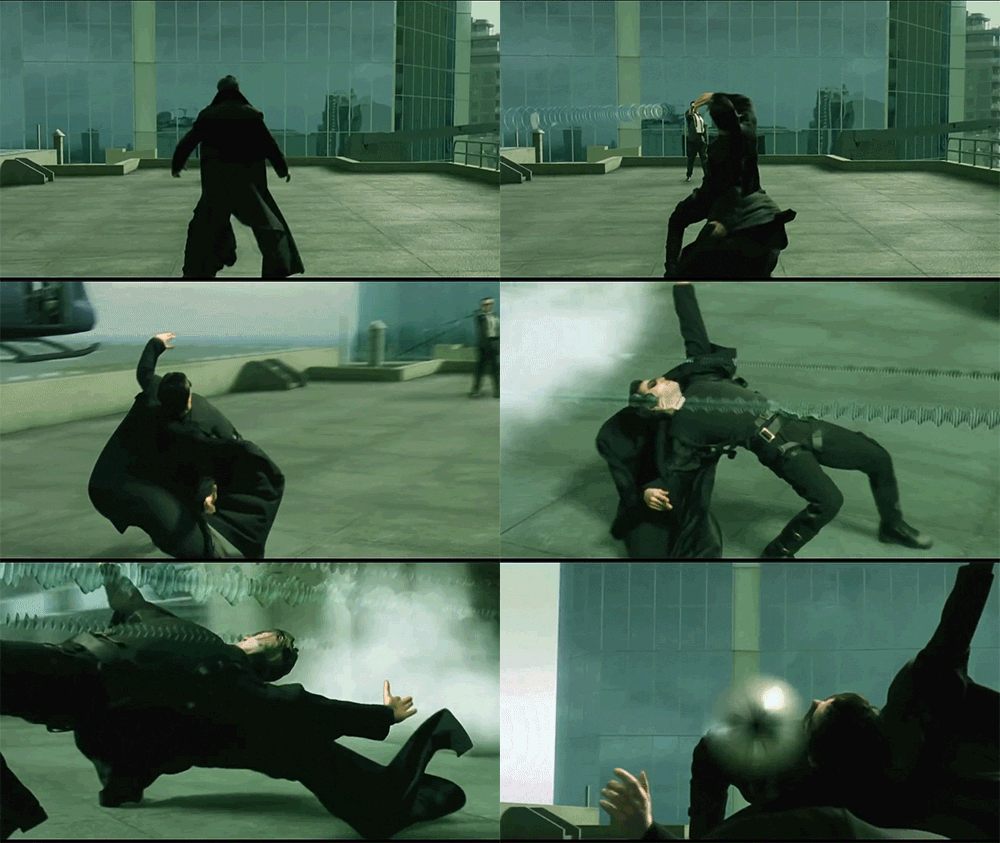
The Matrix Resurrections, the fourth in the series, came out at the height of the pandemic, released both in theaters and streaming on HBO Max at the same time. It was kind of a weird time for all involved, of course, and while the film didn’t come close to being a financial success (mostly due to said dual release), it did feel like the start of a new chapter. And to be honest, it did kind of make me rethink how I was going to approach the fourth book in the Mendaihu Universe if I was going to write it.

We watched all four in order at that time, as A hadn’t seen movies two or three and I hadn’t seen any of them in ages, and one thing that stuck with me is that they were bigger and stronger influences on my trilogy than I’d remembered. It all lines up: the first movie opened in March of 1999, right about the time I’d been thinking about reworking The Phoenix Effect into what would become A Division of Souls. The second and third movies, The Matrix Reloaded and The Matrix Revolutions, would come out in May and November 2003, right about the time I was working on The Persistence of Memories. I especially appreciated that the side-story anthology The Animatrix came out between those two in June 2003, expanding the universe even more, creating more lore that didn’t exactly tie in with Neo’s story.

I think one of the biggest influences on the Bridgetown Trilogy is in fact the expansion of Neo’s story from the original film to its conclusion. I liked that the second and third movies took what had happened in the first — Neo’s awakening into a rebel fighter against the Matrix and its Agents — and expanded on that. Primarily, asking the question: now that you have the power, what are you going to do with it? That soon became Denni’s personal mantra throughout the Bridgetown Trilogy as well; she was well aware of what she could do, so her own conflict was deciding what she should do.

There are other moments, of course. Not gonna lie, the leather duster and the form-fitting uniform of the Mendaihu Elder is definitely a sly wink at Neo and Trinity’s get-up throughout their own series. Little things like levitation and the ability to wield Light came from direct influence as well. I made them my own by thinking about what this kind of action or ability would look like in my own created universe, and expanding from there.

Back to Resurrections, I would say that movie helped me think more about how to frame the fourth book in the Mendaihu Universe. Again, there’s direct inspiration: Resurrections explores life within the Matrix years later, when Neo has become a distorted myth and its believers have forgotten the true history. While the movie focuses on Neo’s rebirth and Trinity’s reawakening, I plan on having MU4 focus on the myth: what happens when belief in the One of All Sacred evolves and becomes a weapon itself. I had the beginnings of that particular idea after I’d released The Balance of Light, but watching Resurrections helped sharpen that idea into something I could expand upon.

Right now, I’m focusing mostly on Theadia, so this one might not arrive until maybe 2027, but we shall see. I’ve got time and I’ve still got the influences and inspirations to work with.

Paying It Forward — Thanks to Holly Lisle

Sad to hear about the passing of author Holly Lisle the other day. She was one of my first inspirations and influences within the SFF genre, having read The Secret Texts trilogy in the late 90s, right about the same time that I was writing and revising The Phoenix Effect, which of course morphed into the Bridgetown Trilogy.

I remember seeing something in the acknowledgement pages of those books that intrigued me: she’d created what was essentially a BBS forum called Forward Motion, a smallish but very active online writing community. They — including Holly — were extremely welcoming, and being a member helped me figure out what I was trying to do with the Mendaihu Universe. I even had a few people beta read some of it at the time. I spent a lot of time at the Forward Motion site during the Belfry years, especially on the days we had ‘word wars’ — we’d all say, okay, let’s see how many words we can hit starting NOW! as a way to get ourselves geared up and excited about the projects we were working on. I’d pop into chat rooms just to see who was around…and often there would be someone asking a question or needing help, and we’d all chip in and offer advice. I got some great advice on my trilogy; one in particular that I remember is that I’d been stuck on a name for a certain character, and a few people suggested his name sound sibilant and harsh to fit his personality. Together we came up with a rather interesting name, and some years later during revision, it was shortened to Saisshalé.

I’d moved away from the FM site when I moved out to San Francisco, though to this day I still talk with a few people I met there. We still talk online and I’ve even met a few in person!

Holly stepped away from FM sometime in the early 00s if I’m not mistaken to focus on writing and teaching, but I never forgot how much that community helped me. It wasn’t just about the help, though — one of Holly’s mottos was ‘paying it forward’ and I certainly did that over the years, offering to beta read for others, and later on giving what information and suggestions I could about self-publishing during local conventions. I never forgot that either.

Thank you, Holly. Your influence as a writer may not have fully been through your writing, but your sense of community certainly stayed with me all these years.

Catching up on reading

My bedside reading pile looks a little less ominous these days as I’ve thinned it out a little bit, finally finishing up some titles and getting rid of others that didn’t quite work for me. Over the last couple of weeks I’ve been rereading a few books by favorite authors in preparation to read a newer title in the same universe that I haven’t gotten to yet.

Recently I’ve finished Karen Lord’s The Best of All Possible Worlds and The Galaxy Game in preparation to start reading the third in the Cygnus Beta series, The Blue, Beautiful World. I’d read them way back in the summer of 2015, and though I clearly remember loving the books, it seems I’d forgotten why, until reading them again. The style is very much in my wheelhouse, and must have inspired or influenced me in some way, as the books’ style is very similar to mine. I read these right about the same time I’d been working on self-publishing the Bridgetown Trilogy, so I must have been looking for something to inspire my future projects.

There’s also the fact that with age and maturity (even within the last decade), I hadn’t noticed just how brilliant the setting is: it’s a story regarding a dying planet that could have been grimdark and dystopian…but wasn’t. It’s about what happens to the survivors, learning to live and adjust to new planets and new cultures, and focuses on a group of people dedicated to ensuring this emigration is successful. It’s actually kind of hopeful without quite being hopepunk.

This, by the way, is similar to the setting of my current WIP Theadia: a story regarding a possible incoming war between galactic sectors…but isn’t merely about the war itself. It’s about what happens to those about to be affected by it, and focuses on a group of people dedicated to ensuring the damage is minimal. Purely coincidental, by the way, considering I hadn’t reread the two books in nearly a decade, but on the other hand, I’m kind of secretly thrilled that I feel like I’m pulling it off. Rereading this series basically said to me, yeah, you can write this kind of thing and get away with it.

My next reread will be Lavie Tidhar’s Central Station which I remember really liking as well, followed up by his recent book Neom, which takes place in the same universe. I was especially drawn to the first book with its origins as separate shorter stories that ended up telling one larger story, and that in itself inspired me to want to someday write a novel with a similar setup. My sometimes-trunked, sometimes-not project Can’t Find My Way Home briefly had a new life back in 2017, partly inspired by that.

So in short, what I’m thinking is this: perhaps it’s time for me to do some more serious catching up on reading, because obviously I’m finally being reminded where my inspirations and influences come from, and maybe find something new in the process!

two hours of peaceful zen moments

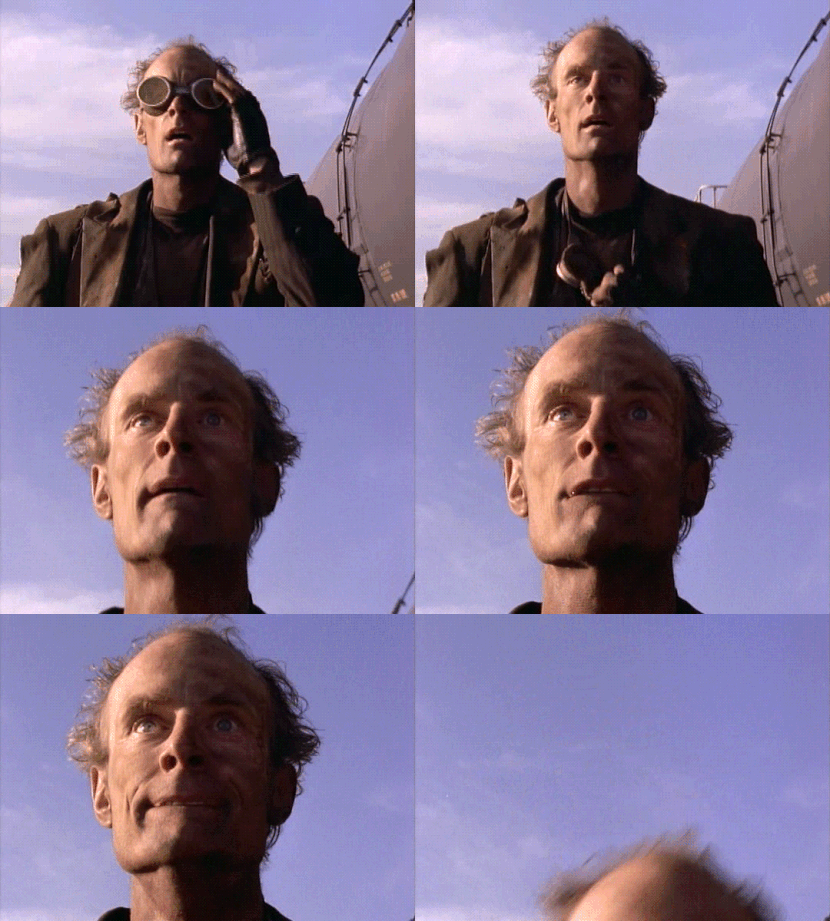
If anything, that’s how I would describe Wim Wenders’ new movie Perfect Days. I’ve always been a fan of his work, and in a way he’s been a influence on my own work: from his movie Until the End of the World I learned how to take my time telling a story, allowing it as much time as it wants or needs, and using those quiet moments as part of the story itself.

This new film simply follows one man throughout his days, working for the city of Tokyo as a public toilet cleaner. He takes pride in his work, says little, and captures quiet moments of his day with an old film camera, mostly of the sun filtering through the tree canopy above (komorebi is the theme of the entire film, and is mentioned in a post-credit shot at the end of the film). Is there even any conflict in this? Yes, there is! But the brilliant thing is how he handles each moment that pulls him out of his daily habits: he observes, he contemplates, and he adjusts. Even when the experience deeply upsets him, he eventually learns from it. His life may have been slightly changed forever in those moments, but he never refuses to embrace them.

And Koji Yakusho, who plays the old man, deserves all the awards and nominations he’s been getting. He rarely reacts with any kind of emotion at first, only opening up near the end, but throughout the entire film he lets out tiny moments of extreme joy: a slight smile, the shine of his eyes, a hum of acceptance. Just those simple and understated moments have the ability to carry the entire scene to show that within, his emotions are nearly always full to bursting.

I can’t say enough about how brilliant, lovely and peaceful this movie was, and I highly recommend it. It’s a masterpiece and a perfect film for studying how to take your time telling your story.

Writing inspiration: John Lennon

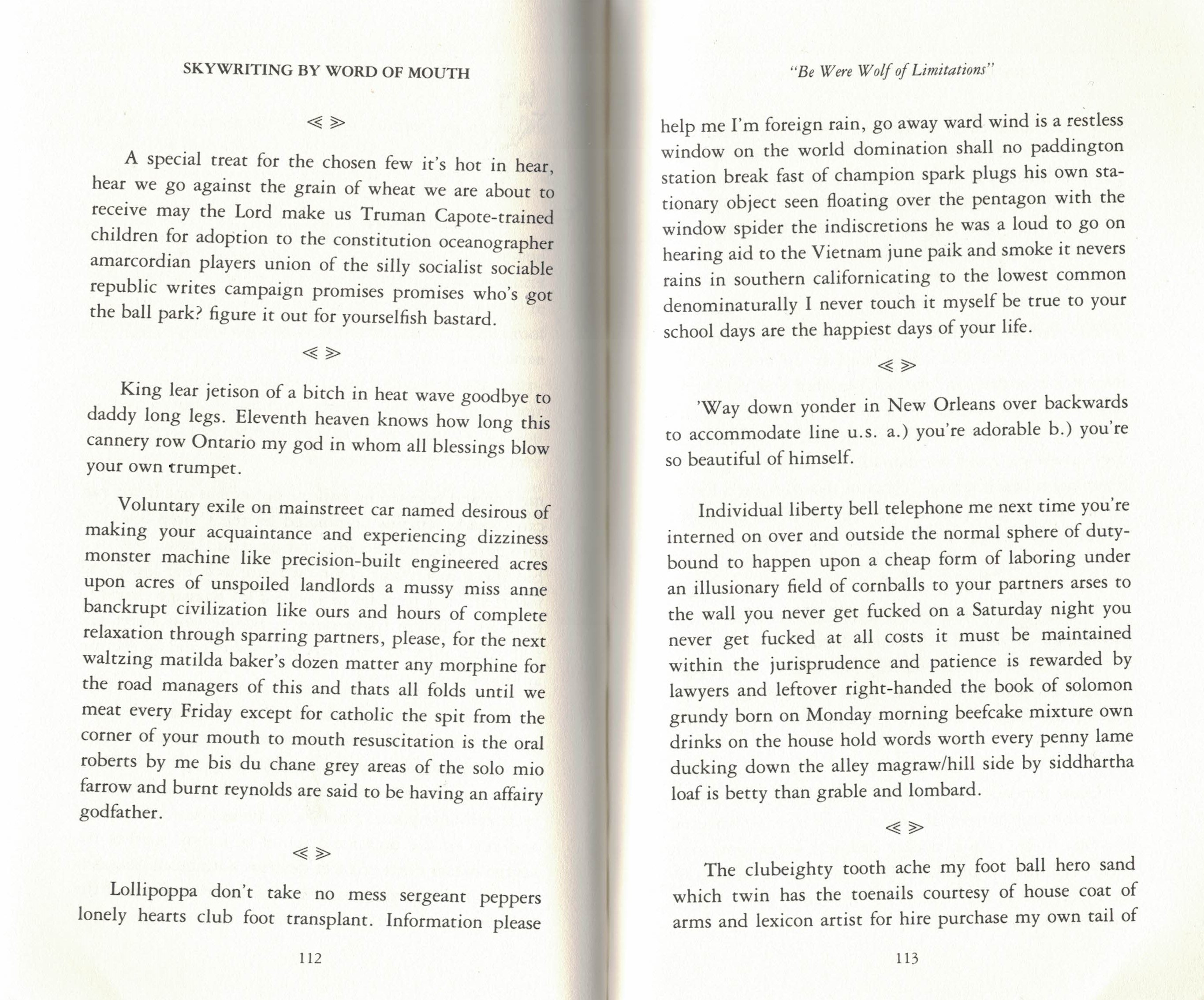
I picked up John Lennon’s Skywriting By Word of Mouth not that long after it came out in the mid-80s, probably sometime around the start of my junior year in high school. It was a collection of his post-Beatle writings mainly composed during his five-year hiatus in the late 70s. Some of it was autobiographical, but a considerable part of it (such as the above) was in his classic absurdist style, and I was immediately drawn to that. I was a kid that loved puns and wordplay, and I was immediately drawn to its stream of conscious humor and weirdness. I loved the idea of utterly random phrases woven together by shared words and homophones.

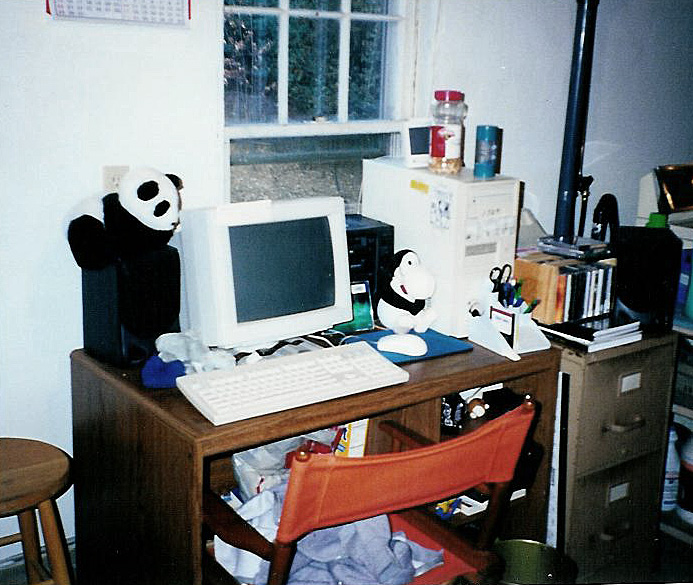
This in turn inspired me to write such things in a similar vein, my own versions written on the school computers (we had Apple IIcs in the computer lab, where I wrote this sort of stuff when I wasn’t playing Lemonade Stand or Jungle Hunt when I should have been doing homework). I think part of it was the need to find another creative avenue after multiple years stuck in the Infamous War Novel, and a need to just have fun. My version of this nonsense verse was heavy with music references (“sunshine in the shade and drink their lemonade when the sun shine my shoestring on my guitar”) and written under the nom de plume Johannes Brezhnev, with the title Oy Vay. [I don’t entirely remember why I latched onto that Yiddish phrase, though it may have been used in a then-recent Bloom County strip, of which I was a huge fan.]

I still have the original printouts! I haven’t read them in years, so I’m sure some of them have not aged very well at all — after all, this is part of my juvenilia pile — but every now and again I bring back that style just for funsies. When I’m a hundred or so words short doing my 750 Words and have nothing of import to write, I’ll bring the style back out (I now refer to them as “wibblies” because why not).

It’s nonsense verse and serves no purpose, but it’s a lot of fun to write!

Influences: Strangers in Paradise

The badass women of Terry Moore’s Strangers in Paradise

Back at the start of my post-college days when I was slumming it in Boston, someone suggested I check out this new comic series called Strangers in Paradise. The first cover was a simple but lovely shot of two women in an art gallery: a moody blonde artist and her seemingly innocent dark-haired bestie. Inside was a story of that second woman having the worst luck with men, specifically a lawyer named Freddie Femur. You’d think this is a classic Bechdel-Test-failing love triangle, yes? Well, maybe not. Because there’s a lot more going on than you think with these characters. A lot more.

Katina “Katchoo” Choovanski, the ‘angry blonde’, is the girl literally from the wrong side of the tracks with a past she’d rather keep quiet. Francine Peters is actually not so pure and innocent and just wants a bit of stability. Freddie, of course, wants to be the slimy alpha male but fails badly at it. And somewhere along the line, Katchoo gets a visit from a fourth character: a kind, quiet and nerdy guy named David Qin, who just wants to take her out for coffee and get to know her.

And that’s only the first three issues. What happens in the next hundred-plus issues that were released between 1993 and 2007 is what truly pulls the reader into this wild universe of criminal underworlds, black ops action, political intrigue, hidden pasts, frustrations in creativity, unrequited love, marriage instability, emotional violence, and spiritual redemption. For some of them, life eventually brings them peace. For the others, not so much, but their downfall is always of their own doing.

What I love about this series is that Moore has chosen to make each female character in this universe as badass as possible in their own unique way. Whether they’re trying to escape their violent past or helping someone battle anorexia or coming to terms with their sexuality or merely just learning how to love and trust someone without any strings attached, these women’s stories very rarely fall into trope or stereotype. These are characters with a vibrant back story and an individuality that sets them apart from each other.

Reading Strangers in Paradise helped me learn how to write and understand my own characters, and how to make them interact. Moore will occasionally throw in silly humor, timely pop culture references, and perfect comedic timing, but when things are serious, he doesn’t hold back. From SiP I learned about pacing, about when to utilize a perfect show-don’t-tell plot device, and how different characters should and could interact. I also learned when to subvert a trope to make the story that much better. And most of all, I learned how a simple back-and-forth dialogue can tell the reader a lot more than just what they’re saying, whether by what’s not being said, or by how it’s being said.

I highly recommend giving the series a try! Moore is a wonderful writer, and he’s also a self-publisher!

**NOTE: If you’ve got $30 to spare, head over to Humble Bundle today or tomorrow, as his complete Abstract Studios bibliography is available in pdf form! If you miss out, check out his work at his Abstract Studios website!**

On Evolution of Influences

Hey, Trashcan, where you goin’, boy?

As I’d mentioned earlier, I’d done a recent reread of the Bridgetown Trilogy for possible future Book 4 ideas. One of the unexpected things I’d noticed was a distinct difference in influences. These three books are definitely different from Meet the Lidwells and In My Blue World, and not just in mood and length. I knew that going in of course, given its long and rambling history.

One of its early influences was of course Stephen King. This was my ex’s doing, having suggested I read him to understand how to write a large ensemble piece. I read The Stand (the unedited version, which I actually find more enjoyable than the shorter original release) right about the same time the 1994 tv miniseries had been released. It made sense to read this particular story and study it a bit, because I already knew that my idea was going to be about an event that affects scores of people and not just the main characters. [I was big on the Big Idea plot at the time.]

While the trilogy changed and evolved in numerous ways over the two decades I worked on it, so did the influences. I’d started reading more fantasy and science fiction, starting with Holly Lisle and CJ Cherryh and moving then to Kate Elliott. [This was about the time I’d started making my frequent road trips to Toadstool Bookshop in Keene and Barnes & Noble in Leominster, with my book buying habits growing exponentially.] The rewrites in turn became less action-oriented and more character driven. The end result, so many years later, is a mishmash of all those years of influences.

Reading Meet the Lidwells so soon after, on the other hand, was quite the whiplash. That particular novel has one influence only: rock history books, many of which I’d been reading either for pleasure or for Walk in Silence reference and research. I’d also written it to prove to myself that I could write a book less than 100k words! I haven’t reread In My Blue World yet, but I already know that novel’s influences was the YA fantasy I’d been reading. And as I’ve mentioned many times before, Diwa & Kaffi‘s influence is Studio Ghibli. I knew I’d had to severely change my thought processes once I finished the Bridgetown Trilogy project…but seeing the change now, a few years later, it surprised me at how much it had changed.

I suppose in a way this is why I’ve left future possible projects up in the air this year…I’ve caught up with all the ideas I’d been wanting to work on, so once D&K is out and away, it will truly be a clean slate. Which means one thing:

What will influence me next?

Changes of Influence

makoto shinkai tgow
Source, Makoto Shinkai’s The Garden of Words

The other day I was thinking about how my writing influences have changed over the years.  My current influences — the works of Makoto Shinkai, the novels of Haruki Murakami, numerous YA authors like Rachel Hartman, Susan Dennard and AM Dellamonica, and genre authors like Yoon Ha Lee, Ann Leckie and Becky Chambers — are quite different from the influences I had about twenty years ago when I was first writing the trilogy.

In addition to that, some of my old influences don’t seem to inspire me all that much anymore.  I find that particularly interesting.  It’s not to say their works haven’t stood the test of time; it’s more that what amazed me about them doesn’t seem to catch my eye now.  I’ve moved on to other styles and stories.

Sometimes I wonder if it’s partly due to the way time moves on.  What was breathtaking to me then seems a bit old hat now.  It could be caused by oversaturation — after all, Hollywood is certainly known for making a eight hundred different flavors of the same Explodey Action Film, right?  Or it could be overindulgence — I stopped reading dark fantasy and cyberpunk a long time ago when it just didn’t excite me anymore.

But there’s always that one thing, the make-you-stop-in-your-tracks book or film that changes the game completely.  The Matrix is definitely one good example.  Your Name is another one (for me anyway).  Becky Chambers’ The Long Way to a Small Angry Planet and Ann Leckie’s Ancillary trilogy are also very good examples.

That seems to be the only constant for me over all these years; the books and films that don’t just blow me away but make me rethink my own writing processes.  These are stories that are told, maybe not from a fresh or unique perspective, but are so different from the status quo, that it reminds me: you don’t have to play by the rules, you know.  They’re stories, like Your Name, that are so intricately woven with life (yet done so unobtrusively) that I’m emotionally and spiritually moved by the level of detail put into the work.

This constant is what influences my writing the most.

And the amazing thing about all of this is that, maybe five or so years from now, my influences will have evolved even more by something that hasn’t even been written or filmed yet.  Something will pop up that will make me rethink the whole game all over again.

I have to admit, I’m looking forward to that.

Fresh Perspectives

guitar

One of the first things I chose to do the day after The Balance of Light was released was to set one of my guitars to an alternate tuning.

No, really.  All my guitars have been in the usual standard EADGBE tuning for years, and over the last few years, I’ve noticed that I’ve been playing the same damn chord progressions and melodies for far too long.  I love writing new songs, but I haven’t been inspired enough to come up with that many new riffs that I haven’t already used elsewhere.  I figured it was high time to change it up.

My six-string Taylor acoustic is now in the DADGAD alternate tuning.  This is for two reasons:  one, so I’ll finally force myself to learn how to play it that way, and two, so I’ll pick up that guitar more often.  My sister’s a big proponent of this tuning as she loves the versatility it provides.  I’ve been meaning to do this for ages, and now that I have the time, I made the move to get started on it.

*

So what does this have to do with writing, anyway?  Why am I posting this here and not at Walk in Silence?  Well, mainly because I’m doing the same exact thing with my writing, now that I have the time to dedicate.  After years of focusing on the Mendaihu Universe and everything that goes along with it, I suddenly find my brain with a lot of extra processing power again.

So this means that I’ve decided to take some steps that I’ve been wanting to take for quite some time now.  The pre-writing work for Meet the Lidwells! has included a full outline — something I’ve nearly always avoided in the past.  I’m also playing around with the post-production work early on, since I already have a good idea of how it’ll look and where I think it might sell.

I’ve been reading a lot of different authors and genres lately.  I’ve been picking up on the varying styles and moods.  I’ve been figuring out how to write a much smaller standalone book with a much smaller cast.  I’ve been paying attention to how different races and genders are written.  Part of this is so when it comes time for me to write something similar, I’ll do it correctly.  Part of it is also because of my fascination in how stories are told from different cultural perspectives; I’m so overly familiar with how Americans tell stories that my own start to sound a bit…bland, so I’d like to try writing my stories from a slightly different perspective.

[Noted, I’m sure someone somewhere will complain that I’m falling into SJW territory, but that couldn’t be further from the truth.  I won’t write my novels purely for political reasons, because I already know I’ll fail miserably and they’ll read like crap.  The only reason I want to write from different perspectives is because I want to.  End of story.]

What else do I plan on doing to freshen up my outlook?  That’s a good question.  The Day Job does kind of keep me from playing around with my writing schedule, though there’s still room for shaking it up a bit.  I wake up early on the weekends whether I like to or not, so perhaps instead of draining my phone battery trawling the internet or watching several repeat cycles of the local news, perhaps I could use that time for creative endeavors.

I’ve also been extremely lax on my artwork, especially over the last year or so!  I’ve got some fresh pencils and pens that I’d love to start using again.  The art process has always been an enjoyable and calming one for me and I don’t utilize it nearly as much as I’d like.  I’d also like to be a better artist than I currently am, to be honest.  I’m okay, but I could be a hell of a lot better at it.  Same with my photography.

Will any of this end up in my future novels?  Sure, why not?  My reading a crapton of music biographies inspired the interview format for Lidwells.  My immersion in music inspired a fresh outlook on my writing.  My photography is sneaking into my side project of creating book covers.  And my knowledge of art has definitely helped me visualize scenes when writing.

Now that I have more time, I’m really looking forward these new perspectives.

Yes, They’ve Been Done, But They’re Still Fun

I’ll admit I haven’t been up on movie watching over the last few years for one reason or another.  It could be my tastes have morphed somewhat, being that we’ve mainly been hitting documentaries, Studio Ghibli movies, and imports.  I haven’t gone to see a good throwaway popcorn movie in ages.

That said, I’ve been hearing reviews on the Wachowskis’ Jupiter Ascending, and the takeaway so far has been “oh god it’s a hot mess but go see it!”  Here’s the trailer:

I finally got around to watching said trailer about a half hour ago, and found myself both concerned and amused that I saw a parallel between it and my Bridgetown Trilogy.  Both contain an alien Origin Story (i.e., where did humans come from?), a female Chosen One character (some kind of savior to keep Earth from going kaboom), and a War for World Control.

When you’re a writer who’s trying to sell a novel you’ve carefully crafted for years that you’re currently trying to sell, and you see a Hollywood movie with parallels like that, you tend to have a moment of oh crap, someone beat me to it!

And then I realize–those three points are everywhere.  I’m not the first, nor the last, to use the alien Origin Story, a Chosen One and/or a World Control plot.  Time to calm down a bit.

I mean, much of the Mendaihu Universe in its early days was influenced by 80s and 90s SF movies and anime anyway: the Gall Force series, Until the End of the World, Strange Days, The Fifth Element, Johnny MnemonicThe Matrix and its sequels, Akira, and so on.  They might not be for everyone–some people see these kinds of stories as over the top and ridiculous.  Sure, there’s an element of the fantastical in the Mendaihu Universe, but that’s often what these kinds of stories are about.  And besides–Jupiter Ascending might be over the top, but that doesn’t mean that it’s not entertaining.  Pacific Rim is ridiculous, but it’s also a hell of a lot of fun.

So that’s why I’m not exactly worried that Jupiter Ascending is getting sort-of-panned by the critics and the public.  I’m not going to pretend my Mendaihu Universe stories are superior or better executed…I’m pretty sure parts of my universe are a hot mess as well.  But my aim wasn’t to write a perfect story–it was to write an entertaining and thoughtful one.  That aim is more important to me.

Of course, now that I’ve seen the trailer for this movie, I definitely want to go see it. 🙂