two hours of peaceful zen moments

If anything, that’s how I would describe Wim Wenders’ new movie Perfect Days. I’ve always been a fan of his work, and in a way he’s been a influence on my own work: from his movie Until the End of the World I learned how to take my time telling a story, allowing it as much time as it wants or needs, and using those quiet moments as part of the story itself.

This new film simply follows one man throughout his days, working for the city of Tokyo as a public toilet cleaner. He takes pride in his work, says little, and captures quiet moments of his day with an old film camera, mostly of the sun filtering through the tree canopy above (komorebi is the theme of the entire film, and is mentioned in a post-credit shot at the end of the film). Is there even any conflict in this? Yes, there is! But the brilliant thing is how he handles each moment that pulls him out of his daily habits: he observes, he contemplates, and he adjusts. Even when the experience deeply upsets him, he eventually learns from it. His life may have been slightly changed forever in those moments, but he never refuses to embrace them.

And Koji Yakusho, who plays the old man, deserves all the awards and nominations he’s been getting. He rarely reacts with any kind of emotion at first, only opening up near the end, but throughout the entire film he lets out tiny moments of extreme joy: a slight smile, the shine of his eyes, a hum of acceptance. Just those simple and understated moments have the ability to carry the entire scene to show that within, his emotions are nearly always full to bursting.

I can’t say enough about how brilliant, lovely and peaceful this movie was, and I highly recommend it. It’s a masterpiece and a perfect film for studying how to take your time telling your story.

Getting there

Unfortunately I’m at the ‘Oh god this sucks why did I even write this drivel’ point in Queen Ophelia’s War, and I’m doing my best to ignore those lingering doubts. I know the reasons why I’m feeling that way, and it’s not because it is drivel…it’s because I’m twitching to get that rewrite of Theadia started. I just want to quit this project and jump into the next one.

So basically I’m tempering myself with a bit of patience and stubborn will to get this novel done first before I dedicate the bulk of my time to that one. [There’s also the fact that I really want to write the romcom as well, but I’ll get to that one soon enough. There’s less impatience felt in getting that one started.] Besides, I’m into Act III now, which means that I’m right on schedule and should hopefully be done by the end of the month.

I always seem to hit this point when I reach the final third of my projects, to be honest. I just want it done! And I’m quite sure there are other writers who feel the same way. All I need to do is see it through to the end and release it out into the world when I’m done.

I’m getting there…I just need to be patient.

here we go again

So the other day while I was at work, I’d started playing around with ideas for Theadia, and I started thinking: well, as much as I love it, I still feel I’ve left a lot out. Too many moments where important things happen but only seen from one person’s oblique points of view. Conflict with muted payoff. Too many actions that lack the backstory other than “…then this happens but no one yet knows why” that deserve a much deeper examination. In other words, it’s great, but it certainly could be a whole lot better. And I want to put in that extra work to make it the best.

In other words, this is exactly what I’d done when I’d rewritten The Phoenix Effect as the Bridgetown Trilogy. It went from something that was good and I’d turned it into something great that I’m proud of.

In other words, Theadia may end up another large-scale, extended-cast trilogy if I play my cards right.

Sure, I still need to finish off Queen Ophelia’s War first — I think I’m about two thirds of the way there, so I’m on schedule for that one — but I’m already starting to do the pre-writing paperwork for Theadia now. Extended storylines and subplots for certain characters. I may not know how to successfully write a space opera, let alone write characters that serve part of a military role, but I already know that this one isn’t going to be a dense war-in-space story, and nor is it going to be a uber-savvy tech-nerd story either. It’s its own thing in its own reality, just like the Mendaihu Universe. And I think I’ve gotten pretty good at creating that kind of thing. And those are the things I love writing.

Will this end in tears? Who knows. But I’m willing to put in the work.

Catching Up

I knew that aside from the expected family gatherings and whatnot over this past weekend, I’d have a lot of time to myself at the hotel I was staying at, so I brought my trusty Lenovo laptop with me. My plan was to hole up and get some serious editing and revision done on Queen Ophelia’s War during that time, and I did in fact get several chapters done in the span of just a few days! Not only that, I was able to bash out a few hundred words for my romcom idea. Hell, I even had a few hours to kill at Logan before my flight back west, so I got some revision work done there as well!

Allowing myself to spend an extended amount of time was something I’d needed, and something I hadn’t been able to do all that often since I started at the Current Day Job. I can do it on my days off, but even then I’m sharing that time with other non-writing things I need to catch up on so the time spent isn’t nearly as long. But hey, that’s something I’ve been trying to adjust! I feel like I’m back on schedule, and that’s where I needed to be in order to make that happen.

Life has returned back to normal now and it’s the start of a new month, so this is the perfect time for me to plan ahead — to do a bit of proactive time management for my creative outlets and life adjustment to get rid of unwanted distractions. I’m still on schedule to get Queen Ophelia’s War out within the next few months.

Fly-by: publishing news/returning soon

Oh hi! Thanks for your patience! It’s been a busy couple of weeks for me for personal reasons, but I am back in Spare Oom and working hard to complete Queen Ophelia’s War, start revision on Theadia, and more. Which means I’ll be back here and blogging hopefully by next week!

And now for the news: I will be migrating my ebook platform from Smashwords to Draft2Digital! I’m hoping this will be super easy for both you and me, as D2D has acquired Smashwords and they’re doing all they can to make the migration and integration smooth and easy. I may need to do some heavy updating of my book links hither and yon, but that shouldn’t be too much of a headache.

Oh! And one of the neat things about D2D is that they’ll offer print on demand! Yes, this means that you’ll be able to acquire all of my books in print at some point in the near future! Woo! This is great news, as currently I only have the three print books in the Mendaihu Universe hanging out on Amazon where they’ve been doing absolutely bupkis for ages and I’ve been wanting to take them off that site for a while now.

So yeah…exciting things coming up in the future! See you soon!

Down Cellar

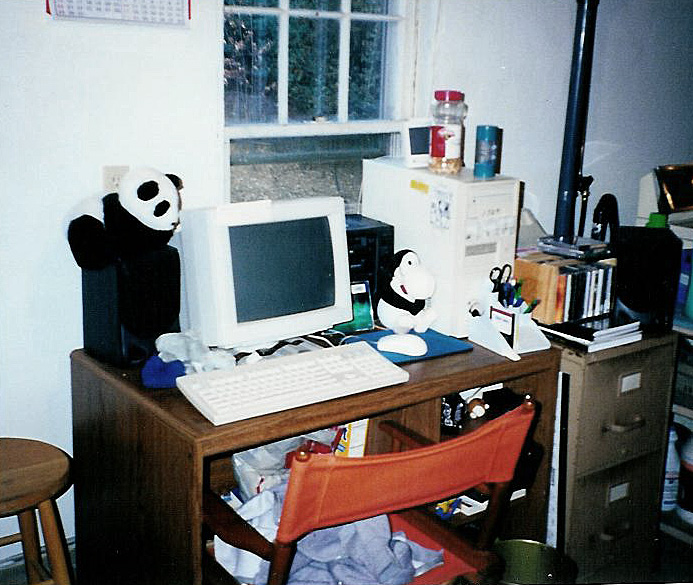
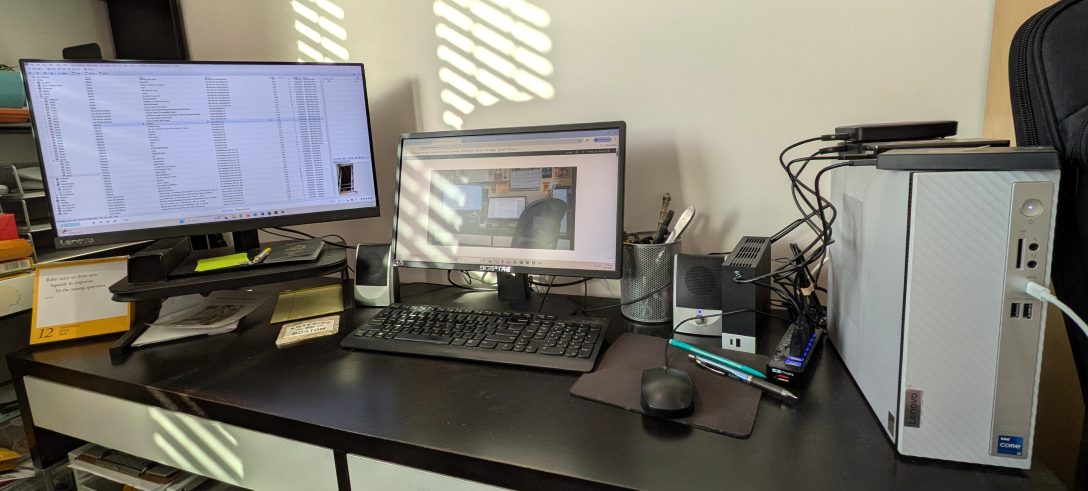
I can’t find it right now but I know I have it somewhere: there’s a picture of this same shot of my desk in the Belfry, a staged and corny shot of me looking at the screen with my dad to my right, looking on. It appears like we’re having a serious discussion about a very important scene in my novel. [If I recall, the picture was shot around 2003, so that means I was working on The Balance of Light.]

I have a lot of memories of my family’s basement. Playing down there as a child when it was too rainy in the spring, too hot in the summer, and too cold in the winter. Being kind of freaked out as a kid by the cold and dusty semi-darkness of the back storage room where the big and scary oil heater was. The rumble of the washing machine and always being startled when the dryer loudly announced it was done. Listening to my records down there. And of course, writing The Phoenix Effect and then the three books in my Bridgetown Trilogy.

But what I remember most is that my dad had pretty much claimed the far north end of the basement as his research office. While he was primarily known about town as the local reporter for the Worcester Telegram & Gazette, he was more known locally as the guy who over several decades had acquired an overwhelmingly complex collection of books, notebooks, files, news clippings, pictures, maps, binders, and index cards, each of them containing an intriguing detail in the larger tapestry of the history of his hometown of Athol, MA. It was a lifelong project he’d started before I was born and continued long after I moved out of the house. None of it was digitized and all of it was cobbled together with tape and glue. He had a chicken-scratch handwriting and always used his old-school Royal typewriter.

He used to have all sorts of visitors over the years who would come over to borrow some of those files for their own research. He’d get college students writing papers, writers working on projects, local historians looking for things they’d missed elsewhere. The local library would sometimes point people in his direction if they weren’t able to help. And the collection kept growing, slowly blocking windows, taking up floor space, and reaching up to the ceiling. And occasionally getting knocked over by cats. [For the record, nearly all of this collection is now found in a reference room of said local library, dedicated to his work.]

He had this very old radio on his desk that he’d often use to listen to swing jazz and classical music, always with more bass than treble. He was a big fan of big band leaders like Glenn Miller and Benny Goodman. [That radio was so old that it would crackle with fierce static every time he turned it on.] He always had music going when he worked. Even when he was at his day job office downtown, he had a radio there as well. He was a pretty good piano player as well; he’d often play standards on our family’s piano and later on one of the electronic keyboards we owned.

I moved my desk down cellar in early 1996 when I’d moved back home and had acquired my first PC, and he was just fine with me staking my own little corner down there at the opposite end of the room, right near the door to the garage and the stairs leading up to the main part of the house. He knew I wasn’t going to be a reporter, and I’d told him many times that I was not interested in that style. But he was just as glad that I’d chosen a somewhat similar creative path, writing fiction. [We never called it ‘the basement’ but ‘down cellar’, definitely a New Englandism.]

Some nights we’d be working at opposite ends of the room, our music sometimes dueling with each other (I was acquiring a massive music collection at the time that would soon overwhelm that back storage room). We were both writers working on what we loved doing most, perfectly happy doing so without much conversation. Some days he’d be down there until late at night, and some days I’d be down there until the wee hours.

One of the last conversations I had with him over the phone was right around Christmas. Whenever we spoke on the phone, he always asked how my writing was coming along. He was proud of the fact that I was still working at it years later, that I’d self-published several novels, seen my dream career all the way through to that level. He always had some kind of writing advice: don’t overedit, know when you’ve done enough research and when to start doing the actual writing, and always make sure you enjoy doing it. And above all, always write what’s true to you.

Thanks, Dad. Best writing advice I ever got.

Richard Chaisson 1935-2024
Breaking out of the comfort zone

(image courtesy of Bocchi the Rock)

I’d almost forgotten what it felt like to push myself out of that comfort zone I’d been in for years. Why was I even there in the first place? Was it about trust? Self-trust? Embarrassment? Worry? One or many of these things? Well. Most of it’s all gone now, at any rate. All I had to do was free myself from the self-imposed chains.

I think the last time I felt this way was when I’d started The Phoenix Effect back in 1997. A new part of my life had started and the road was relatively clear. It was a choice to say yeah, let’s get this writing career started. I can do this, and stick to it. But let’s face it, I hadn’t really adjusted all that much since then. Sure, I had the confidence to self-publish and all that backstage nonsense that goes along with it. But there had to be more. I knew I was holding back.

This is where I feel I’m at now. Pushing myself out of a comfort zone once again, not quite sure where it’ll take me…but trusting myself enough to know what I’m doing. Time to take more chances and look past the boundaries. Knowing I have people who’ll have my back. And knowing how to move forward with minimal blind flailing.

A lot of this will be new to me, but I’m ready for it. And I’m willing to learn.

…I’ll get back to that later.

I’m still a little bit concerned about a certain scene near the beginning of Queen Ophelia’s War, but I’ve come to the conclusion that, like that one missing chapter I had in Diwa & Kaffi, I’ll put it aside and fix it later. I need to catch up on the rest of the novel, and focusing on this one issue was just wasting my time. [For the record, it’s nothing major, and the scene for the most part is written. It’s just that I haven’t decided if it works and I should adjust the later continuity, or if I should change it to fit the same.]

I very rarely went the ‘I’ll fix it later’ route in the past, but I’ve come around to it over the last few projects, especially considering that I feel more confident with my writing. I find it’s a bit of a healthier way to look at life in general, really…things might not be perfect, but if I can fix everything around it, then that’ll make coming back to this big problem that much easier. And I’m pretty good at remembering the points that need the most work and coming back to them at a later time. This one could go either way, really…I always leave a little bit of leeway in my stories so that fixing this sort of issue doesn’t become a major rehaul. I’ll know by the end of this revision round whether or not I truly need to make the fix.

I’m allowed to make mistakes…

…but I’m not allowed to see every mistake as a failure.

Writing a scene that ultimately does not work for the novel is not a failure. Dealing with inconsistencies and continuity errors is not a failure. Sometimes writing is rewriting and revising and trying a different tack. I’m allowed to be worried that my project is still a mess that needs a lot of work, but it’s not a failure if I’m willing to do that work to make it better, no matter how long it takes.

Putting a novel project aside for a while with the possibility of it being trunked is not a failure. Sometimes the end result is simply not what I’d hoped it would be, knowing that I could do so much better. Or maybe that I’ve just lost interest in the idea now that I’ve let it percolate for a while.

Hitting only a few dozen words a day instead of a few hundred, or even a few thousand, is not a failure — nor is it a mistake. Not giving myself enough time to write every now and again is not a failure. Distraction and wasting time is not a failure, but an issue that can be fixed if I put my mind to it.

I’m willing to make mistakes. Failure, at least for me, is not even trying in the first place.