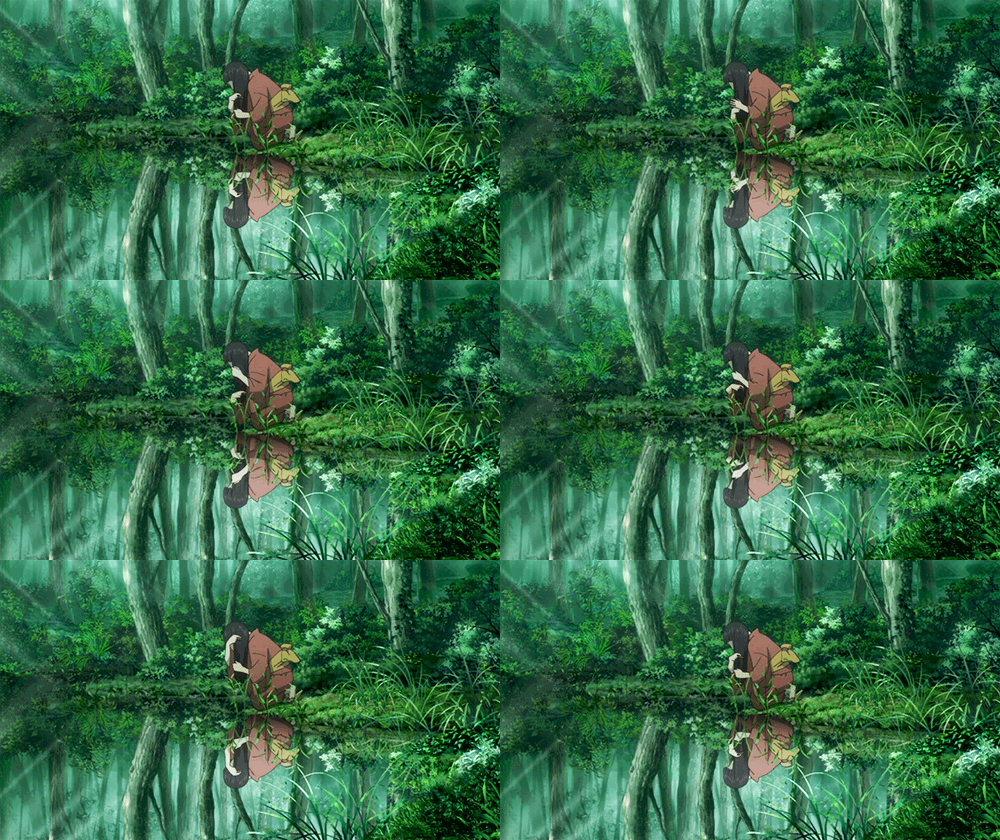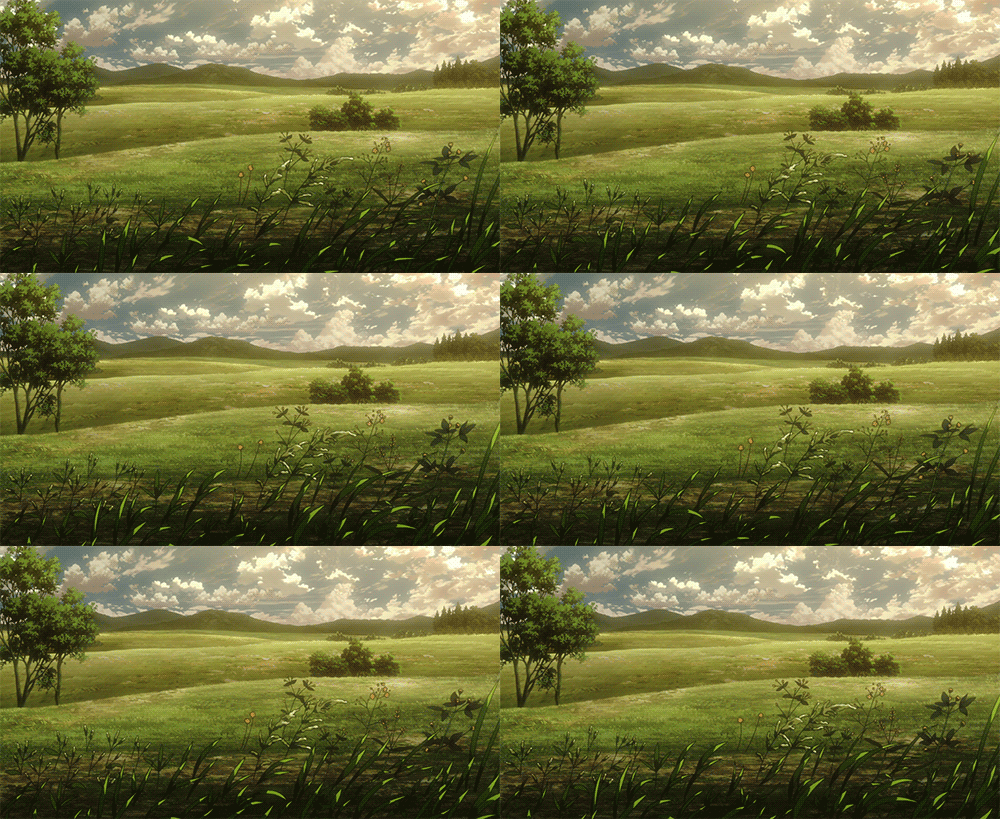
Outside

A lot of my novels spend a considerable amount of time outside, and usually for a reason other than transitioning between scenes. Which is interesting, considering how much time I spend inside in real life, for one reason or another. In Queen Ophelia’s War a lot of it takes place either on wide grassy plains, rolling hills or deep woods; part of it is to evoke a strong sense of natural settings important to the story, but part of it is also to show that what takes place inside isn’t always about safety and security.

I like using the wider world as precisely that: there’s a wider world out there, bigger than what might be going on in front of you. It keeps several characters in check, from feeling completely alone. [I sometimes use the complete opposite of that for emotional punch, too. If you recall my posting of the first chapter of MU4 some time ago, there’s a world beyond what Eika sees, but as far as she can tell it’s completely devoid of any other people, giving a profound sense of desolation and abandonment.]

It keeps the plot from feeling insular, that nothing else happens outside of this one setting. I also get to use nature as part of the plot; in In My Blue World, magic is literally a part of nature in Zuze’s universe. Even in Theadia, which takes place on a planet surface, on a nearby satellite station, and in deep space, all of those locations are important to the plot in one way or another.

Do I go out of my way to write outside scenes? Not always. More often than not, they just end up there, and I’m thrilled when it happens. It means that the scene is important not just to the characters we’re focusing on, but possibly to anyone else out there, just offscreen.

Keeping an eye on things

A funny thing happens when Jules sees a bird outside Spare Oom’s window. I have my two acoustic guitars in front of it, so when she gets excited her tail will start wagging furiously between them, and every now and again I’ll hear a twaaang twaaang twaaang behind me. She’s might not be the quickest cat (unless she has the zoomies) and she’s a calm kitty when it comes to new experiences and enrichment moments, but birds will excite her like nothing else.

What does this have to do with writing? Well, nothing all that much, but I really love this picture of her shooting daggers at two crows back in late June and wanted to share it, but if you really want to stretch a metaphor, I suppose it would be that I’ve been looking at my writing in a similar way. I’ve been making considerable efforts to turn away from distractions, which has always been one of my worst habits. And in doing this, it’s helped me become more focused on what I should be focused on. I’ve been doing my best getting work done on Queen Ophelia’s War, even despite the the day job shifts.

Other than that? Yeah, I’ll totally admit I’ve been distracted by Jules and Cali, but they’re distractions I’m willing to accept.

My favorite time of the year

I’ve been thinking a lot lately about how I haven’t really been able to appreciate autumn like I used to. I suppose part of it is that I now live in an area that doesn’t see vividly changing colors nearly as much as one would in New England…but I think it’s more than that. I think it’s also because I haven’t allowed myself to appreciate the season, usually due to personal and day job things going on.

This year, however, it seems things are falling into place. In working on Queen Ophelia’s War I’ve made a conscious choice to focus on what I feel, see and hear during that time of the year and insert it into the novel accordingly. The changing of the season does lend itself to the novel’s theme of the changing of life. The dichotomy of witnessing the past fade into memory and the future approach unknown. The weather becoming colder and darker. And yet on top of all that, a desperate hope that things will turn out okay despite it all.

And yes, I’m currently searching for the perfect mixtape/playlist to go along with it, and Cocteau Twins will most definitely be on it. [Any other song and band suggestions in a similar style are quite welcome, of course.]

Into the woods

One of the motifs in Queen Ophelia’s War is the forest. I suppose it could be seen as me channeling my years back in New England, growing up in a densely wooded valley and driving all those tree-lined back roads in the 90s and early 00s. But to be truthful, I think this is more about my visits to the actual nature areas to the north of San Francisco. Muir Woods, Armstrong Redwoods, and the hills between Ukiah and Mendocino. And even the little hideaways in Golden Gate Park, Land’s End and the Presidio nearby.

Sure, ‘entering the forbidden forest’ is a classic fantasy trope, but I’ve always been fascinated by it. More to the point, I’ve loved the idea of a mystical passageway between worlds ever since I first saw that animated version of The Lion, the Witch and the Wardrobe in the late 70s. [This of course is one of the reasons my writing office is called Spare Oom.] The idea that just past the edge of the known is an extremely vast unknown is something I knew as a kid, and I’ve often had dreams about it. With Queen Ophelia’s War I finally decided to latch onto that idea as a whole: it’s not just about entering a different world, but about discovering oneself in the process.

As I’ve said before, I’ve written an almost complete rough draft already that I’d worked on during the height of the pandemic, so now what I’m doing is giving it more life and color. Going deeper into the forest, perhaps. Discovering what’s beyond.

Coming back again

I think I can safely say I’ve come back around to working on Queen Ophelia’s War again. I’ve done a few single pages’ worth of work on them these last couple of weeks. Fine tuning the opening for the most part, just to get my bearings. I’m happy with what I have so far, as this has helped me figure out the pacing and the style I’ll be using throughout. There’s a deliberate flow going on here, much like Diwa & Kaffi: unrushed, but not glacial.

This novel, like Theadia, is new territory for me. It’s closer to a straight fantasy novel than In My Blue World, I think. I read a lot of that genre during the Belfry years of the late 90s and early 00s. I’d always wanted to write it, though at the time I didn’t think I’d be able to pull it off. In my usual fashion, I take the genre and give it my own personal twist: it’s less about the monsters, legends and magic and more about what’s going on within. Why the characters are who they are, and what they need to do to change for the better.

And if all goes well, then I’ll be thrilled to share this novel with you when it’s done!

Understanding the (created) world

I’ve come to realize that out of all the moving parts in my novels, I think the strongest and most vivid part of each one is the world I’d created for it. I just find worldbuilding to be my most favorite part of writing a novel. Mind you, I’ve learned not to get too lost in it while writing, but just enough for the reader to have a visual idea of where the story takes place. But I’m not merely using it for a brushstroke or background color…a lot of the time these places are the way they are for a reasons very important to the story.

Such as in the Bridgetown Trilogy, which takes place in multiple locations: Bridgetown itself (a sprawling and crowded metropolis, signifying tension and imbalance), Bann Dassah on Trisanda (a quiet and remote area near an ocean coast, signifying peace and balance), and several other places. Or in the unnamed location of In My Blue World, seen both as a quiet small city (signifying stasis, safety and eventually boredom) and as an overpacked sprawl (signifying movement, excitement and impermanence). The world of Diwa & Kaffi uses a slightly different twist: it generally takes place in several linked areas that are already known by the characters; the role for their world here is in their experiencing these areas on a deeply personal level for the first time.

In both Theadia and Queen Ophelia’s War the worlds continue these ideas: the generally known versus the experienced, safety versus threat, the group understanding versus the vividly personal. It’s one of the most important things I always need to remind myself when writing new novels: I rarely ever want to place these characters in a setting that could be anywhere; the location needs to have some kind of purpose, either directly or indirectly, and often obliquely. It not only makes the story more relatable to the reader, it also makes them feel the same underlying tension the characters are feeling.

Ready to go again

I’ve been away from my WIPs for quite a long time, to be honest. Longer than I’d planned, but I’m okay with that. I had my reasons. But now I’m ready to get back behind the keyboard and set off on another adventure.

It just so happens that I finished up another one of my Great Reread sessions of my own work (for sequel-idea or WIP-finishing purposes) as of last Saturday evening. I finished the session with the Bridgetown Trilogy primarily to psych myself up for writing MU4, and in hindsight that was a good idea. The current version of MU4 that I’m working with resonates with the previous three novels yet stands on its own quite well, and that’s exactly what I was hoping for.

And what about the other projects? Right now I have Theadia and Queen Ophelia’s War on the front burners, and Sheila Take a Bow and Walk in Silence (the book) on the back burners. And I’m fine with that. I’m not worried about not having anything brand spanking new to work on — I think I’ve finally grown out of that particular hang up. I have the stories I want to tell, and I’m ready to start writing them. And if anything new does eventually come along, well, that’s what the 750Words site is for, right?

This also means I’m ready to start reading books again! Yay! I’ve finally gotten past the reading burnout and the indifference of my TBR pile, and I’m looking forward to catching up with what I have. And I’m also looking forward to looking for new titles again, something I haven’t done in quite a while. I don’t get that burnout all that often, but I’m glad in the knowledge that when it does happen, it doesn’t last for all that long.

I’m ready to go again, and I can’t wait!

Current Status: Planning

Right now I’m about two-thirds of the way through the reread of Theadia and I’m happy to say that it stands up quite well despite me having never written a space-related story before. [I’d call it a space opera but you’re not going to see any super heavy tech nerdery going on here, and that’s on purpose.] It could certainly use a bit of tidying up and of course it needs a full ending, but I’m glad to say it’s still in the running for one of my next projects!

I could say the same for Queen Ophelia’s War as well. [In case you missed it, I changed the name slightly for reasons.] That one definitely needs a completely new beginning but once it gets to the start of Act II it really shines and works great to the almost-end. And yes, I need to finish this one as well. I’m thinking this might be the very next project as I feel closest to this one right now. I know exactly what’s needed and how to make it work the best way possible, and that’s a rarity.

So what about MU4, you say? Well yeah, I’m going to need to come back to that as a long term project. And yes, I’m going to be doing another reread of the Bridgetown Trilogy to refamiliarize myself with the universe — and maybe pick up a few story beats that I can use in the new book as well. I know this one’s going to take some time so I’m not going to rush it.

But yeah…I still may not be doing any writing right now, but I’m getting there.

Rereading My Work

Sure, I’ll reread my own work, whether it’s completed and self-published, incomplete and on the backburner, or trunked and best forgotten. I do it rather often, actually, and for various reasons. Since releasing Diwa & Kaffi out into the world, I gave that one yet another once-over, just to see how it looks in epub format. [Quite nice, actually.] After that I reread In My Blue World with the idea of toying with the possibility of writing its sequel. And now I’m rereading what I have of Queen Ophelia (which, now that I think about it, should really be titled Queen Ophelia’s War if I’m going to keep the title at all). I plan to reread Theadia after that.

I’m rereading these three to decide which project I should work on next while also working on MU4. I’m still undecided as to which one to tackle so I’m refamiliarizing myself with the stories to see which one resonates with me the most. Sure, I could come up with a completely new idea if I wanted, but I’m holding back on that because I feel these still have merit, even if they do need a hell of a lot of work.

And that’s the other reason for the rereads: how much work do they need, and is it worth spending the time? I don’t think any of them need a major overhaul, thankfully, and the newer ideas just need their outlines fleshed out and the stories written. I don’t count MU4 here, because that’s in an altogether different beast; when I have the time I’ll reread the original trilogy and what I have of 4 because that particular project needs a different kind of immersion.

It’s a lot of work and it surely eats into my GoodReads numbers, but I’ve found that this is part of a larger process that works really well for my projects — it’s just enough immersion into the created world so that I can easily slide back into it and move forward.

More on putting my novels on hiatus

Okay, so maybe I’m not torching my work. That’s not my style! No, this is just a follow-up from last week’s mention that I’m putting Theadia and Queen Ophelia on hiatus.

To put it bluntly, these were both Pandemic Novels.

Theadia was my novel about my frustrations with the Former Day Job. I’d started it in the final months of that particular position, when I’d been forced to head back into the office four days a week. The novel, on the whole, was about Terrible Managerial Decisions versus Doing the Right Thing, set as an unconventional space opera. There’s a lot of that job in this novel…trying to squeeze actual answers out of an ineffectual manager (in this case, a colonel), questioning bad decisions and getting a shrug and a what can you do? as an answer, and of course choosing to do the right thing because no one else will, and the list goes on. I also wrote it because I’d become worried that I no longer had any further stories in me to write because the Former Day Job had become that overbearing over time, and I knew I had to write something before I started to believe that. This was my ‘this is now fucking aggravating this job has become’ outlet.

Queen Ophelia, on the other hand, was my novel about going on a personal journey of discovery. I’d started that one in the first couple of months into the pandemic, when I’d left the Former Day Job and chosen to do some long overdue cleaning out of my anxieties, bad habits and personal issues. This novel, on the whole, was about Giving Yourself a Blank Canvas. The main character, literally an artist with nothing important and no projects weighing down his life at the moment, is offered the chance to learn about his mother who’d left him and his father when he was a baby. Come to find out, she is not just a beast from another world but royalty as well. This was my ‘you’re free, you can be and do anything you want now’ outlet.

Thing is, I no longer need these novels as personal outlets. They were my therapy for those two strange years and they served me well, but now I’ve moved past that need for them. That was the problem with The Balance of Light as well, the third Bridgetown Trilogy book; I no longer needed that trilogy as an outlet or as therapy by 2004 and I felt a bit creatively lost because of it. But also like that novel, I plan on returning to them after some time and distance. I still believe in them, I just have to see them as the entities and creations they are.

In the meantime, I and my creations are both a blank canvas once more, ready to discover new things.