Year End: Moving On

Sure, I could use the classic phrase I’m too old for this sh*t in regards to some of the more frustrating things that have happened over the past year. But really, I’m not nearly as cynical as that. Despite being firmly Gen-X, I never completely slid into full-on cynicism because I always felt it was an easy way out: writing something off by saying it was never good in the first place. It just didn’t ring true to me.

It’s true, I’ve had a few frustrating things happen here and there this year, and yes, I may have overreacted to some degree. But I’m not writing any of that off, far from it. I’m just choosing to acknowledge it and move on. Not every single event in my life needs to be a conflict that needs to be faced or resolved. Sometimes it just is what it is, and I have to adjust accordingly. I might have to make some changes, but they will be changes made my way and not out of frustration or necessity.

If anything comes with age for me, I think it’s that I’ve refined how I utilize my sense of patience. Back in my 20s I used to semi-joke I was cursed with a tremendous amount of it, primarily because it was the only reaction I could have most of the time, whether due to finances, emotional reaction, or just the situation I found myself in. Some years later I learned how to voice those frustrations, and at times I could be too vocal about it. It took me a while to find a level that wasn’t pathetic or reactionary.

It was all about balance, really. And that’s how I’ve been living since then.

Right now I know there are some things I can fix, and other things I can’t. But I know I am not chained to the places or situations I find myself in these days. It’s a matter of being able to think outside the box instead, and figuring out how to sidestep that particular obstacle and still move forward. It’s true, much of this I’ve inserted into the various characters in Theadia; many of them are just tired of doing it the old way and failing every time, and are looking for alternate ways to resolve their various conflicts. Thus their repeated mantra: if you could…would you do the right thing?

I think in 2026, this is how I’m going to try to think about my writing. While I still have a few things on the backburner waiting to be started, I’m feeling as though I’ve kept a lot of them there not out of a severe case of the Don’t Wannas, but more out of a rational sense that they may not be worth working on at this time. They might be good stories, just that I’m just not feeling the excitement about them. I’m pretty sure I’ll be finally trunking them for good pretty soon.

It’s time to move on.
Editing and tidying up

I’m just shy of the halfway point in the Great Trilogy Remaster for A Division of Souls, which is a very good thing. That should leave me quite a lot of time on the back end to give it one more ‘bedtime reread’ (where my mistakes seem to make themselves the most visible) before releasing it out into the world come September.

It’s been ages since I’ve allowed myself to get this close to the Mendaihu Universe to the point where all the right things resonate. I’m using this to my advantage, because this means I know exactly what I was trying to do with the book. This also means that I know exactly where I didn’t quite pull that off. Anytime I find a moment that feels a bit rushed or confusing, too repetitive, or a potential continuity problem, I’m fixing it right there and then.

It’s also a different process than I’ve been used to since I first completed and released the third book in 2017. Whether it’s due to the writing styles or the shorter lengths, my later standalones went through a somewhat different process. I didn’t feel I had to immerse myself that deeply. Not that that was a bad thing, but over the years I began to miss that. Over the next few years I proved to myself that I could write econo, and enjoyed it just as much…but I missed the intensity of the deep dive. The full immersion.

I know, I know…I’ve brought this up a few times here already, but it constantly weighs on my mind while I work on this remaster. Writing the trilogy was such a powerful and life-changing event for me in that my writing chops escalated considerably within the span of just a few years, and it only got better once I started the original revision and self-publication process. Coming back to it again at this time feels like picking up where I left off, and hopefully I’ll be moving ever forward.

Walk in Silence: resurrecting the book again?

Okay, so this long-simmering, often-backburnered project surfaced completely by chance and maybe because I was, er, cheating on my daily 750 Words.

A few days ago I found I’d run out of time to get my daily words done so as a fix and not miss a day, I figured a quick and easy cheat would be to copy and paste some older blog posts and add some commentary at the end of it. Cue the 2016 entries from my music blog as yet another attempt at a music-themed memoir.

I really liked this version, as I wasn’t really trying to prove anything with it. I wasn’t trying to shoehorn music history into it this time out, because this story was about me and not the college rock scene of the time. It was about my reaction to it, as well as what led up to it. And now that I’m reading it again for the first time many years later, I realize that perhaps this version has a lot more merit than the previous versions…?

The only reason I hadn’t focused on it then was because I was doing some heavy revision in preparation for the Bridgetown Trilogy. I knew that I’d get back to it eventually…I just didn’t expect eight years and several new novels to pass in the interim!

So. Do I pick this one up and run with it? Well, I’ll have to see how much work it actually needs. If it only needs expansion and minor revision, then I’m sure I could see it as a release for 2025. I can’t say for sure, because, well, Best Laid Plans and all that…but you never know.

Juvenilia and Poetry

It’s a trick I learned from working on music history chronology: sometimes things just make a bit more sense when you put it all in the correct order. How one thing ties in with another, perhaps influences something else, all while putting it in a clearer context.

Not counting that bit of extracurricular fun I had in fifth grade, my poetry and lyric writing started sometime in the early months of 1988. The IWN had been completed and its sequel started, and I’d also just finished a very silly John Hughes-influenced screenplay (also my first completed one) in the fall of 1987, and to top it off, I’d just bought myself a cheap bass guitar for $25 downtown and was about to teach myself how to play it. [There were two to choose from, and the other one was shaped like an Uzi submachine gun — no, I’m not kidding — so I grabbed the headstockless one instead.]

I kind of fell into writing poetry because I wanted to try something different. I also wanted to start a band and would be doing so at the start of 1988. With that plan in mind, I figured I’d also need to start writing some song lyrics as well. I latched onto my favorite influences at the time: the goth wordplay of The Sisters of Mercy, the oblique artiness of Wire, the doom and gloom of The Cure and the quirky love songs of Depeche Mode.

The first couple of attempts weren’t all that serious, but I wasn’t taking my assignment all that serious to begin with. I wanted to have fun with it! Most of it would be written in notebooks and on scraps of paper, written in my bedroom. By late summer of 1988, however, I came up with an idea: what if I take one of these numerous notebooks I have in my room — say, this Mead composition book that I rarely used for school to begin with — and started writing in it?

But that was still a few weeks away. Right now I had more pressing things on my mind: my best friends from high school — the ones who were all one year ahead of me and had graduated that May — were about to head out of town and off to college. That hit me pretty hard, and not just because they were all going away…I’d always been the ‘last’ in one way or another. The youngest sibling, the youngest in my extended relations of numerous cousins, one of the last kids of my age in the neighborhood. Usually last picked in gym class as well, of course. It was not so much a sense of abandonment as it was a profound sense of being left behind because I wasn’t allowed to catch up. That would haunt me for quite a number of years.

And it would be the impetus of a lot of my poetry, lyrics and fiction writing around that time. I found solace in listening to music and losing myself in my creativity for a few hours. That composition book would be where I’d bleed out whatever was going on in my head. And I’d also given myself one rule: no boundaries here on the page. If I felt safe in writing something heartbreaking, or horrifying, weird or embarrassing or even hilarious, then I wouldn’t hold myself back at all. My first attempts were sketchy and slight at best, but by the winter of 1988 I’d found the voice I’d needed. I just needed to keep going.

Revisiting these poems now, so many years later, I’ve been able to put this all to rest and in its proper order. I can look at these with emotional distance and appreciation. Putting these in their proper order and context, without holding back on any memories or subsequent clarity that might arise, has indeed brought on both in abundance. Answers finally given, clarity finally achieved.

More on Rereading…and Transcribing

All this rereading of my finished novels, WIPs and backburner projects has also kicked off more rereading, this time of my early longhand writing. Right now I’m going through some of my old chapbook poetry and lyrics, transcribing some of them and making personal notes. Why? Well, why not?

One of the reasons for doing this now is that I’m conducting a writing experiment. I’m assigning myself to work on something every day, without fail. I’m assigning myself simple things like doing some fun Walk in Silence (the book) work on 750Words and this poetry transcription. Easy writing that would take less than an hour out of my day. That was the impetus: I wanted to see if I could do a full month in a row. I started on June 1, kept on going, and I haven’t missed a day yet, so that’s nearly two months right there. Not bad at all, really. I see no reason why I should stop now.

I’ve mentioned before that I’d assigned myself a transcription project back in the summer of 1995 and into spring of 1996. I’d done it then as I’d finally had access to a computer and wanted a digital copy of my juvenilia for safe-keeping as well as for easier access. [There was also the fact that I’d done it as a distraction to avoid falling into a self-loathing spiral due to my failure at staying in Boston, but that’s another story.] That was the last time I’d done it to any considerable extent. This has become a bit of a problem in the present time, because a lot of that work was written using the MS Write program which no longer exists, and WRI files don’t translate well at all to Word or Notepad. I have the printouts…but I’d really like to have the digital versions once more.

Why am I doing this instead of writing novels, you ask? Well, I’m getting there. The rereads of the current work are preparing me for the novel projects. Refreshing my memory of the novel projects I’d like to work on next. And I still have a ways to go before I’m fully ready. It’s prep work.

It’s also interesting to read words I’ve written that I haven’t reread to any serious extent for nearly three decades. While there’s a lot in there at my most inexperienced, there are also smaller gems: unique ideas and impressive passages that merely needed the work of a much better writer. I had to start somewhere, and I wasn’t afraid to start at the bottom just like everyone else. I’m also finding elements of myself then that explain who I am now.

That’s what’s making it worthwhile: looking back in order to move forward.

What is it good for?

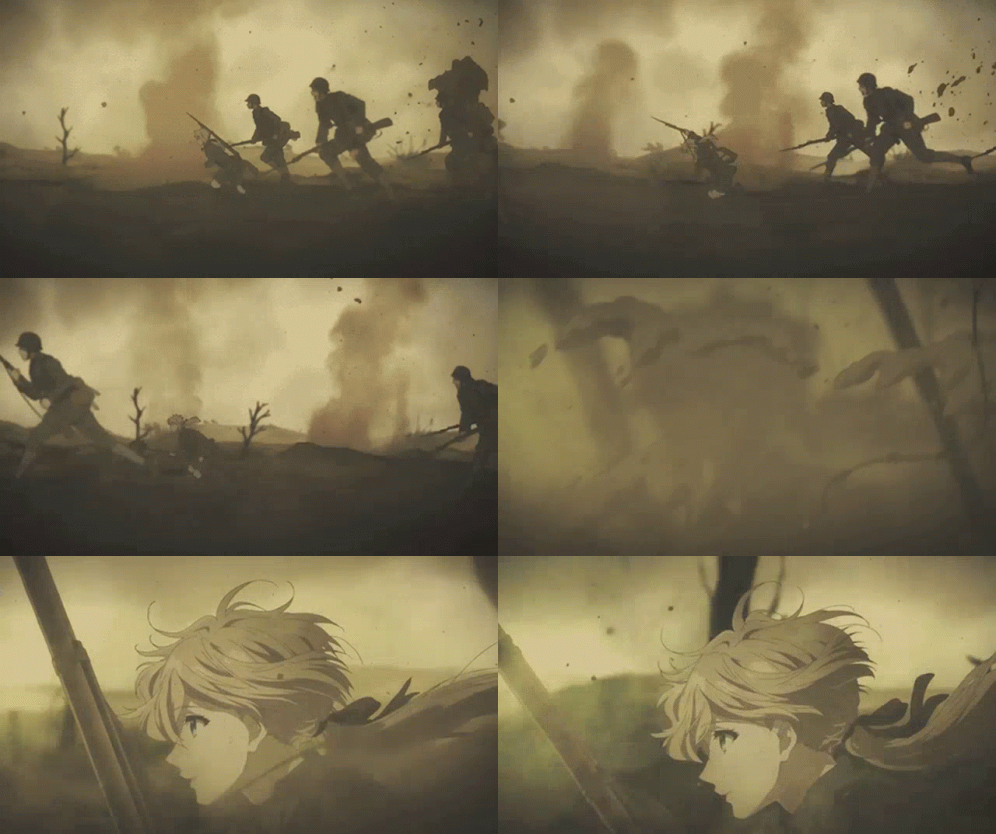
Image courtesy of Violet Evergarden

Yesterday on KEXP, morning DJ John Richards’ playlist was heavily war-themed and it got me thinking of my very first finished project — the Infamous War Novel. Most of the songs he’d chosen were the same songs I listened to in the mid to late 80s when I wrote that bulky thing. There was a lot of bleed-over between his playlist and the ‘soundtrack’ mixtapes I created then.

The IWN was borne of being a young Gen-Xer living on the back end of the Cold War. I mean, sure, I always say it was kind of inspired by those Red Dawn movies of enemy infiltration with an extremely heavy dose of Miami Vice music-as-storytelling-aid to boot. It’s me writing as a teenager, well before I even knew how to write, so grammatically and stylistically it’s thin on the ground and all over the place. I don’t hate it, but in its original form it’s rather embarrassing. Yet it still finds a warm place in my heart as my first completed work and proof that I enjoyed the hell out of writing fiction, and that maybe this gig might be worth working on long-term.

I’ve long referred to it as the IWN because I was obsessed with making it work one way or another. After I finished it in spring of 1987 and started writing other unrelated stories, I would always come back to it at some point. I tried reviving it countless times over several years. It was the project that refused to die. And I would talk about it with others at times, much to their amusement and sometimes irritation. Thus the Infamous part of its nickname. I finally gave up trying to revive it sometime in 1996 when I briefly visited it one last time after True Faith dried up but before I started The Phoenix Effect.

I still have all the paperwork and its various versions here in Spare Oom, decades later. It’s held together in multiple binders in the small bookshelf behind me. The original longhand work started in 1984 and the 1987-8 typed revision, the aborted 1987-88 sequel, the 1990-92 reimagining, the 1995 PC transcription of the original, and the 1995-6 last gasp written on the PC. And all the original mixtapes have been recreated in mp3 form.

So why think about it now? Well, I think it’s because, as that same Gen-Xer, I remember that feeling of there’s a MUCH bigger world out there than what you can even imagine, and not all of it is sunshine and roses that many of us felt back in the 80s, when we weren’t exactly at war with Russia, but we saw them as the bogeyman hiding behind a literal iron curtain, devious and scary and mysterious. They might not have always threatened us, but we never quite knew. The status could change in the blink of an eye.

And that’s why we felt that relief when the Berlin Wall came down, why that Jesus Jones song resonated with us. Why we got nervous when the first Gulf War started, and when any other war in the world kicked off. And that’s why we’re twitchy about the war in Ukraine right now — we remember what happened in our youth, and while we’re hoping that we won’t have the threat of nuclear missiles hanging over our heads this time, we certainly remember that feeling of you just don’t know. All the social media and news sites and podcasts won’t help you when they don’t have the entire story. They rarely do. [Not saying that in a cynical way, just saying it as a hopeful realist. I never depend on one specific site alone for my news and information and I’d like to think I’m well-versed in knowing which ones are honest and which are propagandist. I learned that in college, after all.]

I think, back in those days, that’s what I’d tried to infuse in the IWN. The main character — a self-insert, of course — was put in charge of his own local group of ragtag soldiers and rebels, and his story is the gradual breakdown of his emotional and mental strength as that Constant Unknown kept wearing at him. This wasn’t a story about shirtless beefcake heroes saving the world but about normal people relentlessly and continuously being put through the wringer. Would I write this kind of book now? Well, not an exact kind, but I’d maybe take parts of it that still resonate and use them in new stories. The IWN kind of reverse-glorified the Cold War, in a way; it took the 80s patriotic action film trope and subverted it into something dark and sinister. There’s a price to pay for war, and it’s never glorious.

That idea that just won’t go away

Image courtesy of Depeche Mode

I had this idea for a coming-of-age-in-the-80s story back in the 80s, of course. It had numerous titles and unfinished outtakes, one sort-of complete extremely rough draft, and countless attempts at restarts over the years that all ended up in the trunk. Then I posted a short memoir about that time of my life on my LiveJournal. Then I had an idea to write about the music of that era that I loved so much…which has been on the backburner and in the trunk for a good number of years now, even though I named my music blog after it.

And now, thanks to the imminent release of the movie Shoplifters of the World (a ‘one crazy night’ film based on city kids shocked by the breakup of the Smiths in late 1987) and my, shall we say, adverse reaction to the trailer (this is totally not how I remember the 80s being, at least in central Massachusetts at any rate), I’m contemplating reviving the idea AGAIN.

Considering that I’m already writing two novels, I’m not sure if I have the time or the brainspace for a third — although my brain is of course responding with ‘you never know until you try’. I’m not taking it too seriously right now, but I’m playing around with how I’d properly work on it so it’s a sustainable project and not just another moody roman à clef. I want it to be enjoyable and relatable. I want it to be funny as well as emotional. I want it to show that you can write a story about outsider kids in a small town finding and supporting each other without having to resort to the tired trope of drugs, sex and ennui. And of course I want it to have a killer soundtrack filled with all my favorite college rock favorites and some great obscurities!

It’s one of those ideas that keeps kicking at my shins and demanding attention even when I should be focusing on the other two projects I have going. I’ve already contemplated using the currently-neglected 750Words platform to plan it out (or alternately, going full lo-fi to set the mood by working it out with notebooks and index cards). And I’m even thinking of writing it in tandem with a fourth project: the long-delayed Walk in Silence music book itself. And more to the point, it’s an old project that I’ve always put aside mainly because I’d never quite figured out how to approach it. But now that I have the time and the inclination, it’s tempting me more than ever.

I’m not promising anything, but we’ll see where this takes me…

That one story that just won’t go away

I believe I came up with the story for Can’t Find My Way Home back in…2007 or so? I know it wasn’t that long after we moved out to San Francisco, and it was right about when I’d finished writing that vampire novel I’d soon trunk. I’ve done some work on it here and there, even trunked it multiple times, but every now and again I have this urge to revive it and try again.

It’s not as if I don’t have it planned out…I actually have a full outline for it, and I have a number of outtakes started, both typed and longhand. I even made a mixtape for it back in 2018. [The version of the title song by Electronic is the one I have in mind as the opening credits for the tv show.] But each time I attempted to revive it, I never got any further than maybe a chapter or two; I was either working on the Bridgetown trilogy or something more exciting came up that I wanted to focus on. In the end, I felt I wasn’t yet prepared to write this kind of story. It was forever put on the back burner until it was trunked once more.

Every now and again, however, I’m tempted to revive it again. It would need a hell of a lot of work and some serious refocusing, that I’m sure of. I recently reread the outline and while there are some really great ideas, there are also some incredibly weak points that would need to go. [Having already written a sort-of-time-travel novel with In My Blue World, I think I can pull off the genre so that’s not too high on my list of concerns.] I know one of the things that keeps bringing me back is that I’m fascinated by its format, inspired by anime shows: twenty-four episodes, many of them standalone at first, but with a long-game story arc pulling it all together.

Will I pick this up once more? Who knows. I’m still dithering on what project to start next, as none of them feel like they’re ready to be written just yet. Maybe I’ll try it out on my Daily Words for a bit and see where it goes.

And then maybe this story idea will stop haunting me!

Do I really need to save this? Probably not.

In my ongoing process of cleaning up my files and getting them in order, I’ve come across quite a few printed copies of the same stories. Which surprises me, because I though I’d thinned out that particular collection of papers back in 2006 when I got rid of all those three ring binders. Apparently not…?

And these copies of stories that I mailed off to publishers? Yeah, I definitely don’t need them. Hell, I don’t really need the rejection letters either, to be honest…most of those date back to over fifteen years ago and I’d like to think I’ve learned from my writing mistakes by now. I’m in 100% agreement with them for rejecting that short story from the mid-90s — it’s kind of embarrassing to read now, and I’m embarrassed to admit I even submitted such a piece of half-baked trash.

Which leaves me with…what? Oh, I still have some of the printouts saved. These are the ones I actually used for revision purposes, writing detailed notes in the margins. Those were helpful and I’m okay with those cluttering up my bookcase. And I’m definitely saving those scraps of paper where I’d originally come up with the idea during a slow moment at the Day Job. Those are always fun to look at and remember how it all started.

I found myself doing the same exact thing when I cleaned out my old collection of 3″ floppies. I’d saved a lot of my work on multiple disks over the course of a decade, and making duplicates seemed like a great idea, given how easily they’d get corrupted over time. Especially when I reused older disks. Some documents I had only one surviving copy, while others I’d had maybe three or four. (I narrowed these down by way of moving them to folders on my shared drive and deleting the duplicates via matching the timestamps. I may still have some duplicates, but it’s a hell of a lot more organized now.) Once that particular project is done, I’ll save it to my cloud account for security.

But with the paper versions…I’ve come to the conclusion that the most important things I want to save is the longhand notes and outtakes, the original sketches, the partial outlines…the work behind the finished product. Anything else can go either way.

Thankfully, I’ve kind of grown out of being a pack rat. I used to be a horrible one, both with my writing and pretty much everything I collected. Marriage and moving across the country made me rethink that. Hell, I’ve even cut down on my books! Seriously, though…I’ve still got my digital writings in their various versions (I save each new revision version under a different name so you can still see the work in progress.)

I no longer feel bad getting rid of that fifth print-out of chapter 3 of a book I’ve trunked over a decade ago…as long as I have it saved digitally, that’s good enough.

More on going through old writings

I’m still going through a lot of my old writings here in Spare Oom when I can carve out an hour or so here and there. It’s much easier for me to go through a small collection of folders than it is to attempt sorting the entire thing; less of a chance for me to feel overwhelmed, and definitely less clutter.

My trick this time out is that I’ve put each project or creation in its own plastic sheet protector, and labeling them with Post-Its noting the assumed dates. That way if I find the occasional misfiled item, I can pull out that plastic and put them in their proper place. Many of these will eventually be bound into report binders once I’m done.

I’m also doing a lot of shredding. Why save school notes from 1991 when all I really want to save is the original artwork or poem I’d written in the margin? Why save printouts of documents I know I still have in .doc files? Why save rejection letters from 1998? I have absolutely no use for any of it, and looking at them only elicits the reaction ‘why do I still have this…?’ so out they go!

And all those spiral notebooks with seven or eight pages (or surprisingly, sixty or seventy) that I haven’t touched in years? Time to tear those pages out, bind them in the plastic folders, and find a new use for the notebooks — or alternately, throw them in recycling. I think I’ve finally shaken off that habit of buying them and rarely using them, thankfully!

Most of my writing has already been sorted sometime back, but there are folders of randomness, most likely created under the guise of ‘I’ll sort it later’ or ‘etc’. Which of course means I’d never remember where it was. This time out, I’m sorting at the micro level. A map that’s actually part of my Murph Universe or the Mendaihu Universe or whatever writing/artwork project will of course go into those writing project binders.

I already know this is going to take a long time, quite possibly a few more months. I’m not rushing it. Keeping each sorting session – and cleaning up after each one – makes it a lot easier to handle. One section, one pile at a time, that’s all I need to do.

All this while working on the revision of Diwa and Kaffi, you ask? Yes! I can still find a few minutes here and there to sort through things. After I log off for the day but before I head out to meet A at the gym. My afternoon break. Slow Sunday afternoons when all my other errands are done. And I’m not doing this out of a sense of wanting to relive the past, or even because I might be looking for old notes and outtakes for a revived project. This is just part of my Tidying Up project.

That said, if I do happen to find some old and useful notes, I’m not going to complain. Something new might come out of it!