Thirty Years On: Life Changes

While I’ve been finishing up the current revision of The Persistence of Memories, I started looking at the list of what I call the Mendaihu Universe Legacy Soundtracks. Out of the thousands of albums I’d listened to over the years I wrote what would become the Bridgetown Trilogy, these are the titles I equate to my writing sessions, whether they were in the family basement, the Shoebox apartment in Back Bay, or the sweltering summer in Allston. It’s been a fun reminiscence looking at this list and revisiting some of my favorites over the years.

And while I was at it, I pulled out a spreadsheet I’d made some time ago of a writing chronology. I’d gone through my poetry chapbooks, personal journals, trunked ideas and outtakes, pretty much every creative thing I knew I still had on hand. I entered it all in and sorted it by date just to see what I was working on when. It’s an interesting read on a personal level, as it reminds me when certain life events happened, what moods I was in, when I came up with certain ideas, and so on.

What I found while going through all this is how much my life changed in September of 1996.

I’d had a handful of ‘here until further notice so I can save up/pay bills/get out of debt’ jobs since moving home a year earlier. I left the radio station that June and started a temp job at my mom’s place of work soon after. I’m pretty sure it was late August when she pointed out the ad for HMV, and by mid-September I had the job, starting on the 23rd.

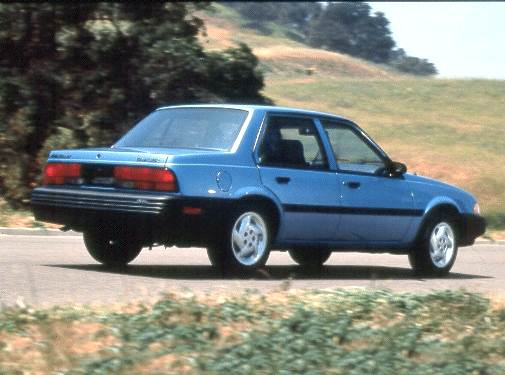
Two things happened that month, one right after the other. One, I really needed to get my own car at that point. I couldn’t continue to borrow someone else’s, so I managed to score a 1992 sky-blue Chevy Cavalier for two grand and only a few thousand miles on it. It pretty much looked like the one below, and I’d drive it into the ground over the next four years on all those commutes and road trips around New England. I called it the Mach 5, of course. I knew that any job I tried out for would not be in the immediate area, and this gave me so much more freedom. I’d buy a few local road atlases to stuff behind the front seats to get me where I needed to go. I used to park it in the grove out front, back when we had multiple cars in the driveway.
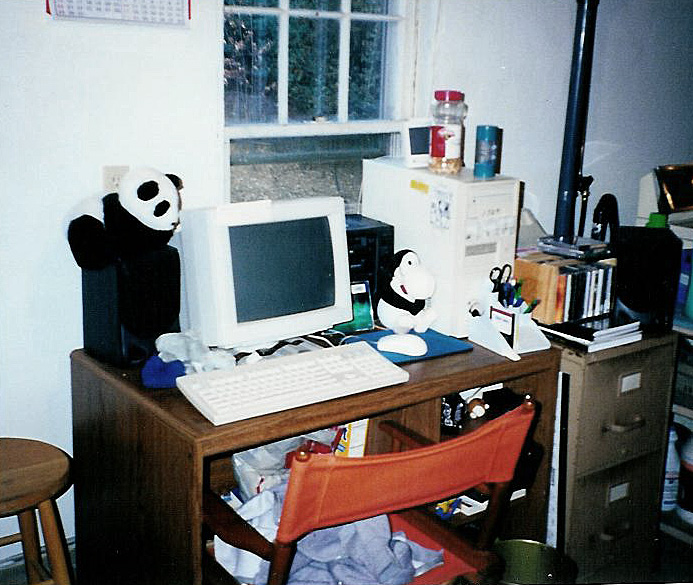
And two, I’d finally decided that it was time for me to move my PC down to the basement. I knew it was sometime in late summer that I’d decided on it, and I’d chosen to do it for a few reasons. The thing was a good few years old and had a rather loud fan, and given my penchant for staying up later than the others in the house, I didn’t want to keep them awake. I also wanted what would essentially be a work area with minimal distraction, and a place I could specifically label as my own personal space.

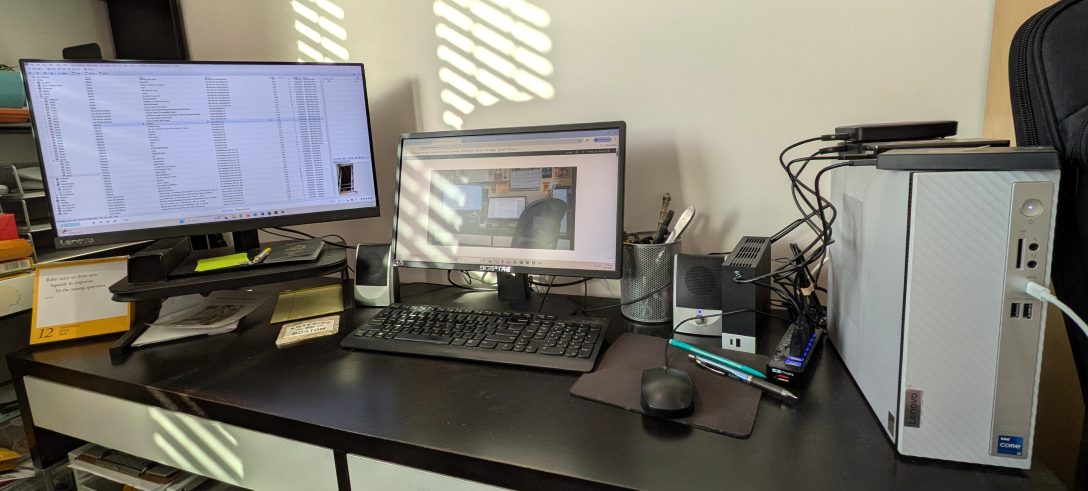
And we certainly had the room down there, the spot in the top picture formerly only housing a few chairs among other things near the wall phone. I utilized a desk (and a boombox, the one you see there) that had been my uncle’s, a director’s chair I’d had during my Boston years, and my dad provided the short filing cabinet. Made a few trips over to Walmart to pick up various desk organizers, 3″ disks and other stationery. My trusty milk crates from my college years got a new life underneath in the footwell area where I stashed three-ring binders of printouts. Snacks were hidden away in those open shelves, and 12-can boxes of Mountain Dew would soon make an appearance as well.

Mind you, I wasn’t down there with any sense of frequency, at least not yet. I think that wouldn’t happen until summer of 1997 when I chose to start transcribing the longhand work I’d started with The Phoenix Effect. That novel project had started in March of that year and by the summer I’d realized that it would make a lot more sense if I revised as I transcribed in order to make it better instead of completing each draft one after the other. And it probably wasn’t until summer 1998 that I finally did start going down there on a frequent basis, once I finished TPE and started in on the major revision work, multiple trunked attempts at sequels and related stories, and eventually what would become A Division of Souls.

But it all started there, thirty years ago in September of 1996, when I made those two life changing decisions.

[Side note: It wasn’t always called the Belfry, even though I refer to it as such these days. I don’t recall the exact date at the moment (surprisingly, it’s not on that chronology spreadsheet), but I’m pretty sure it was the summer of either 2000 or 2001 when two bats entered the basement through an open door and hilarity ensued. Thus the reason why my writing nook in the cellar of my family’s house was nicknamed The Belfry thereafter.]

Perusing the shelves

I’ll be honest, I really needed to rethink my book buying habits, so I did. Just not in the way you’d expect.

I’d been a subscriber to the magazine Publishers Weekly for a good number of years, mainly because I got to read all the news and reviews about the writing field, and during those years I would make note of many of the books that got reviewed and add them to my shopping list. In fact, I ended up obsessively working on that shopping list just like I’ve always done with music releases.

Thing is, there were a few problems with going this route. One, I had to wade through a lot of reviews of dramatic “heartbreaking” litfic that I had zero interest in. Two, these reviews were for books that would not come out for another couple of months, so whenever we made a bookstore run, I’d often get frustrated because everything I wanted to look for was not yet out. Three, eventually I began losing interest in the magazine and going through the same process with every issue. I’d fall behind, sometimes six or seven issues behind, and I finally made the decision to let it lapse earlier this year. Four — and most problematic — I realized that about half of the reviewed titles I thought might be interesting were not resonating with me at all once I read a page or two at the store. It was too much of a long game crapshoot and I was losing interest.

And as a writer, that’s really not something I want to let happen.

So. Did I have any new process for finding books worth reading?

Yes! And it was deceptively simple. It meant doing it old school: perusing the shelves, picking up titles that caught my attention, and perhaps buying them if not making a note of their release for later purchase (or alternately, borrowing via the Hoopla library app on my e-reader). I reminded myself of those pre- and passive internet Belfry years when I would spend hours at Barnes & Noble or Toadstool back in New England, just trying things out. I found so many of my writing influences that way, and not via a professional trade.

And let me tell you, it felt so…refreshing. The other week when we stopped at Copperfields in Petaluma, I truly enjoyed scanning through their science fiction section, truly paying attention to what they had and what popped out at me. Seeing the trending styles and paying attention to what resonated with me. I did it again this past Sunday when we stopped at Books Inc on Van Ness when we were out and about, and I’m sure I’ll do it again the next time we step into Green Apple Books in our own neighborhood.

I’d almost forgotten what it felt like to walk into a store and not immediately refer to the shopping list on my phone (which, by the way, I’ve been threatening to thin out for the last couple of weeks). That’s not to say I don’t mind heading into a book store knowing exactly what I want to buy, it’s just that I think it’s time I started relying a bit more on chance and fate when it comes to finding something new to read. I need to find more books that will influence and inspire me, because I’ve been obsessing with the same styles for far too long.

Writing Soundtracks: Duncan Sheik (RIP)

I heard this morning that Duncan Sheik sadly passed away yesterday at the early age of 56 (one year older than me). He’s been a mainstay in my writing soundtracks for years, ever since his 1996 self-titled debut album. You will most likely know him from the hit that gets played the most, “Barely Breathing”.

I loved hearing that song on the radio when I was commuting to and from work. I actually taught myself proper breathing by singing along to it; the extended lines in that chorus (and its ending in a long “anyway…” that jumps a full octave) are not for the weak! That first album, however, is full of stellar songwriting that goes well beyond what some might see as a one hit wonder. Take the lovely opener “She Runs Away”…

…and the hauntingly delicate ballad “In the Absence of Sun”.

And that’s just the first three tracks. The whole album is full of lovely songs and sounds that prove his strengths as a songwriter so early in his career.

I listened to this first album quite frequently during those early years writing in my parents’ basement. It took me away from the distractions of real life and set me somewhere not quite meditative yet not quite dislocated either. I could get lost in this music, and often did.

He even managed to sneak in yet another banger of a single, “Wishful Thinking” from the Great Expectations album in 1998.

A few years later in 2001 he dropped an interesting album called Phantom Moon, an album that is a bit of a tribute to Nick Drake (and specifically his album Pink Moon, which would only get its due with a wide audience many years later due to its title track featured on a car commercial), full of quiet and poetic folk songs like the wonderful “Mr. Chess” which was one of my favorite tracks of that year. [Side note: Sheik would name his 2006 greatest hits album Brighter/Later as a nod to Drake’s other great album Bryter Layter.]

He’d follow that up just a year later with another wonderful up-tempo record, 2002’s Daylight, which features another of my favorites, “Such Reveries”.

Duncan Sheik’s musical path would take an interesting side trip from here on in, only occasionally recording and releasing a few albums here and there. He would instead focus on writing the music for several stage musicals such as Spring Awakening, Whisper House, Alice By Heart, and yes, American Psycho. He would also write the music for multiple Shakespeare productions.

And in 2011 he released a wonderful acoustic record aimed at us Gen-Xers called Covers 80s, featuring his own takes on our favorites from Depeche Mode, New Order, Tears for Fears, Japan, The Smiths, and Talk Talk.

He’d only release two more albums after that, 2015’s Legerdemain and 2022’s Claptrap, though he’d continue to work on his stage musicals up until his passing. The latest, Memoirs of Amorous Gentlemen, is scheduled to pay off-Broadway next month.

*

Duncan Sheik was always one of those musicians on my I will buy anything they put out even if I haven’t heard anything yet list, thanks to that first album. Whenever I was working on the Mendaihu Universe, eventually those first couple of albums would receive a return spin. His music might be tagged as Adult Alternative, considering it works so well on Listen At Work stations, but it was far from banal or lacking emotion. He told stories in his songs, took the melodies in interesting directions, and treated his music as full compositions. And I think that’s partly why I loved listening to his work during my writing sessions: it was just that perfect level of light yet intriguing and fit the mood perfectly every single time.

Sunday catch-up

I usually write these entries on Sunday afternoons after we get back from our morning jaunt around the neighborhood — the farmers’ market, a coffee run, lunch ordering, what have you — and while doing errands around the house like the laundry. I like doing it this way because I have a lot more time to think about what to write without worrying about running out of time to work on my WIPs. I have nothing else to worry about as most of it is either already done or in progress. I’ll also clean out my email inboxes, run the PC cleaning software if needed, and of course leave time for giving much-demanded attention to our two cats.

I think of it as my Sunday catch-up time. And now that I think of it, it’s also a bit like how I handled Sundays as a teenager: it’s when I got most of my homework done as well. Yeah, I was totally a do-it-at-the-last-minute kid, even the term papers and projects I should have started weeks before. But while it was a terrible habit then, it’s actually a perfect one for me now. The only assignments I work on now are my own, and I can certainly crank them out if and when needed. I spend an hour or so working on an entry or two for this and Walk in Silence while I update the apps on my phone and ereader and the laundry finishes up, another half hour on the 750 Words, so by the time the early evening rolls around, I can focus just on my current WIP (in this case, the Remaster of The Persistence of Memories).

And maybe listen to some of the new music releases I’ve recently downloaded, of course.

It doesn’t always work out that way of course, but it’s nice when it all falls into place and I get all sorts of things done and out of the way. Makes the rest of the week just a little less stressful!

Taking a little break

Well, more of a mini-vacation, heh. We’re both taking a few days off next week to just kick back and relax a bit, maybe do some walking around the neighborhood or drive somewhere for the afternoon. So this isn’t exactly a fly-by, per se, because I’ve been thinking about such days for a while now.

I mean, sure, I’m getting older (I’m in my mid-50s, for those of you playing along) and have already come to the realization that I really don’t need to be constantly plugged into the neural network or Always Being On or whatever. There’s really no reason to stress out simply because a coworker is. It’s okay if I have an off day, as long as it doesn’t turn into Every Day I’m Lazy and Doing Jack.

There’s more to this, but I’ll save it for a future post. In the meantime, I’m going to chill. See you soon!