Songs from the Eden Cycle 2: Annotated

This volume was made not long after I came back from the long distance road trip to visit my friend. The first one came out so well, and I was really getting into writing Phoenix at the time, that I wanted to make another volume. This volume was also made mostly in the back room of the record store, grabbing songs both from my own collection and from the CDs we were selling. [I may have opened one or two just to copy some songs, then to shrinkwrap them back up afterwards.] There are a few songs from the original Vigil song list here as well. I was willing to embrace some of the much earlier ideas I’d had for the project that fell by the wayside when I worked on True Faith.

It’s also interesting how this and the next volume feel a bit disjointed, and I think it’s partly because I was making a lot of the mix up as I went along. It was less about grabbing a bunch of songs I already wanted on there and more along the lines of stuff I happened to be listening to at the moment mixed in with stuff in my collection I’d been listening to since ’95. A good portion of it is less about specific scenes or ideas and more about the mood and the vibe I was looking for at the time. This one does work, although it’s not nearly as strong as volumes 1 or 4.

Songs from the Eden Cycle, Vol 2.

SIDE 1

  1. George Harrison, “Isn’t It a Pity (Version One)”. If I recall, I think this one just happened to pop up because there had been an open copy of All Things Must Pass that needed shrinkwrapping, and as I hadn’t listened to it in ages (I had it on vinyl), I thought it would be fun to revisit it. I’d always liked this track, dire though it was, and somehow I felt it fit in with the mood of the book, specifically how the newly awakened felt disconnected from everyone. It’s also a classic example of the ‘slow build’, a technique I’ve always loved in music.
  2. The Smashing Pumpkins, “Tonight, Tonight”. I’d picked up Mellon Collie not long after it came out, and even though I felt it was a bit bloated, there were some great tunes on it, and I really liked this one. It’s the exact opposite of the previous track: a celebration of freedom, in this case the freedom given to the newly awakened.
  3. Depeche Mode, “Home”. I was listening to Ultra quite a bit at this time as it was already one of my favorites of the year to date, and the mood of the album fit my current writing project perfectly. There weren’t any specific scenes connected to this song other than a vague idea of Poe’s connection with Kai, who at this point was still a recently awakened character instead of the Mendaihu agent she became in A Division of Souls. He wanted to provide her with comfort and a place to belong.
  4. Beck, “The New Pollution”. This continues the above idea, a freshly awakened spirit feeling vastly out of place and trying to figure out their new world. “She’s alone in the new pollution” to me sounded like being given a decision: do I remain a victim, or do I make the best of it instead? I think I was also going through the same thing on a personal level at the time.
  5. Tori Amos, “Little Earthquakes”. This dates back to my post-college Boston days when someone had played it over the air on the college station in a way to grieve a lost friend. In a way it also ties in with the above idea of victim versus victor instead… to me it’s also a song about going through all sorts of personal shit, and needing to be strong about it. Something that kind of fit me on a personal level as well.
  6. U2, “Gone”. Another track from Pop, this ties in with the above as well, as to me it created an image of coming to terms with loss, and with putting so much into something and getting diminishing returns. In a way that was how my connection with my ex played out so I channeled that into the story as well: finding a reason to let go and move on. “Didn’t want it that much anyway.”
  7. Live, “White, Discussion”. I’d been a fan of the Throwing Copper album since it came out, and I quite liked the epicness of this, especially the way it doesn’t so much end as die out slowly. I also remember it showing up in the Virtuosity movie during my time at the movie theater in Somerville. I took the original idea of this song about constant debate about right vs wrong yet actually doing nothing to fix the problem, and turned it into something tied in with Phoenix. In this case, the bigotry the newly awakened would most likely have to deal with, whether now or in the future. That had always been a plot idea: bigotry against The Other, and those who are all talk and no action about it. I suppose that’s always been in a lot of my stories at the time, come to think of it.
  8. Delerium, “Silence”. I absolutely loved this track at the time, and I’m pretty sure I copped the promo copy of the Karma album by then. [I’d also been a fan of Sarah McLachlan at the time.] It got a lot of play on AOR and alternative radio that summer. This ties in with the electronica wave that I felt fit in perfectly with the project; something slightly futuristic and different from the mainstream.

SIDE 2

  1. Sneaker Pimps, “Post-Modern Sleaze [Video Mix]”. Becoming X was getting a lot of play both in the back room and during my writing sessions, as it was the perfect mood music for this project. I’d started looking into more trip-hop, and that was why I’d glommed onto Tricky’s Pre-Millennium Tension as well. This version is a bit beefier than the original album version, so instead of it feeling a bit sparse and lonely, this one feels more like driving through Bridgetown at 2am, which is totally something Poe would do.
  2. Republica, “Ready to Go [US Mix]”. I needed to put in a song with a bit of oomph in it, otherwise this mix was going to be a bit dire. Well, maybe not, as some of my gloomier mixes worked really well! Anyway — this song was still getting a lot of airplay and had that relentless upbeat drive that worked well with the more positive elements of the story idea. The bliss of the exciting parts of cyberpunk, I suppose.
  3. Stabbing Westward, “What Do I Have to Do?”. This one dates back to the summer before I started at the record store, and I always felt this one could be tied in with a scene of the recently awakened ‘rising up’ in some way. Whether that would be a positive or a negative is left up to question. I liked the idea of a character’s drive being seen as both a good and a bad thing, depending on how you look at it. That duality played a big part in this project from here on in.
  4. Sarah Brightman, “Cape Horn”/”A Salty Dog”. This, on the other hand, dates back to my days in 1993-4 living and working in Boston. I’d started listening to Dive quite often on the way to work in the morning, as it had that light pop feel that was both a bit on the retro side and also calmed my frazzled nerves a bit. The first track, basically an intro, samples 1962’s Mutiny on the Bounty before starting the Procol Harum cover. That song itself is of course about the olden days of sailing, but with this synth-heavy version it made me think about spacefaring instead. It reminded me of an anime I’d seen a year or two previous (title long since forgotten) that used the same ‘don’t know when or if I’m coming back’ melancholy during the space launch scenes. This could easily have helped shape the idea I’d had of the newly awakened souls originating from somewhere other than Earth. [The original did in fact come from my New Age reading, but my remembering the song only helped solidify that.]
  5. The The, “Good Morning Beautiful”. I’d recently read that this song was recorded in London after many bottles of booze had been consumed, and it shows, because it’s a song full of disgust and anger, as only Matt Johnson could pull off. While it doesn’t quite tie in with the Phoenix theme, it does lend itself to the antagonism that would arise between the recently awakened and those working against them. I was still big on the idea of spiritual freedom versus religious rigidity.
  6. Elton John, “Believe”. This one also dates back to 1995 when I was still working on True Faith at the time. While a lot of big name alternative and grunge sounds were coming out in the early part of that year, EJ came out with the quieter and darker Made in England, and this was the big single. I remember liking the track quite a lot and latched onto it because it had that “I believe in love” refrain that worked with the Phoenix theme, specifically the connection Poe and Kai were creating. Love conquers all.
  7. Soul Asylum, “Black Gold”. This one on the other hand dates all the way back to the 1993 Vigil sessions! It shows up on the ‘soundtrack’ notes from that time as well. One original idea I’d had was post-apocaylpse, or more to the point a post-war idea in which NewCanta (and Bridgetown, and so on) were created basically after a horrifying world war that wiped out several cities, and several decades later these sprawls were the result. ‘This flat land used to be a town’ hints at that, and this song would work as a sort of soundtrack to those first years as a prefabricated sprawl.
  8. Joy Askew, “Corrine”. This song I first discovered on one of those label promo mixes, and it does lend itself to the idea of coming out of your shell. Tying in with the Phoenix idea, it’s along the lines of “Dear Prudence” in that ‘get out of the box you’ve put yourself in’ way, which was an idea I’d had for Kai.
  9. Phish, “Free.” I’d been listening to the newish album from them and finally getting around to listening to them more often, and I liked how celebratory this was. It ties in with the previous track, uplifting in its own way. Despite all the strife and turmoil the newly Awakened were dealing with, they also knew they had a goal: to free themselves from their binds and be their true selves.

In retrospect, this volume is fascinating in that it really leans heavily on the New Age aspect of the Phoenix project, something I was still somewhat interested in at the time. It’s also interesting in that the third volume, which I’d make a few months later, had a much darker mood to it.

Songs from the Eden Cycle 1: Annotated

Recently I’ve been visiting the early days of the Mendaihu Universe project, specifically when I’d started writing it mid-March of 1997. I’ve talked about the background of this story quite often here, but I’ve sometimes commented about its influences only in a passive way. When I started The Phoenix Effect, it was going to be more dark and intense than its previous incarnation as True Faith. And I can safely say that the primary influences of this version were the movies/series Bladerunner, Gall Force, Bubblegum Crisis, and Johnny Mnemonic, and the Masamune Shirow mangas The Ghost in the Shell, Dominion and Appleseed.

Then of course there’s the music. Nearly all of my writing projects have dedicated mixtapes and/or playlists — yes, even the juvenilia and the trunked ideas — and Phoenix was no different. At the time, this new story was still considered part of a much larger extended universe I then called the Eden Cycle, with vague outlines for several books spanning multiple storylines and eras. [That in itself was inspired by the Star Wars expanded universe.] Mind you, I was still nowhere near the write every day goal I was aiming towards, so by June I was only a few longhand chapters in, sessions squeezed in before my shift at HMV or in the evening after dinner.

The first volume of Songs from the Eden Cycle was created for two reasons. One, I needed all the inspiration I could get, and ‘soundtrack’ mixtapes always worked for me; and two, I was heading out on a weeklong multi-state road trip to visit a good friend of mine, and what better way to think about my project than while I’m on the road? I may have only gotten one writing session in during that trip, but I’m sure I gave that mix a few repeat plays at the time.

Songs from the Eden Cycle Vol 1, created June 1997 (likely later in the month).

SIDE 1

  1. Poe, “Hello [Band Version]”. When I first started making the mixtape in the back room of the store, I knew this was going to be the first track because it had inspired the new direction for the Vigil project. Plus, it’s a banger! I liked that the lyrics were an obvious nod to cyberpunk, and to my ears a nod specifically to Johnny Mnemonic and Neuromancer. At the time, Phoenix‘s plot contained the idea of spirits with the ability to switch bodies, including cybernetic clones. The “phoenix” part of the title then was meant to evoke an idea of being reborn, specifically in a violent way. The opening of Phoenix is almost exactly the same as it is in A Division of Souls, only that the Awakening ritual was originally a catastrophic ‘ring of fire’ explosion at the Tower. [Note: Spotify doesn’t have this version available, so the original album version took its place.]
  2. Failure, “Heliotropic”. There’s no specific scene or idea for this song, only that I was listening to Fantastic Planet quite a bit by this time and this was added more as a vibe than anything else. The heavy and distorted bass and the thundering drums to me evoked a grimy night city scene a la Bladerunner. B-Town was never planned to be all grime and grimness, mind you; just certain parts of it to make sure there’s a visible line between the haves and the have-nots.
  3. U2, “Mofo”. I was also listening to Pop a lot at this time too; I loved the album even despite the critics hating it. I loved the almost non-human sound coming from this song, which hinted at that ‘phoenix’ idea; the story at the time had these newly awakened spirits hiding inside cybernetic bodies just this side of the uncanny valley (another Bladerunner influence).
  4. David Bowie, “Dead Man Walking”. Another “phoenix” idea I played around with: what happens to the original bodies once the spirit leaves and enters a new one? What remains? They were a husk at most, and a possible target for a different and malevolent spirit at worst. [I hint at this in The Persistence of Memories when Caren and Poe meet Saisshalé for the first time.] I was also listening to Earthling quite a bit, pleasantly surprised that I’d finally found a non-greatest hits Bowie record that I really liked.
  5. Psykosonik, “Need to Die”. This CD was given to me by a coworker at the record store who was really into the whole electronica and darkwave thing. He liked it all, even though he was not a clubgoer. This darkwave band was similar to bands like VNV Nation and Front Line Assembly, which I also gravitated towards. I liked this laid back groove and thought this song fit the mix. [Note: I would only find out years later that one of the band’s members, Ted Beale, would end up being the infamous Vox Day. I keep the two as separate as I possibly can.]
  6. Live, “Lakini’s Juice”. Secret Samadhi was their weird album, I think. It was the follow up to the hugely successful Throwing Copper, and while there are elements of their heart-on-sleeve earnestness they’ve always had, it’s a much darker affair. This was the first single and definitely a left turn for them: grimy and gritty and unsettling. I thought it fit the flow and mood of the mix nicely.
  7. Elysian Fields, “Lady in the Lake”. Bleeding Cedar was one of the early promo CDs I’d gotten from the store, and I was taken in by the band’s sultry goth sound. It was like listening to a much darker version of Mazzy Star in a way, feeling like the aural equivalent of a ghost story. While “Jack in the Box” was the single, this was the track that appealed to me. Lyrically it doesn’t quite fit but the vibe is perfect.
  8. Moby, “That’s When I Reach for My Revolver”. Despite my wondering why he decided to cover Mission of Burma for his non-electronic ‘punk’ album Animal Rights, I kind of liked this take on one of my favorite Boston-centric songs, as he manages to retain the meaning and energy of the track. Why here? I think partly because WFNX was playing it a lot at the time and I needed to fill out the last part of Side 1. It does sort of fit the mood of Vigil’s take on the situation: if someone has to take the reins and get shit done, it’s definitely going to be them.
  9. The Verve Pipe, “Veneer”. I’d loved the Villains album and had seen them live at Avalon in Boston in May, where I learned the story behind this dreamlike track — driving alone on a deserted Michigan highway while high as a kite. Hearing it in its proper context made me absolutely love the track. In the context of Phoenix, I think this was how I thought a newly ‘awakened’ spirit would feel: completely out of sorts and confused, maybe akin to being high.

SIDE 2

  1. Richard Einhorn & Anonymous 4, “Exlamavit (from Voices of Light)”. I was obsessed with this album in the latter half of 1996, having heard it on an NPR station as I was driving into Boston one night. Einhorn wrote it as a soundtrack to the 1928 silent film The Passion of Joan of Arc. It intrigued me because it was the first modern orchestral piece that caught my interest, and reminded me of my favorite Dead Can Dance moments. This intro piece fit perfectly with the “ring of fire” moment in Phoenix.
  2. Pulp, “Common People”. This was a good year or two old and I was passingly familiar with it but it hadn’t resonated with me until around this time when I finally got what the band was about. I’d been listening to the store copy off and on and knew this was the big hit. It might not completely fit in with the story idea, but the vibe of distrusting those who mock or hate you fit in perfectly. It kind of fits Vigil’s vibe as well.
  3. Sponge, “Isolation”. I’d also been listening to the Working Class Hero John Lennon tribute album quite a bit at the time. It’s a song about Lennon dealing with the darker side of fame and feeling isolated despite being constantly surrounded. While the original from the Plastic Ono Band album is more plaintive and laid bare, this version is more pissed off, and it works alongside the above song with that feeling of social disconnection. [The tribute album is not on Spotify and is thus not on the playlist above.]
  4. The Offspring, “Gone Away”. This song was super popular on WFNX (does anyone remember the first single off this album?), and it sort of continues the whole feeling of social disconnect, this time from a deeply emotional point of view. It inspired a possible idea of a recently awakened character who felt this deeply yet didn’t quite understand where it was coming from yet.
  5. Filter, “Hey Man, Nice Shot”. There were actually a good couple of songs I thought fit the opening ‘ring of fire’ scene, and this was the more ‘violent’ one I came up with, fitting perfectly with my still-occasional use of Miami Vice style of writing. And I can never pass up a song that perfectly uses the quiet –> LOUD dynamic.
  6. Failure, “Daylight”. Even then I’m pretty sure I saw this song as an “ending credits scene” track, because it has such an epic coda that just builds and builds and leaves you breathless at the end. I’m also sure even then I pictured a hard cut to black when the drums and guitars kick in after the last verse. This is the first of many mixtapes where this song makes an appearance.
  7. U2, “Wake Up Dead Man”. Could this be a denouement scene song after all that? Perhaps? It’s near the end of Pop, after all the louder and bigger songs, and it evokes a feeling of exhaustion after all the pomp and noise. It also fits pretty well after “Daylight” — while the former song is the moment where something life-altering happens in the story, this song is the moment right after when one suddenly realizes what its consequences are.
  8. Jamiroquai, “Virtual Insanity”. I’ll be honest, this was more of an “I need one more song to finish this mix off” song, but it also fits the theme and the flow as another ‘end credits’ track. In my mind it does somehow fit in with the feeling of something life-altering happening, and now here we are having to deal with the fallout.

Not bad for a first volume, and it got a ton of play over the next several years. I’d be making two more volumes by the end of the year, with a fourth and then-final one made late in 1998 when I was working on the transcription and revision. Several of the tracks on these early volumes have had direct influence on The Phoenix Effect. [I will talk more about these in future entries here.]

A few variations would show up over the next few years, but in 2018 I’d revive the Songs from the Eden Cycle series as a way to keep the universe in mind. The most current one is Volume 10, created in late 2024.

HMV:When I Became a Serious Writer

DIGITAL CAMERA
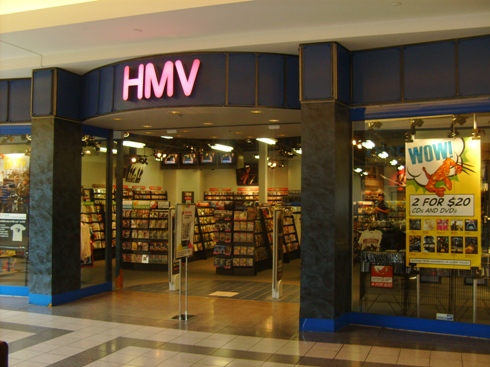
Not the one I worked at, but very similar in size and shape.

It occurred to me that twenty years ago as of the 23rd of September, it’s been twenty years since I’d started what would be one of my favorite jobs ever.  Never mind that it was a fifty-mile, hour-long commute one way.  Never mind that it didn’t pay enough for me to quickly get caught up on all my bills.

Dude: I was working in a record store.  That’s all that mattered.

But I’m not going to go into detail about the store too much here; I’ll be doing that over at Walk in Silence tomorrow.

No, instead, I’ll talk a little about the food court, which was across the way from my store.

spm-food-court-1
Solomon Pond Mall food court: where I had my initial interview, where I ate far too much fast food, and where I wrote a novel.

The mall was built around 1995 into 1996, so it was still shiny and new when I started working there. HMV was the first and only music store there at the time –not to mention this was before the file-sharing boom — so in those few years I worked there, we did pretty good business.  We were in a good spot as well, so kids were always stopping in on their way to meet their friends elsewhere.

The last time I was at that mall was ten years ago, when we went to visit a few people in the area and had some time to kill.  It hadn’t changed in the six years since I’d left the job, other than that the store closed up in 2001 and a Hollister was put in its place.  A brief visit to the mall’s website shows that a lot of the original stores are still there.

HMV was the first long-term job I started after I moved back from my ill-fated stay in Boston a year before.  After the short-term stay at the Leominster Sony theater, a six-month stay at WCAT, and a temp job at my mother’s bank downtown, I had to get hired somewhere, most likely out of town.  I loved my hometown, but I’d long grown out of it.  I needed to figure out a way to live in the larger world.

spm-1
The western wing of the mall, looking east. There was a Waldenbooks just out of shot to the right.  My store was to the left of that ‘Food Court’ sign in the distance.

Writingwise, I’d kind of dried up a bit.  The process of writing True Faith had stuttered to a halt for personal reasons.  I’d given up trying to rewrite the Infamous War Novel by this point, having finally trunked it.  The songwriting and the poetry were drying up as well.  It definitely wasn’t that I’d given up…it was that I had nothing to write about.

When I started the job at HMV, I wasn’t exactly sure how long it would take me to get there and back (even though I’d timed it during my initial interview in mid-August), so I would make it a point to get there with time to spare.  My hours were from opening to late afternoon: somewhere around 9 to 5.  Eventually I timed it so I’d get there about an hour to a half-hour early.  I’d sit out in the food court with another coffee and relax.  No stress when I started the job proper, then.

It didn’t take long for me to realize this was a perfect time to do some writing.

By late 1996-early 1997 I was out there every morning, working on something.  My usual spot was the table closest to the store.  [In the food court picture above, it would be right in front of that Dunkies at the far right.  I chose that one deliberately so I would see the store’s lights go on when whoever opened got there before me, signalling it was time for me to clock in.]

spm-food-court-tables
Similar tables and chairs to the ones I used to sit at.  I remember that wave pattern well.  The zipper of my jacket would always get caught in those damn chair backs somehow.

I started The Phoenix Effect on 9 March 1997 at that table.  A number of personal and creative events had taken place between the start of my job and that date, and that morning I chose to start a completely new story.  I had no idea where I was going with it at first, other than the fact that it picked up where I’d left off with the spiritual/new age story ideas of True Faith and expanded on them significantly.  It would be less dystopian, that was for sure.

Soon I was writing three to five handwritten pages a day before I started the job.  I timed it so I’d get those words done, skip out for a quick smoke (a bad habit I’d picked up in college a few years previous), and then head off to my job.

After about a month of that, I realized it would probably be for the best that I start transcribing all this new work so I could start editing and revising it.  I’d already moved my computer downstairs to the basement of my parents’ house and was already working on other transcription projects and whatnot.  It seemed like the right thing to do.

belfry-1998ish
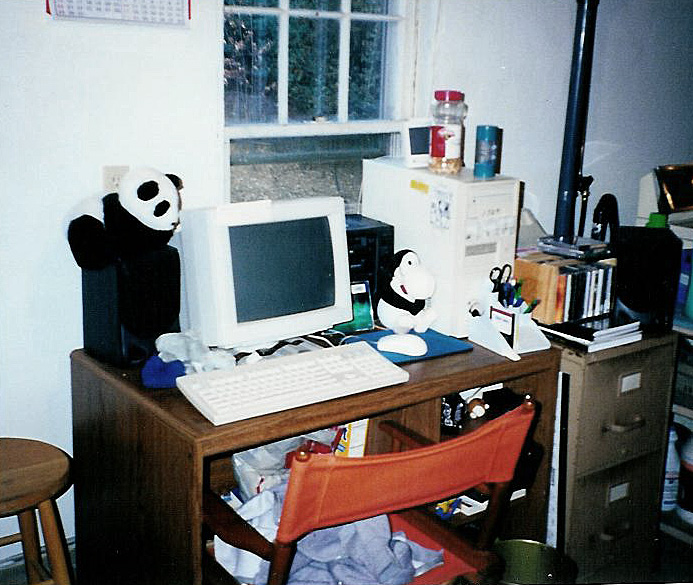
The Belfry, circa 1998, with the hand-me-down Windows 95 computer (my second one).  The writing nook was named so because of a bat problem one evening.  Note the various snacks, notebooks, music, and other distractions nearby.  Not shown: my addiction to playing FreeCell before I started a writing session.

By late 1997 and into early 1998, I was finishing up the handwritten version of The Phoenix Effect and working on a good solid revision, and by the end of that year I was ready to try my hand at submitting it to agents and publishers.  I was also working on a sequel during my morning mall sessions.  And I’d kept up with the publishing field as I went along.  I knew what I was doing, and what I wanted to do.

This was the first novel since the IWN that I’d completed and submitted back in 1987, so I considered all this a pretty damn good milestone.  Even as TPE was rejected left and right (and for good reason), I knew then I had a chance of making this a lifelong career.

I knew I was a writer at that point.

Alas, by early 2000 the job had become unbearable due to the change in management, hierarchy and schedule.  I still made it a point to work on my writing on a daily basis, but it had become close to impossible to keep the same writing habits I’d had just a few years earlier.  The most I could do is head down to the Belfry every night and work on revisions.  I became stubborn about it.  I would not give this up.

By autumn 2000, I’d quit that job and started a new one on the other side of the state.  It was a shorter commute (thirty miles instead of fifty), the pay was better, and the schedule was a hell of a lot more stable.  By early 2001 I’d switched to first shift, which let me out at 2pm.  I had the entire afternoon and evening to write.

And write I did.  And I’ve never stopped since.

20160925_171357a
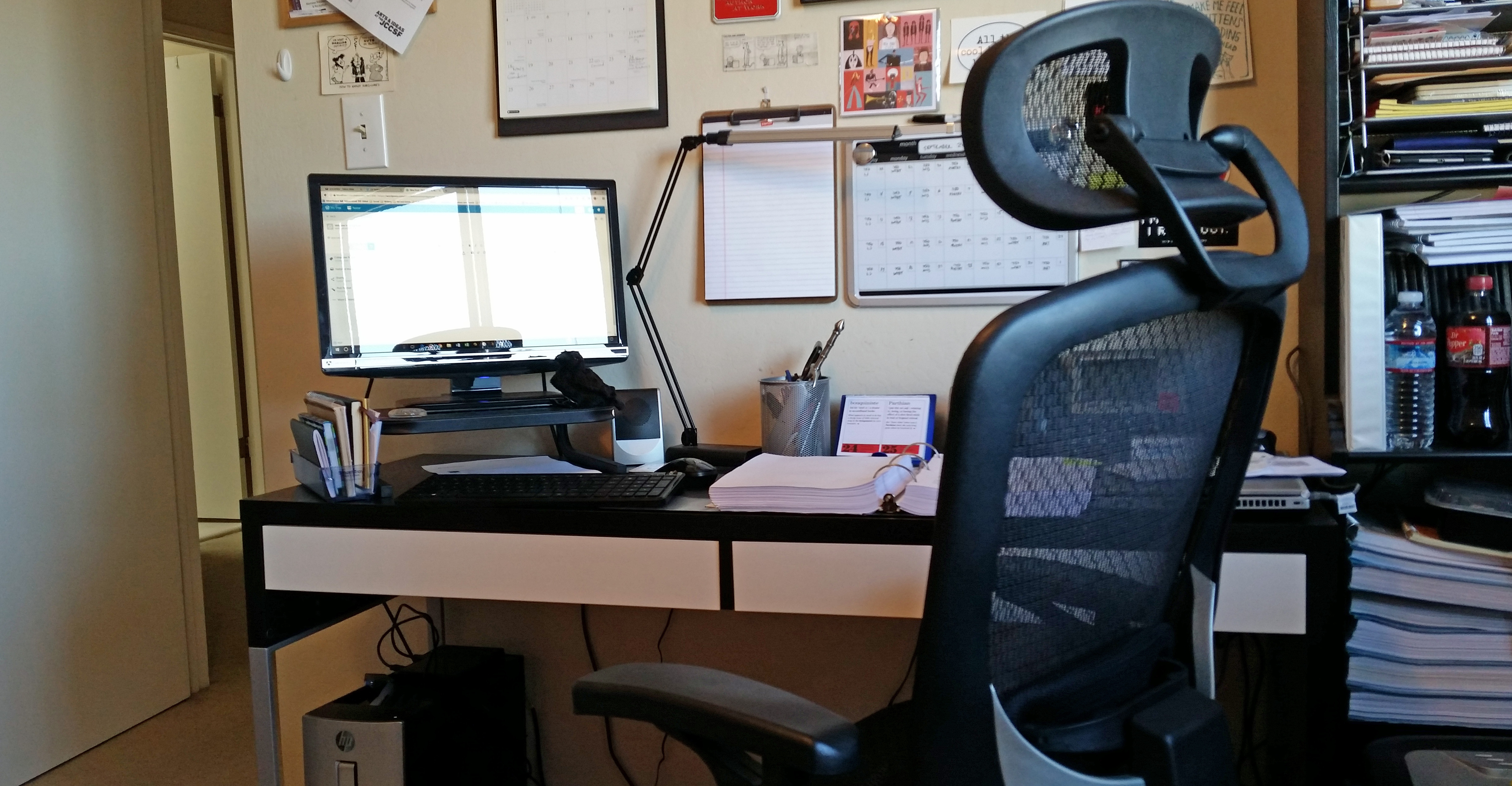
Spare Oom, 25 September 2016 — still writing, still listening to tunage, still snacking, still distracted.

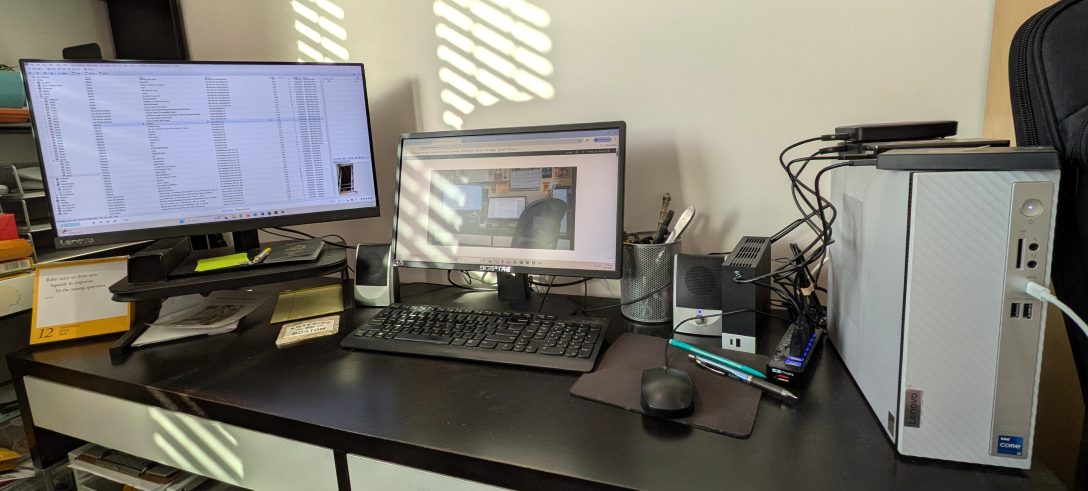
Twenty years later and that novel went through numerous revisions and morphed into a trilogy and an expanded universe.  My music now comes to me from streaming radio stations, ripped cds and downloaded mp3s, and is all stored on two tiny external hard drives each about the size of an index card.  I work from home and my commute is one room over.  I’ve self-published two books of the trilogy, with the third on the way.

I still think about that store from time to time.  I still consider it one of my favorite jobs ever, even if it was retail.  Even near the end, when my manager and I weren’t getting along.  Being surrounded by music all day kept me happy and entertained.

And most importantly, the job helped me create a solid and dependable writing schedule, and it helped me prove to myself that I could balance a Day Job and the Writing Career at the same time with minimal issue.

Without that, I’m not entirely sure where I’d be in my writing career today.