Rebellion

I am coming ever closer to the final act of Theadia, which means that I have to craft what I think is the perfect ending for the story. Mind you, I’m not looking for perfection per se, as that would just be madness. Like the third act of The Balance of Light, I have to work out an ending that both wraps up what I’ve been trying to say with the story, and also gives it a sense of proper closure, and I have to do that using several moving parts of my own creation. It can be tough and daunting, but it’s doable.

Thing is, the cast of Theadia is not your typical group of uber-savvy tech nerds, nor are they artillery-laden soldiers or maverick pilots. (Well, one of them is a maverick pilot, but his flashiness is only used once, and for a good reason.) Those aren’t the characters I wanted to write, and that’s not the kind of novel I wanted to write either. The point here is that I don’t want the ending to be a Winner Take All, Honor Saves The Day sort of thing.

I’d said previously that I’d been thinking a lot about nonconformity lately, and I think that works here in Theadia as well. The book’s cast might hold jobs that require they follow the rules for the greater good, but their story is about not following the rules for the greater good. The repeated mantra in the story is a single question: if you could…would you do the right thing? Every character asks themselves that at one point or another, and often when they have to question authority. Their decisions are never about rebellion for the sake of it…they are about going against norms because it’s the right thing to do.

Will it make a difference, though? That’s another question I’ve been asking myself, and I’d like to think that it will. Maybe not in the grander scheme of things; their actions won’t be universe-altering, but they certainly might affect things on the local levels, and that’s what matters. They’re well aware that it could cause all kinds of trouble after the fact, but it’s still worth it.

I’d like to think there’s a little bit of real life truth in that as well.

Distraction, or just too busy?

I seem to be running out of time to write lately, and it’s bothersome.

To be honest, it’s not as if I’m overly distracted or simply just procrastinating these days. I’ll still deal with the Don’t Wannas every now and again, but for the most part I’ve been doing good. Just…not giving myself enough time.

Part of it lately is that I’ve been working a few odd hours at the Day Job that get me out around 4pm instead of 2pm, which leaves me with a few hours to hang with A and the cats until after dinner, by which time I end up scrunching multiple things into about an hour and a half of time. And to be honest, that ain’t working.

One thing I should probably do is prep multiple blog entries on the same day like I used to — that can easily be done if I give myself time to think about what I want to write about. And though I truly enjoy using the 750Words site, I think I’m at a point where I don’t need to work there right now. At this point writing there is more about getting those words done than using it for various projects. I’m not abandoning it, of course…I’m merely putting it aside.

The other thing I need to do is lay some ground rules, specifically one: what project(s) needs the most focus right now? In this case, I have two I want to focus on: finishing Theadia and starting the remaster of A Division of Souls. I already have schedule plans for each, so that shouldn’t be a problem. And when I’m done with Theadia then I can finally shift the bulk of my focus on writing MU4.

So yeah, I don’t think it’s distraction, at least not right now. Just needing to rethink my schedule a bit.

Binding off…?

I’m willing to admit I kinda sorta know how Theadia is going to end? Maybe? It’s very much like how I finally finished The Balance of Light a few years after stalling: I have a handful of chapters to go with an extremely vague idea of how it will all wrap up, but it’s the getting there that’s eluding me at the moment. And thankfully unlike that novel, it won’t take me another four years to finish.

If anything, my use of knitting references all over the novel kind of comes into play in a stereotypical way: everything that’s gone on is a part of something bigger. I’ve woven all these other patterns (read: character arcs) together and now I need to ensure that they all fit together in a coherent fashion. That’s one of the big themes of this novel: we’re all in it together. As long as I keep that in mind, I should be alright.

Anyway, I’m being hard on myself right now because I’m worried that I’m going to get to the end and have loose and miscounted stitches everywhere and it’ll be a big knotted mess that I’ll have to rip apart and start over. That may or may not happen, but we’ll see.

I guess I just need to have a bit more confidence in myself and in this novel. It’ll get there eventually.

Knowing enough to fake it

Working on this go-round of Theadia, I still feel the occasional worry that readers are going to see certain scenes and think oh dear lord, he has no idea what he’s going on about, does he? In particular, it comes up whenever I have a scene with our two goofballs Althea and Claudia doing their magic as programmers.

I mean, I’ll totally cop to the fact that I know enough about certain kinds of programming. I get what coding is supposed to do. And because of my years working e-payables at the bank, I definitely know enough about what happens if that coding is screwed up, and how a code that runs perfectly fine in test mode can just as easily fail spectacularly in live mode. [Oh, BOY do I know how that is. Reading about BofA’s recent systems kerflooey a few days ago gave me some not so fun flashbacks.]

And that’s what I lean on in this story. I have no reason to get into the nitty-gritty and explain in Doctorow-level detail what the characters are trying to do, because that’s not an important part of the story. What is important is why they’re doing what they’re doing, and knowing full well how it’ll end up because of that. There are a few moments of handwavium, sure, but it’s never a plot point that will disintegrate because of that.

What’s important here is not showing off the two women’s mad skillz, but that they know how to navigate the grey area between compliance and hacking. What these moments do hinge on is them not bringing attention to themselves while tweaking a few things here and there while everyone’s distracted.

As long as I make it believable enough, that’s good enough for me.

Okay, moving on…

I’ve spent way too long trying to make that chapter work and I’ve been getting nowhere. I know something needs to go there but it’s just not coming to me, so I’ve called it, placed a WRITE THIS LATER on the page, and moved on. Maybe I’ll come back to it, or maybe I’ll come up with something altogether different. Or maybe I won’t need it after all? Who knows?

Either way, I’m now working on another revision chapter — one I’ve already written and want to polish up — and I probably won’t return to this problem scene for quite some time. I’ll have it playing in the back of my head, sure, but I most likely won’t actually do any writing for it until I get the rest of the novel done. I actually did this with Diwa & Kaffi — chapter eleven, where Diwa is making rolls with his mother and talking about his dad, was the last thing I wrote for that novel before prepping it for publication. By the time I wrote it, I had a much better idea of what was needed and it came to me much quicker and easier.

It’s not a process I do all that often, but sometimes it’s necessary to move on instead of wasting so much time focusing on something that refuses to budge.

On creating new characters midstream

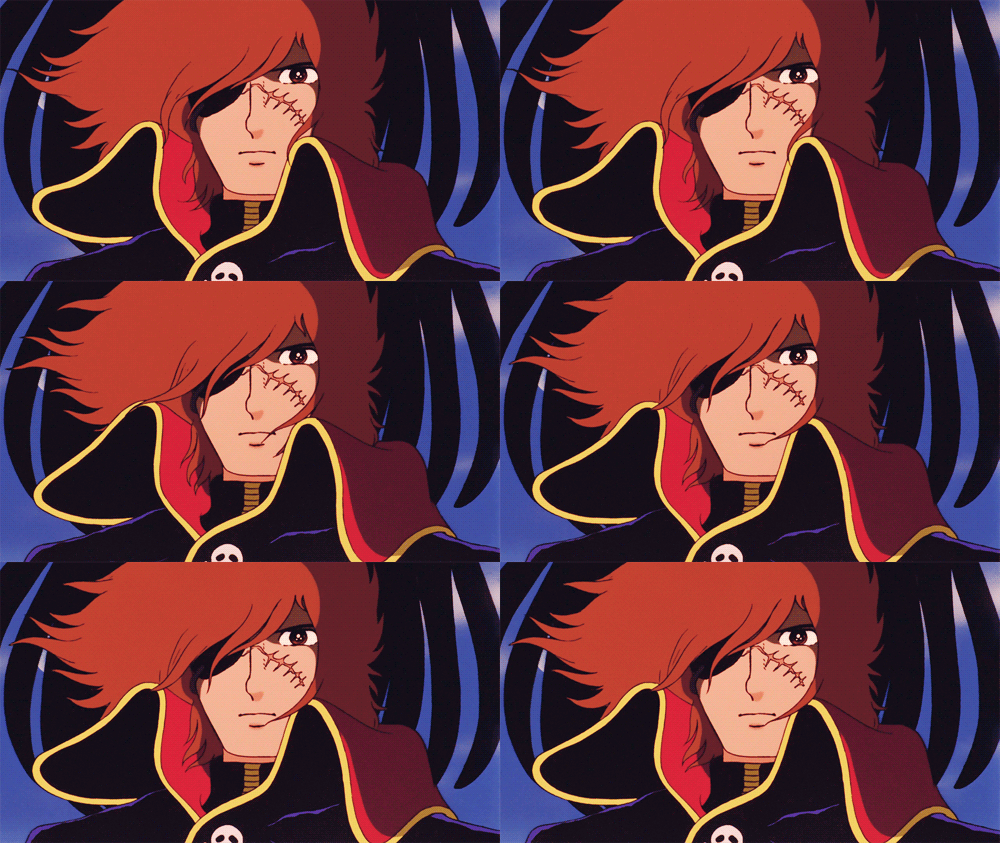
Okay, so Captain Will Dewar in Theadia is definitely not Space Pirate Captain Harlock, but the gif was too good to pass up, heh.

Anyway, I’m kind of stuck on how to write Dewar, as he’s a relatively new character unlike nearly everyone else in the novel. But in the process, I’m reminded that this also happened back when I was writing A Division of Souls; originally Christine Gorecki was merely a name of an old friend that Poe mentioned during a tense moment to ease Caren’s distress. By The Persistence of Memories she’d acquired a major role.

So why Dewar, anyway? Again, he was originally a one-off, someone mentioned in passing during a conversation between a few flight captains, someone known as being gruff and not entirely friendly but someone who could be trusted. As it happens in this particular revision/rewrite, I need to expand his role as someone willing to take extremely dangerous chances in order to help the main characters achieve their goals.

But who is he when he’s not in uniform? What kind of civilian would he be? Well, I kind of see him a bit like Alan Ritchson’s take on the Jack Reacher character: ridiculously well-built, surprisingly intelligent, yet a bit of a quiet loner. He’s not all that easy to rile up, but you don’t want to be in the same area when he is. I wouldn’t say he has a strong sense of justice, but more like a strong drive to ensure the right thing is done, and done correctly the first time. He craves competence.

All this thought and brainstorming, just for a secondary character! Well, this is why I loved writing the Bridgetown trilogy so much: every character in that universe has a backstory and a reason for being there, and that’s exactly the kind of writing work I love doing. [Why yes, I’m definitely anti-AI when it comes to creativity, why do you ask?] While I do have some idea of who Dewar is and what he’s about, I’m still a bit vague on his reasons for being who he is and why he does what he does, and how he relates to the other characters.

Well, that’s something I’ll need to keep plugging away on, isn’t it?

Long Work Days and Writing Sessions

There are just some days at the Day Job that leave me so exhausted that you say okay fine, I’m taking a day off and passing out on the bed instead of trying to work through this chapter. And as all good writers do, I always feel incredibly guilty about it, even though I should know better that creativity rarely works well during a drain of energy.

It’s been a couple of busy days at the Day Job, mainly due to back to back holidays known to be extremely chaotic in retail (Mother’s Day and Memorial Day), a strong wave of warm and sunny days in the neighborhood, as well as the final days of the local middle and high schools wrapping up, bringing twitchy teens loading up on snacks and drinks.

Usually I can get a few hundred words done despite this, but the deal-breaker this time has been allergies. Those warm and sunny days have brought along several blooming and pollenating plants and trees that have kept me stuffed up and/or handling a migraine throughout my shifts. I look forward to days off when this kind of thing lays me low.

Still…I don’t feel too guilty about missing a few days or doing the least amount of writing work. It annoys me that I have to sacrifice that and not something else, but I’ve made my peace with that some time ago. As long as I’m able to get back to work soon enough.

Those little ‘aha!’ moments

I’ll admit one of the things that’s been worrying me about the new version of Theadia is that with the new scenes, I sometimes feel like I’m putting in filler. I know I’m not; I’m putting these new scenes in for reasons that will become clear further into the story. Thing is, some of these reasons are a bit, er, vague at the moment because I don’t have a crystal clear idea of how to reveal these plot points.

Then there are the moments where I’m being super patient with the low word count and pushing through, and somehow a shining bit of plot clarity pops in. That aha! moment, so to speak. I’ve just had a few of them over the last couple of days, in which I somehow backed myself into the exact spot the scene needed to be in.

Those are some of my favorite moments in writing, to be honest. It’s the pay-off for all the hard work and the frustration, where I suddenly see all the threads being woven together at once. That happened a lot with the Bridgetown trilogy and is happening here as well.

So I just need to remind myself to remain patient and vigilant, and all will make sense eventually.

Contemplation

Still working on distraction. I know, I know…but it’s a lifelong battle for me. Well — I wouldn’t necessarily call it a battle per se…more like an avoidance. In this current case, I feel like the new words I’m providing for Theadia are not working because I’m avoiding going any deeper with the story for some reason.

I mean, I’ll admit that a few of these chapters feature characters in positions I’m not entirely familiar with, and perhaps I’m worried that I’ll make a hash of it. But then again, I’ve written about messiahs, professional musicians and magical girls, right? How hard could this really be? Perhaps it’s not entirely about wanting to get it right, but wanting to get it right the first time.

Now that is one of my best and worst qualities, really. Perfectionism in writing is madness, as I’ve already learned many times.

Anyway…the fact remains that I’m going to need to force myself to do a much deeper dive for these characters. The scenes work…but they’re still far too static. I need them to be doing things, not just sitting at desks talking. And I need to take care of this now before I get too far into the rewrite, or else it’s just going to be a literal rewrite: a transcription with a few things changed and some pretty boring added scenes.

So I think what I need to do is get rid of this habit of avoidance. Let myself contemplate what goes on in the minds of these characters. Why are they doing what they’re doing? Who are they in relation to their surroundings? How are they able to do what they set out to do, what are the possible obstacles, and what are the possibilities of them being stopped?

I need to work this out somehow.

Acceptable Terminology

One thing I’ve been doing with Theadia is playing around with the terminology of things. Considering it takes place at some unknown point in the far future, I’ve decided that I’m going to experiment with some technological terms so that perhaps some of it is anachronistic while other terms are more generalized.

Computers, for example will rarely be referred to as ‘computers’ (the term just feels so 80s in my head even though it’s universal these days) but rather as things like databases, tablets and monitors. The same with phones; the tech has changed just enough in my story that I don’t see them using cell phones as we know them, but more like mini-tablets as we do know them. They don’t take a call but answer hails. My terminology is supposed to hint at familiar devices that have slightly different names and appearances than what we’re normally familiar with. And to be more nerdy: the internets are less about websites and social media (though they do exist here) and more about useful connection points to what you want or need to do at that moment. And yes, that does in fact include reading social sites and reading news feeds. The same, just slightly different. [Part of this is to underscore the way our two heroes view their work and what will happen to them in this story; the tl;dr is that their jobs are such that they understand what’s under the hood here and see their tech in that way.]

Do I really need to do this? Well, not exactly, but it’s part of my worldbuilding that I enjoy playing around with. I did the same with the Bridgetown Trilogy — there were cars (‘transports’) but there were also driverless lorries and such. It’s just part of the background color that makes the story a bit more real and intriguing.