Every now and again I’ll figure out a long-standing block in my current project, and in the process, I’ll be of two minds about it: one, that this unexpectedly clears the path for everything else to run smoothly…and two, that it’ll be a hell of a lot more work than expected. I suppose it’s the variant on the angel and devil on your shoulders bit, really. You feel thrilled that this one problem has finally gone away, but you don’t want to fully trust it just yet.
This has happened twice recently with Theadia, actually. Late last month I’d come to the conclusion that the problem I’d had with a certain character had nothing to do with their actions or what I needed them to do…it was that the character didn’t work. They were just…boring the hell out of me. I hated writing them and initially thought it was because it was a scene I ultimately would not need. That didn’t quite feel right to me, however. The clarity came when I decided that maybe I should have their actions be played by a character I had a bit more interest in but had woefully underused. And LO! It actually worked! These new passages are still a bit weak and in need of revision, but I’m not too worried about that — right now I just want to get the scenes done and written.
The second time was just a week or so ago, when I FINALLY came up with a plausible ending for the novel. This was just like The Balance of Light, in that I knew how I wanted the story to end, but I wasn’t exactly sure how I was going to get there. Thankfully there was no years-long block this time, only a general I’ll get to it when I get to it avoidance. Suffice it to say, I happened to have the day off then, and allowed myself to ruminate over this bit of clarity for a bit to work it out. After about an hour or two, I had a pretty good idea of how I was going to play this out.
As of this moment, I am focusing mostly on the first revelation, as they are the main character of nearly all the ‘WRITE THIS LATER’ scenes I’d skipped over the last year or so. This is actually working for the best, as I’m able to expand on this new character organically, just like I had with the other mains. And once that is taken care of, I can finally finish the novel properly.
I am just a few short(ish) chapters away from completing this current revision of Theadia, which means two things. One, my next step in completing this novel is to go back again and fill in all the ‘WRITE THIS LATER’ scenes I blocked out. This one’s going to be a bit tricky, as a lot of them will feature a character that’s just as important but only works indirectly with the two main characters. They know of each other, but they’re never seen in the same room, let alone on any kind of communication device. He’s not the kind of character I normally write, either, but he’s just as important to the overall story, so I’m going to have to work out just what I want and need him to do.
The second thing? Well…I’m going to have to finally figure out how I’m going to end the dang thing. I’ll admit this is similar to how I had to deal with finishing The Balance of Light…that is, I kinda-sorta have an idea of how it ends, but no set plan on how to get there. In order to make it work, I’m going to have to take the time and plan it out so I can nail the landing. Which means I’m probably going to have to give it a few more re-re-re-rereads like I so often do. Hey, whatever works, yeah?
This novel’s history is rather similar to the history of the Bridgetown Trilogy in certain ways. I’ve returned to the ‘extended ensemble cast’ for starters, and it’s also a story that’s been given a from-the-ground-up worldbuilding process (minus a conlang this time out, though a few characters do affect a certain patois, somewhat inspired by a similar setup on the tv series The Expanse). It’s also a story that’s had a bit of a hiatus for varying reasons due to Real Life Stuff. I think this is partly why I have a soft spot for this project — it’s something I’ve worked on for an extended time and with patient care. It’s not a novel I can phone in.
*exhales* WHOOF. I have finally completed Queen Ophelia’s War! I knew I’d be finishing it in the next day or so, but I hadn’t expected the ending to come so quickly! Come to find out, I’d already written the ending I thought I’d need to write, just that I had it in the wrong place, heh! [The above title is the last sentence of the novel, of course.]
Anyway…this was an interesting and extremely personal novel to write. To start with, I’d come up with the idea inspired by a waking dream in May of 2021, and sketched out the entire synopsis in one three thousand word go that morning. Surprisingly, the end result follows it almost to the letter, with just a few minor changes here and there and the addition of a few characters I hadn’t come up with initially.
But the real reason I say it’s personal is that this one mirrors my own life during and post-pandemic. It’s a story about reconnecting with people and things you’d been disconnected from for ages. It’s a story about unexpected life changes and choosing to embrace them instead of fearing them. It’s a story about being honest with yourself. And it’s a story about trusting yourself. Things I felt it was far past time to embrace in real life.
I already have a few book cover ideas in mind, so once I give this current draft a quick once-over, this will be my next self-published novel.
As of this week I am revising the most climactic scene in Act III of Queen Ophelia’s War, which means that one, I am coming close to the end of the book, and two, that I am on schedule to get this thing out into the world by late spring! Woohoo!
Finishing this one does feel a bit like how I felt when I finished Diwa & Kaffi…a sense of satisfied completion mixed with an eagerness to move ahead with the next project. In a way, QOW is a very personal book in that I’d written it during the pandemic and post-leaving the Former Day Job, but there’s also the fact that one of its themes is about the willingness to completely change one’s life, and how far one might go to achieve it. I kind of feel like this is my way of signing off many parts of my old life and embracing where I am now. I’m ready to move on to the next chapter now.
This is also one of the last standalones I’ll be working on for a while, and that’s something new to deal with as well. I’m eager, almost impatiently so, to jump back into an extensive created world again, this time with Theadia. I’m ready to move on to that style once again, to the point that I’ve been preparing myself for it over the last month or so.
The beginnings of my novels and stories usually get the most revision, mainly due to the fact that there’s a bit of flailing involved. I’m still trying to figure out the voice and the focus of the story, so there’s going to be a lot of dead-ends and extraneous filler that gets cut out, once I find my footing.
The endings, on the other hand, can go either way. Usually I know exactly where I want to stop; it’s just a matter of laying out how I’m going to get there. It’s a balancing game at that point…I don’t want to rush it, nor do I want to pad it out with unnecessary rambling.
I’ve made all kinds of errors in my years of learning how to write stories. I’ve written corny cliffhangers, implausible wrap-ups, unimportant ‘where are they now’ passages, and everything in between. [I can proudly say I have yet to write an ‘…and then he woke up, and it was all a dream” ending. Even I have my standards!] I usually spend as much time focusing on nailing the end as I do nailing the most important climactic scenes that come before it. I want to do it just right. Or right enough, where it can be fine-tuned in revision.
With Meet the Lidwells — I’m currently writing the last chapter at this time, and I should be done most likely this week or next — the ending has definitely been a tough one. As this is a story written in the format of a music biography, I can’t give it a nice poetic ending, or a roll-credits ending. Those books tend to resolve themselves in a slightly different way. The focus characters go on with their lives and careers, so this ending has to be more of an emotional closure. That part of their lives is over now, and they’ve moved on. And that’s been a hell of a tough one to capture just right.
I’m not looking to nail the ending perfectly, at least not right now. But when revision comes along, hopefully I’ll be able to do it justice.
As I may have mentioned earlier, I’ve just started Act III of Meet the Lidwells. This of course means that it’s that point of the story where I start bringing all the plot threads together, winding up the tale I’ve been telling, and wrapping everything up at the end.
Having either written novels piecemeal over the course of a long spread of time (thanks to homework, social life, or other priorities), or working on the same project for years on end (the trilogy), it feels quite strange to be completing a novel in roughly a half a year. I’m not used to this speed. There’s also the fact that this is a relatively short novel for me — I’m currently at 55k, and I’m expecting the finished project to be around 70k.
Still, there’s something to be said about reaching the home stretch. I felt this when I picked up The Balance of Light again in 2009-10 to finish it off. It’s exciting to be wrapping up a story, my writer brain going at a hundred miles an hour as it tries to weave everything together into a coherent ending for me to write, and balancing that with the knowledge that I need to make that ending smooth and well-paced. No rushing to the last page here, kids. Even if I know exactly how to finish it, I have to make sure I don’t make a chaotic mad dash to get there.
My original deadline was going to be mid-September (I had a general deadline, not a specific one), and it looks like it might be more like late October, given that I still need to revise it, clean it up, and get it ready for uploading. I’m fine with that; my ultimate goal here was to write something fast and light — a complete opposite to the trilogy, to be honest — to see if I could do it, and to see if it was something I could be proud of.
That’s a hell of a long time to be working on a novel, don’t you think?
At 11:18pm PT last night, I completed what I call the Great Trilogy Revision Project, a major overhaul of all three novels in the Mendaihu Trilogy. Entire scenes were rewritten, edited mercilessly, tightened up, names changed and characters strengthened. It took the better part of fourteen months and I kicked my own ass numerous times to avoid laziness and weak prose; I read, reread, re-reread, and re-re-reread (sometimes while at the gym!) until I knew the story, its history and its cast inside and out. And I read it again to make sure I knew where it worked and where it didn’t.
Today marks the first day in probably a decade or so where I have no plans to work on the existing novels or work on anything related. [Mind you, I definitely have plans to work on future Mendaihu Universe stories, just not at the moment.] In my mind, this epic project is DONE.
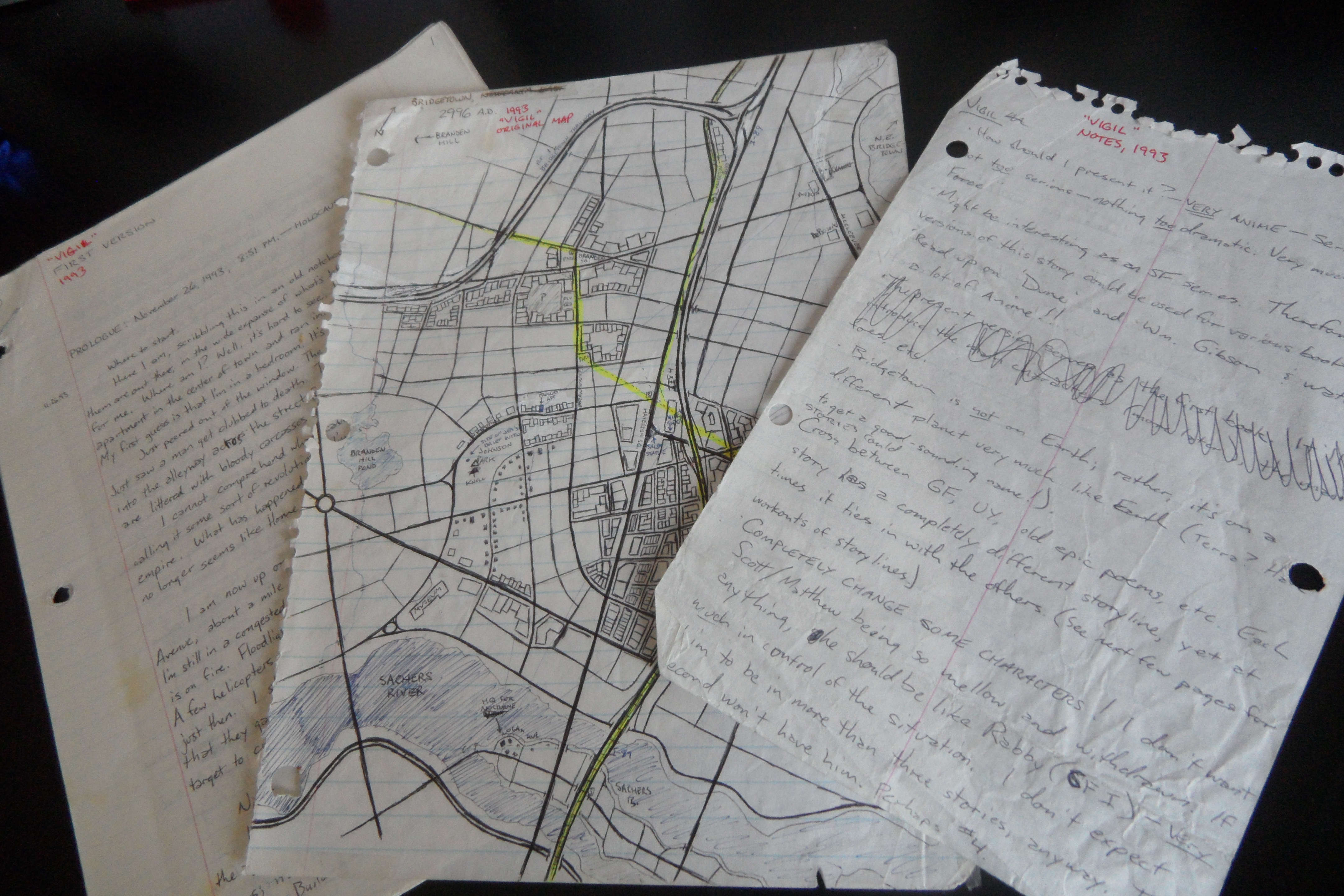
Notes made while doing laundry, October 1993.
In late 1993, I’d just watched the first two Gall Force animes (I’d find the third movie a short time later) and found inspiration to write what I often call my Infamous War Novel, or IWN–my first novel from my high school years–in a completely new style I hadn’t tried before: science fiction. I wrote a few notes in a steno notebook while waiting for my clothes to dry at the Charles Street Laundry, and came up with a number of ideas that I could work with. I’m amused by the first line saying “VERY ANIME”, as well as the consistent anime references on that one page. As if I knew what the hell anime was at that point in time, other than my latest obsession! All I wanted to do was write something that was totally unlike American SF at the time.
Did I know what the hell I was doing? Probably not. I was woefully ignorant of genre fiction other than through movies, comic books and Japanese animation. But I was willing to learn along the way. I understood right away that storytelling in Japan is significantly different than storytelling in America, and I wanted to try my hand at writing that way.
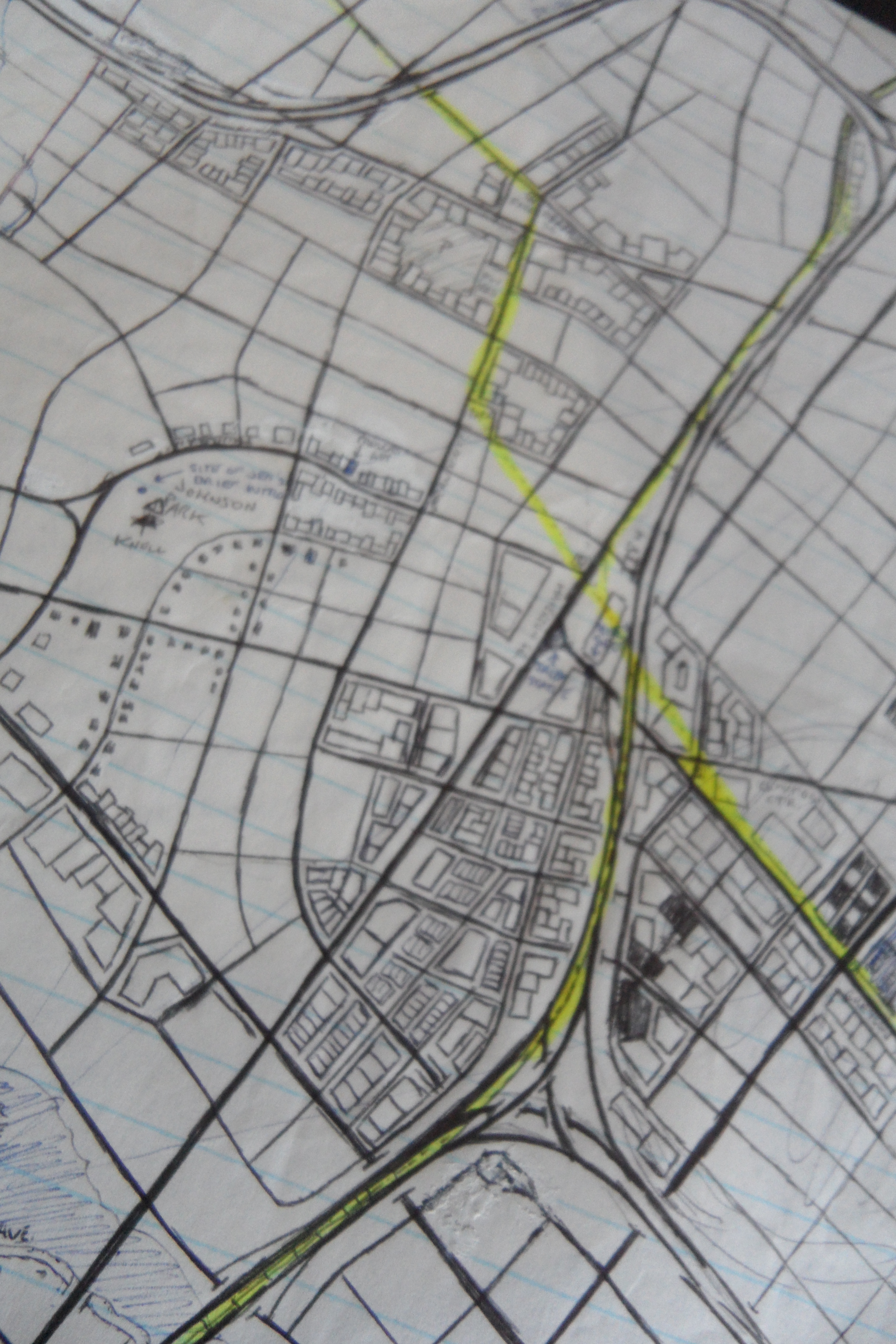
Soon after, I did what I normally do when I come up with story ideas: I draw maps.
The original Bridgetown Sprawl as of November 1993
I knew I wanted a few things: a sprawling metropolis, a giant tower (hints of the GENOM Tower from Bubblegum Crisis), and a megacity so packed with different places and cultures that I knew I’d be able to use the setting for multiple story arcs. Bridgetown morphed and grew considerably and exponentially over the years, but there are points here that made it all the way to the finished product in one form or another. Sachers Island, Branden Hill Park (named Johnson Park here, but pretty much in the same shape), the warehouse district, and the dirty and dangerous strip of McCleever Street were there from the start.
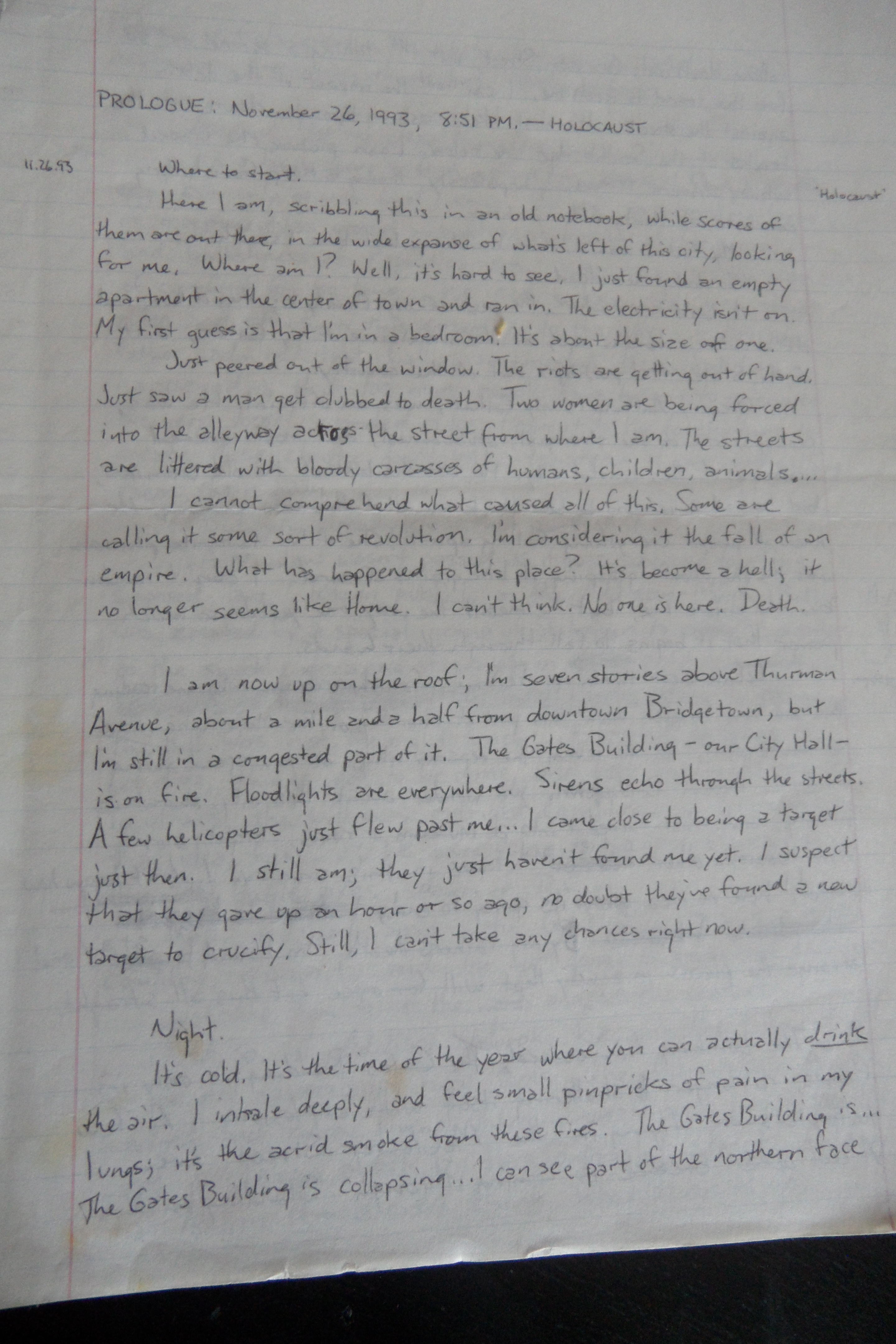
Vigil, Take One. Started 26 November 1993, 8:51pm ET in my shoebox apartment.
Where to start, indeed.
My primary aim when I first started this novel was to write something totally unlike anything I’d written before. I wanted everything about this project to be completely new for me–an untried style, a setting I’d never ventured through, a plot that challenged me to work it through to the best of my ability.
Granted, I was far from perfecting that, but I was going to try anyway. Vigil–so named after this band of rebellious misfits bent on saving the world from corruption–was started on the Friday after Thanksgiving 1993, after getting off work. I’d had a few ideas written out here and there, but this was where it all started.
True Faith–the aborted rewrite from summer 1994–would grow out of this, introducing the spiritual background. The Phoenix Effect, the project from 1997-1998, grew out of TF and introduced the alien races. TPE in turn became the trilogy after a complete restart from scratch.
So for all intents and purposes, Vigil was the version that started it all. And now it’s done.
Any author will tell you that they have a hard time letting go of their projects, even once they’re completely finished and on their way to publication, and I am no different. I’m sure I’ll want to pick these three books up again and tinker with them some more. I’ve already got Book 1 out to a publisher, and am ready to take the next steps to shop it around and even get an agent if need be. I’ve also debated self-publication as an alternative. It’s a wide world out there, and I’d like to introduce you all to the Mendaihu Universe someday. On this evening, I’m finally that much closer to doing so.
But for now? I think I’ll do what I haven’t done since I started writing the trilogy proper, way back in 2000: I think I’ll let it sit awhile, and let it age gracefully.




 Welcome to Bridgetown