
Creating a Writing Regimen

exercise panda

Now that I have a new project to work on, I’ve been thinking seriously about revisiting and revising my writing habits.  I’ve already talked about my writing regimen during the Belfry years, which was probably the most solid and consistent I’d ever had.  [The Arkham West years, not so much.  I spent most of those years just trying to adjust to married life and living on the opposite coast.]  The Spare Oom years have been stable and evolving at a stable rate.

But I just feel that I’m not doing enough.

This is my current weekday schedule:
Eat breakfast, catch up on webcomics
Focus on Day Job stuff during Day Job hours (sneaking in a blog post or Daily Words if time permits during slow time)
Longhand personal journal entry during first break
Catching up on social media or writing magazines during lunch
Breather during second break
Dinner and maybe an episode of whatever A. happens to be streaming that night
An hour or so working in Spare Oom at the end of the night
Getting into bed and reading until lights-out

Weekends include e-mail catch-up, chatting with family on the phone, shopping and errands, outside activities, blog writing, and so on.  End the day continuing work on whatever project I’m focusing on.

Mundane stuff, yeah, but I can’t help but think that I’m really not doing my best at time management here.

BUT!  Since I no longer have a Giant Book Project weighing me down, I realize it’s time for me to give that all a rethink.  It’s too scattered, too disjointed.  I find myself wasting time when I shouldn’t be.  Sure, maybe I’m already using these few hours whenever I can, and just like every other writer, I feel it isn’t enough.  The question becomes: how to get the maximum work out of a limited time frame?

Or perhaps that’s the wrong question.  Besides, that way lies madness.  I’ll never have enough time, even if I decide to drop every other minor exercise to make it happen.

No, the better question is:  how do I organize my time better?

Well, the problem is that I’m dithering.  I’m in the very early stages of Meet the Lidwells! and I’m chomping at the bit to get writin’.  I’m trying a new approach this time: preplanning by way of index cards and an outline instead of making it up as I go along.  [Noted: the reason I’m doing this is that the trilogy project took so damn long and needed so much clean-up afterwards that I figured being more organized might save me a hell of a lot of time.]  All this precision is driving me batty, because I’m so used to being a pantser writer.  I still have this excess energy with nowhere to put it, so it ends up getting wasted on skimming social media or futzing around with my music collection.

And to be honest, I had the same problem in the Belfry years.  I’ve talked about my time wasted playing multiple rounds of FreeCell (or worse, wasting twenty minutes pondering over my cd collection trying to decide what I was going to listen to that night).  And I definitely had the same problem during the Arkham West years.

So what do I do?

Well, the best thing for me to do is to expand on that daily assignment regimen.

One of the steps I take is following my whiteboard schedule.  As you may have noticed, I’ve been reasonably consistent with my blog schedule here and at Walk in Silence.  I’ve also been good at writing the personal journal five days a week during Day Job hours.  I can expand on that, then.  I’ve already given myself a deadline of getting the indexing and outlining done for MtL! by the end of April, and to get the major writing started by the first of May.  I can certainly add more assignments with other projects if need be.

Mind you, I’m not trying to Write All the Things.  I’m just trying to be more productive.  It’s also a long and evolving process, so I can’t expect a complete change right off.  It takes time and practice.  And dedication.

It’ll take time, but I’d like to think it’s worth it.
A Division of Souls Ending, Director’s Cut

As promised, here’s what I call the “Director’s Cut” of the ending of A Division of Souls.  This one’s been in my head for at least two years.  And yes, this was written to fit Failure’s “Daylight”, as expected.

I actually thought about writing a prose version of this ending for the book, but it would have just been extraneous.  It’s a completely visual segment anyway.  So, using my dusty and woefully underused BA degree in film, I decided to instead write this in screenplay form.

Hope you enjoy!

[SPOILERS AHEAD, OBVIOUSLY.]

Continue reading “A Division of Souls Ending, Director’s Cut”

Starting fresh

20170326_134449 (2)

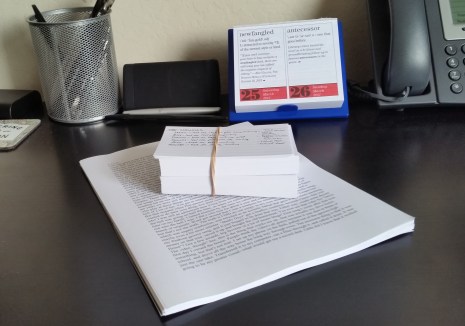
In contrast to the previous post, where you got to see all the paperwork and whatnot that I accumulated during the writing of the trilogy, the above is pretty much everything I have for my new project, Meet the Lidwells!   A print out of the very rough draft I wrote two years ago using 750 Words, and a pile of index cards that I’ll be using to outline the next draft.

That’s it.  Well, okay, there’s a few MS Word files of an incomplete outline and a rewrite I wasn’t happy with, and an mp3 playlist I’m slowly building, but other than that…that’s all I have.

I’ve got a nifty idea for a cover in my head (which I’m hoping I can pull off, as I’m not sure if I’m able to do it in Photoshop).  I already know what the format’s going to be.  And if all works out, this will be one of my fastest project turnarounds ever.

But yeah.  Starting fresh.

I’m looking forward to it.

Extra: All in one place (sort of)

20170305_161536

Sorry it’s a little out of focus, but there you go:  twenty-plus years’ worth of work, all in one place.  Pretty sure I’m missing a few things here and there due to misfiling, but what you see there is the beginning and the end — and the future — of the Mendaihu Universe.

Of note:

–That pile of folders in the top left corner is all pre-TPE work, including a print out of True Faith and all its notes, character notes, and so on.
–That tattered green notebook is the one I used for writing The Phoenix Effect.  The second notebook with the latter half is underneath it, as well as outtakes, notes, and other things.
–Top row, third over, under the ‘more outtakes’ folders:  the three binders holding the print-out of the trilogy, circa 2005.
–Top row, far right: the sketch book that contains my map of Bridgetown.  Underneath it is a very large binder carrying all the work from the Infamous War Novel (whose only relation to all of this is that I’d originally written Vigil as a sci-fi IWN rewrite).
–Bottom row, far left: extraneous notes from the Belfry years, as well as various pocket calendars marking my daily word counts.
–Next to it, the 3″ disks where I backed up my work during the Belfry years, including outtakes, notes, outlines, and other related things.
–Bottom row, middle: two attempts at sequels to The Phoenix Effect, circa 1999-2000, before I decided to start over with A Division of Souls
Bottom row, yellow notebook:  A VERY rough draft of the possible next story in the Mendaihu Universe, set once more in Bridgetown, but 70 years later.
–And finally, the end result:  galley copies of Books 1 and 2!

In comparison, I’d show you the stuff I have for Meet the Lidwells!, but it would be a picture consisting of a printout of the original rough draft and a pile of index cards. 😉

Writing Places Over the Years

I know I’ve shared a few of these over on Live Journal (and a few in earlier WtBt posts) in the past, though I figured it would be fun to create a bit of a visual scrapbook of places related to the Mendaihu Universe over the years.  I made it a point to write whenever and wherever, so I quickly got used to finding a nook in whatever apartment or house I lived in.  All I need is a few plugs, a PC, my music collection, and I’m golden.

Continue reading “Writing Places Over the Years”

A Division of Souls: The Graphic Novel?

One of my many ideas for the Bridgetown Trilogy, if I wasn’t going to turn it into a wacky multiproduct entity (No, there won’t be any Saisshalé-O’s breakfast cereal, sorry) was to give the books a visual approach.

Part of this was inspired by the frequent comment that my style of writing is very visual.  I went to the Miami Vice School of Writing Cool Scenes Using Music back in the day, and having a degree in film studies from Emerson College, so I’d say that comment is spot on.  It’s just the way I read and write: I see the scene visually and try to describe it that way.

A year or so ago I thought I’d try my hand at laying out the first scene of A Division of Souls, just for the fun of it, just to see if I could pull it off.  In retrospect I could probably rein it in a bit in terms of pacing, but I like how it ended up.  There’s a distinct hint of Dave Sim’s Cerebus in there (specifically latter half of the Church & State storyline), which heavily influenced me back in my college days.

Hope you enjoy!

Continue reading “A Division of Souls: The Graphic Novel?”

Bridgetown Maps: Evolution

I’ve mentioned this before: I’ve been fascinated by maps since I was a kid.  My dad had put up nine US Geodetic Survey maps of the local North Quabbin area on the wall of his downtown office (he used it as reference, as he was a local reporter), and I would stare at the things for ages.  The topography lines helped me imagine what the areas I’ve never visited looked like.  When I did eventually visit those areas, my visual guesses were rarely far off the mark.  My fascination soon expanded to the roads I carved into the dirt in my side yard for my Hot Wheels, and by 9 or 10 I was drawing maps just for the fun of it.  They weren’t of anywhere in particular; I’d just make them up as I went along.  It became a relaxing way to pass the time for me.  And once I went to college, you’d see map doodling all over the margins.  I still do it to this day; if you see me in the audience at a con, leaning over and doodling, chances are I’m drawing a map while I’m listening to the panelists.

Bridgetown Central 1993
Artwork ©1993 Jon Chaisson

When I started the Vigil project in the winter of 1993, I knew map drawing would have to be part of the world building.  If not for the publication, at least for my own reference.  I had certain areas of Bridgetown laid out in my head, but I wanted to have a physical layout I could use.

I hadn’t quite gotten the hang of size and perspective in these early maps, but they at least gave me an idea of what the Sprawl looked like.

This first map to the left was drawn that winter, with a much smaller layout of the city (it’s more like a small city here than a big giant sprawl it ended up being), but certain parts of it remained to the end of the project: the gentle curve of Branden Hill Park (called Johnson Park here), Sachers River and its island (with Vigil’s island location laid out), and the major north-south highway splitting through the middle.

Bridgetown Central 1995
Artwork ©1995 Jon Chaisson

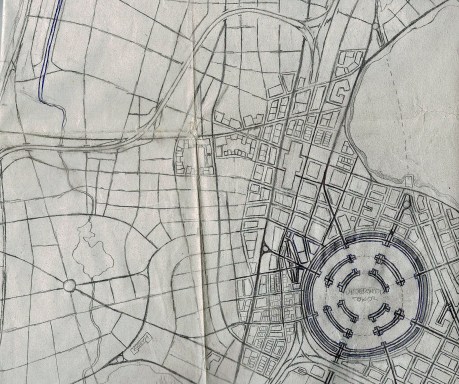
The Vigil project ended up more like a lot of world building than doing much actual prose writing (I think it had more to do with me trying to figure out what story I wanted to tell and how).  By the summer of 1995 I expanded the above map by taping the original to my apartment window, covering it with blank newsprint paper, and building it up.

The layout was still a bit wonky, but I was getting there.  The big circle in the lower right corner is the first visual suggestion of the Mirades Tower (called the Underwood Tower here — I think I originally wanted Jenn’s family to be tied do it but never expanded on that plot line).  I’m kind of fascinated by this one, because by that time I’d watched a lot of anime and wanted something like the GENOM Tower from Bubblegum Crisis.  I was well aware of security issues with major driving arteries going underneath this tower, but I thought it was kind of a neat idea anyway.

Mirades Tower Looking South
Artwork ©1998 Jon Chaisson

Come 1998, I was about halfway through writing The Phoenix Effect, and I had a much better idea of what Bridgetown looked like.  At first I had an idea to draw certain visuals, such as the one to the left here: a view of the Mirades Tower, lording over the entirety of the Sprawl (the circle of buildings is a reference to the initial awakening process that takes place at the start of the book…ie, the Ring of Fire).  I wasn’t too happy with the artwork though (mainly me being a perfectionist and being annoyed at how wonky the Tower looks here), but it did its job.    I even got a better idea of how wide the Sachers River needed to be.  In fact, looking at this now, I realize this is very similar to the view I have out Spare Oom window, looking across the mouth of the Golden Gate towards the Marin Headlands!

Bridgetown Central
Artwork ©1998 Jon Chaisson

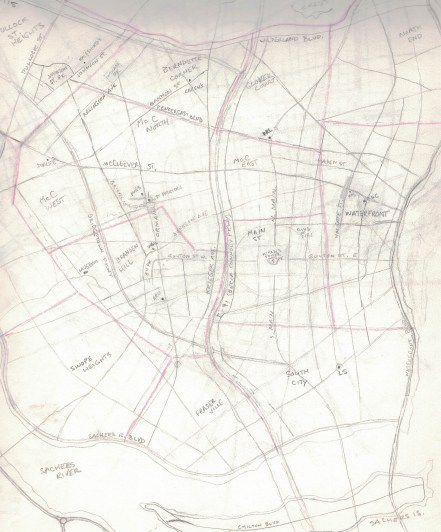
Probably within a month or so after that above drawing, I drew what would end up being one of the official reference maps for Bridgetown, complete with the district boundaries.  I would refer to this one page constantly during the TPE revision and the major rewrite as the trilogy.  Very little has changed in Bridgetown since then.  A few street names have changed, and I still hadn’t quite gotten Sachers Island drawn correctly, but for the most part this can still be considered a semi-accurate reference map for all the stories that take place in this city.

Note: Also seen on this map are the rough points of the hrrah-sehdhyn attack that takes place in A Division of Souls.  I’d added these a few years after the original map was drawn and just before I wrote that scene so I could get the layout correct.


But wait, there’s more!

During the years I wrote the trilogy, I would often flesh out ideas during the slow hours at my Day Job at the candle warehouse.  My buddy Bruce would often make fun of me when I did this.  I’d snag a piece of scrap paper (or more to the point, the blank forms we used for the pallets we built) and commence with that day’s outlining for whatever I’d be writing later that evening.  Or I’d draw detailed maps, sometimes even working on certain sections of Bridgetown.

Branden Hill Park
Artwork ©2001 Jon Chaisson

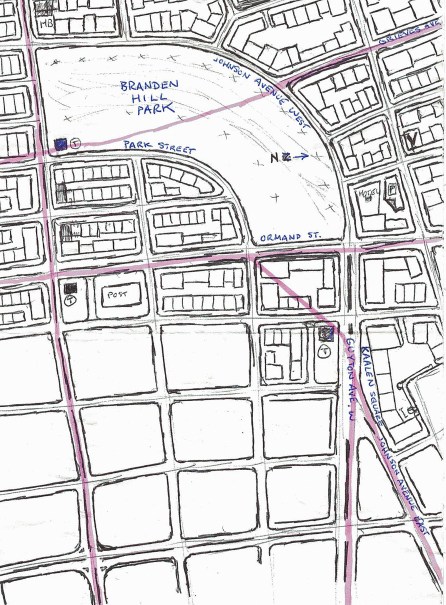
Here’s a great example of that:  My favorite section of town Branden Hill Park, which had been a point of interest since the Vigil days (the original Vigil story starts at the northeast corner of the park).  This is probably the best example of what Bridgetown truly looks like in my head.  I even went so far as to draw subway lines, considering that subway kiosk in the park shows up multiple times in the trilogy.

Note: You can even see where I put Nehalé’s apartment (the HB in the top left corner, referring to his old name of Halley Brown).

I do like the idea that even though the trilogy takes place at least 300 years in the future, there really hasn’t been too much of a change in terms of street layout or architecture for that matter.  I used the reasoning that Europe still has some of its original medieval roads, not to mention architecture that’s been around for a few centuries.  Besides, I really wasn’t all that keen on using the SF trope of multi-level cities and mountains of detritus.  The Meraladians helped us get past that economical and ecological snag sometime ago.

Mirades Tower Park
Artwork ©2003 Jon Chaisson

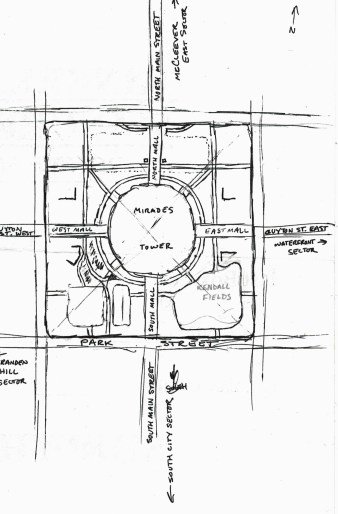
And lastly, I wanted a general layout of what Mirades Tower Park looked like — it would be used as a major setting throughout the trilogy, and numerous scenes take place there in The Balance of Light, so I had to make sure I got it right.  I think this one definitely gets the dimensions correct, as the Tower really is that huge.  I also deliberately left the surrounding neighborhood empty…since this is the financial and governmental center of the city, the entire area would be filled with skyscrapers and business towers, so the map would really end up looking like a bunch of large squares inside a square grid of streets.

I’m sure I have more maps and building drawings lying around.  I know I’d made a rough sketch of what the Branden Hill ARU headquarters looked like (hint: one of those arty curvy buildings, but without all the bizarre useless angles).  I’ll have to scan more of them when I have the time.

All these drawings definitely helped me visualize Bridgetown as I was writing the stories that take place there.  Without them I’m sure I’d have gotten a lot of the directions and distances incorrect.  It also helped me narrow down the images I wanted for my book covers; I knew that they would have to be busy metropolises, though not necessarily with the dark cyberpunk attitude of Bladerunner.  Both A Division of Souls and The Balance of Light use Shutterstock pictures of Singapore, which is just about the right level of sprawling city I was looking for.


On being an SME

mr_smee_live_action
No, the other SME.

What is an SME?  It’s a business acronym (and companies loves them some acronyms something fierce) for Subject Matter Expert.  I’ve been labeled one at my Day Job thanks to my expertise regarding check printing and OFAC regulations (w/r/t checking accounts).  How did I get there?  Well, I’d originally been a Jack of All Trades in my position, but over the years I’d become more and more knowledgeable in this sort of stuff, to the point where I could write FAQs and easy to understand How-To’s for my coworkers and new hires.  I’ve had managers from other departments requesting my input on related things.  And to add to that, I can also go on vacation like I did this week and not have to worry about my team completely falling apart trying to do my job in my absence.

Granted, I didn’t learn all this over the course of a few weeks.  I started working specifically with checking around 2008 and OFAC around 2012.  Some of it was learned via outdated documentation, and a lot of it was learned on the fly.  In short, I decided that this was a narrow-focus subject I could pick up on and get to know in detail.

So what does this have to do with writing?

Good question!  Right about the same time I started learning more about OFAC, I’d made a conscious decision to become an SME on writing novels…at least to the level where I could feasibly do it myself instead of farming it out to someone else.  It was twofold: I really did want to know more about the process, and I wanted to see if I could pull it off.  So over the next five years, I dedicated myself to learning as much as I could about the writing and self-publishing process.

I wouldn’t say I’m an SME at all facets of the writing business, far from it.  My focus is deliberately narrow: I know a goodly amount about novel writing, self-publishing, self-editing, cover art production, and so on.  I’m still a n00b when it comes to the marketing and promotion side of it, though I’m making an effort to learn more about that as well.  And most importantly, I enjoy being at this level of knowledge.  Writing is one of the few creative avenues where I’m able to think multiple steps ahead and see all the moving parts of the whole.  Knowing what to do with all those parts makes me a better writer.

There’s also the fact that I’m a huge fan of Paying It Forward.  This is why I post entries like this…I like the idea of helping out other writers, clearing the path for them so they can see where they need to go.  If I can take what I’ve learned and make it easy for others to pick it up as well, so much the better.

Does an author have to be an SME?  Another good question; and I would answer that by saying ‘only to the level they need to be at.’  You want to know how to write in your specific genre, of course, and you want to be good enough at it so your readers won’t feel cheated by a poorly written story.  You may farm out the editing and the cover and the distribution (or that may be left to your publishing house), either because you’re not good at it or you’re simply not that interested in taking the time for it.  Nowadays you might want to have at least a moderate amount of knowledge about promotion, considering the current state of publishing.  [As an aside, it never hurts to know a bit about the various parts of the process anyway, so your conversations with editors/cover artists/etc won’t be as confusing and/or scary.]

Think of it this way:  when you bring your car into the shop, you can either trust the mechanic, or you can also understand what the mechanic has to do.  There’s no right or wrong here; it’s all about how much you want to know about the moving parts.  For some it’s advanced algebra, for others it’s utterly fascinating.  It’s completely up to you.


Going Public: Conventions

20170310_151952a
Note: don’t forget to breathe. Also: don’t tilt your head down like I did, unless you’re fine with showing off your extra chins.

So!  My first official convention as an author rather than a fan went well, all told!  FOGcon was a very good place to start, as it’s a relatively small convention attendance-wise, so I didn’t feel overwhelmed by standing up in front of any large crowds.

A few things I learned:

–Dress for the occasion. What I wore is actually pretty conservative for a typical SF/F con, but my Diesel Sweeties ‘Almost There’ shirt went over well with a lot of people, including one of the hotel bartenders!

–Keep well hydrated, especially if you’re doing a reading.  There’s a bottle of water hiding behind my book in that picture there, which came in handy.

–You will always end up reading faster than you think; remember to slow..it..down.  I forgot this and zipped along at quite a pace, according to Amanda.

–Noted: remember to say what you’re reading and give it a bit of a preface.  Due to my nerves I’d completely forgotten to do so.  D’OH.  Thankfully I had my book front and center, so I’m sure most in the room understood that’s what I was reading from.

–Reading in small rooms means you don’t have to shout; however, it’s also good to remember to enunciate and project regardless.  Try to remember to keep your chin up when reading; tilting your head down tends to muffle a person’s voice a bit.  [Yup, sort of failed here too.  Didn’t think about it until about halfway through.]

–Important:  even though I made those couple of mistakes?  I’m far from a failure.  I read my piece and got a positive response, and that’s all that really matters.

–With some conventions (like this one), you’re not doing readings alone.  This works well on multiple levels: you can choose to go last if you need that extra bit of self-preparation; you’re not up front and completely on your own; that little bit of camaraderie between authors before the panel starts really does help calm you down; and if someone in the audience is there to see their friend read, they’ll be there to hear you as well.  This last bit nicely quashes any worries that you’ll read to an empty room!

–Some are picky about it, but really, don’t worry about it:  if you want to put your book up for all to see, by all means, go for it.  I stood mine up and kept a few of my flyers next to it.  As long as you’re not doing the Shameless Salesman thing every other sentence.

–On a completely random note:  About halfway through the day, it suddenly occurred to me that, since I was now a panelist, I’d leveled up and could now visit the Con Suite if I wanted.  [I didn’t, but con suites (aka the green rooms) are quite excellent for unplugging from crowds and refueling with snacks if needed!]


And as for being on panels where you chat about a subject instead of reading?  I’d say that by far was the least stressful thing this weekend.  I was part of a panel about Self-Publishing and Marketing Strategies with three other people of varying levels of success.  [I lightened the mood by introducing myself as being a total DIY writer who’s using the Indiana Jones method of marketing strategy: “I dunno, I’m just making it up as I go along.”  That got a chuckle from the room, as I’d hoped!]  Again: talk with your other panelists before the show starts, get to know them a little and gauge how they’ll perform and what points they might hit, so you can adjust your delivery accordingly.  Keep a bottle of water nearby.  Again, no need for shameless self-promotion, but if you use your book as a prop in the point you’re trying to make, that’s fine.  [I spoke a little about visibility of covers, pointing out how I deliberately used certain colors to make them stand out.]

Granted, I lucked out in that I’m fine with speaking with large groups.  I’m always a little nervous about being the center of attention, but I pushed past that the best I could.  As the panel went on, I became more comfortable talking with both the panelists and with the audience — it felt less like putting on a performance and more like having a fun and super geeky conversation with a bunch of other like-minded people.

Will I do it again?

Hell yes!! 🙂