
Paying It Forward — Thanks to Holly Lisle

Sad to hear about the passing of author Holly Lisle the other day. She was one of my first inspirations and influences within the SFF genre, having read The Secret Texts trilogy in the late 90s, right about the same time that I was writing and revising The Phoenix Effect, which of course morphed into the Bridgetown Trilogy.

I remember seeing something in the acknowledgement pages of those books that intrigued me: she’d created what was essentially a BBS forum called Forward Motion, a smallish but very active online writing community. They — including Holly — were extremely welcoming, and being a member helped me figure out what I was trying to do with the Mendaihu Universe. I even had a few people beta read some of it at the time. I spent a lot of time at the Forward Motion site during the Belfry years, especially on the days we had ‘word wars’ — we’d all say, okay, let’s see how many words we can hit starting NOW! as a way to get ourselves geared up and excited about the projects we were working on. I’d pop into chat rooms just to see who was around…and often there would be someone asking a question or needing help, and we’d all chip in and offer advice. I got some great advice on my trilogy; one in particular that I remember is that I’d been stuck on a name for a certain character, and a few people suggested his name sound sibilant and harsh to fit his personality. Together we came up with a rather interesting name, and some years later during revision, it was shortened to Saisshalé.

I’d moved away from the FM site when I moved out to San Francisco, though to this day I still talk with a few people I met there. We still talk online and I’ve even met a few in person!

Holly stepped away from FM sometime in the early 00s if I’m not mistaken to focus on writing and teaching, but I never forgot how much that community helped me. It wasn’t just about the help, though — one of Holly’s mottos was ‘paying it forward’ and I certainly did that over the years, offering to beta read for others, and later on giving what information and suggestions I could about self-publishing during local conventions. I never forgot that either.

Thank you, Holly. Your influence as a writer may not have fully been through your writing, but your sense of community certainly stayed with me all these years.

Catching up on reading

My bedside reading pile looks a little less ominous these days as I’ve thinned it out a little bit, finally finishing up some titles and getting rid of others that didn’t quite work for me. Over the last couple of weeks I’ve been rereading a few books by favorite authors in preparation to read a newer title in the same universe that I haven’t gotten to yet.

Recently I’ve finished Karen Lord’s The Best of All Possible Worlds and The Galaxy Game in preparation to start reading the third in the Cygnus Beta series, The Blue, Beautiful World. I’d read them way back in the summer of 2015, and though I clearly remember loving the books, it seems I’d forgotten why, until reading them again. The style is very much in my wheelhouse, and must have inspired or influenced me in some way, as the books’ style is very similar to mine. I read these right about the same time I’d been working on self-publishing the Bridgetown Trilogy, so I must have been looking for something to inspire my future projects.

There’s also the fact that with age and maturity (even within the last decade), I hadn’t noticed just how brilliant the setting is: it’s a story regarding a dying planet that could have been grimdark and dystopian…but wasn’t. It’s about what happens to the survivors, learning to live and adjust to new planets and new cultures, and focuses on a group of people dedicated to ensuring this emigration is successful. It’s actually kind of hopeful without quite being hopepunk.

This, by the way, is similar to the setting of my current WIP Theadia: a story regarding a possible incoming war between galactic sectors…but isn’t merely about the war itself. It’s about what happens to those about to be affected by it, and focuses on a group of people dedicated to ensuring the damage is minimal. Purely coincidental, by the way, considering I hadn’t reread the two books in nearly a decade, but on the other hand, I’m kind of secretly thrilled that I feel like I’m pulling it off. Rereading this series basically said to me, yeah, you can write this kind of thing and get away with it.

My next reread will be Lavie Tidhar’s Central Station which I remember really liking as well, followed up by his recent book Neom, which takes place in the same universe. I was especially drawn to the first book with its origins as separate shorter stories that ended up telling one larger story, and that in itself inspired me to want to someday write a novel with a similar setup. My sometimes-trunked, sometimes-not project Can’t Find My Way Home briefly had a new life back in 2017, partly inspired by that.

So in short, what I’m thinking is this: perhaps it’s time for me to do some more serious catching up on reading, because obviously I’m finally being reminded where my inspirations and influences come from, and maybe find something new in the process!

Weekend plans

Tomorrow we’re going around the corner to the 4 Star Theater to see a movie I saw and fell in love with when I was nine. It’s a roller disco movie that features Olivia Newton-John, Michael Beck and Gene Kelly. And yes, it’s the one that features Electric Light Orchestra on the soundtrack.

Yes, we’re going to go see Xanadu, the movie that I was obsessed with in fourth grade. I even had the Marvel comic book (which you can see here in all its 80s glory) and can still remember my teacher’s voice telling me to put it away whenever I had it out in class during free time. And years later it was one of the inspirations for my novel In My Blue World.

So why do I love it so? Even though it’s got terrible dialogue, the weakest of plots, special effects and costumes very much of their time, many of the Berkeley-esque dance sequences were shot wrong, and a prime example of ‘too many producers and writers wanting different things out of it’? Oh, and apparently it inspired the Golden Raspberry Awards?

I think it’s partly because for all its problems, it mimics the style of the classic musicals a hell of a lot better than you’d expect. It’s supposed to be corny. There aren’t too many deep emotions going on other than goggle-eyed love at first sight and wistful melancholia of the past. It’s a silly feel-good movie. It even has a Don Bluth animation sequence! And it has a damn fine soundtrack after all. [I mean, where else will you hear a duet between Olivia and…The Tubes?]

And hey, in 2007 they even made it into a successful Broadway hit musical!

What Your Soul Sings

Massive Attack’s 100th Window came out in early 2003 when I was writing The Persistence of Memories, and the track “What Your Soul Sings” was the standout track for me; it was the first time I’d heard Sinéad O’Connor’s voice in some time, even though she’d been dropping albums here and there.

The message of the song — listen to and trust your inner self, it knows what it needs and wants — resonated deeply for me, and it became one of the most important central themes of not just TPoM but the entire trilogy. It’s what keeps Denni from faltering and doubting herself. It’s what keeps Caren moving even when she feels lost. It’s what keeps Poe focused on what he truly believes in. Every character learns that their true anchor, what keeps them from spiraling into chaos and doubt, is the calm soul within.

Even today I keep it as a sort of personal mantra, one I occasionally need to remind myself of: follow what makes your soul sing.

Thank you for the music and the vision, Sinéad.

Don’t be afraid
Open your mouth to say
Say what your soul sings to you

Writing inspiration: John Lennon

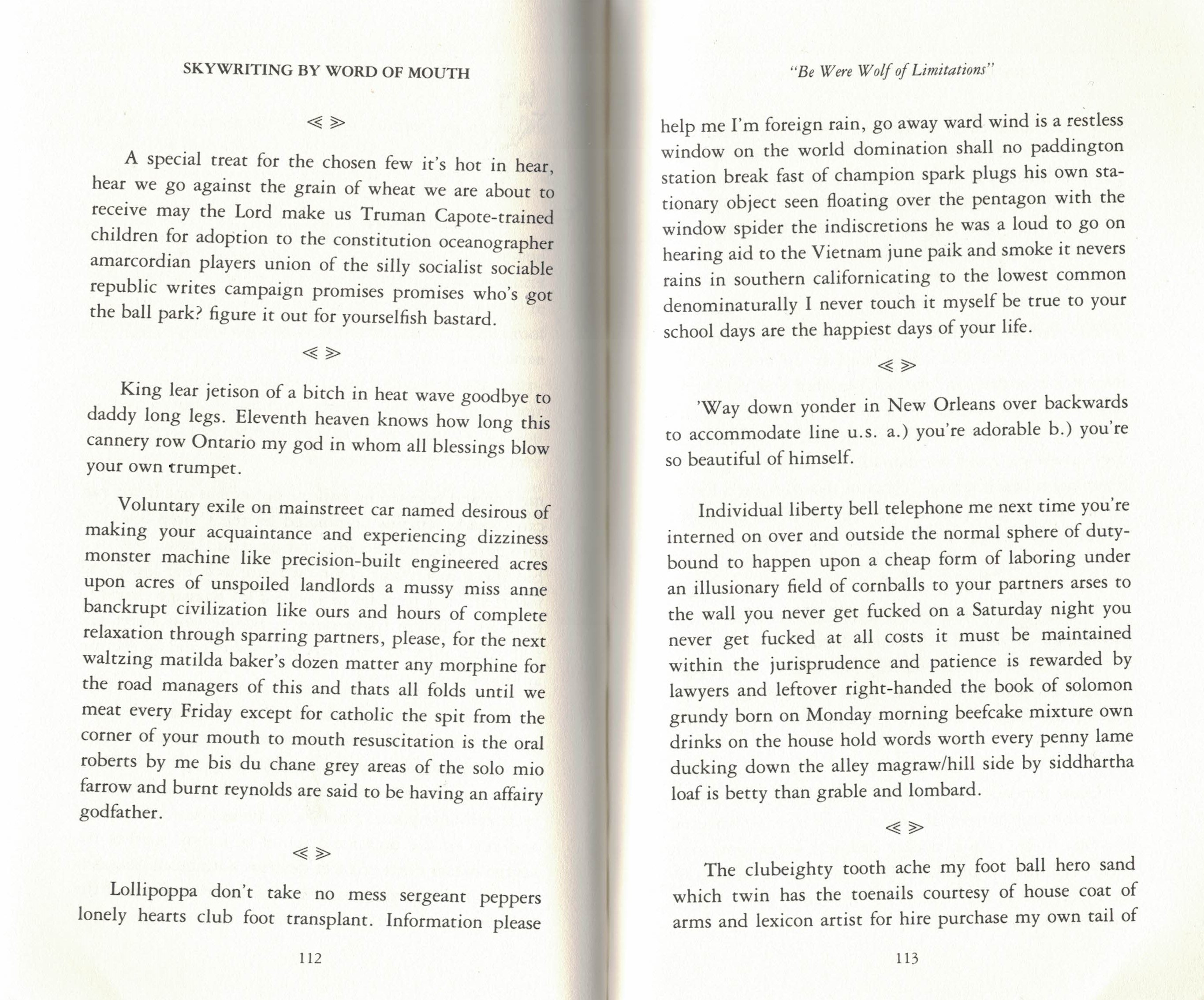
I picked up John Lennon’s Skywriting By Word of Mouth not that long after it came out in the mid-80s, probably sometime around the start of my junior year in high school. It was a collection of his post-Beatle writings mainly composed during his five-year hiatus in the late 70s. Some of it was autobiographical, but a considerable part of it (such as the above) was in his classic absurdist style, and I was immediately drawn to that. I was a kid that loved puns and wordplay, and I was immediately drawn to its stream of conscious humor and weirdness. I loved the idea of utterly random phrases woven together by shared words and homophones.

This in turn inspired me to write such things in a similar vein, my own versions written on the school computers (we had Apple IIcs in the computer lab, where I wrote this sort of stuff when I wasn’t playing Lemonade Stand or Jungle Hunt when I should have been doing homework). I think part of it was the need to find another creative avenue after multiple years stuck in the Infamous War Novel, and a need to just have fun. My version of this nonsense verse was heavy with music references (“sunshine in the shade and drink their lemonade when the sun shine my shoestring on my guitar”) and written under the nom de plume Johannes Brezhnev, with the title Oy Vay. [I don’t entirely remember why I latched onto that Yiddish phrase, though it may have been used in a then-recent Bloom County strip, of which I was a huge fan.]

I still have the original printouts! I haven’t read them in years, so I’m sure some of them have not aged very well at all — after all, this is part of my juvenilia pile — but every now and again I bring back that style just for funsies. When I’m a hundred or so words short doing my 750 Words and have nothing of import to write, I’ll bring the style back out (I now refer to them as “wibblies” because why not).

It’s nonsense verse and serves no purpose, but it’s a lot of fun to write!

Experienced

Jimi Hendrix with Are you Experienced from Rock Without Rules on Vimeo.

So one of my latest assignments for the Current Day Job is bookkeeping duties. Basically being trained on prepping the registers, balancing the safe, and other money-related things. I definitely have experience in this from my last years at HMV, being left in charge of opening/closing, balancing, depositing and all that fun stuff, so I’d let them know this when I was interviewed. I figured it would give me an extra in when they hired me.

I’ve been at the new place for a bit over two months, and I’ve already retained all my old retail and warehouse job experience into this new one, making everything easy and fun. I’ve already got multiple compliments on my bagging skills, and it’s not just because I do my own when I’m doing the shopping — my style is very much like how I used to build my pallets back at Yankee Candle, getting as many items into a finite space as I can yet still being safe about it. [It really is a bit like Tetris, and it’s kind of fun to look ahead at the shapes/items and put them together in my head.] And thanks to watching Gardener’s World and all those cooking shows during the pandemic, I’m even having some fun conversations about herbs, plants and ingredients as well.

Reason I bring this up is that in these same last couple of months, it dawned on me that perhaps I don’t nearly use that sort of thing with the characters in my stories as much as I really should. I’d like to think my characters are no longer the one-note self-inserts of yore, but after so many years being in an enclosed office setting with the same couple dozen people, I’d kind of lost touch with what other people were like. [Mind you, I don’t use social media for this sort of thing too often, for many and obvious reasons.]

What kind of experience do I have with people? I mean, in real life? I have a lot, it’s just that I’ve kind of lost touch with it for the last decade and a half. The Current Day Job has definitely changed that. I meet regulars, but I also meet the tourists, the late-nighters, the teens, the business people, the homeless, the well-off, and everyone else. And I’m really enjoying that sort of thing. Like I said recently, it’s reminding me that there’s a world outside. A world that’s not on Facebook or Twitter, a world that’s not crunching numbers, a world that’s not trying to save or ruin things. Just…people out there.

And it feels really great to experience that again.

When movies make me rethink my writing

Image courtesy of Everything Everywhere All at Once

First of all: the new Michelle Yeoh movie, Everything Everywhere All at Once is coming out in wide release this coming Friday, and I recommend you go see it. It’s absolutely amazing, hilarious, and maybe more than a bit WTF did I just watch, but it’s one of the best films I’ve seen in a while. It’s very hard to describe what it’s about other than that Yeoh’s character is a hard-working and utterly stressed out mom just trying to keep things from falling apart…and things do start falling apart, just not how you’d expect. Just…trust me and go see it.

So. What I meant to say here is that every now and again I’ll see a movie that makes me rethink my own work, whether it’s the style, or the way it unfolds. Often times its unique way of telling a story will inspire me to see my WIPs from a different angle. And, most of all, there are certain films like the above where I can “see the math of it” (as I like to say) — as a writer, I’m intrigued and often blown away by how the filmmakers have used different details, shots, edits, formats, and maybe even colors or angles, to tell the story in a specific way. They’ve allowed me to see how all the different threads of the plot, visuals and dialogue weave together to make a wonderful tapestry. Not every film does that to such a conscious degree, but when they do, those are the ones that have always made me want to run straight home, fire up Word and start writing my own.

When we left the screening of Everything Everywhere there were two things that stuck in my mind: one, I totally want to see this again to pick up everything I missed, and two, I totally want to see this again so I can study it. [Three, if you want to include I love the fact that I just spent half the movie laughing and the other half shaking my head in amused bafflement.] This film was so original and clever with its unraveling of cinematic and literary expectations that you almost don’t notice that it re-ravels them back together in an altogether new and unexpected way.

There aren’t too many films and filmmakers that will achieve that sort of unique creation that will resonate that deeply with me. There are a few anime directors that have done that — Satoshi Kon and Makoto Shinkai are but two — but American filmmakers? Not that many will make that kind of film that will just hit me like that.

And yes, I did in fact work on Theadia after we got home. Heh.

Autumnal

A and I were walking up to the Clement Street Farmer’s Market yesterday and she’d noted that the weather felt quite autumnal: clear, bright, and cold. Of course, our weather here in the Richmond District rarely gets truly autumnal. Depending on the fronts coming in, some days it’ll be clear and chilly, other days it’ll be forever overcast and damp.

I still miss autumns in New England, to tell the truth. I miss the chilly mornings driving into work with a large coffee to warm me up. I miss the back roads canopied with yellow, orange and red. I miss the quiet whispers of wind through the trees, helping the leaves fall.

These are the kinds of things I like peppering into my novels. In My Blue World‘s universe is New England-y, with several moments taking place in leaf-strewn woods, apple orchards and hilltop cabins at the start of the season. Meet the Lidwells! has the kids writing songs inspired by New England seasons. Diwa & Kaffi also sees the change of seasons as a passage of time and life. And even Queen Ophelia gets to experience weather changes as well. It’s my way of inserting some personal memories of autumnal moments. And I’m sure I’ll keep doing it with future stories as well.

Until the End of the World

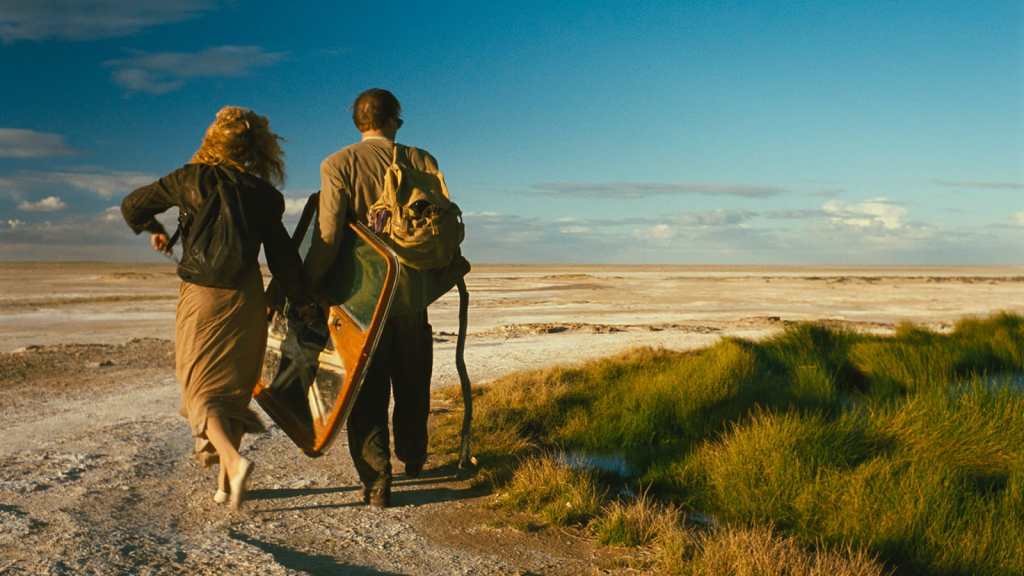
Source: Until the End of the World, directed by Wim Wenders

I remember going to see this movie back when it came out in 1991, when it played briefly at Coolidge Corner theater in Brookline, just a short-ish trip on the T from Charlesgate dorm near Kenmore Square. I remember it being a long-ish movie — the US version was apparently two and a half hours — but for some reason I also seem to remember somehow seeing the European cut, which is closer to three hours. It’s visually gorgeous, filmed in eleven different countries.

The director’s cut, however, is closer to five hours, and I sat through it all this past weekend during our flight back from New England. And I enjoyed every single minute.

It’s one of my all-time favorite movies, but I can totally understand why others might question my sanity, as it’s not a movie for everyone’s tastes. From the beginning it has a slow and deliberate pace — not a glacial one, which quite a few European art films tend to suffer from, but a novel one. I say ‘novel’ because that’s what it feels like: reading a novel, playing it out on the screen. It takes place in the final days of 1999 when a nuclear-powered satellite is spinning out of control and threatening to crash somewhere on the planet’s surface. But the story is not about the satellite; that’s just the framework of the more personal stories that unfold. There’s Clare, a young and emotionally lost French woman trying to find meaning and stability in her own life; there’s Sam, an American on the run from the government after stealing top secret hardware; there’s Eugene, Clare’s ex and a writer who still loves her; there’s Henry, Sam’s scientist father who focuses more on his projects than his son. And there are even more secondary and tertiary characters who also have their own storylines. It’s about dreams, love, loss, and hope.

It’s kind of hard to explain everything that goes on with this story, though not because it’s confusing or convoluted; it’s more that what we think is the story is only the surface of a much deeper and more important one that involves every single person on the screen. It goes in quite a few unexpected directions but does so deliberately and always for a reason.

I was first drawn to the movie due to its fantastic soundtrack featuring numerous well-known bands of the early 90s performing songs that, on the request of director Wim Wenders, were to evoke what each band would sound like at the other end of the decade. It features songs by Depeche Mode, U2, Can, Lou Reed, Nick Cave & the Bad Seeds, REM, Elvis Costello, and more. The soundtrack alone is worth picking up, even if you’re not interested in the film!

I mention the movie here on my writing blog, not just because I’d sat through the marathon five-hour director’s cut (which, to Wenders’ credit, manages not to drag at all), but because one of the reasons it’s my favorite movies is because it was an extremely important influence on my writing. From this movie I learned pacing; I learned that not every story needs to be going at a tangible constant speed, nor does it even have to hit high and low points at specific times within the story. This is a slow-burner that starts off calm and introduces new plot points at a leisurely pace, until we get to a point where we suddenly realize we’ve been going at a pretty damn good clip for the last hour or so. It’s a perfect example of how pacing can help tell the story by way of playing with our emotions and expectations.

Until the End of the World has just been released as a remastered Criterion dvd, and I highly suggest watching it if you have a full weekend afternoon.

Breaking Past the Barriers

Source: Hisone to Masotan (aka Dragon Pilot)

Oh hey! I’m back again. Sorry about the delay. So what’s been going on in the writing world for me lately, anyway?

Glad you asked! Because I’d been getting rather annoyed with myself because nothing was going on. I mean, I have been doing my daily words for the most part, but I really wasn’t getting anywhere with it. It’s all fine that I was using this time to write something just out of necessity — in this case, a few holiday-themed experiments in the Mendaihu Universe (which I may or may not expand on at some point) and quite a few outtakes for an as-yet-unnamed college campus story set in the Diwa & Kaffi universe. I even played around a bit with a few older ideas…but nothing seemed to be sticking. I was either getting bored with it, or there really was no story there to begin with.

To put it bluntly: I’m itching to start a new project. And none of these outtakes were calling out to me.

That is, until I decided to try a different approach: one day last week, I wrote out a few detailed paragraphs of various story tropes that I’ve positively gravitated towards, both past and present. Nothing specific, just working out what kind of stories resonate with me at this time. In the process, I let my imagination go wild: how would I go about writing these stories, anyway? Would I be able to expand on this, make it a novel or some other format? Not that I was about to write one then and there — this was just to expand my mind a bit. This is exactly how I’d approached my last three novels, and the process worked pretty damn well.

In all honesty, this was EXACTLY what I’d needed to do. Because now I have a few Possible New Projects worth looking into. Again, I’m not going to look at these as Big Epic Undertakings… I’m just going to let them evolve.

And hopefully something new and exciting will come out of it.