Work/Life Balance, a year and change later

I had this past Sunday off from the Day Job and spent it frivolously by heading over to the Mission District to watch Fast X at the Alamo Drafthouse (it’s just about as over the top ridiculous fun as you’d expect). Considering my hours change from week to week, I’m always happy that I (usually) get at least one weekend day off like that.

But what about in general? Back in my days at the Former Day Job, I protected my work/life balance as much as I could. But what about the Present Day Job? Well, thanks to my ten-minute, eight-block commute and average of about 35 hours/five days a week, I’ve got a lot more time to work with than I did at the end of my tenure at the FDJ.

It’s been a year and change since I’ve started at the new place, and things are going pretty good. I’ve mentioned before that I take my sometimes wonky schedule day by day, working around it one way or another. When I have an 11:30am-8pm shift, I’ll get up early and write in the morning. When I have a 6am-2:30pm shift, I let myself have a bit of fun or do errands and get my writing done after dinner. And some days I’ll even write a few notes on scrap paper while at work! This is definitely a change from the FDJ when I had to fight for moments for writing when and wherever I could. [Remember those final days when I realized I could access 750Words on my work laptop and used that as much as I could?]

I’ll admit I have the occasional days when I’m a bit too lazy and/or distracted, but I’m no longer feeling too guilty about that. As long as I get something done by the end of the day, even if it’s just a few paragraphs, that’s all that matters.


AI and Writing

I’ll be honest up front with one thing: knowing me and my utter lack of patience, planning and focus in junior high and high school, I’d probably have used AI to write some if not all of my term papers if it had been around when I was a teenager. I’d have known enough to take the end result and revise it so it sounds more like me than a bot scraping info from the ‘net, but yeah, I would have been that student. I might have been one of the smart kids growing up, but the slow rigidity of school education often bored me.

These days however, the only reasons I’d use online AI bots is as a playground. Create silly mash-up picture memes. See what it can do sonically with music as inspiration for my own. Use it for character worldbuilding, just enough to keep it a private reference but not call it official. I’m not sure if I’d ever use it for writing, per se, because that would just be a) cheating, and b) taking all the fun out of what I love doing. I mean, come on: there’s nothing I love more about writing than working through the bits and bobs and swivels and parallels that go into writing a novel. That’s the best part! Why would I want to let a bot do that??

As is usual with a lot of my takes on various things, my feelings on AI these days is complex and often paradoxical. I love it and hate it. I’m fascinated and repulsed by it. I hope that it isn’t completely eradicated but I also hope that we find ways to tame it. I hope that it doesn’t die out as a fad but I’m pretty sure that, like VR in the early 90s, companies will try to monetize it and it won’t age well in a few years. I hope we don’t get a lot of terrible movies about AI (guaranteed to be about either hackers saving the day or bots taking over the world, as they often are), but I do hope screenwriters come up with clever ways to integrate the AI idea into their stories.

I do hope that the fad of creating full-on novels via AI will go away and stay away, however. I do believe that one won’t last long as most professionals are already calling ‘authors’ out on it. [And I do put that in quotes because come on: are you really a novelist if all you do is type out a few prompts and let a computer do the rest?] We’re near the beginning of this particular wave, so it’ll probably take a little longer for it to fade away, but I just don’t see it becoming anything major once that wave crests and starts to retreat.

Balance…and Barrier

So, you ask. We’ve shown that the Shenaihu are not the antagonists of the Mendaihu in this universe. And yet…who is?

That’s a very good question indeed, because it took me a long time to figure that out myself. In the Bridgetown Trilogy we learn that the two do not necessarily have a protagonist/antagonist relationship, but one of balance. One exists to balance out the other in some shape or form. Both sides had a reason for doing what they do, whether that action is noble or misguided. But the fact remains that there is balance between the two. It is nuanced and often contradictory, but it’s there and that’s how life is. I thought about this early on when writing A Division of Souls as an extension of the Golden Rule: similarity and difference working together peacefully.

This was the question I’d been asking myself: who wants to upset that balance? Whoever that happens to be in MU4 is the real antagonist. The person or group — or even a belief — must have a reason to ensure that the true balance between the Mendaihu and the Shenaihu cannot hold. Which brings up the next question: why would they want to do that?

It occurred to me recently that the answer to that question will not be found in a goal-oriented way. Maybe they are doing this to gain power, but that’s only one of the end results and not necessarily a goal. I started thinking about how in this current political climate, there are those who see progressive movement as a positive evolution, and there are those who see it as a perversion of stasis.

Thus the drive of the antagonist of MU4 (and perhaps whatever comes after it) could be precisely that: a person or a group — or belief — that sees only the perversion and fights to eradicate it. [Which of course begs further thoughts about the balance between those two. But that’s a bit further into this created future.] They want to create barriers that keep this evolution from taking place at any cost.

So far I have two concrete things for this antagonist: a name for the group, and their sigil. And a pretty good idea of how far they’re willing to take it.

A different view of Bridgetown

It occurs to me that in writing MU4, this is the first novel in this universe that I’m actually writing while living in a large city, rather than in a small town somewhere in New England. [Not that San Francisco is a large city geography-wise, as it’s only 7 x 7 miles, but it is about 815k residents.] When I was writing the original Bridgetown Trilogy, I envisioned the Bridgetown Sprawl very much like a portion of Los Angeles, which I’d never visited let alone seen or researched to any extent. It was just a personal vision of a large city.

Years later, however, I’ve made multiple trips down to LA and lived in the Bay Area for several years, and also visited many other large cities and metropolises. Has this personal vision changed since then? Well, I don’t think so, at least not by much. I kind of understand the idea of distance better, for one. And thanks to my years living in the Boston area, I understand how different neighborhoods look different depending on their own locations, altitudes and so on. For example, I took that into account when I pictured Branden Hill being slightly higher in elevation than Main Street sector, but also less condensed, a mixture of residences and school campuses.

I’m kind of doing the opposite with these first few opening chapters of MU4, which take place in the Wilderlands area just west of Bridgetown. I’m using memories of living back in New England, but I’m also picturing the unincorporated areas and satellite towns here in northern California. A small city like Petaluma, or a cozy small town like Half Moon Bay. It feels kind of strange writing this sort of thing, as I really don’t think I’d have written it if we were living back on the east coast. I feel like I’m doing the exact opposite of what I’d done with the trilogy: writing a personal vision of woodlands and small towns.

Not to fear, though…Bridgetown is definitely going to be playing a big part in this novel as well. I am curious, however, if this vision of city sprawl will be different from before.

New Settings in the Mendaihu Universe

One thing I’ve been looking forward to in writing MU4 is that many scenes take place in locations that weren’t in the original trilogy. For instance, three of the first four chapters I’ve written so far take place outside the Bridgetown Sprawl, specifically in and around a small outpost town west of the city. It has specific ties to the trilogy, but as of now those ties aren’t the main focus.

It’s been fun and refreshing so far to write these characters in this new location. I’d been wanting to write a MU story set in the Wilderlands for ages! While this doesn’t solely take place here, a good portion of it will. This of course means giving the location a distinct layout, perhaps a map or two that I can use for reference, just as I did with Bridgetown. It’ll also have its own set of rules that I will need to follow. This is a special place in the mythology, so what happens here will affect everything that happens after.

Creating the setting has always been one of my favorite parts of writing novels, to tell the truth. Such as the city shared in two different universes/timelines for In My Blue World. The bayside cities and suburbs of Diwa & Kaffi. Even the small New England town of Meet the Lidwells. I love creating layers of this kind of background: its geography, its size and shape, its population. Little things that might not be completely important to the story as a whole, but certainly makes it more real.

Writing New Characters

Brand new characters are always an intriguing exercise, because I don’t always know where I’m going to be taking them. Some of them, like Caren in the Bridgetown Trilogy, are sort of based on tropes (she was originally a mix of Agent Scully in X-Files with a touch of Captain Kusanagi from Ghost in the Shell but became something altogether different). Others, like Zuze in In My Blue World, are characters I already know inside and out before I even start.

While writing MU4, I’ve been introducing a few new characters into the Mendaihu Universe and it’s true, I’m still working out where they’ll end up by the end. I have an entirely new character, Lizzie Kapranos, whose drive is decidedly not like Caren’s; she knows who she is and where she fits in, so her conflict is the refusal to give in so easily to conformity. [Tuckerization time: she’s named after Elizabeth Bennett from Pride & Prejudice and singer Alex Kapranos of Franz Ferdinand. A fierce free-thinker and a bit of an oddball but not without a sense of humor.] Like Miss Bennett, Lizzie is all about staying true to what she believes in. Also like her, Lizzie will (eventually) admit to being wrong when she makes errors in judgement or action.

This might be partly why my word count has been so glacial these last few weeks, as I work out the scene with all that in mind, but to be honest that’s part of the appeal of writing new characters. I get to learn something new about them, and about the story. Their actions will influence what comes next, whether it’s positive or negative. Another new character, Eika, embodies this to the extreme: she’s the id escaping highly restrictive boundaries and set free. Eika is a chaos element in a way, while Lizzie is the stability element. And both characters are completely aware of that role. In the process, Eika and Lizzie are polar opposites but also the key to Balance. And Balance has always been a big part of the Mendaihu Universe.

Do I know where these two will go, and if they’ll ever meet? Maybe? I’m not sure? But it’s in my mind and it’s a vague signpost further into the story that I’m heading towards. And that’s all I really need.

Twenty Years of MS Word

In writing something elsewhere, it suddenly occurred to me that I’ve been using MS Word exclusively for twenty years now. I believe it was sometime in March or April of 2003 that I bought my first completely new PC off the Dell website. With my own money and everything! I’d been using the previous writing programs that came with Windows 3.1 and 98 — MS Write and WordPad — and I realized this would be an excellent upgrade. This was one of those ‘customize your own personal computer’ specials Dell had and I spent the slightly extra money to have that added along with a decent media player that could play cds and dvds. I wasn’t (and still am not) a PC gamer so all that processing power and speed went to those two apps.

Over the years I’ve heard many pros and cons of Word from the writing community. Some swear by it, others swear at it. I’ve heard many writers suggest other programs and refuse to touch this one. Me? I’ve had nothing but pleasant experiences with it. I don’t think it’s ever crashed once on me (not including when it was actually the PC doing the crashing). As long as I keep up my habit of frequently saving my work (thanks, Dropbox!), all is well. Even now that it’s part of the Office 365 umbrella, It’s worked a peach.

All of my novels from A Division of Souls forwards were written, edited and revised using Word, and it’s even used to do the formatting for their Smashwords editions. I’m using it now for MU4. I’ve learned how to use more of its fiddly editing and formatting functions and they’ve pretty much become part of the tool bar at the top header.

I’ll use a Word-like app for reading on my tablet and e-reader, but I don’t plan on switching to anything else at this point.

Movement

One of the things in the back of my mind while writing MU4 has been that as much as I enjoy a nod to a previous story, the last thing I want to do is open this novel the same way A Division of Souls did. This is partly why it’s taken me a good couple of tries to nail the landing in these first few chapters. The stakes are just as high, but they’re different stakes this time.

I’ve also been reminding myself that this is a universe that is in constant motion. Sure, there are moments of quietness and contemplation in these stories, but that’s when the mind is in motion. This is how I remember writing the previous novels: every session has to have at least one scene where something moves. It can be incremental, or it can be the steadfast refusal to do so, or it can be a rash unthinking decision.

The Mendaihu Universe always had a theme of Balance In Motion; there are a few scenes in the original trilogy where someone says that life is always changing and never static (or something close to it), and it’s up to ourselves whether to move with the changes or stay in one place. Denni’s decision in this case was the one that changed fate: she chose the former, to adjust her role as the One of All Sacred when and where necessary. No former Ones had done ever done that.

So what about MU4, then? Well, without giving too much detail, let’s just say there’s a schism going on: the ones who have adjusted their fates and those who have refused. One of MU4‘s themes is about how far people will follow those paths. There’s dedication, and then there’s extremism. There’s response and then there’s reaction.

I’m just as curious as you are to where all this movement will take us.

Back to writing work

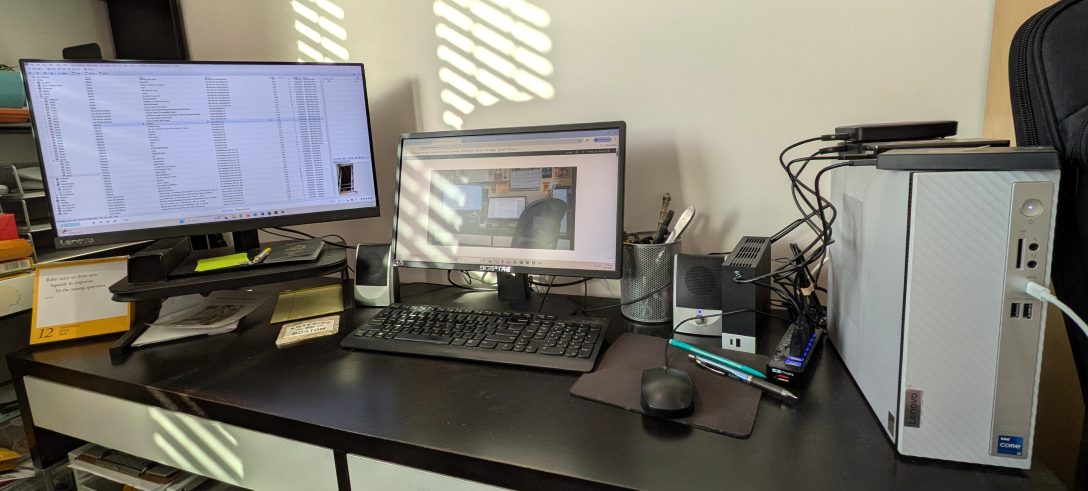
OKAY! So it’s been a bit of a weird week, what with the Day Job schedule and all the PC issues I’ve been having of late. On Wednesday night I chose the nuclear option and did a factory reset of my computer, and spent my day off reinstalling several apps I use the most. [I should add that in doing the reset, it finally let me upgrade to Windows 11 as well. I’m still getting used to the changes, though there don’t seem to be too many that are all that significant.] The PC is now behaving quite nicely again, other than the continuing Bluetooth keyboard stickiness (which I’m yet to figure out how fix).

The good news is that everything is back to normal and I can get started on writing again! Even better news is that this gave me the time at work to think about the next chapter. I knew who was going to feature in it, but it had to be different from my original outtake from a month or so ago. And the amusing thing is that this new approach was influenced by…the original 1993 opening of Vigil! Heh. See, this is why I’m a packrat when it comes to my writing!

Anyway, now that I’m back on track (FINALLY), I’m hoping I can get a headstart soon!

Patience

I’m usually pretty good at being patient. If I have to wait for a certain length of time, I’m not all that bothered by it because I’m good at keeping myself occupied in the meantime. [This is especially helpful when I’m working a very busy eight hour shift at the day job. The trick is that I break it up into two-hour increments, and take my lunch or my ten-minute breaks in between.]

Writing a novel, on the other hand, can sometimes be a lesson in just how long I’m able to wait. It’s a different kind of time management, based on the pacing of the story and the time I’m able to spend working on it. In this case, working on MU4 has definitely been a case of patience-testing. I’m purposely not distracting myself with other more compact story ideas, which has happened in the past. I’m determined to see this one through. I do have distraction issues of another sort, however, which I’ve mentioned plenty of times: the Don’t Wanna’s. It’s not that I don’t want to write the story, I just don’t wanna do the work.

Once I get past that, however, I’m good to go. Power up the Word document and get stuck in. And once I’m there, patience is the last thing I worry about: I rely solely on what I need to write at that point in time. Whether it’s a lot of words or just a few, I give the best I can, and that’s when I enjoy it the most. That’s when I realize I could do this all damn day if I wanted. [And have, though rarely.]

It’s after I finish the session when that patience-testing comes in, of course. It’s when I’ve written just a few hundred words and the scene has moved ever so slowly and I’m far from finishing it, that’s when I want to surge ahead and get to the next scene! It’s not that the scene is glacial; it’s just that I’m moving slowly and deliberately.

But I’ll get there, sooner or later.