Future inspiration

A lot of my non-writing things have definitely fallen by the wayside over the years, and I always wish I could return to that. I often complain about that here. And at the end of every year, I make some vague plan to try to do better at it, but never quite follow through. I’ll try for a few days and hit nothing but frustration, and let it go soon after

This year, however, I’ve come to the conclusion that the issue here isn’t quite about being consistent with the whiteboard schedule. I can easily follow that if I put my mind to it; I’ve done it countless times in the past. But sometimes just DO the thing doesn’t quite cut it.

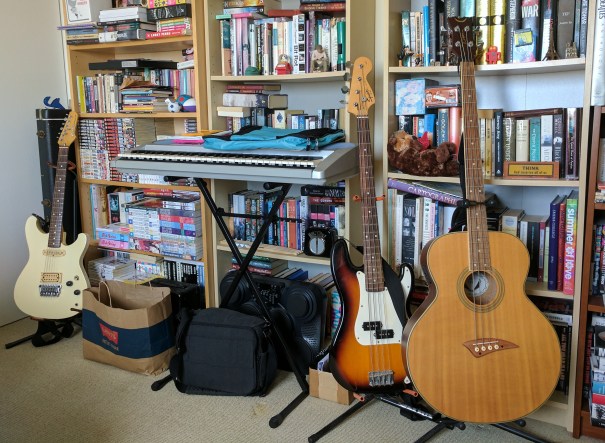
This year I realized that I haven’t been inspired to do it. Think about it: why am I rarely picking up my guitars these days? It’s partly because I’m playing the same damn riffs and bass lines over and over, like I have for the last several years. The last major change I had was when I was doing the Blogging the Beatles and as a side project I taught myself some of their songs, and in the process I learned a few new tricks. But since then I’ll pick it up, play those same songs yet again, then put it down soon after. I’m not trying to be a semi-professional at it like I am with my writing, of course. I just want to expand my repertoire.

The same could be said with my artwork. I do miss doing that a lot, but again: the inspiration is eluding me. It’s been ages since I’ve broken out my pens, pencils and art notebooks, and I think it’s mainly for the same reasons: I keep drawing the same damn things and not trying anything new. Hell, I even miss drawing my maps, but I always end up drawing the same setting over and over!

And let’s be honest, the same could actually be said with my writing as well: I haven’t allowed myself to be inspired to try new fiction projects in a while, either. These last few years have been about finishing the active ones. But with this particular avenue I’ve made some inroads: I’ve been forcing myself to expand my reading habits again. And not just reading more, but leaning heavily on novels that have given me that wonderful I would LOVE to write something like this feeling, which can sometimes be a rare event. And in order to do that, I have to actively look for these books and try them out, whether it’s through trying out a chapter at a bookstore, purchasing them, or borrowing them through Hoopla.

But most importantly, I have to remember this about inspiration: it doesn’t always need to be mind-blowing, heart-moving and earth-shattering. Diwa & Kaffi wasn’t just about me writing a hopepunk story, it was also about me training myself to appreciate the smaller, quieter things in life. Same with me grabbing those Zen-a-Day desk calendars. I must remind myself that it doesn’t always have to resonate so incredibly deep. I swear this comes from being a Gen-X film student in the 90s and soaking in every media outlet that embraced Michael Bay levels of epic action and drama. For years my intake was dialed to 11…and it’s taken me years to unravel myself from that habit. This is precisely why one of my favorite movies of 2023 was Wim Wenders’ meditational Perfect Days, because this was the balance I needed to aim for.

So if anything, if I’m to look for future inspiration, I need to remember to look for the quiet as well as the loud. Whatever resonates the most.

A creativity rethink

No, I don’t plan on giving up this writing gig anytime soon. I’m seven books in, one I’m currently working on and a few future ideas on the back burner, and I have no plans on letting them fall by the wayside.

I’ve been thinking — again — about other creative outlets lately. More to the point, how I haven’t allowed myself to give them any proper focus and practice to be anything other than passing hobbies. I’ve often said my other two creative outlets would be art and music, but I’ve spent so long working on writing novels that I rarely ever have time for either of them.

Why is that? Well, part of it has been just not allowing myself the time. Balancing the novel writing and the Day Job (and spending some time IRL with A.) often leaves me with very little time to do anything else. I still have a habit of carrying a notebook with me at all times so I could easily spend a few moments doodling. I have enough time outside of the Day Job that I can pick up my guitar and noodle for a bit. And I’m better at both than I used to be just ten years ago.

What’s stopping me? I think it’s that my creative brain gets stuck on the ‘well, you’re not bad, but there’s at least 9,000 more hours of practice and experience before you’ll be good‘ and I put it aside for a later time. And that later time keeps getting pushed further into the future.

I think I’m perhaps also a little daunted by seeing so many musicians and artists relying on computer software nowadays, and simply I don’t have the money to spend or the PC memory to eat up (or the desk space, for that matter) for it right now. And then I start thinking that maybe my art and music should remain a hobby.

But if I’m going to take either of them more seriously, I realize what I should do is take the same route I did with my writing: Do It Yourself.

I mean, my inspiration for having a DIY writing career is based on music, so I’ve got the knowledge to go that route anytime I want, right? Why should I worry about trying to learn the technology when I have the Beatle-based inspiration of pushing a button, saying ‘oh hey this sounds neat’ and running with it? I’m not a synthpop based performer that needs all the doowackies; Drunken Owl is more something you’d hear on Slumberland Records than a hipster indie label, and would be right at home on Bandcamp.

As for art? Who knows what would come of that. A webcomic? Storyboarding? Something else? And as for photography, I really just need to give myself the time to properly edit the pictures and make them saleable on stock footage sites like Shutterstock.

The net is vast and infinite, as Major Kusanagi says. I just have to make the time to explore it.

Make Your Own Music

Image courtesy of K-On!

Sometimes even I catch myself trying too hard to fit in. Yes, me. The one who’s always gone on about being a nonconformist and doing my own thing. We all do it, really: we make ourselves a bit malleable so that we can get along with our employers, coworkers, neighbors, whoever it might be. Adjusting our lives in small ways so we can be a part of a functioning and peaceful workplace or society. And that’s a good thing! There’s really no good reason at all to be an active misanthrope other than to attract attention to yourself, and there’s no good reason at all to be actively terrible to people other than selfishness.

But sometimes, when I’m not paying attention to the situation, that malleability will take over and become the default. Always trying to be everything to everyone, as Art Alexakis once sang. In the process I’ll lose sight of my core self. And next thing I know, I’m feeling miserable and wondering how I let myself fall into this predicament. I’ll have lost sight of what I wanted because I hadn’t established my own boundaries.

So I need to remember to make my own music.

I’ve told managers that I might not follow their exact process of workflow, but I’ll prove that I have my own that work just as well (if not better, and still within their established regulations) for me and will achieve the same expected results. I’ve told them that I can’t do any off-schedule ‘on-call’ work because I have my writing career. I’ve told them that sometimes their role-playing training doesn’t work on me because I’m terrible at that on-the-spot “repeat what I just told you” style of learning because of the way my memory works — make me do it in a live setting and I’ll learn by doing instead.

What I’m saying is that I have to remember that the worst I can do is go into a new work situation and establishing an ‘I’ll do whatever you tell me’ malleability. I have to remember to let them know that my style is this: tell me why I need to do something and give me the context, and I’ll figure out my own way to make it work. That’s how my brain works best, and that’s how you’ll get the best out of me.

It might not be the musical score you’ve already established, but it’s a melody that makes sense to me and achieves the same goal.

The Fever Dream of Being a Creator

I’ve always wanted to create, ever since I was a kid. I knew early on I wanted to be three things: a writer, an artist, and a musician. Not just one or two of them — I wanted to be all three. It wouldn’t be something I’d learn overnight or through osmosis, of course. These were things I knew would be a lifelong learning experience.

The downside to this was that once I’d shared this dream with others, I was constantly reminded that, American capitalism being what it is, the expectations were super high. [Never mind the fact that whenever I mentioned writing as a kid, adults immediately expected me to follow in my father’s footsteps and become a reporter — which I did not want to do. I knew I wasn’t good at it, and it didn’t intrigue me. My strength is in making up stories.] Most of these expectations were learned by experience and by reading well-meaning advice books and columns: write this kind of fiction, always write in that style, shmooze with these people and you’re in. And in college: read these books, be influenced by that author, be a part of those scenes. I really hated that part of the creative field for a long time, to be honest: being forced into a mold I knew I wouldn’t fit into.

I tend to be the kind of writer who’ll read an article talking about bad things in fiction — prologues, dialogue tags that aren’t “said”, adverbs, whatever — and how I should never use them. Of course, the nonconformist in me (thank you, college radio!) always responded with, well, why not? I would use them anyway, not really to prove them wrong but to prove to myself that they can be used, one just needs to understand how they work to one’s benefit. For example, I play around a lot with unspoken pacing in my work as a subtle way to hint at impatience or exhaustion or whatever other emotion a character is feeling. It’s really fun to do and I’ve learned to pull it off. So I’m always worried that someone will read that scene and say it’s too slow, when I’ve spent a considerable amount of time deliberately making it slow on purpose. I know, it’s not for everyone, but I really enjoy doing it.

Anyway — I’ve been thinking a lot these days about just how much time and effort I need to put into my creativity and make it a strong career choice instead of just a hobby or a side thing. All this week I’ve hit 1000-plus words for all three writing projects, and just the other day I officially started up my Shutterstock portfolio page (it’s sparse at the moment but I’m working on building it up a few days a week). Yes, I’ve taken the plunge and also working on my photography. It’s long been on the backburner and it’s high time I started taking further steps.

That’s been my true motto with my creativity all this time: let’s see how far we can take this. It took me years to understand what I truly meant by that; I didn’t want it to mean ‘mavericky pushing the envelope’ or ‘shock value because I can get away with it’. I wanted that to mean, let’s take this creative outlet and play around with it, mold it into something worth expanding on, and make it a long-game career that I’ll always enjoy and dedicate time to. I did that in the late 90s with my writing. I’ve done it to some degree with my music playing. And now that I’ve realized I have another creative outlet that intrigues and inspires me — close-up nature and landscape photography — that I’d like to expand on. See how far I can take it. I’d like to think I’m pretty good at it to some degree (again, always room for improvement, of course) and I’m willing to take that next step to make it happen.

I call all this a fever dream because it feels like one to me sometimes. Dedicating that much time, energy and brain power to creativity is kind of weird if you think about it because most of the time you’re starting with absolutely nothing and making something out of it. I won’t say it’s “magical” as I so rarely think of it in those terms, but it really is unlike any other day job I’ve ever had. It’s following an idea and having absolutely no idea where it’ll take me, but trusting that I’ll get there if I trust myself.

It’s taken me far too long to get to this point, I’ll admit, but I’m glad I’m there now, and I won’t look at it in terms of regret. I’m here now, so let’s embrace it.

Let’s see where it goes.

What’s Going On?

That’s a very good question indeed, because I’d like to know myself. I’m kind of hovering at the moment, providing nearly all of my writing focus on the editing and revision of Diwa and Kaffi and doing very little in terms of anything new. I mean, I always want to have a new project going, but I’m purposely not doing that for the reason I just stated.

I’m not going to complain, I’m kind of enjoying this break from Writing All the Things. I’m forcing myself to try new creative avenues, which was part of my plan. I’m picking up my guitar more, thinking about songs to write…hell, I’ve even started noodling around on our keyboard after ages of ignoring it or using it as a temporary storage table! I’ve churned out so many words over the last five years that it’s time for me to give that a break and have some fun.

I don’t plan on making my music a professional thing, as I don’t see myself at that level. Maybe putting stuff out on Bandcamp if I ever get a full song down? Sure, why not? I’d essentially be self-publishing my music and I already have a background on that, so I think that would be groovy.

What about the other avenue, you ask? My art? Good question. I’m winding down a few small projects at the moment and will be finding more time to doodle. I’m not sure what — it could be my usual map drawing, perhaps my Murph comics, maybe trying out new styles. I have the sketchbook and the pens and pencils, I just need to start doing it. I’ve always found drawing to be quite calming, so I’m looking forward to doing that again.

But yeah, the writing, after D&K is out and away? Good question. I have plans there, but they’re not set in stone, and they’re not on any kind of schedule. For the first time in I don’t know how long, I’m just going to not think about it for a while…

On Creative Outlets

Source: Beck: Mongolian Chop Squad

I’ve been thinking a lot about my creative outlets.  I know, I know…in previous posts I’ve talked a lot about wanting to play more guitar, write more songs, make more art, but it was always in the context of trying to squeeze it in when and where I could, while also working on my writing.

Lately, however, I’ve been thinking about focusing on these outlets instead of always putting the novels first.  Perhaps instead of trying to brainstorm the next project, it’s time for me to give these two other outlets some serious stage time.  I’ve been recording more than a few song ideas and demos on my phone over the last few months (using the Hi-Q mp3 recorder app) and I think I can work with some of them.  I’ve long been tempted to find decent (and not expensive) multi-track software and do a bit of experimenting, so perhaps it’s time.

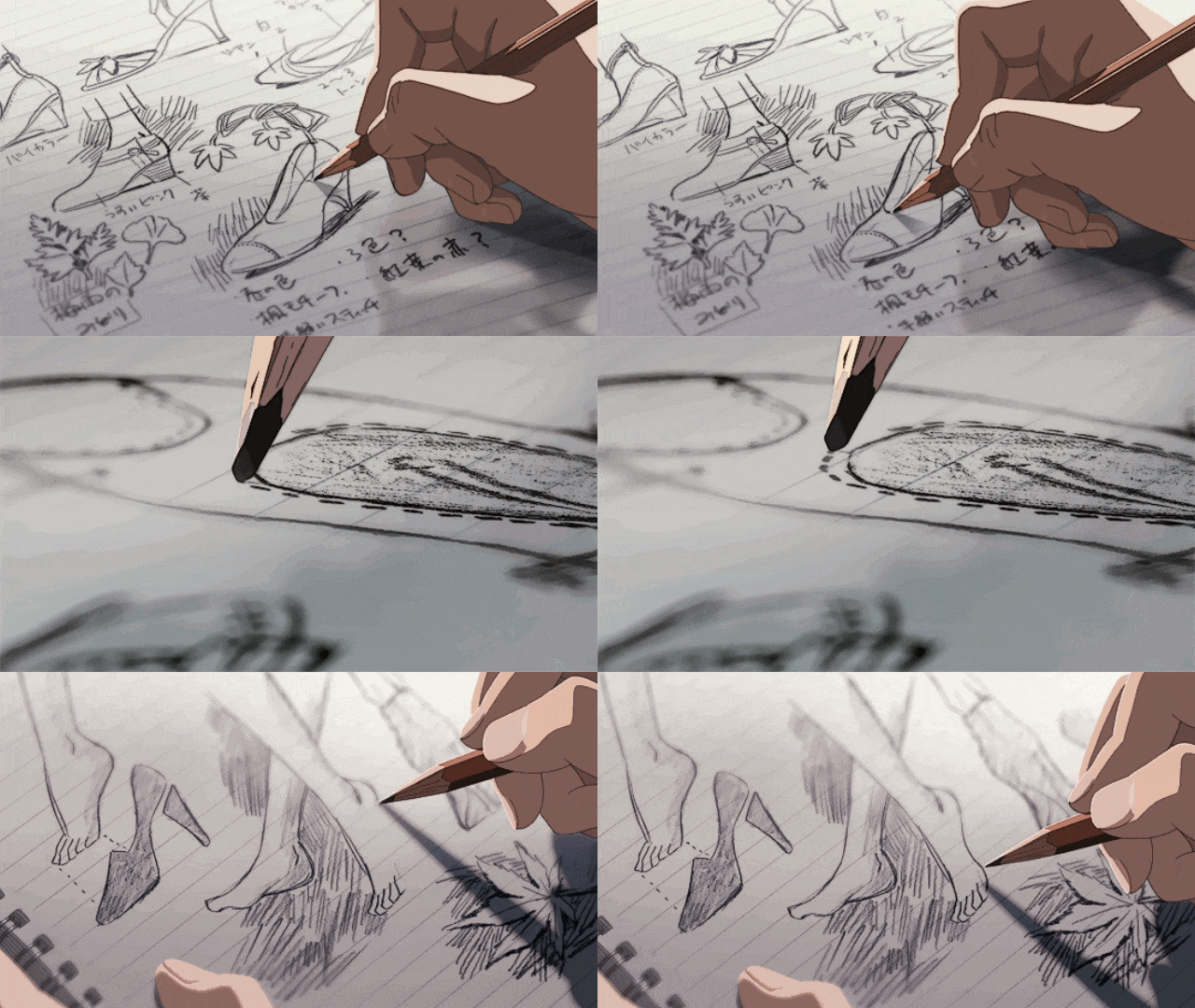
As for art…?  Good question. I have a few art notebooks, pens and pencils that are collecting dust as I haven’t used them in a while.  That’s gotta change as well.  I’m much more on an amateur level here, so this would be mostly for personal enjoyment than anything else, at least for now.  But yeah — I miss the enjoyment of drawing, even if it’s drawing my imaginary maps.  It’s a peaceful outlet that chases away everyday stress and makes me look at the world from different angles.  And I’ve always wanted to try new styles; I think I’ve burned myself out on drawing my Murph caricatures.  I’ve also been told (very often, actually) that my storytelling style is extremely visual, so perhaps trying my hand at visual storytelling might be something to look into.

I suppose these thoughts have been brought on by my recent decision to make a lot of personal changes in my life.  I’m not chasing away my novel writing, I’m just pulling it from center stage for a bit so the other outlets can have a chance to shine.  I’ve already proven to myself that I can write novels; I want to prove to myself that I can play music and create artwork as well.

I’m very curious to see where this all leads me.

Source: The Garden of Words

More on Adjusting

img_20170709_141703.jpg
Part of Drunken Owl’s gear, such as it is…

A. and I had a conversation over dinner the other day about adjusting to life’s changes.  She’s currently between jobs and she might be, as she says, “catching up on years of lost sleep”, but she’s not wasting time at all.  She’s been brushing up on her skills by taking various online courses, and she’s also currently taking part in NaNoWriMo, writing a mystery novel.  We’re both relatively comfortable financially at the moment where she can afford to take some time off and readjust to real life.

This got me thinking as well, because we both understand what it means not to have a job, and especially what it means to live paycheck to paycheck.  So many things we’ve put off for one reason or another, whether it be financial or emotional or whatever.  I always found this deeply depressing and intensely aggravating, to be honest.  Since I was a kid I’d always wanted to be a writer, an artist, and a musician — not one or the other, but all three — but it was hard for me to focus on all of them.  They all demand countless hours of practice, knowledge, and labor that a person already working full time may not have time for.  This is precisely why it took me until my forties to become a self-published author, and to a lesser extent, why it took me until my forties to dedicate some daily practice time for my music playing.  And why, alas, I have never had enough time to focus on art.

I’d said to her that I was both impressed and maybe a little jealous that she now had this time to catch up on all the things she hadn’t been able to do.  I would absolutely love to be able to not think about Day Job stress and simply focus on learning the ins and outs of things I’d love to do.  I would love to take art classes again — something I haven’t done since high school.  I would love to learn how to record multi-track song demos in Spare Oom.  I would also love to improve my writing without having to carve out whatever precious time I might have for it.

[Mind you, this is also why I am always angered by those who view the arts as frivolous and not worth federal funds or adequate payment for delivered goods.  But that’s another post entirely.]

So what’s happening right now is that I’ve been doing some deep thinking about this.  I’ve been contemplating changing up the Day Job for some time, as you already know, and with that change comes the adjustment of other things in my life.  This is a perfect time for me to start making a stronger effort to include those ‘extracurricular activities’ in my daily life instead of keeping them at the level of wishful thinking.

Play

Recently Dave Grohl released a 23-minute instrumental called “Play” that was written and played entirely by him alone, and upon hearing it, I realized the creation of this track is very similar to how I write novels.

The accompanying video is prefaced by a six-plus minute talk about not just the recording but a music school for kids that he’s taken part in. It’s worth watching for both; in particular, I’m intrigued by how dedicated he is to his creation. It’s not a long-winded progfest at all, but very similar to an orchestral piece in its structure. It’s going in a specific direction through deliberate sections, laying down certain motifs to experiment on and later return to, and each instrument is supporting the other. Grohl also ensures that each segment is played to the best of his ability, leaving no weak or meandering moments.

This is how my mind works when I’m writing an extended project like a novel. While the initial pass-through might be raw and desperately in need of revision, once I immerse myself in the serious work of laying it all down, I’m all in.  I immerse myself in the story by seeing it from multiple angles:  there’s the shape of the overall piece, where I can see the plot’s peaks and valleys as a whole;  there’s the attention paid to the scene itself, and its relationship not only to what’s already gone on, but how it’ll affect future scenes; there’s the volume of the piece, where I can feel when it needs calm and when it needs friction; there’s the motifs (such as character traits, for instance) that I will return to in different shapes and forms throughout the novel.

Over the years I’ve talked with writers and musicians (and music historians) alike and interestingly I’ve found that many of them are kind of surprised when I tell them this is how I taught myself how to do it all, that this was the way it made the most sense to me.  I think this is also why I find myself drawn to other creative people whose process is unique and/or unexpected.  To me it gives their projects a deeply personal touch; it’s not just their style that gets imprinted in the words or the music or the art, it’s their own spirit.  It’s what makes their creation uniquely their own.

Too Much Information

During a Worldcon panel the other weekend, someone had asked one of the panelists about detail in your prose; when do you need more, and when do you have too much?  It’s a very good question indeed, because it’s one of the biggest mistakes a beginning writer often makes.

I should know, because I’ve gone through both extremes.  Back in my school days, my writing lacked so much exposition that it read more like a shooting script than a novel.  A few years and a handful of trunked projects later, I finally got the hang of balancing exposition with the action and dialogue.  However, I soon slid to the opposite end of the spectrum: my prose was far too verbose.  It took a few more years before I finally found and stuck with a happy medium.

How do I handle keeping a fine balance between prose and exposition in my writing?  Good question, because half the time I’m going by instinct.  I suppose all writers have their own balance they’re comfortable with, and mine is achieved by being aware of my pacing.  It all goes back to my equating novel writing to songwriting: I go with what sounds right to me musically.

When I’m writing a scene, I’ll know ahead of time whether or not this is going to contain a lot of action and detail (fast beats, layered production, a high-powered chorus, and perhaps a middle eight to provide a quick breather before moving on again), if it’s going to be a highly emotional scene (slower pace, minimal production with detailed focus on the melody, a memorable chorus, and a solo to pull at the heart strings), or if it’s just going to be a connecting scene (short, sweet, and to the point, and the barest hint of a motif borrowed from a previous piece).

With this in mind, I’ll know when I need to fill out the scene with exposition or detail, or when it needs the barest of touches.  A connecting scene will be tedious and drag on if I decide to put an infodump there, but it’ll make much more sense if I spread it out over the course of an action scene.  Perhaps as a character slowly coming to the realization that the cousin was the murderer after all, and that all the pieces suddenly fall in to place and giving him even more reason to keep chasing this now-familiar shadowy figure in the alleyway.

Most of this is instinct to me now, because of my decades of listening, studying and memorizing different pieces of music.  I write the scene according to the pace and the emotion I’m looking for.  This is my particular style of writing so it may not work for everyone, but it certainly works great for me, and hasn’t steered me wrong yet.  I even use it now and again when I’m writing these blog entries; even if it’s only a quick five hundred words, it’s still worth it for me to make the flow and style enjoyable to you, my readers.

I can’t tell you exactly what works for you as a writer, but I think keeping all this in mind might give you an idea of providing your own answer to that question:  when do you need more information in your prose, and when do you have too much?  Listen to the pace you’ve set, and let it provide the clues for you.

Picking Out the Writing Soundtrack

Between the two new projects I’m working on, I’m listening to a lot of newer albums lately. This is quite the change from the older projects I’ve spent tons of time on (such as the trilogy) or ones where I need to focus on a specific time period (such as the 90s and Meet the Lidwells!).  It’s part of returning back to deep immersion with the music.

Mind you, I do give a lot of my purchases a deep listen as it is, or else I wouldn’t be gushing over albums over at Walk in Silence like I have for the past few years. This is about really getting into the meat of the album, and I find I often do that best when I can assign a mnemonic to it.  That way the album will stay with me that much longer.  [This is precisely why albums like Beck’s Sea Change are forever connected not just to the trilogy, but to my writing sessions in the Belfry.]

I’m doing this again with a handful of new albums that have become soundtracks of a sort for the Apartment Complex story and In My Blue World:

Beach House, 7. Unlike their more Cocteau Twins-like previous albums, this one ramps up the noise a little bit and sounds more like Slowdive and a bit of My Bloody Valentine as well. The dreamy atmosphere works really well for the otherworldliness of IMBW.

The Naked and Famous, A Still Heart. I keep coming back to this one for the Apartment Complex. TNaF are a much louder band with walls of guitars and soaring melodies, but this ‘stripped’ album takes out the volume and leaves beautifully delicate reimaginings.

Lucy Dacus, Historian. “Addictions” is one of those tracks you hear on the radio and then get stuck in your head for the rest of the day. The music is laid back and unassuming, but the melodies go in really interesting places. This one’s been getting plays for both projects lately.

Editors, Violence. I think pretty much every project I’ve ever worked on since 2005 has had Editors playing in the background at some point. They’re just an amazing band with a unique and adventurous sound. This one often gets played when I need to write an exciting action sequence.

Pinkshinyultrablast, Miserable Miracles. I gushed over this band on the other blog last week, and I still love them to bits. Russian shoegaze is all I need to say, and it’s all kinds of fun. IMBW has been getting most plays of this one, not to mention the rest of their discography!

GoGo Penguin, A Humdrum Star. Same thing — a recent discovery and now I play all of their releases during sessions, mostly for the Apartment Complex. Intriguing jazz sounds that remind me to keep the setting just a little bit on the odd side.

This is the fun part of my writing sessions…I love listening to music while I write, so connecting to a new album while working on a new project makes the sessions — and the albums — that much better for me.