Making that connection

The hardest thing about writing MU4 so far has been making a personal connection with my characters. I know what I want from them, and I think I know how I want them to evolve, but getting to those points has been fraught with missing by inches.

I also know, this time for a fact, that I’m not trying hard enough. I’m still suffering through waves of the Don’t Wannas with an equal serving of Easily Distracted. I want to write this novel, damn it all, I’m just avoiding working on it, and I’m starting to piss myself off because of it.

If this means I have to take desperate measures, I’ll do it. I’ve already uninstalled or removed several apps from my phone to minimize distraction during Day Job breaks I should be spending less passively. But though I’ve been doing all my actual writing work at home and I do close my web browsers come writing time, I still have too many distractions. If this means unpinning nearly every shortcut from the Task Bar, so be it. Making it harder to open distraction apps usually works for me simply by utilizing the Out of Sight Out of Mind method, and I’d rather not use one of those ‘won’t/can’t open until forty-five minutes pass’ apps if I can help it.

Still — the issue remains that when I am writing, I’m still not quite making that connection. I’m not connecting on that emotional level I’m aiming for. They still feel too distant. And again, that’s a personal issue I have to work through: I have to let myself establish that level, allow myself to take that deep dive. I know I can do it and I’ve done it before.

Eventually I’ll make that connection I’m longing for. I just need to keep trying.

Connections

I’ve been thinking a lot about what some of the themes in MU4 might be, and I think one of the most important is about personal connections; the ones we make, the ones we destroy, the ones we wish we had and the ones we protect with everything we have.

I posted a rough version of Chapter 1 some months back, in which a young woman named Eika is dropped off in a deserted town and forced to undergo a solo trial to prove her worth as part of the Order of the Blessed Ones. Her story of connection is about the utter lack of it in her failure to live up to her family’s and community’s expectations. In Chapter 2 we’ll see the connection between two new Alien Relations Unit officers, Lizzie Kapranos and Ruu-Sseikassi Tiiegasi, who will have a somewhat unconventional connection with each other that’s different than Alec Poe and Caren Johnson’s in the previous books. And later on we’ll see an arc about Ampryss and Shirai, and how their connections to their original fates have changed because of the Season of the Ninth Embodiment.

I’ve chosen ‘personal connections’ to be one of the backbones of MU4 (and possibly other related stories) partly because of what Denni Johnson did near the end of The Balance of Light: she pretty much broke all the rules and expectations and sent fate off in uncharted directions. Every detail, every question and every choice is related to what connections the characters make, because that is the only anchor with each other that they truly have.

Of course, this isn’t about strict maintenance of those connections…like I said, it’s also about how they can be destroyed, and why.

But then I’d be giving away too much if I kept going, heh.

More on Distraction

Yes, Cali and Jules (see above) are definitely distracting, in a good way. Especially when they get all cute and cuddly and want our attention. But that’s not the distraction I’m talking about.

I’ve fallen behind on my work on MU4 partly because this past week I’d worked mid-shifts at the Day Job for three of the five days, Tuesday through Thursday, followed by two early mornings starting at 5:30am. My brain’s been a little loopy because of it and the most spoons I had was to maybe do a bit of reading of what I had so far.

I still have the same distractions I’ve had since we moved out to the west coast, of course — fiddling with the music library, refreshing the social media timelines, cleaning out the email inboxes, things like that — but I’d like to think I’ve gotten better over the last couple of years, especially now that my Day Job isn’t a high-stress brain melter and that I’ve cleaned out the detritus up there. I’d say my worst distraction right now is simple avoidance: purposely finding other things to focus on to avoid doing the actual work. The good thing is that’s an easy thing to combat, simply by shutting down those browsers and starting the work whether I’m ready for it or not.

I find that’s the most common start to a writing session when I’m distracted. Most of the time I am ready for it and the output isn’t all that bad (and when it is bad, I try not to dwell on it for long and remind myself to fix it next session). I’m simply just delaying because I’m trying to get the session mood just right. [Hey, remember during the Belfry days when I used to waste a half hour deciding what cds to listen to? Some things never change, do they?] My workaround has been the same thing since I came up with it in the mid-90s: just shut the f*** up and DO it already.

And that still works to this day.

Hopefully this coming week will be better! My schedule is mostly mornings with a day off midweek, so I should be able to work through the lingering Don’t Wanna’s and make some progress. There probably won’t be any new words, but I can at least revise and improve this newly reinserted chapter and work out how to go from there.

It’s okay, just…keep going

Image courtesy of Recovery of an MMO Junkie

I think I need to rewrite Chapter 2, and I’m not entirely happy about it. But it has to be done.

I’ve got a good handle on what needs to happen in the chapter…but this first attempt doesn’t quite stick the landing. I’m pretty sure it’s because I’m writing it from the wrong point of view. The way I have it now is that it’s a nod to the opening of A Division of Souls, but really lacks the oomph I want it to have. It lacks the important conflict that will set the course of the rest of the story. It’s causing the pace of everything else to slow down considerably, and that’s not what I want.

I guess when you’re a deity followed by multiple worlds, you get a little jaded by the repeated nonsense that goes on? So maybe not from Denni Johnson’s point of view…maybe from Alec Poe’s instead? I mean, he spent the entire Bridgetown Trilogy trying to maintain a balance that normal people wouldn’t be able to handle, so maybe he might be a little cheesed off that this bullshit is still happening.

Yeah, that works for me.

I really should be used to multiple takes of early chapters by now, and right now I’m reminding myself that this is all part of the job. Just cut it out, paste it in the Outtakes document, and keep going. That works just fine. I think I’ve done this enough where I can bypass the temporary freak-out of thinking I’m a failure or that I’ll never get this thing off the ground. I hope…? Anyway, I’m not going to let such a minor error cause much of a problem. I’ll just need to start again!

On Gender and Pronouns in Character Building

One of my coworkers at the Day Job goes by they/them pronouns. I do my best to use the correct ones, though I’ll slip sometimes. After working with them a short time and getting along quite fine, I told them to feel free to correct me at any time — in fact, if I slip in their presence, they are free to slap me on the arm. [And they have, much to mutual amusement.] I’ll still slip from time to time, but I think I do pretty well now. In fact, it’s gotten me thinking a lot about others I work with or the customers I meet, wondering if I’m using the right pronouns they prefer, and it got me thinking a lot about how I write gender in my novels.

I’ll admit I didn’t know much at all about the gender spectrum when I began writing the Bridgetown Trilogy back in the early 00s. I mean, I did, but I didn’t have all that much real-life experience at the time to base it on other than movies and books that may or may not have done it justice. I did, however, encourage myself to insert characters with different sexual and/or romantic preferences. Caren, for instance, is bisexual. Sheila is lesbian and Nick is asexual. (Alec is purely hetero but he accepts the entire spectrum, which fits his character.) The closest I got to it was hinting that Colin was a variant of the gender spectrum, which gets explained in a bit more detail in The Balance of Light — the reveal of who Colin really is, and how there are others like them, is actually tied in with the book’s thematic concept of balance.

It wasn’t until maybe the last ten years that I realized that maybe I should expand my central casting a bit more. I’d learned a lot and expanded my knowledge and experience considerably by that point, so it only made sense to use it. In My Blue World, for instance, includes both nonbinary and trans minor characters that I put there for that reason. And in MU4, I’ll be introducing two new soon-to-be majors, one of whom is trans and the other is nonbinary.

I realize that some writers are worried that they’ll do it wrong: placing this kind of person in there for the gold star (Hey look, I’m inclusive n’ shit! Gimme a cookie!), creating this character for manufactured conflict or drama (the minor role/target that ends up dead because Real Life Is Gritty), or something similar. I knew I’d fall into that same trap if I overthought it or constantly worried about it, so the way I approached it was to approach the way it is in real life: hey, some people are just trans or nonbinary or queer or whatever, simple as that. No literary reason except that’s just who they are, and that’s how life is. I do expand on their character description as necessary to ensure they read as such, but I’m always conscious of making them realistic instead of a caricature or a stereotype. I don’t create these characters for political reasons, because that’s not the kind of writer I am (and believe me, I’ve tried that route and I am absolutely terrible at it). I create them because it’s like meeting my coworker for the first time: they just happen to be such, and it’s up to me to honor that.

And just like my coworker, I have to make sure I use the correct pronouns. In Theadia one of the main characters is nonbinary and I had to make sure I constantly used they/them. And yes, I did have to fix it in a number of places during revision! I totally understand that when you’re taught that he/him and she/her are the socially correct defaults, it’s sometimes easy to forget when you meet (or in this case, create) someone who doesn’t go by that default. It’s not about going out of your way to please them; it’s just about creating an alternative to make it work for both sides.

Still here, still writing

It’s been a couple of weeks, hasn’t it? So what’s been happening in the Mendaihu Universe? Well, aside from the fact that I feel like my writing work is moving at a glacial pace (I always feel that at the start of a project), I’m actually not doing that bad at all. I’m allowing myself to write as few — or as many — words as befits the scene or the session, so some days I’ll get about three hundred words and other days I’ll get closer to seven hundred.

A few things I’ve learned so far:

–I really love writing in this universe. I mean, really love writing it! When I started working on this version, I immediately felt a lot of things click into place: I knew and remembered the universe’s voice intimately, what tone and pace it’s supposed to take. As I’ve said before, I’m not trying to emulate what’s already been written or trying to relive the sessions of the Belfry years, and in doing that I was able to return to that tone and pace naturally.

–I do loves writing me some dialogue. I’ve also been doing a reread of the original trilogy at night as part of the refamiliarization process, and it’s apparent that one of my favorite things about writing fiction is conversations between characters. Sometimes I worry that the scene might stall a little because of it, but my workaround for that it is to keep the characters physically moving somehow. A frustrated Caren will start flailing her arms, an angry Sheila will barely be holding back violent impulses, and Poe will almost always have the urge to light up a cigarette when he gets stressed out. The focus is on the words they’re saying, but I’m also having them react to them in some way.

–My openings are, as always, a hot mess. But on the flip side, I’ve learned to just write them anyway so I can fix them later. All the new scenes so far are a bit weak, but that’s okay! The whole point of writing them is to get the story moving in the right direction.

–I am, as stated earlier, listening to mood-appropriate music just as I did in the Belfry years. Sure, I’m returning to a few classics (I had Beck’s Sea Change on the other day) but I’m also enjoying some newer albums that will surely become a part of the Eden Cycle Soundtrack list. [At the moment I write this, I’m listening to Radio Songs by Blur’s Dave Rowntree and I’m pretty sure this one’s going to be on the playlist for a few months.] Again: not trying to relive the sessions of the Belfry years, merely trying to recapture its vibe and update it. And I think it’s working!

–And lastly, I admit I’m not writing every single day. I’ll take a day off to focus on errands or other important non-writing things. And I’m okay with that, because I know I’ll end up writing again the next day, whether it’s a quick hour’s session before doing a midshift at work or bashing it out after dinner. By not forcing myself, by allowing myself the writing time, the stress of getting it done lowers considerably.

I’m not expecting a quick three-month turnaround. It might take a few months or it might take a year. I’d love to have something out this year, but it definitely won’t be this. I’m taking my time with this one. I’m writing this on my own terms, with the simple aim of writing the stories I truly want to write. I know I’m not going to be a pro writer, I’ve come to terms with that quite some time ago. It’s not the kind of writing I do. But I’m writing something that’s just as intriguing, just as enjoyable and exciting. Something that resonates with me.

And that’s the most important reason.

Note Worthy

Notes swiftly written on the back of old team schedules

First of all, I do apologize for the terrible pun in the entry title.

When I was writing the Bridgetown Trilogy back in the early 00s, my process was that I’d start the day by utilizing the slower moments of my work day at Yankee Candle by doing a bit of plotting. Nothing too detailed mind you, as these moments usually lasted no longer than five or so minutes before the next wave of boxes came down the conveyor chutes, but I wasn’t looking for detailed to begin with. This was merely doing a bit of planning ahead of a few scenes. I’d think a bit about what I wanted my characters to be doing while I built those pallets of candle boxes and then write it out when I had a minute. And more often than not these scraps of paper were nothing more than the backs of copied labels that we’d tape to the side of our finished pallets.

Then later that evening during my writing sessions in the Belfry I’d take those notes and start elaborating on them. Sometimes I’d use them to the letter, and sometimes I’d actually go in a slightly different direction, but the whole point of these notes was that I’d be prepared for the session instead of sitting there staring at the screen or distracting myself with whatever music I wanted to listen to that night. When I returned to the Trilogy in 2009 to finish the last quarter of The Balance of Light I realized that the best way to go about it was to do the exact same thing: longhand notes followed by typed elaboration.

I used slightly different versions of this process for most of my follow-up novels, but never to the same degree. Most of the notes for Meet the Lidwells! contained personal information about the characters and a detailed discography of the band. Same for In My Blue World: for the most part that was written on the fly with most of the notes merely being character bios. I think part of the reason for this was that working for a bank, even as a back office drone, didn’t really lend much time or brain power for this sort of thing. I figured out alternate ways to write novels, even if I didn’t feel it was quite the same.

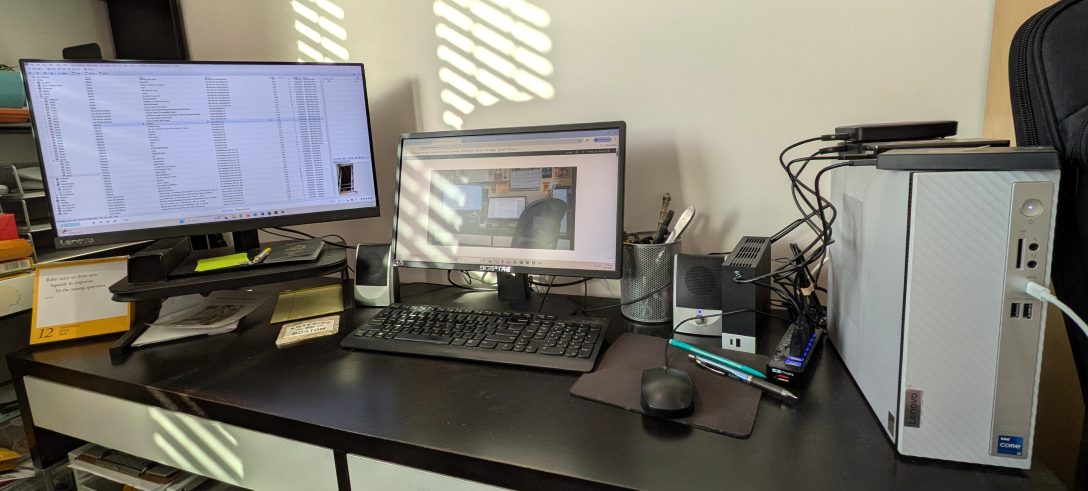
So when I recently decided it was time to return to the Mendaihu Universe, I also decided that the best way to play all of this out was to go back to what worked: a bit of note writing while at the Day Job followed by elaboration at home. And being that I’m back in retail, I’m once again able to steal a few personal minutes during breaks and slow times to write, this time using the backs of the previous day’s team schedule we have set up at each register. I have the time and brain power for this sort of thing again, so why not take advantage of it?

So far I’ve gotten myself maybe two or three scenes down that I can work with. I’ll be starting off the fresh new version very soon, and I plan on continuing this note taking throughout the entire project. I’m even thinking there’s a chance I’ll do a bit more Tuckerization, once again using coworkers’ last names somewhere while I keep them updated on the latest fictional drama.

All told, it’s not only great to be back in Bridgetown, but it’s also great to return to a process that worked really well for me.

Creating and Cats

Writing — well, pretty much doing anything around the house — with two young cats prowling around and constantly getting under foot and demanding attention can be a bit tricky. Cali and Jules have been with us for a good couple of months now and they’ve been a lovely addition to our home and the biggest distraction ever. (Sometimes enforced distraction when one of us needs to get work done and the other needs to take over catsitting duties.) It’s a matter of taking it as it comes and squeezing whatever time we can to do it all.

During my evening writing sessions I’ll use one of the stick toys to get one of them away from A’s knitting and yarn stash, and eventually they’ll forget that A has all that enticing and chewable yarn in the other room. Jules is a little easier to sway, as she’s more chill about everything and will end up napping on the cat bed I have here in Spare Oom. Cali is a bit harder to deal with, but eventually I’ll get her to calm down as well. Giving them the nightly bowl of kibble also helps. We’re hoping they’ll become a bit less chaotic as they grow older, but for now we’ll need to keep them occupied when and how we can.

In the meantime, as I write this Jules is in the Spare Oom cat bed and Cali is most likely in the cat tree in the living room. That gives us a bit of personal time to get work done. It might not always be a lot of time, but it’s time enough for now.

Juvenilia

I still have pretty much all of my juvenilia here in Spare Oom. Poems I wrote in fifth grade for an extracurricular project, the origins of the Infamous War Novel (my first completed project) and its several versions, the numerous maps I’d draw in the margins of school notes and on book covers, the various story ideas that lasted a few pages and the novel ideas that lasted just a little longer, the several unused Murph comic drawings, the silly exquisite corpse stories between me and my high school friends. I’m only missing a few things, really…some of my early art, a few stories I may have thrown away in embarrassment, things like that.

I don’t read it all that much, but I do think about it now and again. I do so because it reminds me of where and how I started. My dad was a local news reporter and I grew up with a lot of adults assuming I’d do the same considering I too wanted to write, but even then I knew that style wasn’t for me. I loved the idea of making up stories. I tended to have a vivid imagination and weird dreams and I wanted to use them. I must have come up with a few dozen decent ideas — again, most of them lasting only a few pages — before I sat down and started writing the IWN. [And even that one took multiple tries over a few years before I clicked with the first complete version. That was just the one that stuck with me the longest.]

This is partly why I’m okay with having several trunked story ideas over the years. Some of them I truly enjoyed working on, others not so much. Some were written as an emotional outlet, something that needed purging. Some written with the best of intentions but ultimately with little personal connection. Some written in desperation because I needed to do something to balance out personal real-life issues.

I consider my juvenilia reaching into my early 20s. Everything just before I started The Phoenix Effect was written with the idea that I would learn this craft one way or another, on my own terms. It was certainly frustrating to see a number of my college classmates zip by me with relative ease and see print, but I had to remind myself that I wasn’t writing the same thing. I had my own reasons to do this. The Phoenix Effect (and to some extent the unfinished novel before it, True Faith) was different. It was the dividing line between sunny-eyed ‘I wanna be a writer!’ dreaming and ‘I am a writer’ determination.

I’ve used a few ideas from this trunked work elsewhere. Meet the Lidwells! has a few ideas nicked from my abandoned coming-of-age idea Two Thousand, for instance. That novel also uses a few song lyrics I’d written years ago. The universe of Diwa & Kaffi originated from a horror story I’d come up with in high school that I retooled into something completely different. This sort of thing is normal for most writers, actually. There’s no rule against borrowing some of your favorite unpublished scenes elsewhere! But for the most part, I’ve kept them stored away in notebooks and folders in a few bookshelves here. They’re well sorted (I did a major sorting project a few years back) and well-kept so I have no worries about them ever being lost, damaged or misplaced.

Will I ever use any of it in the future, though? Who knows. Probably not, but I’m okay with that too. Maybe I’ll post bits of them in the future, or maybe I won’t. Some writers have donated them to their local library. I doubt I’ll ever get that popular to warrant that, but it’s certainly fun to dream that.

It doesn’t matter that they may or may not be worth to anyone else, but they’re worth something to me, and that’s what matters.

End-of-Year Changes

My annual end-of-year contemplation almost always includes Getting Rid Of Things. Whether it’s physical, mental or emotional, it’s something worth returning to and reviewing what’s gone on over the past several months and deciding if I really need to keep such things in my life. I know, I could do this at any point in time, but this works just fine for me so I’m sticking with it.

I’ve been thinking a little more about why I put Theadia and Queen Ophelia on hiatus, and it occurs to me that unlike the Bridgetown Trilogy, it’s not about having writer’s block due to life changes. I merely felt that while I like these story ideas, emotionally they’re not who I am right now and I don’t feel right in continuing the work. They’re good stories but they’re not the direction I need to go in.

I’ve also been thinking about what that particular direction should be. I don’t want to write another story out of frustration or desperation, nor do I want to passively write an I have no plan but let’s see where this goes story either. I’ve done enough of those over the years.

I need to find out what it is that will resonate with me. Something that excites my creativity. Mind you, I don’t want to fall back into the trap of trying to recreate the same writing mood that I had with the Trilogy, because I’ve done enough of that as well. What will that be, though? Who knows?

Still, I’ve been taking this time to figure it all out. I’ve also been taking the time to adjust how I do that, being well aware of the obstacles and trip-ups I’ve had or made over the years. Don’t be a perfectionist, but do attempt your best. Don’t build up so many barriers, but allow yourself a bit of comfort. Don’t overexplain everything but feel free to deep-dive when necessary. Be aware of the situation but don’t be so self-conscious about it. Find a new voice and figure out how it sounds.

Changes are always a good thing when they make life and creativity even better.