A product of my generation

1984
courtesy of 1984, Michael Radford 1984 version

Somehow I found myself listening to 1984 the last few days.  It may have been sparked by hearing my favorite song by The Fixx, “Deeper and Deeper” (the end credits song to the movie Streets of Fire from that year) on an 80s Sirius XM channel.  This in turn influenced yesterday’s Walk in Silence, with the various songs that I was listening to at the time.  And as is my wont, I’ve gone down the rabbit hole and am listening to various songs and albums from oh so long ago.

I was thirteen at the time, seeing the back end of junior high and entering high school as a freshman, hoping that life would be a bit more exciting and less drama-filled.  [Seriously, what is it about middle school and everything in life sucking?]  I’d just started focusing seriously on writing, to the point where I probably spent more time on the Infamous War Novel project than I did on my homework.  It just seemed a hell of a lot more exciting to me.

Thinking about it now, I’m fascinated by the parallels between then and now.  A resurgence of ultra-conservatism, American exceptionalism, international terrorism, sexism, ism ism ism.  I’m even a bit weirded out that we could fit Russia into this equation again.

With the current administration doing whatever it thinks it’s doing, I’ve been sort of preparing myself mentally to get through it.  I could easily fall down the other rabbit hole — the one where I fall prey to the doom and gloom and feel like shit until it’s over and done with — or I can learn from the past and know that there will indeed be a light at the end of this tunnel soon enough.  [Granted, this tunnel is a detour that we really truly did NOT need to take and it’s a big pain in the ass for all involved.]

Personal point being — to get through the troubles and frustrations of today, I’m thankful to have a decent memory of the past.  It helps me to stay one step ahead of the beast.

In the context of writing: this is part of why world-building is so important to me, and it’s also why I’ve been working on future projects with the 750 over the last few years.  When I was first starting out way back in the 80s, figuring out how it all works, I just sort of made up the scenes as I went along, with a somewhat vague overall plot line being nudged ever so slowly forward.  The end result was patchy and inconsistent at best.  Writing these practice words for a project I haven’t even started yet gives me just enough of a world and a plot to base it all in.  It helps me to stay one step ahead of that beast.

It’s tricky, and you really need to know yourself and your own thought processes, but it’s worth it in the end.  It’ll keep you sane, that’s for sure.


Trying a little something new

hanks-aol

With my Sort of Secret Next Project taking up my daily practice words, I’ve been tearing down some of the boundaries I’ve had set up for ages.  I suppose you could say it’s part of the ‘own it’ mantra I’ve been using lately…instead of trying to find reasons not to write a certain scene for whatever reason, I’m forging ahead and writing it anyway.

These are passages that work within the context of Secret Next Project, of course.  It’s not so much about pantsing the writing as I’m letting myself come up with things that I would normally not write.  Here’s the thing: when I’m writing a character, I have to have at least some connection with them, whether mentally or emotionally.  I get inside their head and see how they tick.  This is all well and good, but there is the tendency to write samey characters, or worse, write Jonc Personality #483.

I tried (and I think mostly succeeded) writing this way for the trilogy, especially when I had to get inside the head of characters like Denni and Amna, who were major players with a hell of a lot of stressful issues going on.  I think this is also partly why I trunked some of my earlier novels, because I’d failed.

The Secret Next Project involves quite the menagerie of characters, so I definitely need to stretch my boundaries there.  In writing my daily practice words, I’ve been doing my best to set as few boundaries as possible.  In the process, over the last couple of days I found myself writing some passages that surprised even me!  And I like that feeling.  It means I’m doing something right.


…That said, it also means I still need to focus mostly on Meet the Lidwells.  Which means the Secret Next Project is currently also the I’d Rather Be Working On This Fun New Project Instead Project.

As is typical of any writer, of course.

Yoiks and away!

daffy yoiks and away
This is what being a writer feels like sometimes, folks.

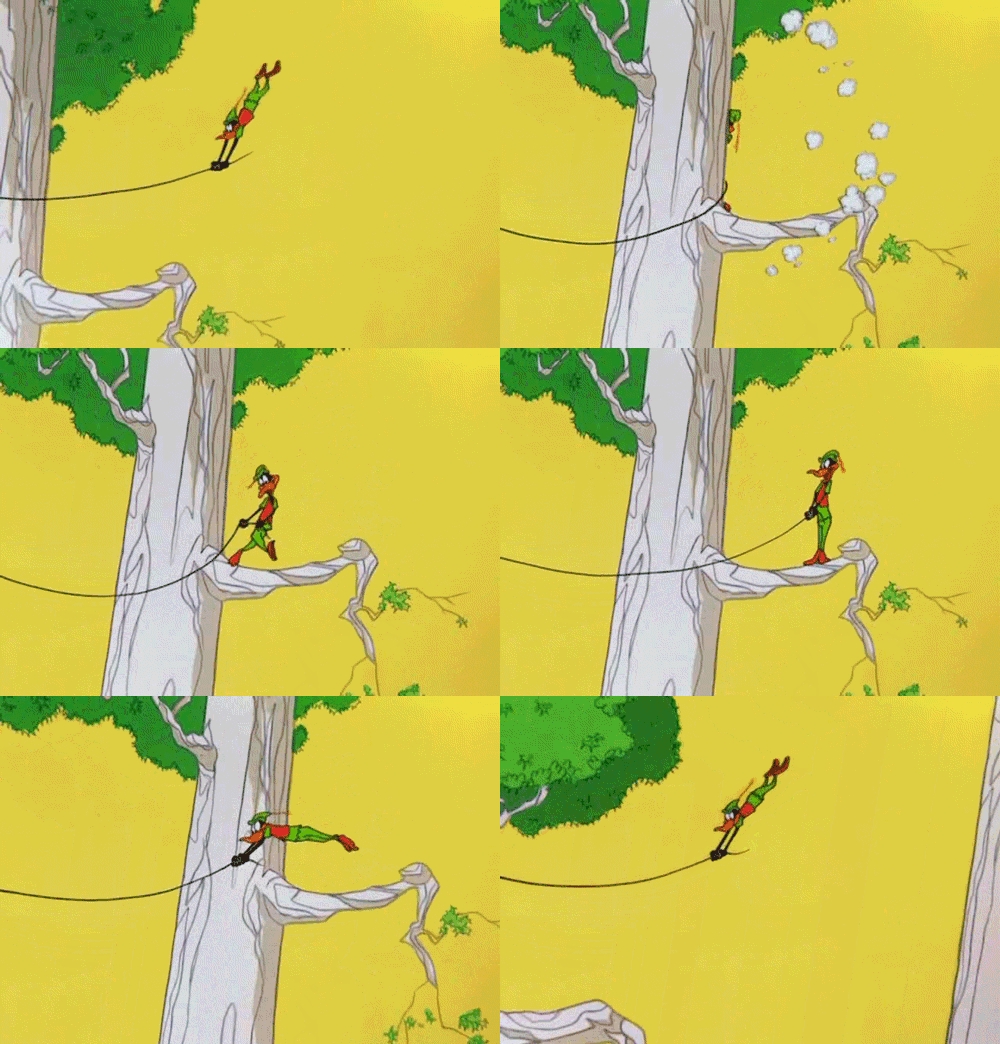
Another thing about perseverance, especially when you want to be a writer, is knowing full well that you’re going to face-plant into that next tree, but you go ahead anyway, scream “Yoiks, and away!” and make the jump.

It took me a long time to figure that out.  I’d say most of my 90s output was really just about fostering the writing habit, getting used to it, getting better at it, little by little.  Sure, I had delusions of grandeur that I’d be able to sell what I was writing, but there was always a small part of me that knew those delusions were exactly that.  My attempts at submission then were during a time when I had no idea if I was any good.  If they’d get accepted, then I’d figure I was on the right path and doing something right.  If they didn’t, well…at least I knew that I still had some ways to go.

I still metaphorically face-plant into trees on a regular basis, of course.  This time it’s less about quality or submission success, and more about dedication and time management.  On Wednesday I wasted too much time doing other things that I didn’t give myself enough time for my daily practice words.  I only got a few hundred down before I had to log off of that and get some Lidwells work done.   I made up for it Thursday by avoiding Twitter* and making a point to get the practice words (and a few other creative things) out of the way early.

(* – Well, given that it was filled with comments, hot takes and livetweeting of the James Comey hearing, I had good reason.)

That’s the thing, really…despite the face-plants, I still have to shake it off and jump again at the next opportunity.  Maybe one of these days I’ll clear all those obstacles.

Characters and Their Stories

calvin-writing
When I’m pantsing my writing…which I’m trying not to do this time out.

I supposed you could call my preferred style of prose ‘character-driven’.  The way I often create stories is to put characters in a scene and try to figure out how they react — to the situation, as well as to those around them.  This reaction often drives where I’ll go with the plot next.

Noted: it’s not as if I let them run rampant in the scene to the point where I have no idea what comes next until I get there.  I just have them going from Plot Point A to Plot Point B and I pay attention to their movements and emotions.  There’s a few reasons I do it this way:

–The character is always evolving.  One of my worst errors in a lot of my early attempts at writing was that the characters had style, but they were static; they never changed.  And when they did, it felt forced.  I don’t always expect each one to change completely and irrevocably…more that I just want them to evolve in some way.

–I pay attention to how they interact with other characters and use that as part of their evolution.  A good example is Christine Gorecki from my trilogy: originally she was a one-off character, but her initial single walk-on part with Sheila and Nick worked so well that I had to expand her role considerably.  She was obviously well-loved by all the main characters that she needed an important role as well as her own personal story.

–Quite often, the interaction between the various characters gives me more background, more grist for the mill.  One character’s personality will irritate the hell out of his brother after a while, which in turn gives me a subplot dealing with the two brothers not talking to each other for a year, which in turn gives me a scene where they have to sit in the same room and talk to each other and behave.

In a way, my writing process is a mash-up of half-pantsing and half-outlining.  I have a solid (if vague) idea of where the story is supposed to head.  Lately I’ve been calling that the backbone or the spine of the story.  But I keep the movement of the story fluid, keeping it open for change and unexpected inspiration.

In the process, any major arcs in the story feel less action-driven and more personal.  The action moments end up being there for a reason; it’s less about playing plot point bingo or trying to Save the Cat and more about how life puts unexpected hurdles in our path, and how we respond to that.  Personally, I find that a MUCH more fulfilling story.

Germination

fullmetal idea
Never a good sign when Edward gets an idea.

Coming up with ideas really isn’t all that hard.  It’s the latching onto one, getting it to germinate, that’s the hard part.  I’ve got to have some connection to it, otherwise it’s just a single scene that doesn’t belong anywhere.  And I’ve got an old trunk full of those already.

Sometimes those ideas take a hell of a long time to germinate, and that can either be a good thing or a bad thing, depending on how you look at it.  Meet the Lidwells! came to me nearly two years ago, and I’m only working on it now.  That was primarily due to the trilogy project taking precedence, but I also wanted to give it a good planning-in-my-head before moving forward with it.

I’ve got a few backburner projects as well, ones that have been simmering for quite a few years.  Those are ideas with merit but I wasn’t ready to work on them just yet for one reason or another.  I’ve got a few new and fresh ideas as well, ones that I may play around with via 750 Words (like I did with Lidwells) until something concrete comes about.

Is it frustrating, having these stories in various points of stasis?  Well, yeah, of course it is!  But I’d like to think I’ve gotten to the point where I no longer feel like I MUST WRITE ALL THE BOOKS RIGHT NOW. Once I cleared the table of the Trilogy Project, I found it…actually pretty empty.  I’d trunked numerous story ideas over the past fifteen years; ideas that didn’t work, that I’d lost interest in, or just led nowhere.  Others I’d turned into blog series.  I had maybe three or four Possible Next Projects, tops.

Which also meant that I could afford to come up with a few new possible seeds of ideas that I could nurture down the road.  I could let myself play around with the tiniest inklings that passed by.  I have to relish when that happens now, because I haven’t had that feeling in a long time.  Writers love coming up with scraps and seeing where they go.

It feels great to be fully creating again after years of editing and revision work.  It feels even better to let my brain come up with these seeds of ideas and know that I won’t have to wait for ages to get to them.

wile e coyote idea
Granted, it’s never good when Wile E Coyote gets an idea, either.

On Outlining: The Discography…?

anime piano

I’ve complained about outlining before, both here and elsewhere…even in high school I disliked outlining, if only because I knew even then that I was a pantser writer and that whatever outline I created would be thrown out within the first couple of pages.  It always felt like a waste of time.  So previously here, I talked about swallowing my pride and stubbornness (and working against my long-ingrained pantsing style) and giving Meet the Lidwells! a solid outline.  It’s working out well so far, I think.

Especially since I came to the conclusion that in order for me to have a solid story, I needed to give it a solid backbone.  And considering this story is about a band, what would be more solid a backbone than said band’s discography?

If you think about it, a band’s discography does tell an interesting story.  Take the Beatles, for instance.  From the prologue-worthy “Love Me Do” to the first peak point at “She Loves You” to the end of Act I with A Hard Day’s Night; the conflict of fame versus creative evolution in Act II (with plot peaks of Rubber Soul and Revolver) and climaxing at Sgt Pepper; the conflict of creative outlet versus personal evolution with The Beatles and the recording of Let It Be, climaxing with the creative peak of Abbey Road.  And finishing the story with a bittersweet denouement; the band breaking up but their legacy lasting far into the future.  [Hell, they even have a song called “The End” that works as a closing epigraph.]  It’s no wonder they have so many books written about them.

Read any music biography and you’ll see similar backbones.  Each band or performer has their own life story with climaxes and low points, successes and failures.  These are actually great books to read if you want to learn this sort of storytelling.  [Off the top of my head and looking at my nearby bookshelf, I would definitely suggest reading Johnny Marr’s Set the Boy Free, Bob Mould’s See a Little Light, or Carter Alan’s Radio Free Boston: The Rise and Fall of WBCN for a taste of a rock bio with a lot of plot peaks and valleys.  Those are but three of the numerous books out there; next time you’re at the local bookstore, take a peek at their music section and take your pick.]

These are also good books for how to tell a story in a format other than straight prose.  The current popular style of rock bio seems to be in the form of an ‘in their own words’ text; most if not all the dialogue is from recorded interviews, but without the interviewer’s words or point of view.  The flow of the story is usually chronological, from the band’s creation to their demise (or alternately to their present iteration); it behaves almost exactly like fiction does.  The only difference is how the story is presented.

Creating a Writing Regimen

exercise panda

Now that I have a new project to work on, I’ve been thinking seriously about revisiting and revising my writing habits.  I’ve already talked about my writing regimen during the Belfry years, which was probably the most solid and consistent I’d ever had.  [The Arkham West years, not so much.  I spent most of those years just trying to adjust to married life and living on the opposite coast.]  The Spare Oom years have been stable and evolving at a stable rate.

But I just feel that I’m not doing enough.

This is my current weekday schedule:
Eat breakfast, catch up on webcomics
Focus on Day Job stuff during Day Job hours (sneaking in a blog post or Daily Words if time permits during slow time)
Longhand personal journal entry during first break
Catching up on social media or writing magazines during lunch
Breather during second break
Dinner and maybe an episode of whatever A. happens to be streaming that night
An hour or so working in Spare Oom at the end of the night
Getting into bed and reading until lights-out

Weekends include e-mail catch-up, chatting with family on the phone, shopping and errands, outside activities, blog writing, and so on.  End the day continuing work on whatever project I’m focusing on.

Mundane stuff, yeah, but I can’t help but think that I’m really not doing my best at time management here.

BUT!  Since I no longer have a Giant Book Project weighing me down, I realize it’s time for me to give that all a rethink.  It’s too scattered, too disjointed.  I find myself wasting time when I shouldn’t be.  Sure, maybe I’m already using these few hours whenever I can, and just like every other writer, I feel it isn’t enough.  The question becomes: how to get the maximum work out of a limited time frame?

Or perhaps that’s the wrong question.  Besides, that way lies madness.  I’ll never have enough time, even if I decide to drop every other minor exercise to make it happen.

No, the better question is:  how do I organize my time better?

Well, the problem is that I’m dithering.  I’m in the very early stages of Meet the Lidwells! and I’m chomping at the bit to get writin’.  I’m trying a new approach this time: preplanning by way of index cards and an outline instead of making it up as I go along.  [Noted: the reason I’m doing this is that the trilogy project took so damn long and needed so much clean-up afterwards that I figured being more organized might save me a hell of a lot of time.]  All this precision is driving me batty, because I’m so used to being a pantser writer.  I still have this excess energy with nowhere to put it, so it ends up getting wasted on skimming social media or futzing around with my music collection.

And to be honest, I had the same problem in the Belfry years.  I’ve talked about my time wasted playing multiple rounds of FreeCell (or worse, wasting twenty minutes pondering over my cd collection trying to decide what I was going to listen to that night).  And I definitely had the same problem during the Arkham West years.

So what do I do?

Well, the best thing for me to do is to expand on that daily assignment regimen.

One of the steps I take is following my whiteboard schedule.  As you may have noticed, I’ve been reasonably consistent with my blog schedule here and at Walk in Silence.  I’ve also been good at writing the personal journal five days a week during Day Job hours.  I can expand on that, then.  I’ve already given myself a deadline of getting the indexing and outlining done for MtL! by the end of April, and to get the major writing started by the first of May.  I can certainly add more assignments with other projects if need be.

Mind you, I’m not trying to Write All the Things.  I’m just trying to be more productive.  It’s also a long and evolving process, so I can’t expect a complete change right off.  It takes time and practice.  And dedication.

It’ll take time, but I’d like to think it’s worth it.

Writing Places Over the Years

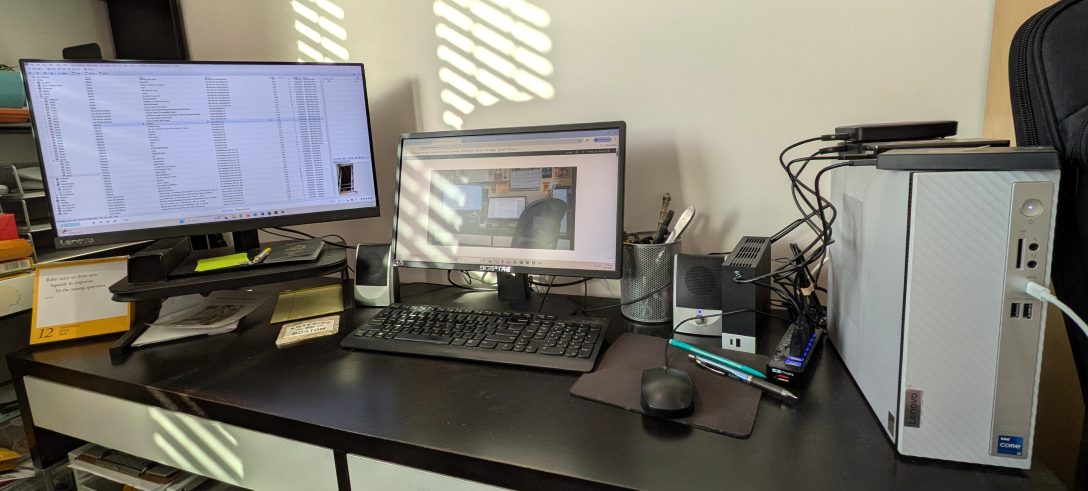
I know I’ve shared a few of these over on Live Journal (and a few in earlier WtBt posts) in the past, though I figured it would be fun to create a bit of a visual scrapbook of places related to the Mendaihu Universe over the years.  I made it a point to write whenever and wherever, so I quickly got used to finding a nook in whatever apartment or house I lived in.  All I need is a few plugs, a PC, my music collection, and I’m golden.

Continue reading “Writing Places Over the Years”

On being an SME

mr_smee_live_action
No, the other SME.

What is an SME?  It’s a business acronym (and companies loves them some acronyms something fierce) for Subject Matter Expert.  I’ve been labeled one at my Day Job thanks to my expertise regarding check printing and OFAC regulations (w/r/t checking accounts).  How did I get there?  Well, I’d originally been a Jack of All Trades in my position, but over the years I’d become more and more knowledgeable in this sort of stuff, to the point where I could write FAQs and easy to understand How-To’s for my coworkers and new hires.  I’ve had managers from other departments requesting my input on related things.  And to add to that, I can also go on vacation like I did this week and not have to worry about my team completely falling apart trying to do my job in my absence.

Granted, I didn’t learn all this over the course of a few weeks.  I started working specifically with checking around 2008 and OFAC around 2012.  Some of it was learned via outdated documentation, and a lot of it was learned on the fly.  In short, I decided that this was a narrow-focus subject I could pick up on and get to know in detail.

So what does this have to do with writing?

Good question!  Right about the same time I started learning more about OFAC, I’d made a conscious decision to become an SME on writing novels…at least to the level where I could feasibly do it myself instead of farming it out to someone else.  It was twofold: I really did want to know more about the process, and I wanted to see if I could pull it off.  So over the next five years, I dedicated myself to learning as much as I could about the writing and self-publishing process.

I wouldn’t say I’m an SME at all facets of the writing business, far from it.  My focus is deliberately narrow: I know a goodly amount about novel writing, self-publishing, self-editing, cover art production, and so on.  I’m still a n00b when it comes to the marketing and promotion side of it, though I’m making an effort to learn more about that as well.  And most importantly, I enjoy being at this level of knowledge.  Writing is one of the few creative avenues where I’m able to think multiple steps ahead and see all the moving parts of the whole.  Knowing what to do with all those parts makes me a better writer.

There’s also the fact that I’m a huge fan of Paying It Forward.  This is why I post entries like this…I like the idea of helping out other writers, clearing the path for them so they can see where they need to go.  If I can take what I’ve learned and make it easy for others to pick it up as well, so much the better.

Does an author have to be an SME?  Another good question; and I would answer that by saying ‘only to the level they need to be at.’  You want to know how to write in your specific genre, of course, and you want to be good enough at it so your readers won’t feel cheated by a poorly written story.  You may farm out the editing and the cover and the distribution (or that may be left to your publishing house), either because you’re not good at it or you’re simply not that interested in taking the time for it.  Nowadays you might want to have at least a moderate amount of knowledge about promotion, considering the current state of publishing.  [As an aside, it never hurts to know a bit about the various parts of the process anyway, so your conversations with editors/cover artists/etc won’t be as confusing and/or scary.]

Think of it this way:  when you bring your car into the shop, you can either trust the mechanic, or you can also understand what the mechanic has to do.  There’s no right or wrong here; it’s all about how much you want to know about the moving parts.  For some it’s advanced algebra, for others it’s utterly fascinating.  It’s completely up to you.


(Not so) Great Starts

snoopygreatstart

The upside is that I’ve already gotten a good couple thousand words in on Meet the Lidwells!  Most of the text is coming straight from the very rough draft I wrote a few years back, of course, but it’s going in the right direction.

The downside is that I can already see where I’m going wrong.  Thankfully I know exactly what it is that’s wrong, and how to fix it.

I’ll be honest — the beginnings of my novels are always a mess.  I spend the first couple of chapters knowing what I want to write, but I haven’t quite grasped how I want it to play out.  The prose is all over the place as I try out all kinds of different styles on the fly.  I’ll plant the seeds of one or two minor plot points that may or may not survive the end result.  I may even get a few of the details mixed up.

But hey, that’s what revision and editing is for, right?  Once I do figure it all out (which is usually around two or three chapters in), then I have a solid platform for the rest of the novel, and I can clean everything up in those two or three sketchy first scenes.   A Division of Souls had at least three wildly different openings before I put all the pieces together and figured out which one works the best.  I had a hell of a time trying to figure out how to start The Balance of Light the way I wanted it.  Lidwells is no different; once I get into the groove, I’ll be able to build a more solid opening.

Do I wish I could write a perfect opening?  Nah.  Doing it the way I do is actually part of the fun!  It helps me connect with the story on an emotional level; once I’ve done that, then I can reshape the opening to fit that mood.  I don’t see it as wasting time and words; I see it as part of the whole exercise.  As long as I’m going in the right direction…that’s all that really matters.