Theadia update…?

I’m still floating in a stasis on this project, mainly because I’m having an issue with these final scenes of the book. Rereading the novel-so-far is feeling more like a distraction than a help. I’m almost thinking that perhaps I should start in on another project in the meantime, just to take my mind off it for a bit, and come back to it when I feel more refreshed and ready to approach it.

However, the other day I was also revisiting those perhaps this is actually a duology thoughts I’d had off and on throughout this project. While this could conceivably be a standalone, at the rate I’m going it feels like I’m rushing the ending, or alternately I’m tying up all the plot threads a little too cleanly. And it occurred to me: if I stop where I am now in this book and follow through with said thoughts about a duology, that would give me the space and the breathing room to work on the rest of the project. And it’s a perfect cliffhanger at that.

To be honest, this is close to how I’d decided to finish A Division of Souls back in the day. That book is different in that I’d already decided it would be a series and not a standalone, but all the same, by the time I got to that final scene, I actually had a much better sense of where I actually was in the entire trilogy’s layout. Souls was all about Denni coming to terms with being the One of All Sacred, and her final ritual in that book was her acceptance. That meant that the next two books had to be about what she had to do next and how she had to bring it all to completion.

So, back to Theadia: I’ve said before that this book is indeed about taking responsibility when it’s needed, even when it goes against the rules. But it’s also about a bigger story as well: what happens when one’s way of life is threatened for the most dangerous (and frustrating) of reasons. And in the context of this story, I don’t think it’s one that I can successfully tell within the confines of one book. There’s a much bigger story being told in the background, and that is the story that needs more room to breathe.

Perhaps it’s time to make this duology idea happen.
Characters and Their Stories

calvin-writing
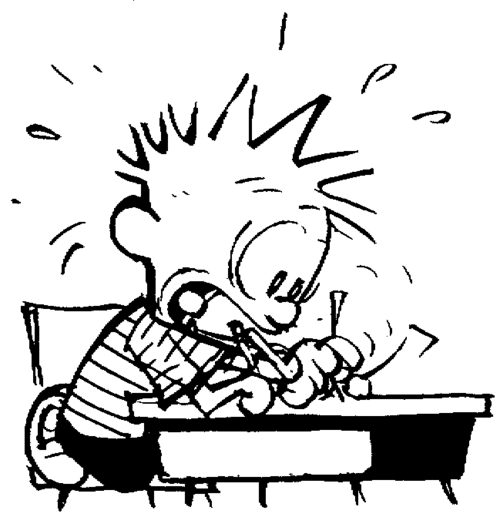
When I’m pantsing my writing…which I’m trying not to do this time out.

I supposed you could call my preferred style of prose ‘character-driven’.  The way I often create stories is to put characters in a scene and try to figure out how they react — to the situation, as well as to those around them.  This reaction often drives where I’ll go with the plot next.

Noted: it’s not as if I let them run rampant in the scene to the point where I have no idea what comes next until I get there.  I just have them going from Plot Point A to Plot Point B and I pay attention to their movements and emotions.  There’s a few reasons I do it this way:

–The character is always evolving.  One of my worst errors in a lot of my early attempts at writing was that the characters had style, but they were static; they never changed.  And when they did, it felt forced.  I don’t always expect each one to change completely and irrevocably…more that I just want them to evolve in some way.

–I pay attention to how they interact with other characters and use that as part of their evolution.  A good example is Christine Gorecki from my trilogy: originally she was a one-off character, but her initial single walk-on part with Sheila and Nick worked so well that I had to expand her role considerably.  She was obviously well-loved by all the main characters that she needed an important role as well as her own personal story.

–Quite often, the interaction between the various characters gives me more background, more grist for the mill.  One character’s personality will irritate the hell out of his brother after a while, which in turn gives me a subplot dealing with the two brothers not talking to each other for a year, which in turn gives me a scene where they have to sit in the same room and talk to each other and behave.

In a way, my writing process is a mash-up of half-pantsing and half-outlining.  I have a solid (if vague) idea of where the story is supposed to head.  Lately I’ve been calling that the backbone or the spine of the story.  But I keep the movement of the story fluid, keeping it open for change and unexpected inspiration.

In the process, any major arcs in the story feel less action-driven and more personal.  The action moments end up being there for a reason; it’s less about playing plot point bingo or trying to Save the Cat and more about how life puts unexpected hurdles in our path, and how we respond to that.  Personally, I find that a MUCH more fulfilling story.