The downside to using 750Words for my daily* writing exercise platform is that I don’t always get around to making offline copies of them. And I’ve been using the site for quite a few years, so I’m not entirely sure what I have out there right now.
[* It hasn’t actually been daily for a while now due to other projects and responsibilities that I’ve been working on. But hopefully I can get back into the habit soon enough.]
Last night I read a temporary project I did save was something I’d called The Hurleys. It was an idea in the Mendaihu Universe that took place in the current day instead of far into the future; its central characters were three adult siblings living in midwestern Massachusetts (go with what you know) who are some of the very few who are awakened to the fact that they’re connected to the Mendaihu. I didn’t get too far with it other than maybe five or six entries, but I gave it enough life and detail that it’s something I could possibly expand on.
I know I’ve written quite a few of these over the years I’ve used 750Words. My last three novels all grew out of these. And now I’m curious as to how many others are out there on my account, just waiting to be picked up and expanded upon. Thankfully it’s an easy enough thing to do, as the site keeps everything no matter how old, and I’m the only one who can access it.
Perhaps within the next month or so I’ll take a bit of time and do a deep dive. Maybe I’ll find my next novel idea!
Just like anyone else here, I too read what’s going on in the world lately. I get frustrated. I get angry. I get riled up. I want to go on a long-winded Twitter rant. I want to start yelling and someone, anyone, about why the world sucks.
And then I step back and exhale. I delete the rant and close the app. I reconnect with what’s going on in front of me; the job search, my health, our upcoming trip to the UK, my pre-submission work for Diwa & Kaffi. I wind myself back down to a calm level and move forward again. I don’t ignore what’s out there; I just do what I can to keep it from consuming me.
I wrote Diwa & Kaffi in part because I wanted to write a story that was positive. That doesn’t necessarily mean that everyone is happy and cheerful and nothing bad happens and everyone’s okay in the end. In fact, the exact opposite of that happens. It’s just that this story could not be told in a dystopian way. This is about characters trying their best to be good people, and all the ups and downs that entails.
I used to read all kinds of dystopian novels, but now they exhaust me. Sure, I might return to them eventually, but right now it’s not the kind of book I want to read or write. I’ve got enough bringing me down; I need something that lifts me up and inspires me instead. If I’ve learned anything over the years, it’s that I’m much more productive, both creatively and in real life, if I use the positive as a goal rather than focusing on all the negatives I have to wade through.
It’s about going into battle knowing that I’ll win in the end.
As I’d mentioned earlier, I’d done a recent reread of the Bridgetown Trilogy for possible future Book 4 ideas. One of the unexpected things I’d noticed was a distinct difference in influences. These three books are definitely different from Meet the Lidwells and In My Blue World, and not just in mood and length. I knew that going in of course, given its long and rambling history.
One of its early influences was of course Stephen King. This was my ex’s doing, having suggested I read him to understand how to write a large ensemble piece. I read The Stand (the unedited version, which I actually find more enjoyable than the shorter original release) right about the same time the 1994 tv miniseries had been released. It made sense to read this particular story and study it a bit, because I already knew that my idea was going to be about an event that affects scores of people and not just the main characters. [I was big on the Big Idea plot at the time.]
While the trilogy changed and evolved in numerous ways over the two decades I worked on it, so did the influences. I’d started reading more fantasy and science fiction, starting with Holly Lisle and CJ Cherryh and moving then to Kate Elliott. [This was about the time I’d started making my frequent road trips to Toadstool Bookshop in Keene and Barnes & Noble in Leominster, with my book buying habits growing exponentially.] The rewrites in turn became less action-oriented and more character driven. The end result, so many years later, is a mishmash of all those years of influences.
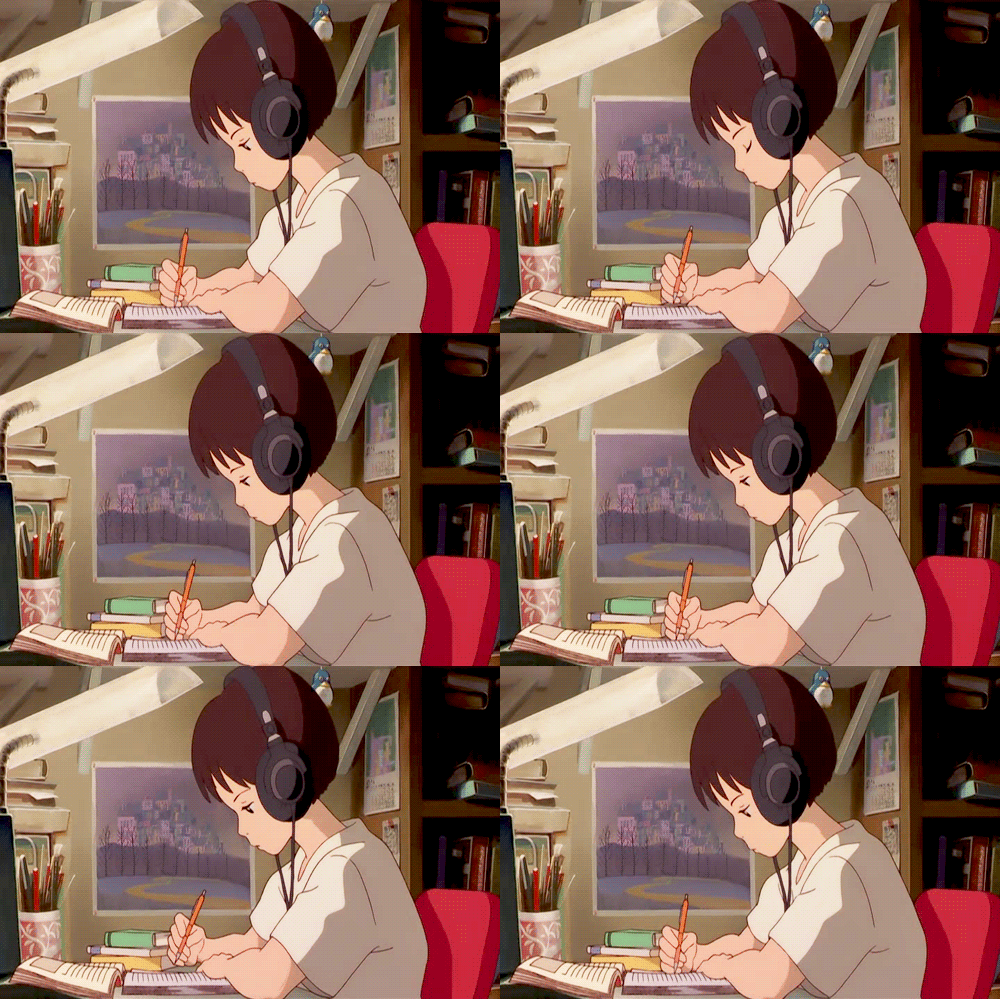
Reading Meet the Lidwells so soon after, on the other hand, was quite the whiplash. That particular novel has one influence only: rock history books, many of which I’d been reading either for pleasure or for Walk in Silence reference and research. I’d also written it to prove to myself that I could write a book less than 100k words! I haven’t reread In My Blue World yet, but I already know that novel’s influences was the YA fantasy I’d been reading. And as I’ve mentioned many times before, Diwa & Kaffi‘s influence is Studio Ghibli. I knew I’d had to severely change my thought processes once I finished the Bridgetown Trilogy project…but seeing the change now, a few years later, it surprised me at how much it had changed.
I suppose in a way this is why I’ve left future possible projects up in the air this year…I’ve caught up with all the ideas I’d been wanting to work on, so once D&K is out and away, it will truly be a clean slate. Which means one thing:
I have about five more chapters’ worth of revision to go before I can call this second go-round of Diwa & Kaffi done. I’m still on schedule, hitting about one chapter per evening while we watch British gardening shows. [They’re quite soothing after a long day at work, and perfect background noise for my writing sessions…although I do get occasionally distracted!]
I know I’ve talked about what The Next Project will be, but right now I’m not thinking too much about it. All my focus has been on revision, and the next step will be submission research. Right now if feels right for me to dedicated as much time and attention on this project.
In the past this would have bothered me…the fears of running out of ideas and falling out of practice, mainly. Over the years, though, I’ve realized that these fears will only manifest if I let them. I’ve cleared the table of nearly every story I’d put in backburner status, holding onto maybe two or three. They’ll be there when I come back to them. And if they no longer hold my interest, well…I’ll come up with something else eventually. I’m not worried.
Part of this comes with having done a reread of My Work to Date. I’ve reread all three books in the Bridgetown Trilogy as well as Meet the Lidwells over the last few months. It does kind of blow my mind that I’ve already self-published five books and I’m about to submit my sixth to a publisher, all within the space of four years. That’s a hell of a lot more productivity than I ever thought I’d have, to be honest.
So if I have a bit of a dry spell after D&K is out and away, I’m not going to worry too much. As long as I practice.
We just returned from an extremely busy weekend at Outside Lands and all that entails: multiple band performances, vague attempts at eating healthy, walking all over Golden Gate Park, braving the questionable porta-loos, and trying to ignore the more performative extroverts and drunk frat bros. And walking back home six long blocks away at the end of the night. It was a blast and I’m always excited that we have this incredibly cool music festival less than a mile from our apartment, but I am now tired and sore and a nap sounds like a great idea.
And yet somehow I’ve decided that doing my Daily Words, posting an entry here, and working on revision for Diwa & Kaffi later tonight is a good idea. Sometimes I just don’t know when to stop and take the day off.
I used to do this all the time down in the Belfry, back when I was writing the trilogy. I’ve spoken many a time about coming home from a ten-hour day during fourth quarter at the candle factory (when I used to have to go in for 4am in the winter, meaning I had to get up at 2am to get ready and brave the unplowed roads). And yet somehow I’d still decide to do my comic and cd run in Amherst, and spend an hour or so working on the novel. Granted, some days I’d get as far as playing a few hands of FreeCell, write a few hundred words, and call it done.
But other days I’d actually soldier through, fueled by snacks and Mountain Dew, and managed to hit my thousand-word goal for the day. Tired or not, sometimes these writing sessions were fruitful and enjoyable. As long as my brain wasn’t too loopy, I could pull it off.
I’m of course years older now, I eat healthier and go to bed at a decent hour, and thankfully my Day Job doesn’t demand ridiculous hours and overtime, but I don’t plan on pushing myself if I don’t have to.
So A finally made me sit down and watch the original 1998 Blade film, and HOO BOY yeah that was certainly something. Definitely one of those “this is terrible” but in a fun popcorn flick kind of way if you’re into that sort of thing.
It reminded me of something that I’ve been thinking about over the last few weeks or so: man, the 90s were fucked up. I’m not just talking about world events here, which goes without saying. I’m talking about some of the films, books, music, art, pretty much any medium. It’s almost as if us Gen-Xers, realizing that we were essentially the Generation Nobody Paid Attention To, decided to see how far we could push our creativity. And then push it just that little bit more. See what we could get away with. And it usually paid off, because the Gen-X audience loved it when the boundaries were pushed like that. It’s part of our DNA.
Blade in particular is a ridiculous vampire action film with all the bingo spots that makes up 90s action films: badass martial arts battles, quote-worthy dialogue, insane weaponry, a secret rave in a bizarre location, a ridiculous car chase, a few insane how-the-hell-did-they-shoot-that sequences, and all of it edited to fast-bpm techno dialed up to 11. It also features quite a few ‘let’s see how far we can push this’ moments, one especially squicky scene within the first five minutes of the film.
I watched a hell of a lot of these in the 90s and 00s, from the Matrix films to the Underworld films and yes, even the Mortal Kombat films. They were all good fun on a stupidly hot Saturday afternoon during the summer.
They also feature some great whoa! moments, and I’m not talking the Keanu Reeves kind or the car-jumping-a-moving-train kind. I’m talking about the kind that a writer like me would love: the little seemingly inconsequential shots that make me perk up. There’s a shot in Blade that did it for me, when our heroes are being chased down a subway tunnel with way-too-fast trains zipping by every couple of seconds. Dr Karen Jenson somehow loses her balance and lands on the tracks, but at the last second reaches her arm over at an odd angle, thus keeping her face from landing on the electrified third rail by mere inches. It’s a three second shot that didn’t need to be in there, but for me it was definitely an ooh, nice detail! moment. A lot of 90s films are filled with those kinds of shots, and they add charm and reality to the moment.
These often inspired my writing at the time. The original version of the Bridgetown Trilogy (The Phoenix Effect, written 1997-98) features the same level of detail alongside some of the classic tropes. Some of them even show up in the final books. I had a rule for writing them: if I wanted to add a ‘this would look really cool’ moment, I had to give it a reason for being there. I realized the best way to do this was similar to that Blade moment I mentioned above: it had to tie in with the character’s personality. Dr Jenson’s purposely avoiding the third rail underlines a major point of her character: she’s smart and always thinks ahead, especially on the fly. Whenever the Mendaihu gang had one of those similar Hollywood moments, I made sure it had consequences.
While a number of more recent action films have dialed back the over-the-top ridiculousness somewhat, that’s not to say they’ve completely disappeared. See the still-going Fast and Furious series for a prime example of that. It’s even there with more recent stories: the John Wick series is just one over the top fight scene after another. Even there we have a nice attention to character detail: Wick hardly ever speaks in any of the movies. And when he does, he does so for a reason, and his words are important.
My point here? Well, let’s just say that watching 90s action films might be a fun and enjoyable way to waste an afternoon…but even these films have moments that inspire a writer like me.
It’s the question that nags at every writer at some point: what should I write next?
I’ve got two, maybe three projects idling in the background, and I’m not entirely sure which ones I want to start first. I’m not making a solid decision just yet, as I’m still heavily focused on this current revision phase of Diwa & Kaffi. If I’m going to do any prep work for any of these at this time, it’ll just be a few notes here and there or some practice words.
Each new project starts off a bit differently from the previous one, I’ve noticed. Meet the Lidwells started out as an enjoyable diversion while trudging through the massive prep work for the Bridgetown Trilogy releases. In My Blue World started out as a light adventure, and Diwa & Kaffi started as a serious approach at YA. I really have no idea how these two or three possibles are going to kick off.
And once I start them, who knows if they’ll see completion? Between the those three books and the Trilogy, there are at least three or four more projects that I’d started but eventually trunked. That’s always a frustrating decision, but sometimes it’s got to be done. [There are many red flags that will tell me when a story needs trunking, but the biggest one for me is when it truly feels like I’m wasting my time.]
The most I can do as a writer is just DO it, and hope for the best. I doubt I’ll ever truly run out of ideas. I might have a dry spell, sure — I had one of those about ten years ago — but something else will come along eventually. And when it does, I’ll do my best to see it through. And if that fails, well…onto the next project.
It’s an honest question. Do we read our own books after they’re out there in the wild? After spending all those hours slaving away at it, pulling it apart and putting it back together, wondering if anyone else out there is ever going to read it…do we want to pick it up again after we call it complete?
We most definitely do, for various reasons. I can’t say if other writers read their own books for the fun of it, but I would not be surprised if some of us do. After all, a good portion of us write these things because these are the kinds of stories we like to read.
Over this past weekend, inspired by finishing off my cleaning and sorting of the Mendaihu Universe papers, I uploaded an epub copy of A Division of Souls to my Nook and started reading it during our relaxing weekend down in Monterey. I haven’t picked up that particular book since I self-published it back in 2015.
I’ve distanced myself from the Bridgetown Trilogy since then, by choice. The major reason being that I had a few unrelated stories I wanted to write and release first. I also wanted that distance so I could look at it with a fresh viewpoint, that way I could reconnect with certain parts of it for the potential Book Four.
I’m already picking up things I’d like to change with it, of course. Perhaps a bit more editing. A few formatting issues that might have gotten missed. Quicken the pacing a bit more, especially in those first few chapters. But other than that, I’m surprised at how solid it all is despite that. Spending so many years on a single project can sometimes become a desperate fall into a rabbit hole, but I can see I managed to avoid that. It’s very heavy immersion, I’ll grant that. This was my Epic Urban Fantasy project and written that way on purpose. Just like Meet the Lidwells! and In My Blue World were written fast and compact on purpose. Just like Diwa and Kaffi was written in a deliberately even and relaxed pace.
And I’ve reread those books as well! I read MtL for the fun of it because it was such an enjoyable and quick project. I reread IMBW because I wanted to make sure I did a good job on it, a few months after I released it. And I’ve been rereading D&K over and over again lately for revision purposes. A common piece of advice that many authors (and agents and publishers) give is that you’ve got to be able to reread your own work countless times and not get sick of it, and I totally get that.
I’m not planning on doing a New and Improved Edition of the Bridgetown Trilogy because of this current reread. At least not yet, anyway. (I might eventually do one to fix the few very minor issues that I catch, but that’s not going to happen right away. Right now, all I want to do is reread the trilogy and see how it sits with me, and what I can glean from it for later books in the Universe.
Still, it is kind of fun to read these things and get that occasional feeling of pleasant surprise and pride: I wrote this? Daaang! Heh.
As I’ve mentioned before, I’ve been contemplating submitting Diwa and Kaffi to agents and/or publishers. I haven’t taken this route since probably 2013, when I submitted A Division of Souls out to a few publishers. I’ve self-published everything since then.
So why go the submission route this time out? Well, my first and most important reason is that I have high expectations for this particular novel. I’m quite proud of how it’s come out; it’s quite possibly my best work since I started self-releasing my work. And to be honest, I really don’t want this one to fall into a void like my other books have tended to do. [That’s partially my own fault, but that’s for another post.] I want Diwa and Kaffi to get the best cover, the best production, the best editing, the best everything. While I could find an artist to commission for a great cover, and while I could do my damnedest to get this book into the hands of as many people as possible, I also know that going the ‘pro’ route would provide me with better chances than I could ever give myself.
Which means I need to start researching for agents and publishers for the first time in ages. I’m aware that the process and the field has changed considerably over the last ten or so years since I last researched it, so I’m going in knowing full well that I may need to relearn it all. I’m totally down with that, considering I’ve been in this writing gig for pretty much my entire life. I’ve read all the Writer’s Digest articles. I’ve read the how-to books. I’ve talked to the panelists at conventions. I know where to look and who to ask.
So what’s different for me this time out? On a personal level, I’m going into the submission process with a bit of context and experience. I’m not mailing these printouts passively into the wind and hoping they graduate past the slush pile. I’m not looking at the process with rose-tinted glasses and getting my feelings hurt when I get rejection letters back. And most importantly: I understand why those past submissions failed as they did. I learned how to read my own work clinically so I could see why they were rejected. I was able to understand that changing my style or my process or whatever had no bearing on me personally; there’s going against the grain and then there’s just using that as an excuse for sloppy work.
Do I know who I want to submit to? I have a few ideas. I look at who’s published my favorite books in the last decade, who the editors were, who their agents are. I’ve met a few of them at cons, or know of them through some of my other writer friends (this is one of the reasons I do enjoy social media).
I know it’ll still be high-stakes. I know the turnaround will be significantly longer. I know it might still get published but not get any promotion whatsoever. I know it might still get rejected. I know it still depends on timing and luck. But I’m willing to try it anyway.
And if all else fails, I can still self-publish it.
My notebook of choice for poetry and journaling for decades.
The Mead composition notebook hasn’t really changed much over the years. The stiff cardboard cover is bendable cardstock now, but the cover is still available in mottled black and white, still has 100 sheets bound by string and glue, and still fits perfectly in a backpack.
Back in early 1988, when Chris and Natan and I started up our band The Flying Bohemians, I’d tasked myself with writing song lyrics. Deeply inspired and influenced by the music we were listening to on college radio and as you can well imagine, most of it ended up being pastiches of songs by The Cure, The Smiths, and The Sisters of Mercy. There’s some decent stuff in there, given my age and experience, but for the most part it’s the kind of too-serious writing you’d expect from a seventeen-year-old stuck in a small town, waiting to escape.
Song lyrics and poetry became a perfect temporary escape for me then. During bouts of frustration and depression, I gave myself one rule: no boundaries. Let’s see how far we can take this. Mind you, that didn’t mean ‘let’s write the most vile/violent/gross/puerile shit just to get away with it’. I never wanted to go that route to begin with. No, it meant ‘let’s lay our heart and mind out and go deep, no matter how dark it gets.’ Sure, it’s a teenage cri de coeur and everyone’s done it, but I took my craft (if not the words) seriously. It was writing exercise to work on my frequency and consistency, and it was a mental exercise to purge my negative emotions. And they were a creative outlet when my fiction writing well had run dry.
This was an avenue that got me through a hell of a lot over the years. The frustrations of high school, the worse frustrations of college, and especially the dismal post-college years. I may not have always been consistent with it, and would sometimes go years between writing in these notebooks, but I never gave it up completely.
My history with personal journaling, on the other hand, had been spotty for years. For a brief time I used these same Mead notebooks for personal journals, starting in 1991. Most of it was voicing personal frustrations with school, friends, relationships, roommates, and lack of money. Later on, I’d write personal entries in regular notebooks here and there (I’ve been finding quite a few of them during my KonMari Tidy-Up of Spare Oom Project), but they never lasted more than a few pages. And once I joined Live Journal back in 2004, all that writing ended up online.
It wasn’t until New Year’s Day 2014 (after a brief false start a few months earlier) that I bought a 3-pack of Moleskine’s large cahier journal from our local bookstore that I made it a point to redirect that public display back into something personal again. Since that day I’ve been writing in those particular notebooks five days a week with very few exceptions; it’s what I do during my 9:30am break during the Day Job. I’m glad I took that step, as it made me refocus my creative output. My online writing morphed into the two blogs you’re now following. My personal issues now stay personal, just like they were all those years ago.
But what about the poetry? I’ll certainly have highly productive waves every now and again, but those are often few and far between. Those remain an exercise in emotional and mental purging, but they’re also done for the pleasure when the inspiration strikes. I’m working on trying to make this outlet more consistent, however.
Every now and again I’ll pull out one of these journals and poetry notebooks and read a few pages, just for the fun of it. Sometimes I’ll cringe, but more often I’ll let myself revisit the memories and emotions tied to these writings. It’s a way for me to remember what I’ve learned, reminders of where I was and where I’m going. Sometimes it’ll even inspire something new.




 Welcome to Bridgetown