See, I’m not entirely sure what I should be posting about. I’m worried that I’m starting to blog the same things over and over again. On the other hand, I’m at the back end of the Bridgetown Trilogy project, so I’m worried I’ll run out of fresh blog ideas. I JUST DON’T KNOW WHAT TO WRITE, DAMMIT.
See, I’m writing this at 7:30 on a Sunday night, and thanks to my horrible homework habits as a teen, this means that I’m making a right hash of this entry. Instead of focusing on writing something of interest, I’m thinking of what my Day Job workload will be like now that I’m back from vacation. I’m thinking about what I’ll need to do for most of November since A will be away on her own work-related trip during that time. Half of me is thinking, technically…I did say I’d return in November, but tomorrow’s October 31, so I don’t really need to write this. The other half is thinking, WILL YOU JUST STFU AND WRITE THE DAMN THING ALREADY?
So let’s pull ourselves together here a bit, shall we?
Don’t get me wrong…my writing habits are a hell of a lot better than they used to be. I’ll give myself a bit of a pass tonight because this was my first day back from a week-long trip (and a night flight that got us back to our apartment near midnight). I spent most of Sunday afternoon cleaning up a few hundred personal and work emails. We had to do some grocery shopping today, considering the refrigerator was embarrassingly bare. And the weird San Francisco weather was sunnycoldwetwarmovercastrainywho the hell knows and the humidity gave me one hell of a migraine. Not to mention the irritation of the recent news cycles. So I’ll forgive myself for being half-assed today and slipping into distraction mode. My brain has no idea what time or day it is right now.
That said…
What usually happens come Monday morning is that I’m rested up, focused, and ready to go. The frustration and the stress of Sunday night has been dropped and forgotten. What remains is renewed dedication to forge ahead and a bit of embarrassed acceptance that all this stress was a bit of a waste of time.
Hey gang! Sorry to let you down, but both blogs are going on a brief vacation for a few weeks.This next week is probably going to busy, between Day Job stuff and preparing for an actual trip (we’re heading back to New England to visit friends and family).
We’ll be back fresh and ready to go in November! Until then, don’t eat too much Halloween candy!
Inktober. NaNoWriMo. A to Z Blog Challenge. I keep thinking I can do these month-long or daily memes, but I always stall after about ten days. Why is that?
I mean, it’s not as if I actually get bored with them. I love to write. I love to draw. Give me a subject to blog about and I can probably whip something up by the end of the day.
One reason is that they usually take place at the wrong time for me. Inktober and NaNoWriMo both take place during the last quarter of the year, when my Day Job is usually the busiest and the most stressful. There’s only so much brain power I can provide on any given day. Even something as quick as Inktober can be a chore if I can’t think of anything to draw that day. And if I skip a day, then I feel I’ve already given up. It’s stupid and annoying, yes, but it always happens.
How do I break that?
First of all, I have to remember that everyone of us has off days. Days when we get broadsided by so much Day Job ridiculousness that the last thing we want to do is think when we get home. We just want to have dinner and watch Time Team episodes all evening until it’s time for bed. [At least that was me yesterday.] It’s A-OK to skip a day; the meme will probably forgive you for that.
Second of all, sometimes there’s already a major project going on that needs more attention. I’ve just hit Act III in The Balance of Light so most of my focus has been on its editing. If I can sneak in a half-assed drawing in five minutes that I can post, that’s cool, but I have to remember that I don’t need to hit every single meme goal. If I was more of an artist and not a writer, sure, I probably would nag at myself a bit harder to hit that goal, no matter how ephemeral it might be. But writing has been the major driver here, with everything else riding shotgun. [This is the main reason I can’t do NaNo…I just don’t have the time to dedicate.]
I know what you’re saying right now: it’s just a meme! Don’t take it so seriously! Honestly, I don’t. I don’t beat myself up for missing a day. I may feel frustrated by it, but I won’t feel like a complete failure. But here’s the thing: I do these memes for fun, but I also see them as possible projects as well. Yes, even the maps…I either think of those as my ongoing portfolio, or possible worldbuilding reference. I know, it’s weird, but I’ve never been able to create something without thinking ‘hey, I could use that somewhere’. It’s just how I am.
It’s not as if I don’t know how to have fun on my downtime. As mentioned above, we’ve been watching old episodes of Time Team (the UK version) to relax, and I’ve been burning through my TBR book pile at a furious clip lately. I’ll watch music videos on YouTube and listen to new release streams online. I pick up one of my guitars for a few minutes every day just to noodle around on it. I just don’t always have time to provide to a month-long meme, is all.
Still, it would be nice to be able to dedicate a good block of time for these. Especially NaNoWriMo…I’m curious to see if I can actually write a full novel in a month. Maybe once my slate is finally cleared of all projects, I’ll give it a go.
No, I mean trunking a — you know what, never mind.
Trunking a project is always a weird feeling. You’ve been hoping beyond hope that you could keep this project alive, even as it’s going down in flames. He’s dead, Jim. The heart stopped beating some time ago, and there’s no way to revive it. Time to file away the document, close the notebook covers, and file them away under At Least I Tried (or alternately for me, Seemed Like a Good Idea at the Time). Time to move on.
I’ve trunked a number of story ideas over the years. My first couple of novels, my screenplays, and nearly all the story ideas that never evolved past their initial first couple of days of workshopping. The digital versions are all filed away in a nondescipt ‘etc writing’ folder, and all the printouts are gathering dust on one of my bookshelves.
I don’t think I’ve ever trunked a format before, however.
This past Thursday, I decided I was going to make it official and stop writing poetry. At least until further notice. [The fact that I chose to do so on National Poetry Day was a complete fluke, by the way. I didn’t know about it until after I’d made the decision.] For a bit of closure, yesterday afternoon I wrote a eulogy poem called “30”, and once I was done, I filed that composition notebook away with all the others.
So why did I chose to take this step? Well, partly because over the last five or six years, it started feeling more like a chore and an exercise and less like something I used to enjoy. See, when I started writing poetry semi-seriously, I was a senior in high school. That’s back in 1988, folks. It was primarily a mental and emotional escape for me, and over the years it never really changed.
I think it says something really positive that I no longer need that outlet.
The downside is that any poetry I have written over the past, say, seven or eight years, has felt forced and lifeless. Like I was doing it for homework rather than for any personal or professional reason. There were moments where it was fun, like when I was writing it for my now-closed Dreamwidth account, but I really was beginning to lose interest in it.
So why did it take me so long to make this decision?
Well, a few things, really. Like I said, I’d been writing poetry since 1988. Since before then, really. My first attempts were actually back in 5th grade, which would be seven years earlier in 1981. I’d dabbled with song lyrics and other things since then, but 1988 is when I first started focusing on it as a valid creative and emotional outlet, using one of those Mead composition books with the mottled black and white cardboard cover (you know the ones I’m talking about). I have about twenty of them now, some filled to the ending pages and some with only a small fraction of pages used. So making the decision to put that part of my life away after twenty-eight years was no easy decision. It had become a close confidant.
But the main reason? Simply put: I couldn’t think of anything to write about in that format anymore. I had no need for it. My writing projects and processes have changed significantly over the years — especially over the last five or so years — that I had little to no time to focus on it. It felt a bit frivolous. Poetry was no longer my avenue for self-guided therapy…that’s now hiding in my personal journals, offline and well away from everything else going on. I had nothing to write about anymore in poetry form.
Does that mean I’ll never write another poem again? Hardly. I’m sure I’ll scribble a stanza or two in my journal. And I’m quite sure I still have a few song lyrics in me that have yet to surface. This only means that I’m not going to force myself to write something that no longer works as a viable format for me anymore.
It’s time for me to move on, to continue to evolve as a writer.
Hey there! Sorry for the mess here at Welcome to Bridgetown. I’d been wanting to update the blog’s setting for quite some time, and of course the one day I was able to do so with not much interference, the site decided it didn’t want to cooperate. Every time I tried to play with the customization, something crashed. [In retrospect, I think WP was doing a server update and so most of the coding responded with LOL NOPE. Very much like this very amusingly excellent Nichijou segment above.]
SO!
I did manage to get a nice sunset picture of Dubai for the header picture to set the new mood. I’d like to give WtBt a much brighter view with easier navigation and readability, so I’m trying out a few different settings to see what works.
I’m also looking into different writing things to blog about — not just the writing, and definitely not just the Bridgetown trilogy! I’ve got a lot of writing-related ideas percolating in the formerly dusty confines of my brain, so hopefully within the next coming months I will be providing you with more entertaining, informative, or just plain silly things to brighten your day.
This will be a work in progress, so thanks for your understanding and patience!
Not the one I worked at, but very similar in size and shape.
It occurred to me that twenty years ago as of the 23rd of September, it’s been twenty years since I’d started what would be one of my favorite jobs ever. Never mind that it was a fifty-mile, hour-long commute one way. Never mind that it didn’t pay enough for me to quickly get caught up on all my bills.
Dude: I was working in a record store. That’s all that mattered.
But I’m not going to go into detail about the store too much here; I’ll be doing that over at Walk in Silence tomorrow.
No, instead, I’ll talk a little about the food court, which was across the way from my store.
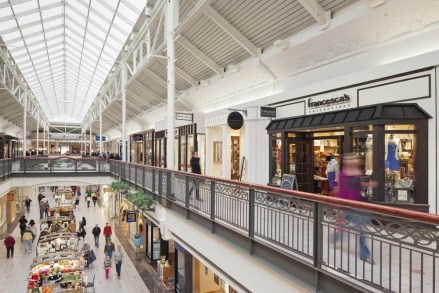
Solomon Pond Mall food court: where I had my initial interview, where I ate far too much fast food, and where I wrote a novel.
The mall was built around 1995 into 1996, so it was still shiny and new when I started working there. HMV was the first and only music store there at the time –not to mention this was before the file-sharing boom — so in those few years I worked there, we did pretty good business. We were in a good spot as well, so kids were always stopping in on their way to meet their friends elsewhere.
The last time I was at that mall was ten years ago, when we went to visit a few people in the area and had some time to kill. It hadn’t changed in the six years since I’d left the job, other than that the store closed up in 2001 and a Hollister was put in its place. A brief visit to the mall’s website shows that a lot of the original stores are still there.
HMV was the first long-term job I started after I moved back from my ill-fated stay in Boston a year before. After the short-term stay at the Leominster Sony theater, a six-month stay at WCAT, and a temp job at my mother’s bank downtown, I had to get hired somewhere, most likely out of town. I loved my hometown, but I’d long grown out of it. I needed to figure out a way to live in the larger world.
The western wing of the mall, looking east. There was a Waldenbooks just out of shot to the right. My store was to the left of that ‘Food Court’ sign in the distance.
Writingwise, I’d kind of dried up a bit. The process of writing True Faith had stuttered to a halt for personal reasons. I’d given up trying to rewrite the Infamous War Novel by this point, having finally trunked it. The songwriting and the poetry were drying up as well. It definitely wasn’t that I’d given up…it was that I had nothing to write about.
When I started the job at HMV, I wasn’t exactly sure how long it would take me to get there and back (even though I’d timed it during my initial interview in mid-August), so I would make it a point to get there with time to spare. My hours were from opening to late afternoon: somewhere around 9 to 5. Eventually I timed it so I’d get there about an hour to a half-hour early. I’d sit out in the food court with another coffee and relax. No stress when I started the job proper, then.
It didn’t take long for me to realize this was a perfect time to do some writing.
By late 1996-early 1997 I was out there every morning, working on something. My usual spot was the table closest to the store. [In the food court picture above, it would be right in front of that Dunkies at the far right. I chose that one deliberately so I would see the store’s lights go on when whoever opened got there before me, signalling it was time for me to clock in.]
Similar tables and chairs to the ones I used to sit at. I remember that wave pattern well. The zipper of my jacket would always get caught in those damn chair backs somehow.
I started The Phoenix Effect on 9 March 1997 at that table. A number of personal and creative events had taken place between the start of my job and that date, and that morning I chose to start a completely new story. I had no idea where I was going with it at first, other than the fact that it picked up where I’d left off with the spiritual/new age story ideas of True Faith and expanded on them significantly. It would be less dystopian, that was for sure.
Soon I was writing three to five handwritten pages a day before I started the job. I timed it so I’d get those words done, skip out for a quick smoke (a bad habit I’d picked up in college a few years previous), and then head off to my job.
After about a month of that, I realized it would probably be for the best that I start transcribing all this new work so I could start editing and revising it. I’d already moved my computer downstairs to the basement of my parents’ house and was already working on other transcription projects and whatnot. It seemed like the right thing to do.
The Belfry, circa 1998, with the hand-me-down Windows 95 computer (my second one). The writing nook was named so because of a bat problem one evening. Note the various snacks, notebooks, music, and other distractions nearby. Not shown: my addiction to playing FreeCell before I started a writing session.
By late 1997 and into early 1998, I was finishing up the handwritten version of The Phoenix Effect and working on a good solid revision, and by the end of that year I was ready to try my hand at submitting it to agents and publishers. I was also working on a sequel during my morning mall sessions. And I’d kept up with the publishing field as I went along. I knew what I was doing, and what I wanted to do.
This was the first novel since the IWN that I’d completed and submitted back in 1987, so I considered all this a pretty damn good milestone. Even as TPE was rejected left and right (and for good reason), I knew then I had a chance of making this a lifelong career.
I knew I was a writer at that point.
Alas, by early 2000 the job had become unbearable due to the change in management, hierarchy and schedule. I still made it a point to work on my writing on a daily basis, but it had become close to impossible to keep the same writing habits I’d had just a few years earlier. The most I could do is head down to the Belfry every night and work on revisions. I became stubborn about it. I would not give this up.
By autumn 2000, I’d quit that job and started a new one on the other side of the state. It was a shorter commute (thirty miles instead of fifty), the pay was better, and the schedule was a hell of a lot more stable. By early 2001 I’d switched to first shift, which let me out at 2pm. I had the entire afternoon and evening to write.
And write I did. And I’ve never stopped since.
Spare Oom, 25 September 2016 — still writing, still listening to tunage, still snacking, still distracted.
Twenty years later and that novel went through numerous revisions and morphed into a trilogy and an expanded universe. My music now comes to me from streaming radio stations, ripped cds and downloaded mp3s, and is all stored on two tiny external hard drives each about the size of an index card. I work from home and my commute is one room over. I’ve self-published two books of the trilogy, with the third on the way.
I still think about that store from time to time. I still consider it one of my favorite jobs ever, even if it was retail. Even near the end, when my manager and I weren’t getting along. Being surrounded by music all day kept me happy and entertained.
And most importantly, the job helped me create a solid and dependable writing schedule, and it helped me prove to myself that I could balance a Day Job and the Writing Career at the same time with minimal issue.
Without that, I’m not entirely sure where I’d be in my writing career today.
I very briefly mentioned a few weeks back that I’m feeling the need for Changing Things Up. I get this way when I’m feeling a bit twitchy near the end of a Big Project, but I also get this way when I’m feeling a bit…well, bored, creatively. When I feel that certain writing habits have worn thin. Perhaps I’ve used them to the point where they no longer work for me.
When this happens, I’ll take stock and clean house. What do I no longer need to do anymore? What can I do without? What can I put to the side and let go? Why am I working on these projects/exercises/daily words that aren’t being used anywhere? And if these words are online, is anyone actually reading them?
My Tumblr feed has pretty much become an aggregator for my WordPress posts, as I haven’t posted any photography there for some time. Do I want to pick that back up? Or is Tumblr really where I want to post such things? I still visit the site, as I follow a lot of artists there, but I don’t post nearly as much as I have. That may change, but for now it’s on the backburner. My Live Journal is pretty much in the same status. I only post there on the weekends, and I still follow a few writers and friends who are still there.
I’m even contemplating putting aside the 75o Words — not getting rid of the daily word practice, mind you, just taking it offline. I’ve proven to myself that I can work to assignment and deadline, and with my personal journaling I’ve proven that I can make it a daily habit. Taking the exercises offline will give me much more versatility, as I’ll be able to work on different things within one notebook: poetry, artwork, and daily words. And I can hit them at any time and not have to log in.
[Speaking of artwork: this Saturday is the beginning of Inktober, and yes, I will be taking part! I may even post them here for your enjoyment!]
On the one hand, it’s kind of a bummer when something you love doing so much comes to an end, but on the other, it’s healthier to move on when it’s clear that something’s not working as well as it used to. And in the process, sometimes I even learn something new!
These past few days have been uncharacteristically warm here in San Francisco. On Sunday it hit 88° F, which is far higher than we here in the Richmond District are used to on any given day, even in the height of summer.
These are the days when I’m just as happy hiding in the cool of our apartment, working on whatever writing project I happen to be dealing with. Back in my Belfry days, I’d hang out down there because my family’s basement was the coolest part of the house, considering it never got any sun except at the end of the day. I loved hanging out down there during the summer, listening to tunes and writing away.
Warm days at Arkham West (aka our first apartment in North Beach) were another problem entirely. Due to our bay windows we’d be getting sunlight all day long and it would get quite toasty if we didn’t close the blinds. I’d make do with writing on the PC, but some days I’d move to the couch and write there.
Here in Spare Oom, though? Perfect weather. The one window faces north so we don’t get direct sun at all, just the breeze off the ocean. And we’ll sometimes get some absolutely gorgeous sunsets as well. It never gets hot or muggy in this room. Sure, it’ll get cold in the winter, but not enough to drive me from getting work done.
I’m usually not one for writing sessions outside of the home, though. I just feel kind of weird taking up space in a café or a bookstore for hours on end. It’s not about other people watching me write…it’s more that I’d feel like I’m hogging a seat that one or more people could possibly use instead during the time I’m there. [That, and I’m usually there for other things, like buying coffee or books. I don’t feel as bad if I’m sitting somewhere going over the book pile and debating which ones I’ll buy.]
Still, I make sure I get out and enjoy the air now and again. A. and I try to make a point of going out for a walk on the weekend, even if it’s up to the brewpub at the other end of Clement Street. We’ll take a walk in Golden Gate Park or the Presidio, both a short walk from our apartment. We’ll head over to the gym and work out for a bit (during which I’ll be listening to my mp3 player and working out plots in my head while on the treadmill). We’ll head somewhere for brunch or a late lunch on the weekends as well.
As much as I’d like to be one of those writers hanging out in their workspace for hours on end, writing thousands of words and working on everything under the sun, I do need to exit the house now and again. Just to remember there’s a world out there.
So that said, we did manage to get outside and walk a bit before the heat and humidity got the better of us and we went back into hiding in the apartment to watch football. To prove this, I took a panoramic shot from our nearby vista point, Land’s End Trail. It was so clear we could just about make out Point Reyes in the far distance (it’s around 50 miles north of us, and just about barely visible in the far left horizon in this picture).
View from the Eagles Point lookout on Land’s End Trail. I love that this is in our neighborhood.
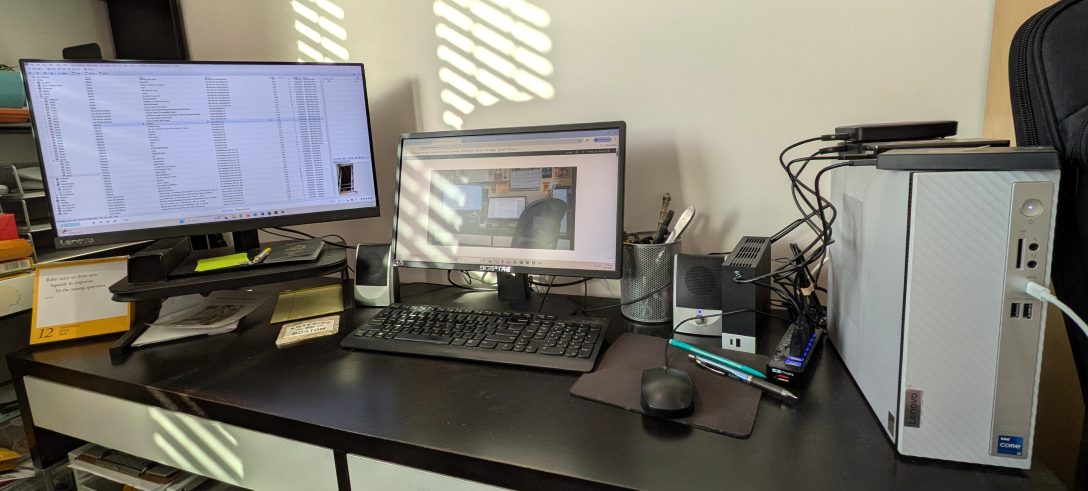
Day Job system crashes. Unending emails to work through. Client fires to put out. A drive across the Bay for an office visit. I missed a few writing days. I’m late in getting this post out. I’m just about done, and it’s not even noon on Friday yet.
BUT.
I gotta do it. No way around it.
I gotta write. I can take a rest day every now and again, but I gotta pick it up again when I’m ready.
Perseverance. A stubborn will to hit my deadlines.
Even if this post is a half-assed one with yet another anime picture as the header. Heh.
Still.
Gotta get my work done.
Despite all the roadblocks. Despite the raving case of the Don’t Wannas. Despite really needing a beer right now because the Day Job’s been that much of a pain in the ass.
One thing I always need to remind myself is that I’m not in a race with other writers to get my work out. Sure, I had that feeling way back in the day, back when I as naive enough to think that my manuscripts were good enough to warrant attention. I thought the turnaround was super-quick, that I’d have my byline and my comp copies in my palms within a few weeks. [Reality hit me pretty quick and hard, then.] And I still get that twitch of envy when I see writers I know personally or online, releasing new works while I’m still languishing.
Every writer gets that feeling. You want to be in the same race as everyone else, wanting to keep up and be One of the Gang. But everyone in that gang is already miles ahead of you, already known to readers, physical copies of books in hand, doing the signings and the readings at the conventions and book stores. It’s enough to make you wonder if you’ll ever catch up.
Well, here’s the thing: it’s not a race. Not unless you want it to be. You might give yourself a hard deadline like I did, to get that book out and away by a specific date, to have that physical copy in your hand (even if it is a galley or an ARC). But you’re not racing the other writers. Far from it.
They’re running just as hard as you are, tripping up at the same points you are, maybe even making it up as they go along like you are. Their race is not about who gets there first across the finish line, or who gets there the fastest. Their race is about finishing the race. To them — and indeed, should be to you as well — this race is a marathon. Running those twenty-six-point-two miles of hard work, revisions, edits, re-edits, re-revisions, meetings, sales plans, working on other projects in the interim, and aiming for that final goal of completion.
In the end, the only race in writing and publishing that a writer should be concerned with is a deadline. I had to remind myself of this for quite a long time, and once I finally got over that, I no longer felt frustrated that I was getting left behind, or annoyed that I was taking far too long to get my own work done.
One of the best ways I learned that is to take part in the writing community. I’m still a solitary writer that hasn’t joined a local writer’s group (and I kind of feel more comfortable that way — that avenue is completely up to you whether you want to follow it or not)…but I talk with other writers online all the time, I’ve met up and become friends with writers both beginner and pro. Once I came to the conclusion that we’re all in the same boat, that we’re all slightly frazzled and overworked but still loving what we’re doing, none of us are truly left behind. A lot of us support each other at all levels, because we know just how hard the job can get.
We’re all running, but we’re all running together.