The inspiration behind the stories, ideas, settings and characters of the Mendaihu Universe have come from all kinds of places over the years. I’ve talked about quite a few of them on various blogs as well. I’ve mentioned the albums I listened to, the movies and the books and the TV shows and and and… There’s been a lot that I’ve read and enjoyed that inspired me to write these stories. I made a semi-official list sometime around around late 2002 that included all of these. Maybe one of these days I’ll update it and paste it here on the blog, just for fun.
So where does this inspiration come from, anyway? Well, my first rule of being inspired by something has always been if it causes me to drop everything and run to the computer to start typing. If I finish reading a book or watching a TV show or a film and my first reaction is a creative excitement, if it’s made me notice the writing and the production in a good way…then it’s done its job, and done it well.
[Good recent examples: the always level-headed Christopher Foyle in Foyle’s War, no matter what mood he may be in; the deliberate pacing of the movie adaptation of The Martian, the one-person cast of driving ninety percent of Gravity; the movements of a large cast in Kate Elliott’s Black Wolves.]
I always cite music as an inspiration, though that tends to be more on a molecular level, as it were. Certain songs will inspire the mood of a specific scene; some albums will be my go-to’s for writing sessions (one recent release getting heavy rotation here is Shearwater’s Jet Plane and Oxbow). I may occasionally hear a song and imagine a scene not yet written; with those I’ll either make brief notes or I’ll listen to the song a few more times and think about whether it’ll fit in the project I’m working on.
I like to keep my eyes and ears open for these sorts of things. I’m not one to read or see something and think I want to write THAT! Mainly because I know by the time I finish it, it’ll no longer be in season. It’s more on a creative level; if I’m amazed by the writer’s dexterity in weaving a complicated plot, or their ability to look at a well-used storyline from a completely different angle, that’s what will inspire me to take the same route.
I suppose it all boils down to: how did the creator get his or her creation stuck in my mind? It has to be more than flashbangs and shock-and-awe and disturbing scenery; there’s a time and place for all of that, but it’s nothing I can or should completely rely on. It has to be the whole as well as its elements; the artistry as well as the work.
Yes, I have returned from the shadows and back to the land of the living! I’ve been so busy as of late, it took me a few days to realize that I didn’t have any pressing OMG deadlines weighing me down!
The last few days have been spent mostly doing project clean-up and getting everything back to some semblance of order. This meant an often precarious balance of Day Jobbery-related fires to put out (and there were many), doing the post-production and release prep for The Persistence of Memories, and generally just taking time to BREATHE again.
So now that it’s midweek and my brain has stopped spinning some, what do I have on tap for the close future?
Glad you asked! A partial list:
— The Persistence of Memories to be released in ebook on 4/15! WOO!It’s available directly from Smashwords in all kinds of formats, including Kindle, for $4.99. And for a brief time, you can buy the first book ABSOLUTELY FREE! Two for the price of one! [Note: As before, since the formatting of the physical book takes more time, I’ll let you know as soon as I can when it’ll be available through CreateSpace/Amazon.]
— I shall be taking part in the Blogging from A to Z April Challenge this year, here at WtBT! It’s a fun blogging exercise that I’ve done a few years in the past on my LJ, and thought I’d give it a go here. I was thinking of doing an A-to-Z of the Mendaihu Universe, partly to get me to talk about it more (as I’m sure you’re all wondering, what the hells is he talking about in these books?), and partly to get me back into the blogging habit. Hope you enjoy what I have in store!
— And speaking of blogging, I’m still planning making good with my ‘alternate plan’ for the Walk in Silence project by turning it into an ongoing series over at the WiS blog. This series will start the third full week of April (around the 20th or so). Stay tuned!
— Returning to the whiteboard schedule. I purposely put it aside a few months ago when I chose to focus solely on the TPoM revision/edit/remaster/release, and now it’s high time to return to it. Which means more practice words at 750 Words, more WiS entries, and maybe even some words and music elsewhere. Truly looking forward to that.
So yes! Definitely looking forward to returning back to the writing and the other projects. It’s going to be a fun and creative summer, that’s for sure!
I subscribe to a handful of writing magazines, many that I’ve been picking up for a good few decades. Over the years, they’ve helped me rethink how I look at my stories. Sometimes they’ll point out the blatantly obvious that I’d been ignoring for one reason or another (weak prose and word repetition for a start). Sometimes they’ll provide insight on what agents and publishers are looking for and how to contact them. It’s all helpful, and over the years their advice did help me get a lot farther than just guessing or assuming I was doing it right.
On the other hand, I’ve been quite contrarian lately, and I’m not entirely sure why.
Well, maybe I am sure; I think it has to do with self-publishing my work. Also that I’ve been a nonconformist at heart since I was a kid.
Thing is, lately I’ll read these advice articles and think, ‘well, why can’t I do it that way?’ For example, I saw an article earlier this morning regarding a novel having too much plot. I get where they’re coming from, don’t get me wrong; the example they used was bombastic and ridiculous (some litfic plot regarding way too many characters causing way too many plot twists and coincidences that even reality gave it the side-eye), and in that instance, it’s probably for the best that you back it up a bit and maybe narrow the focus. My reaction, however, was this: well, how is it that apparently readers don’t like way too much plot, and yet we love reading doorstop novels from George RR Martin, Kate Elliott, Neal Stephenson, and so on? How can I write the plot-heavy book and still make it readable and enjoyable? The kind of doorstopper that makes readers go ‘damn, that’s some great world building!’ In other words, the kind of books I love to read.
That’s when it dawned on me: it’s not that the writer of the article is stifling creativity; they’re just trying to keep your novel’s highway from gridlocking. If you’re going to write a doorstopper, just make damn sure it’s navigable.
Getting back to my bit about nonconformity, here’s an ironic admission: I’m also a pathetic conformist as well. Let’s just say that even though I touted my individuality in my high school years – sometimes to annoying extremes – and tended to question authority when needed (again, usually in the form of “well, why can’t we…?”), I also found myself desperately trying to fit into the status quo at the same time. I’m a proud self-contrarian in that respect.*
[* – A good example of my proud self-contrarianism: Yes, I am aware of the irony of using a Psykosonik song in a blog entry about writing my sf trilogy, considering that one of the band’s principal songwriters was one Ted Beale, aka Vox Day. I’m not a fan of his politics in the least, but I did love the Unlearn album when it came out in 1995, so I’m fine with keeping the two separate.]
With regards to my writing, I went through quite a few phases of trying to shape my novels into something that agents and publishers would enjoy. The truth is out: one of the reasons it took me so long to self-release the Bridgetown Trilogy is that I spent a good number of years trying to figure out how to revise it so that it was more commercially acceptable to agents and publishers. Suffice it to say, I never successfully figured out how to do it. I didn’t want to give up on the Mendaihu Universe, I just wanted to make it marketable.
I could never figure out why nobody was biting, though — and that’s the downside to the form rejection letter. No one is telling you why. I understand the reason behind the process…most agencies and publishers are actually quite small in crew and literally can’t respond personally to thousands of submissions. At the same time, though, it doesn’t help the writer one bit. It’s like being trained at your workplace for a new system, and when you’re baffled and stuck and ask for clarification, the trainer responds with “Well, what do you think it does?” My initial response to that kind of question is almost always “How the fuck should I know? That’s why I’m asking you!”** I get that they’re trying to make you think it through, but some need a frame of reference first before they can answer that question. If I’m not doing it right, I want to know how I should be doing it to your specifications. I’m a writer: asking that question of me provokes about 3,425 different responses. I have no idea which one is the right one or which would bring me success. I have nothing to base it on.***
[** – Yes, this has actually happened at one of my day jobs.]
[*** – I am aware that this is what writing groups and beta readers are for, but they’ve never quite worked for me. They’re great for talking out ideas and suggestions and I love the camaraderie, but more often than not they end up doing little more than confirming problems and issues I’ve already noticed and hadn’t yet acted upon. I’ve come to the conclusion that I just happen to work better solo and should trust my instinct more often.]
And the nonconformist in me, after so many years, finally decided that DIY seemed like a more viable and entertaining option. The time was right, the field has been quite strong, and I’d already done my research on it. This time I listened that rebel in me.
I’ve mentioned here before that music is an incredibly huge influence in my life, and I took that to heart this time out when I chose to rethink how I viewed publishing. I’ve read so many music bios about punk bands scraping by on a meager pittance and a beat up van yet absolutely loving the lifestyle; I’ve read about their wonderfully creative ways of getting their singles out to radio stations and audiences. There’s a reason why the image of a telephone pole covered with the bark of a thousand nightclub flyers is so iconic; that was punk’s social media of the time, to let all and sundry know that you were in town and were going to play at some seedy bar close by.
So this is what happened in 2015: I chose to unlearn the process of publication as I knew it. I already understood it all too well…if I want to publish commercially, I already know what steps I need to take, and I think I have a bead on how I can make my lighter stories marketable. What I had to do for my self-published work, though, was think like a nonconformist: what makes sense to me, first and foremost, and be consistent in that belief. I taught myself to react to moments of weak prose and plot. I learned to completely trust my creative instincts. I taught myself the mathematics of creativity (thanks again to music), of being aware of what makes a pleasurable work. And most importantly, I taught myself to ignore any self-doubt that popped up. I’m proud of the creative things I can do; I love writing and drawing and playing music, always have since I was a kid, so it was about damn time I followed through with those long-held dreams and make them realities.
I won’t lie…sometimes the DIY route can be daunting. It can be emotionally nerve-wracking. It can also be expensive. But I really do think unlearning the process of trying to be a commercial writer was one of the best moves I’d ever made. I’ve never been happier and more excited about being a writer.
The decision to pull out of a writing project is a strange one. It’s never a knee-jerk reaction. More often than not, it’s a laborious, emotional, drawn out process. All kinds of questions arise, whether it’s worth soldiering on or cutting losses. The feeling of frustration and irritation due to wasted time. And even the relief (and the guilt of feeling such, despite the decision) when the deadline is no longer hanging over the writer.
I say this now, as I seem to be on the fence on a current long-term project at this time (don’t worry, it’s not Mendaihu Universe related). I won’t go into detail just yet, as I’m still debating on what move I’ll take, but suffice it to say, the end result is different than what I’d expected it to be. It’s starting to feel less like a publishable book and more of a private ‘vanity’ book…something that would appeal to me, but probably not to too many others. Will I finish it? I most likely will, given that I’m close to the end of the initial rough draft anyway. I just may not self-publish it.
It’s a tough decision, and one I’m not taking lightly. It’s not exactly frustrating that it may take this direction…just that it feels weird, signing off something that had potential at one point.
Hey there, everyone! Lots of movement here in Spare Oom. The Day Job has been keeping me busy, though I’ve been sneaking a few minutes here and there to edit.
At this point, it looks like the release of The Persistence of Memories will more than likely be end of March rather than February…I do apologize for the delay, but this edit run is taking a bit longer than expected. I’m still about a quarter of the way through, but I’m making good headway. I’m giving myself a bit more of a buffer so I can do the formatting and the cover, and so I can release both the e-book and the physical version at the same time.
I’ll have more to blog about my editing processes to date, but that will be after everything is done. Yay, future blog posts! And thank you for your patience, as always! I promise, it’ll be worth the wait. This one’s still my favorite of the three.
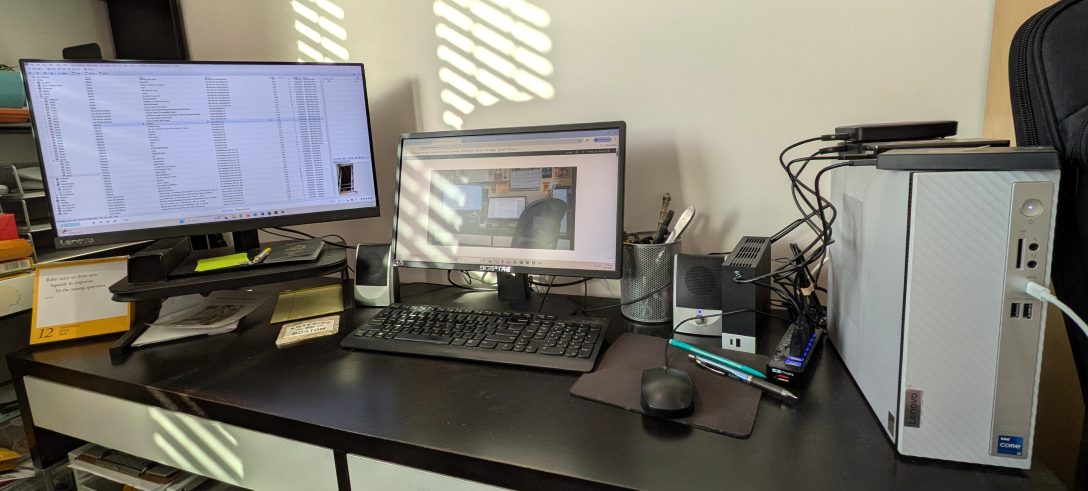
But seriously, I’ve been taking extra steps to make sure I get all this work done on time and with minimal distraction. I’m still utilizing the habit of closing down all web browsers when I’m not using them for something important (like checking my word choice against the Merriam-Webster website). I’m even doing this during the day when I’m editing during slow moments, as you can see from the above picture. Making good on my plan to scale back on my internet usage in general has worked out just fine. I’m more productive and less distracted.* Once I post this, I’ll be closing down the browsers again.
* – Okay, I may have returned to my FreeCell playing habits, but the trade-off is worth it. A five-minute game is a lot better than a half hour of Twitter.
Oh — and if you’re curious, here’s the wallpaper I currently have. I took this out Spare Oom window with my nice camera during a rather spectacular sunset late last year.
Okay, actually I blame my ex from ’94 for handing me a copy of The Stand while we were working on True Faith, but the point remains: I blame Stephen King for introducing me to the Large Ensemble novel. I read a wide assortment of his novels in 1993-95, intrigued by his style and his characterizations, and it was The Stand that grabbed me the most. I’m extremely picky when it comes to stories with End of the World themes (they don’t bother me, I just have very little interest in them), but this one fascinated me, because it was such a sprawling piece of work. A doorstop. And the edition I read was the expanded version that had just been released. And I loved it. Still do…specifically that version.
I loved the idea of a large ensemble in a novel, because I was fascinated by how each character’s life intertwined with the others, even if they never met face to face. I loved the idea of each character’s unique development and evolution throughout the course of the novel. I especially like how each evolution had a specific role within the main plot, whether it was a large role or a small one.
That’s one of the reasons the Mendaihu Universe novels are always an ensemble affair. Like the purging and repopulating of the human race in The Stand, I wanted to show that the awakening and ascension of spirits in the Universe weren’t merely relegated to the main characters, but to everyone in the world. Not that future MU stories will also have a large cast; I already have some ideas focusing on a minimal number of characters that we may see down the road, and I’m quite sure I’ll have a Tales from the ARU sequence soon enough.
Writing large ensembles is tricky work, because you need to be a really good note-taker, or at least have it down really solid in your head. Switching from one POV to another is simple enough; you just need to pay attention when you do it. More often than not I kept with a single main POV character throughout an entire chapter to keep it simple — and in the process I got to play with that character’s evolution within that length of time. And on a higher level, I had to make sure the main plot kept moving. It was quite the juggling act, but it was a hell of a lot of fun.
I know a lot of people who aren’t big on ensemble casts, or doorstop novels for that matter. They prefer a slimmer cast (and a slimmer spine!) in their books. Shorter, more concise stories, ones that don’t meander or take forever. Events that affect a small group rather than the entire planet. I tend to switch between the two; one of my favorite novels is Mark Danielewski’s House of Leaves, which essentially has two main characters and about six secondary characters, and the plot mainly focuses on how the house affects the characters. And on the other hand, I also love Masashi Kishimoto’s Naruto manga, which spanned 700 chapters and has an incredible array of main, secondary and tertiary characters who all have unique personalities and play an important part in the overall plot.
I say all this because I know that some readers may find the Bridgetown Trilogy a bit long; A Division of Souls is nearly 150k words, which is quite long even for a genre novel. This made me think about playing with convention, maybe taking the opposite approach that the 1994 edition of The Stand took: what if I created an abridged version of the trilogy, and leave it up to the reader to choose which version they’d like to buy or download? I’m totally fine with taking that step, because I learned from Douglas Adams: there’s always more than one way to tell a story. I could conceivably edit out some minor characters and leave out a few scenes here and there and still have the same story.
Don’t get me wrong; it’s not that I’m refusing to listen to reason by whinging that severely edited versions of the books lead to them being less than pieces of art. Yesterday I bought a copy of one of my favorite 90s movies, Wim Wenders’ Until the End of the World. The original 1991 version Warner Bros released is around two hours long; the director’s cut, which I picked up, is 288 minutes — that’s over four and a half hours long. I get that Hollywood needed a much shorter movie. I was fascinated when I watched the first twenty minutes and noticed something: at the 20 minute mark in the Hollywood version, the main female character (Claire) meets the main male character (Trevor/Sam). In the director’s cut, they haven’t even met yet, let alone Claire getting to the destination where they meet. There are number of short establishing shots, bridging scenes, and emotional moments that are there to show how the world looks and behaves in this fictional 1999. Each version tells the story: one is crisp and concise, the other is slow and deliberate. Both work the way they’re supposed to, and both are enjoyable to watch.
And like any director’s cut of any movie, there are going to be fans and detractors. Some audiences hate long films. Others love the idea of an ‘alternate’ version of their favorite movie. This is where I started thinking: why not alternate versions of my novels? Am I willing to spend all that extra time playing around with different versions of my stories? Am I dithering in wanting it both ways? And realistically, would anyone really care either way? Well, some of those questions really don’t matter all that much in reality. I’m not looking for Hugo nominations here.* I’m not looking for scores of fans; I’m just looking for readers who’ll have fun reading my universe, whichever version they so choose.
* — Yes, as a matter of fact, A Division of Souls can be nominated for a Hugo! Go ahead and nominate if you want, I’m cool with that. 🙂
This always happens, damn it. I give myself a reasonable, decent timeframe to finish the line edit for The Persistence of Memories, and something comes along and says “OH HEY You need to get this done first, there’s a couple of errands you also need to do outside the house, and oh, by the way, Day Jobbery has been busier than usual, so chances of you sneaking any writing in during the day is slim to nil. Oh, and remember those blogs that you ignored all weekend because you were too busy shopping and doing housework, and watching the new X-Files episodes?”
Grumble grumble whine whine.
But you know, I’m not going to let it get to me. This has happened enough times that the most I can do is work around it. I’ve read too many blog writers and webcomic artists that have this same issue, and that’s all you can do: soldier on the best way you can. I say this, as it seems my original schedule has gone a bit wonky. I’m pushing the release of The Persistence of Memories out a few more weeks, mainly because after this line edit is done, I’m going to need to give it another surgery. It’s great as it is, but it’s still far too long at nearly 169k words. That’s actually about 15k more than A Division of Souls. The response to that book, by the way, has been quite positive, except for the words no writer really wants to hear: it’s too long. And Book 3 is even longer than Book 2, which is not a good sign at all.
But! But! It’s a piece of art! You’re supposed to savor the pace both when it’s fast and slow! Why does no one understand my genius?
Heh. Yeah, right. More like, “….Oh. Yeah. Huh. You’re right, that bit’s pretty sluggish. I should definitely speed it up.”
The thing with self-publishing is that you’re going to see it, warts and all. The original 150k version of ADoS is still out there as an e-book and a trade until I get around to re-editing that. On the one hand, as a writer, I feel like a failure because I put the book out there well before it was completely ready, and now No One Will Ever Trust Me as an Author Ever Again.
On the other hand, I can just get back on the horse, fix what needs fixing, present it again, and move on.
Whatever works, kids.
Granted, I’m also giving myself quite a lot to do in the next six months. Editing and revising books 2 and 3 in the trilogy, as well as writing Walk in Silence. My original plan for WiS was to have it released in April, but due to the trilogy editing and re-editing, work has been embarrassingly slow on it (about 2 handwritten pages a day, which really isn’t much). I’m thinking that one will end up being released during the fall semester. I’m okay with that…as long as it’s done by some point this year.
And then, maybe, finally, I’ll be able to work on new stuff. Maybe.
I’ve been seeing a few articles here and there lately, both old and new, about the business of self-publishing. They’ll come from both sides of the conversation. Some say the field has never been more robust and user-friendly, so it’s worth checking out; others will admit that it’s a viable avenue, but hint that you’re probably better off building up patience and going pro. [I usually avoid the oh god don’t do it, you’ll shoot yourself in the foot and will NEVER BE A LEGITIMATE WRITER EVER articles. In fact I usually avoid any article that hints that Everything Is Ruined Forever.]
I’ll admit, it’s not for the weak, and it’s not for the Day Tripper either. You’ve got to dedicate time, space, and money to it. You’re doing most of the work yourself, or at least farming it out to freelancers, and that doesn’t come free. You’re essentially producing, funding and recording your own album, in musical terms.
But that’s not to say that the non-writing part of it is like pulling teeth, especially if you’re going it completely alone like I am. It’s career knowledge, and it will definitely come in handy down the road, even if you end up going pro and signing with a publisher and/or an agent.
Formatting can be a tricky bastard, both for e-books and physical books. Both have their own idiosyncrasies that need to be ironed out and tamed before they should be sent out into the wild. Editing is just as tricky; there’s a reason writers joke about reading their own work using their Editor Brain rather than their Writer Brain. The cover may not be tricky to put together, but you certainly need to have an artist’s eye (and again, not the Writer Brain looking at it). In essence, you’re looking at the same object from multiple and often conflicting angles.
As I’ve said here before, I haven’t been doing all the work on the Bridgetown Trilogy on my own because I don’t trust outsiders toying with my work (or worse, that I think I can do it so much better than the pros). I’ve been doing it because I want to. I want to learn how to do it, and how to do it right. Okay, I admit, there’s a streak of selfishness there, that I enjoy being self-taught rather than shown how to do it, because that’s how I understand it more fully and completely. But the point remains: it can be done, if you’re willing to dedicate the time and faith to it.
After all, that’s the whole trick to writing, isn’t it?
2015 was definitely a banner year for me. One of my best writing years in a long time.
I trunked a majority of dead story ideas and created a number of new ones to work on in the future. That was a big move for me; finally letting go of stories that no longer sang to me, and making the decision not to revive them. That’s always a tough move for a writer, but it has to be done to clean house, so to speak, to make way for newer and more robust ideas. By retiring many of these stories, I’ve given myself more room to focus on the new Mendaihu Universe story, as well as others not in that universe.
I was more consistent with my other creative endeavors that aren’t exactly for public consumption (yet): writing daily journal entries, photography, poetry, artwork, and playing guitar. Are these ever going to be shared elsewhere? Who knows…I’m not aiming to be a semipro poet, artist, photographer or musician for the moment, as these are personal and not professional projects. Things I do purely for selfish enjoyment. I’m able to push myself and get better at them without having an expected plateau to hit.
I hit one of my highest goals of seeing the trilogy out in the wild by self-releasing A Division of Souls as an e-book (and soon to be available as a trade paperback). I was also included in Uniquely North Quabbin, a collection of essays about the area of Massachusetts where I grew up. The trilogy was an extremely long term project for me (spanning over a decade, technically over two), so releasing it has very much given me a sense of closure. I can finally move on to new projects, both within the MU and elsewhere.
So what does 2016 hold for me?
On the professional end of things, I’ve already made the choice to have at least three books to be self-released next year: the second and third book of the trilogy, The Persistence of Memories and The Balance of Light; and my memoir/music book Walk in Silence. I’ve been working on all three since October, just after I released A Division of Souls, so I’m still on schedule to see these come to fruition. TPoM should arrive early next year, WiS sometime late spring or early summer, and TBoL by autumn.
After that, my writing calendar will be disturbingly, frighteningly clear for the first time in ages.
Which means that I should look for another project to focus on. If I’ve learned anything from the trilogy project, it’s that I now understand the level of dedication and focus I should give to my writing. Whatever project comes next will be given that same amount of dedication and focus.
Do I have ideas? Yes I do! There’s the new Mendaihu Universe novel that’s currently on pause while I get its related novels out. This one probably won’t see the public eye until 2017. Then there’s the musical family idea (aka The Lidwells Story) that’s also on the backburner. That one’s a compact standalone, and a very rough draft has already been written via my daily words earlier this year, so this one could very well be another quick turnaround.
But other than that? It’s wide open. I’m as curious as you are about what I’ll write next.
Speaking of daily words, I’m hoping to return to writing them via the 750 Words website in the new year, especially now that I’ll have more time for them. This is where many of my recent ideas have arrived on the scene, so I think I’d be remiss in passing it up. The key is to not be stressed out about it. The point is not to ensure I write 750 or more words on a daily basis, but to exercise my imagination and have fun with it.
I haven’t updated my whiteboard schedule yet, but I usually end up doing that on January 1, so you’ll see that post tomorrow. Oh! And speaking of updates…I plan to have a much tighter and more frequent schedule here at Welcome to Bridgetown as well as Walk in Silence. Maybe one or two posts a week for starters, but I’d like to expand on that later on. I’d like to expand on the subjects I write about as well. As much as I love talking about college radio or how I write, I’d like to investigate different avenues related to writing and music. Different genres, different processes, that sort of thing.
Other than that, I’m going to revel in the fact that the road looks much clearer than it has in years. I want 2016 to be the Year of New Things. I’m really looking forward to where it takes me.
Thanks for your patience…I’ve been all kinds of busy doing too many things as of late, but thankfully a handful of said things have been writing related! To wit:
The line edit of The Persistence of Memories is about halfway done. This one’s taking a bit longer than expected, but I hope to get this one out sometime early in the new year. It’s a bit longer than ADoS, but it’s actually shorter than it once was thanks to some heavy editing.
The cover for The Persistence of Memories is still in debate phase. So many cover ideas, but none are gelling just yet! The three books have a color theme: ADoS was to indicate late evening, thus the city glow. TPoM is to have a much darker cover, signifying past-midnight; The Balance of Light is to be brighter than the other two, signifying morning. I’ll have a few outtakes for you in the new year once I have more of a solid idea!
The physical book for A Division of Souls should be ready by January. This one’s been tough, as I had to wait for A. to finish reading and suggest any edits, plus there’s a lot of weird formatting bits that I had to work my way through. Thankfully I’ve figured them out, so at this point it’s a matter of doing the edits and uploading to KDP. As an aside, the new (non-format) edits will also make their way to the e-book as well for consistency.
Longhand work on Walk in Silence continues apace, a few pages at a time. Okay, this one has morphed so many times since its inception quite some years ago, but I’ve finally got it anchored. This version is most likely the latest and last version. It’s not exactly the nonfic book about 80s college radio that I’d originally envisioned (that may be a future book), but that music is still the main backbone. It’s now become a memoir of sorts.
The new (still as yet untitled) Mendaihu Universe story got a reread recently. It’s got some really good ideas, but it’s still very spotty. Once I’m caught up with all my other projects, this one gets shotgun.
So yeah…all this on top of the usual fourth quarter Day Job silliness and other personal events going on. It’s slow going, but I’m getting there! 🙂