Won’t You Come Out to Play

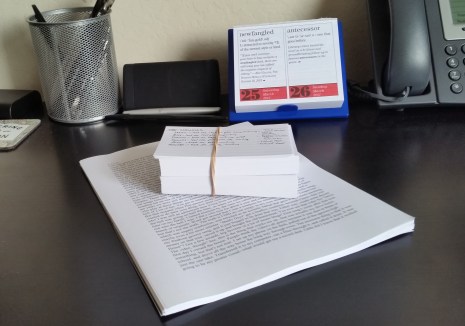
20160925_171357a
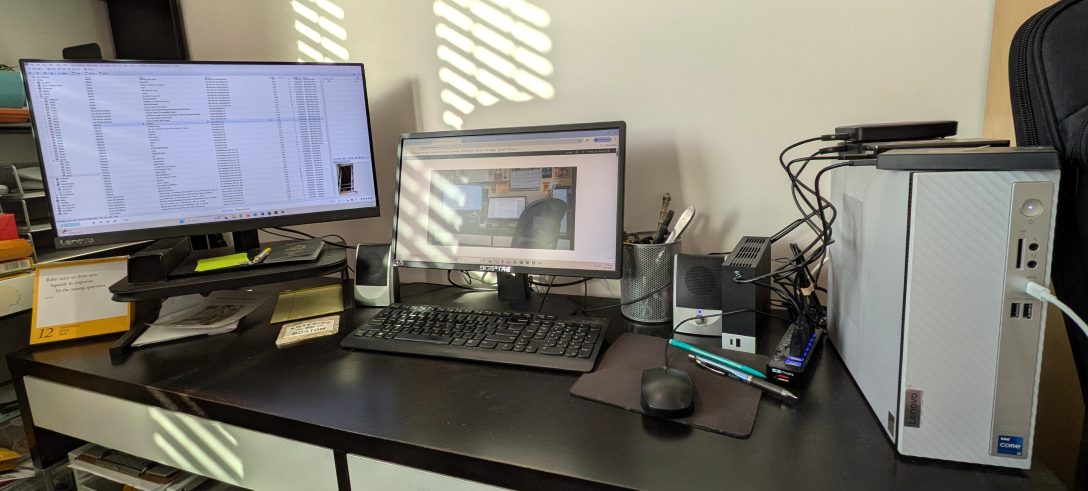
Just another day in Spare Oom.

These past few days have been uncharacteristically warm here in San Francisco.  On Sunday it hit 88° F, which is far higher than we here in the Richmond District are used to on any given day, even in the height of summer.

These are the days when I’m just as happy hiding in the cool of our apartment, working on whatever writing project I happen to be dealing with.  Back in my Belfry days, I’d hang out down there because my family’s basement was the coolest part of the house, considering it never got any sun except at the end of the day.  I loved hanging out down there during the summer, listening to tunes and writing away.

Warm days at Arkham West (aka our first apartment in North Beach) were another problem entirely.  Due to our bay windows we’d be getting sunlight all day long and it would get quite toasty if we didn’t close the blinds.  I’d make do with writing on the PC, but some days I’d move to the couch and write there.

Here in Spare Oom, though?  Perfect weather.  The one window faces north so we don’t get direct sun at all, just the breeze off the ocean.  And we’ll sometimes get some absolutely gorgeous sunsets as well.  It never gets hot or muggy in this room.  Sure, it’ll get cold in the winter, but not enough to drive me from getting work done.

I’m usually not one for writing sessions outside of the home, though.  I just feel kind of weird taking up space in a café or a bookstore for hours on end.  It’s not about other people watching me write…it’s more that I’d feel like I’m hogging a seat that one or more people could possibly use instead during the time I’m there.  [That, and I’m usually there for other things, like buying coffee or books.  I don’t feel as bad if I’m sitting somewhere going over the book pile and debating which ones I’ll buy.]

Still, I make sure I get out and enjoy the air now and again.  A. and I try to make a point of going out for a walk on the weekend, even if it’s up to the brewpub at the other end of Clement Street.  We’ll take a walk in Golden Gate Park or the Presidio, both a short walk from our apartment.  We’ll head over to the gym and work out for a bit (during which I’ll be listening to my mp3 player and working out plots in my head while on the treadmill).  We’ll head somewhere for brunch or a late lunch on the weekends as well.

As much as I’d like to be one of those writers hanging out in their workspace for hours on end, writing thousands of words and working on everything under the sun, I do need to exit the house now and again.  Just to remember there’s a world out there.

So that said, we did manage to get outside and walk a bit before the heat and humidity got the better of us and we went back into hiding in the apartment to watch football.  To prove this, I took a panoramic shot from our nearby vista point, Land’s End Trail.  It was so clear we could just about make out Point Reyes in the far distance (it’s around 50 miles north of us, and just about barely visible in the far left horizon in this picture).

20160925_123433-2
View from the Eagles Point lookout on Land’s End Trail.  I love that this is in our neighborhood.

Perseverance

anime-tired

It’s been a hell of a week.

Day Job system crashes.  Unending emails to work through.  Client fires to put out.  A drive across the Bay for an office visit.  I missed a few writing days.  I’m late in getting this post out.  I’m just about done, and it’s not even noon on Friday yet.

BUT.

I gotta do it.  No way around it.

I gotta write.  I can take a rest day every now and again, but I gotta pick it up again when I’m ready.

Perseverance.  A stubborn will to hit my deadlines.

Even if this post is a half-assed one with yet another anime picture as the header.  Heh.

Still.

Gotta get my work done.

Despite all the roadblocks.  Despite the raving case of the Don’t Wannas.  Despite really needing a beer right now because the Day Job’s been that much of a pain in the ass.

I gotta write.

Because no one else will do it for me.

It’s not a race

kakashi-guy-2

One thing I always need to remind myself is that I’m not in a race with other writers to get my work out.  Sure, I had that feeling way back in the day, back when I as naive enough to think that my manuscripts were good enough to warrant attention.  I thought the turnaround was super-quick, that I’d have my byline and my comp copies in my palms within a few weeks.  [Reality hit me pretty quick and hard, then.]  And I still get that twitch of envy when I see writers I know personally or online, releasing new works while I’m still languishing.

Every writer gets that feeling.  You want to be in the same race as everyone else, wanting to keep up and be One of the Gang.  But everyone in that gang is already miles ahead of you, already known to readers, physical copies of books in hand, doing the signings and the readings at the conventions and book stores.  It’s enough to make you wonder if you’ll ever catch up.

kakashi-guy-1

Well, here’s the thing:  it’s not a race.  Not unless you want it to be.  You might give yourself a hard deadline like I did, to get that book out and away by a specific date, to have that physical copy in your hand  (even if it is a galley or an ARC).  But you’re not racing the other writers.  Far from it.

They’re running just as hard as you are, tripping up at the same points you are, maybe even making it up as they go along like you are.  Their race is not about who gets there first across the finish line, or who gets there the fastest.  Their race is about finishing the race.  To them — and indeed, should be to you as well — this race is a marathon.  Running those twenty-six-point-two miles of hard work, revisions, edits, re-edits, re-revisions, meetings, sales plans, working on other projects in the interim, and aiming for that final goal of completion.

kakashi-guy-3

In the end, the only race in writing and publishing that a writer should be concerned with is a deadline.  I had to remind myself of this for quite a long time, and once I finally got over that, I no longer felt frustrated that I was getting left behind, or annoyed that I was taking far too long to get my own work done.

One of the best ways I learned that is to take part in the writing community.  I’m still a solitary writer that hasn’t joined a local writer’s group (and I kind of feel more comfortable that way — that avenue is completely up to you whether you want to follow it or not)…but I talk with other writers online all the time, I’ve met up and become friends with writers both beginner and pro.  Once I came to the conclusion that we’re all in the same boat, that we’re all slightly frazzled and overworked but still loving what we’re doing, none of us are truly left behind.  A lot of us support each other at all levels, because we know just how hard the job can get.

kakashi-guy-4

We’re all running, but we’re all running together.


[Images courtesy of Naruto, of course!]

Point of No Return

While doing the Big Edits and the galley edits of my trilogy, I noticed that with each book, I set the main plot’s Point of No Return in the exact middle of the story.  Not that it’s necessarily where the one Act ends and another starts; it’s merely a concrete point in the story where enough has happened and the only way out is forward.  It’s the point where one or many of the characters face the No Turning Back Now part of their arc.

I don’t even try to do it consciously.  I’m aware that it’s one spike of many in the story arc, just like they all are, but I don’t always plan it to be the most important one.  Most of the time, it just ends up that way.

The climax of the story is near the end where it should be, of course…but this isn’t the climax I’m talking about.  It’s the point where the characters may pause and finally get their bearings and finally truly see just how deeply they’ve embedded themselves.  [Out of amusement, I’ve sometimes called it the “oh shit we really are screwed aren’t we” moment.]

And this moment can happen at any time, really.  And it can happen numerous times within the span of a book or a series.  But there’s usually one true Point of No Return moment.  And somehow I’ve figured out where to put it exactly in the middle of my stories!


Long Long Long

I’m going to state right here and now — I have absolutely no problem with doorstop-length novels, if they’re written well and keep my interest.  I know they’re not for everyone.  Back in the 70s and 80s, doorstoppers were all over the place (I’m looking at you, Robert Jordan and Stephen King), topping over 200,000 words or so.  But by the 90s, books got thinner and more compact — leading to more space on the store shelves for more titles.

Some say this was the publishers’ plan, asking for writers to produce shorter books so they could sell more varying titles.  Others say that it was a change in reader taste, that the doorstopper is passé these days and readers prefer their word count to hover around 120k at the most.  I’m not sure who’s right, but either way, it’s become tough to submit those things to the Big Pros nowadays.  Unless you’re GRRM or Alan Moore.

But now that books are available digitally in a format that takes only a sliver of memory from your reader, the space for All The Books has expanded significantly.  You can fit a surprising number of long tomes on a regular-sized reader, and some e-book providers will even let you store them on a cloud so you can create even more room on your reader.

But what does that mean about long books?  Does this free the writer up to work on their long dreamed-of epic tale they’ve always wanted to write?  Of course, at this time the only real avenue for that is probably the indie/self-pub route, but the question remains: does this mean the restriction for writing long books has loosened?  Does this give the writer more breathing room to experiment?

And the big question: will readers’ tastes for long books change once more?


I Write the Songs

I don’t think I’ve written more than a dozen or so songs since I moved out here to San Francisco in 2005.  Probably much less than that.  A few clips of melody, maybe a riff or two, but nothing concrete, not like my last songwriting wave in the early 00s when I was jamming with Bruce and Eric in jeb!.  The latest actual song milling about in my head is an instrumental I created using the sound of London’s District Line clacking down the tracks near Earls Court as percussion (which I recorded to my phone); I have not yet had time to lay it down as a demo, though I did get as far as making a very rough loop of the train as a trial run.

Why do I bring this up?  Well, it seems my next writing project involves songwriting.

What’s this, you say?  Has Jon gone off the deep end in a severely misguided attempt to write a multimedia book?  I mean, he’s a pretty decent writer and makes cool covers, but music?  What the hell is he thinking?

Well, I blame Wesley Stace for this.  Formerly known as John Wesley Harding for you 90s alternative rock people, he wrote a fun novel called Wonderkid about a quirky band that, against all odds, became a huge hit in the 90s, primarily due to having an extremely large preteen audience.  It’s a hell of a fun book and worth checking out.

Sometime later, I was chatting online with a friend about the Osmonds (I forget the context), when I came up with an idea of writing a music-based novel myself.  Thus the family band The Lidwells were born!

That said…

Now that I’m at the point of wanting to do some prep for the Lidwells project, I’m not just thinking about making character sheets and a working discography (yes, I’m going that deep), but may be writing a few of the songs mentioned in the text.  All told I’m hoping to write about a dozen or so songs during the course of writing this book.

Added to that, this story takes place in the 90s during the alt.rock boom, so I’m going to have to write music that sounds like it would have fit then.  Will I record them as demos and post them here?  Yeah, there’s a good chance of that happening.

This should be interesting…

STFU

not writing

I came up with a mantra in the spring of 1995 when I realized that if I was going to get any serious writing done, I was going to have to stop making excuses not to.  Or more to the point, I was going to have to stop procrastinating.  I had a lot on my mind that summer…a stagnating long-distance relationship; lots of overdue bills; a really horrible diet of cereal, ice cream, concession stand food, soda, and smokes; jobs that weren’t paying enough for me to actually live on.  It’s quite true that life stress is not conducive to the creative mind. At. All.

But I had the use of my girlfriend’s PC that summer, and a hell of a lot of time on my hands when I wasn’t at my theater job.  I had a few projects milling about in the back of my head.  And I had my radio and my music collection to keep me entertained.  All I needed to do was get myself into the groove somehow.  If I was going to finally jumpstart this writing gig with any seriousness, I was going to have to go all in.  I couldn’t do it half-assed.

Which meant that I had to come up with a daily reminder.  And this reminder was written on two index cards in very large letters — one was posted right above my desk, and the other was next to my bed.  That way I’d see them every single day, whether I wanted to or not.

This is what they said:

Just DO it.  Shut the f*** up and START WRITING ALREADY.

Terse?  Maybe.  But it did the trick.  The only reason for not writing at that time was so I could feel sorry for myself and my pathetic social life and post-college career.  I hated feeling that way, and I hated that I knew I was wasting time feeling that way.  I had to break the cycle somehow.

Even if that meant working on the small, inconsequential stuff like transcribing my writing from the past ten years.  Even if that meant making small notes on scrap pieces of paper while at my job.  The main aim here was to create a daily habit out of it.  I’d worry about results at a later time.  As long as I was doing it and not wishing I was.

*

I’ll be honest, that’s still my writing mantra, twenty-one years later in 2016.  It’s for different reasons, of course.  I say that to myself when I’m having a mean case of the Don’t Wannas, or severely distracting myself online, or whatever.  I still have my moments of self-doubt (what writer doesn’t?) and wonder if the current project I’m on is worth finishing.

Procrastination and self-doubt are still two of my bitterest enemies, and the only way I know how to defeat them is via the same mantra:  just shut the f*** up and DO it.

And you know what?  It still works.

Names

I’ve heard all kinds of advice about names in fiction.  Some say you should really think it over before you chose a character’s name; others just suggest that you make the name believable and pronounceable.  I think most of us have grown out of needing a Dickensian hit-you-over-the-head name like jilted sweetheart Rosa Bud from The Mystery of Edwin Drood, of course.

What makes a good character name, though?

I’ll admit that I don’t think too much about it.  Just enough to make sure the name fits the character I have in mind.  I go with the sound of the name and the mood of the character.  Alec Poe’s name came to me when I wanted someone whose family was part of the collegiate crowd, and yet doesn’t quite fit his personality due to him being adopted.  Caren Johnson’s name was chosen because I wanted her to have a simple name despite her very important fate, to the point that I spelled her name with a C instead of an K.

Back when I was first trying out this whole writing gig, I didn’t even go that far; I just picked names of people I knew.  I knew three Scotts in junior high and used that as the Infamous War Novel’s central character.  I knew a few Stephens in high school and used that for Belief in Fate.   [‘Stephen’ became my go-to placeholder name for a lot of my stories at the time, especially around 1986 when I found it was Morrissey’s first name.]  Come to think of it, I knew absolutely no Simons, and that was probably my first not-based-on-anyone character, again in BiF.  I used Simon again with my anti-me Murph character (his full name is Simon Murphy — yes, it is in fact the same character who gets a cameo in The Persistence of Memories!), getting ‘Murph’ from the nickname of one of my managers at the college library.

It really wasn’t until 1993 when I started writing science fiction that I actually started focusing on choosing the right name, going just a slight bit further than just ‘because it sounds good’.  The characters in the original Vigil story were newer and better names for older IWN characters.  Most of the names in True Faith were chosen for a specific reason: there’s a family whose full names are all two syllables and the first name has double vowels; another family’s first names were only a single syllable and contained either O’s or A’s.

That’s when I realized that naming conventions could be used as a way to describe a family’s culture.  I could have a bit of fun with them by briefly telling the reader about the character’s background without actually having to do an infodump.  [There is a reason why the Shalei name is so prevalent in the trilogy: it’s an extremely common Meraladian clan name like the Vietnamese ‘Nguyen’ or the English ‘Smith’.  It’s meant to show that they are the largest Meraladian clan in this story’s world, even if they aren’t all closely related.]

Since then I’ve stayed with my own naming conventions, especially with the new projects.  There are a few characters named after the person or character that inspired them, and there are a few whose name fit their background.  I still don’t linger all that long on finding the best one, just one that rings true to who they are and what they’re about.  I’ve expanded over the years to include more names from different countries and cultures as well.

Do I have a list of names I’d like to use?  Sure I do!  It’s in my head, of course…one of those ‘I should use that somewhere’ lists that come up whenever I’m reading or watching something.  I own a few baby name books and name-meaning books as well.  I don’t think I’ve ever used a name specifically because it means anything, though.  More that I’ll use it backwards; a character I’ve already named might have some secondary or minor traits that fit in with said meaning, just to expand on their background.  Either way, it’s a necessary part of the writing process, and I’ve come to have fun with it.


And now I’ve gotten to the point where I’ve used the word ‘name’ so many times in this post it sounds like a silly sound effect in my head. :p

Spare Oom Unplugged (again)

gravity falls
courtesy of Gravity Falls

Yes, I’d have to say it was definitely a good idea to work longhand with this edit.  The evenings where I’m focusing solely on this project is when I take the binder to the loveseat across the room and settle in.  I’m not chained to the desk, but I can still have the tunage going while I work.

Which brings me to the subject of unplugging again.  It seems every six to eight months I need to unplug from the internet and do some IRL things.  Or more to the point, needing to remind myself to unplug from the internet and do some IRL things.

What this usually means is that, even though I kvetch about it from time to time here at WtBt, I don’t always follow through.  Sometimes I’ll just have a long day at work and want to goof off online and watch cat-drifting gifs all night.  Or I’ll consistently distract myself with the Twitter feed.  Sure, I’ll catch myself and shut down the browser right there and then and do something more productive with my time.

It’s not like I haven’t eased up on the distractions over the last year.  I’m not as passive about them as I used to be.  In fact I’ve become quite tight with my latest writing schedule of practice words, blog entries and exercises, balancing them quite nicely with the Day Job and the regular writing work.

This time out, however, I’m thinking about actively unplugging for a bit.  I mean, doing some serious longhand work, for various reasons:

–Obvious:  Less chance of distraction.
–Health:  Reasons for me to start moving around and getting out of the chair more often.  Also, considering my Day Job is to look at a laptop all day, and following it up by looking at a PC later that evening, I really should give my eyes a break more often.
–Personal:  Sitting with A. instead of hiding away in the back room all day and night.
–Mental:  Focusing solely on the task at hand because, well, it would be the only thing I have at hand.  Also, I have something a little more tangible to work with, rather than having to remember where I was in the document, especially if I’m flipping back and forth.
–Physical:  Handwriting tends to be less straining on my wrists than typing, even with my new PC and its wireless keyboard and mouse.
–And let’s be honest here: when I write new projects longhand, I need to be able to write on the fly.  The habit of editing on the PC is far too ingrained right now, thanks to the Epic Trilogy Editing Seasons.  Once the trilogy project is done, I can reassess.

But yes…it’s one thing to say “I’m thinking of doing [X] to make my work better” or “I’m going to close the browsers now so I can work”, but it’s another to make good on those statements.  And unplugging does seem to be the only way to do this cleanly and efficiently.

Does that mean all my blogs are going on hiatus?  Nope, not this time around.  Those will still be around, as long as I have something to say.  I don’t have to unplug for mental reasons this time.

I just want to be a better writer is all. 🙂

Cooler heads

west side story cool

Cooler heads have presided, and the edit of The Balance of Light has been reeled back in.  I’m keeping it a single book. It won’t be the sprawling epic that my Writer Brain threatened earlier this week.  Heh.

Printing out the manuscript seems to have worked wonders, as I figured it would.  Having done a galley edit with a test copy of A Division of Souls (which helped me find a lot more issues I’d missed), doing the same for Book 3 seems to be working out just fine.

Which reminds me — remember that first chapter I deleted a month or so ago?  Yeah, it’s back in again.  Why, you ask?   Well, again, cooler heads.  I realized that starting the story on the original Chapter 2 was an even WORSE idea.

So…what does that mean?  I need to delete at least 50k words somewhere in this behemoth.  Where the hell is that going to take place?  Well, that’s a good question.  This is another reason for the printing out of the ms…so I can give it another reread and find those soft squidgy spots that can be cut out.  Scenes I can merge or leave out.

This is still going to go far past my original deadline, but again — I’m okay with that.  As long as I’m going in the right direction, that’s all that matters.