Oof! Between the end of Q4 sneaking up on me at the Day Job, and giving myself some insane writing deadlines over the next few months, I don’t have too much time to spare for any blog posts of quality. And I’d rather not post something half-assed here (I mean, aside from the occasional silly fly-by post like this one to let you know I’m still here and functioning) if I can help it. Sorry about that.
Thanks for your patience, I hope to be a little more on track soon! 🙂
One of my biggest worries when it comes to the Mendaihu Universe novels, to be honest, is that it would be taken as a ‘religious’ novel, or that it would be mistaken for a soapbox for my own ideas on spirituality. Granted, the novels have a heavy amount of spirituality, belief and faith involved in the world building, so it might happen yet.
Thankfully my worries have been misplaced so far.
The whole idea of using spirituality in the MU is not to preach or to proselytize, but to imagine a reality in which a belief system, its tenets, miracles, and everything else is not only real, but a natural part of society. Like the use of spiritual chakra energy as a source of power and strength in anime like Dragonball Z or Naruto, the enlightened people of the MU use their spirit energy for many useful things: innerspeak (clairaudience), physical sensing (clairsentience), reality seeing (claircognizance), and so on. More to the point, these abilities are part and parcel of Meraladian life — innerspeak is the ‘silent half’ of the Anjshé language, where the intent is projected psychically while the words are spoken, for instance. All these abilities are from ‘within’ — that is, their souls. It’s a part of their life organically as well as spiritually.
That’s not to say that I’m ignoring zealotry and bigotry, of course. There are characters from ADoS forward who use cultural bigotry, even if their reasoning for it is an innocent (to them) ‘you wouldn’t understand’. The new as-yet-unnamed MU novel reveals a new generation of believers of the One of All Sacred who think of themselves as a special enlightened class personally chosen by their deity — something Denni Johnson would have been horrified to see. There are those who are committed to their version of their belief, regardless as to whether it conforms to reality.
I will admit that the terrorism that we’ve witnessed in the past twenty years or so (including the past few days) has been a bit of an influence in this universe as well. The Mendaihu and Shenaihu both contain extremists in their ranks (the kiralla and the nuhm’ndah, respectively), and both have their physical embodiments of such extremism. But as with everything in this universe, nothing is ever black and white, good and evil, and the MU is no different. There are gray areas, where the best of intentions lead to bad conclusions, and vice versa. This is precisely why the Bridgetown Trilogy is not about good triumphing over evil, but about doing the right thing, despite overwhelming outside influence. And this is also why I chose to paint both sides as fallible. Both sides have had blood on their hands at some point in their histories. Neither is without sin.
I’ll also admit I’ve been thinking about this since Friday, after the events that took place in Paris. Understandably I was shocked by the terrorism that unfolded, but I was also equally as shocked by the white noise that followed in social media — the blaming of an entire religion (or all religion, for that matter), the puerile political taunting, the ‘how can you feel bad when [x] is happening elsewhere’ shaming, and the reactive surface emotions of revenge and vilification. That white noise, thankfully, has receded somewhat over the weekend. As they say, cooler heads prevail. I also saw a beautiful outpouring of compassion and love coming from the same channels, and those are the voices that have remained as the others have begun to die away.
And this, by far, was the hardest part of writing the Bridgetown Trilogy: trying to make the events of the novels a global spiritual and religious event, and not something that only the main characters are feeling. I felt that it needed much more than just the population reacting like they were in a Michael Bay film, running away from explosions in glorious slo-mo. I wanted a more realistic reaction: This is really happening. I’m angry/sad/terrified, but I’m not helpless. I will either stay and fight (accept the personal awakening) or take flight and protect those I love (refuse a personal awakening). The trick was to passively show these nameless background people reacting, even if it was in just a sentence or two. The reader sees this three times in the first few chapters of ADoS: via clairaudience when Nehalé performs the Awakening ritual and senses everyone’s reaction; offscreen, with Nick and Sheila mentioning the number of witnesses they’ve spoken with just after the ritual; and onscreen, when Poe passes a car on the highway on the way to the Crest and notices how eager its occupants are to get out of town. I pepper these throughout the three books; just a mention or two to remind the reader that the rest of the world is out there, and they’ve been affected as well.
As a writer of fiction, I’m not going to claim my way is the best way to see reality, nor am I trying to push a message. I’m merely telling a story and unfolding it the best and truest way I know how. I can only hope that what the reader gets out of it is entertainment, and maybe something to think about as well.
The problem with going through a major editing/revision/release process is that it eats up quite a lot of time I set aside for my writing. It leaves precious little time for any new work unless I sneak some time in during the day. [Which I’m doing right now…this post is being written in the slow moments of my Day Job.]
This makes me twitchy. I want to write something new, but deadlines loom. I don’t mind the editing/revising part of the job, but the longer it takes, the more I have that itch to pick up a notebook and start working on a new project. Not out of avoiding the revision process, but that I start feeling rusty. I feel the need to write new words somewhere, anywhere. My personal journal entries (which I write during my midmorning break) are getting more verbose, and I’ve been blogging like a fiend lately. My brain is clogged with Future Plans for When I’m Caught Up. I’ve got ideas for the Inktober art meme. I have a few stories simmering and a new MU story in stasis.
I believe it’s time for me to get creative with my writing time again.
I think it’s time I readjusted my attitude about my day-to-day. It needs it.
I know many writers who write part-time — that is, they balance their writing time with their current day job and/or parenting duties. It can be a frustrating attempt at balance, especially when your Day Job Brain functions much differently from your Writing Brain. I play with numbers and emails all day, and I’m extremely well versed in business-speak. That job entails a lot of logical, linear thinking. Nine times out of ten, point A and point B should lead to point C. [That tenth time is the exception setup, what I often refer to as “it goes like this…except when it doesn’t.”] It’s not exactly a tough job — okay, it is in its own way, but I’ve been at it for seven-plus years and I’ve gotten used to it. I don’t let it stress me out all that much anymore.
My writing, on the other hand, includes a lot of nonlinear plotting, multiple points of view (not just in narration but in character personality), and a lot of leaps of faith, in hopes that it’ll all make sense at the end. It’s the dreamland I always look forward to, where I can play with words and images, make up fantastical things, and tell fun stories.
Just as logical, but completely different frames of mind. I’ve been doing both for so long I can easily switch between the two when need be.
Cary Grant from His Girl Friday
Lately I’ve been in a rut, however. By the time 4pm rolls around and I log off, I just want the day to be done already.
Okay, maybe the situation’s not quite that dire…but after eight hours of the Day Job, sometimes the last thing I want to do is work on something else. I want to be lazy and goof off! I don’t even want to go out at night…I just want to sit around and whittle the time away. Thankfully my ingrained guilt receptors kick in soon enough and I get to slog away for a few more hours doing whatever it is I need to do creatively.
How did I get this way? And don’t tell me “you’re getting old.” I may have just recently turned 44, but I’ll be damned if age is going to be an excuse for being a lazy bum.
I started thinking…what was it that got me excited about writing previously, anyway? Or excited about going out to do something?
As always, I thought back to a time where I was truly excited about my writing time. I thought about my Yankee Candle days — I had a half-hour commute each way, I moved hundreds of boxes all day long, and yet I still managed to make a weekly habit out of doing a comic book and new cd run in Amherst. I was also able to spend two solid hours writing at least a thousand words every night. My personal best in terms of word count that I’ve been trying to reach for ever since.* Or my days at HMV, where I’d drive 50 miles to the mall I work at, slog through the day, drive 50 miles back home (or the 70 miles to Amherst for the occasional comic book run, then an additional 30 back home!)…but still balance that with the hour before work writing longhand, and the hour or so at home, transcribing to the computer.
Point being: I know I can do it. There’s no doubt about that.
So why am I complaining that I can’t, or don’t want to? It’s not as if I’m particularly exhausted, mentally or physically, or can’t stand the project I’m currently working on.
I mean, I’ll be heading over to Amoeba over on Haight tonight to see The Church, one of my favorite bands, play an in-store show. The store is only a few miles away, and I’ll probably be home before 8pm anyway. And yet, why do I feel lazy enough to want to come up with an excuse for not going? I mean, come on. It’s the freakin’ CHURCH, for pete’s sake! They only sing my favorite song ever! Why the hell am I feeling so damned lazy??
Finally it dawned on me, just today: I was looking at this current schedule from the wrong angle.
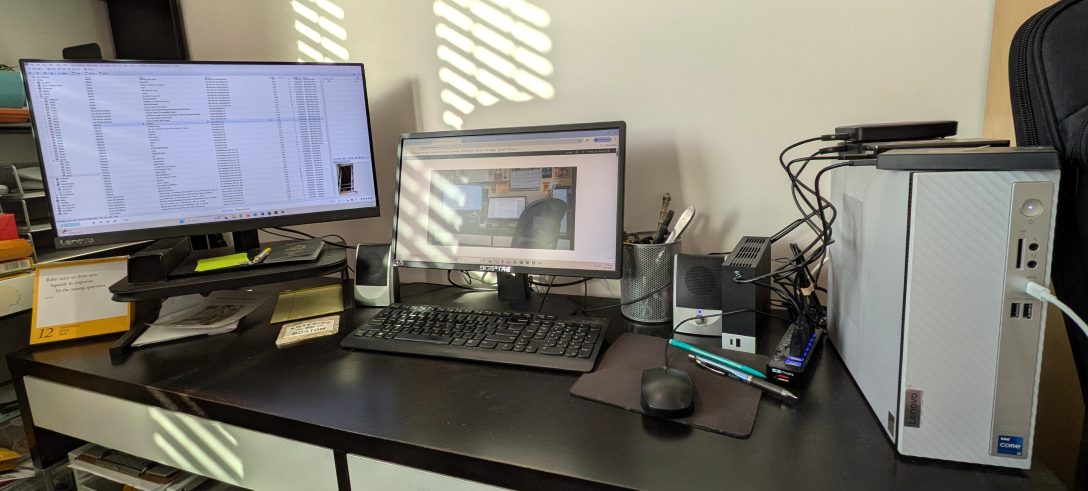
I work at home, so it’s not as if I have to deal with a commute; I wake up at 6am, have breakfast, read some webcomics and catch up on the Twitter feed, and log on at 7:30. I take two fifteen minute breaks and a half hour lunch. I log off at 4pm and we head over to the YMCA soon after to get our exercise. Dinner is usually around 5:30-ish and I’m writing by 6:30pm, all the way to about 8pm. I get my daily words and my project words done at that time…and if the work day is particularly slow, I sneak in some personal writing, such as this particular blog entry. The day’s packed to a reasonable degree, but I’m not draining myself in the process.
All the same, I’ve been suffering from a terrible case of the Don’t Wanna’s.
And that’s the issue right there! It’s not the schedule or the work/writing balance that needs fixing: it’s my attitude.
So I submit this: let’s return to my YC-era work mindset — my day job is my paycheck, but my writing is my career. But don’t forget to have fun as well.
I’ll still dedicate the same time and brain power to the day job, of course. But let’s also look forward to logging off at the end of the day.
Let’s remind ourselves throughout the work day that, once I’m off the clock, it’s time to go and have some fun! Let’s look forward to walking around the neighborhood after work. Let’s look forward to playing in that imagined world for a few hours. Let’s look forward to having fun with what I love doing the most.
It’s not about trying to do everything at once. It’s simply a change of attitude. Look forward to life. Look forward to that bit of entertainment. Look forward to that writing time at the end of the day, because you know and I know it’s a hell of a lot of fun, even when it does get frustrating.
Chances are, the payoff will be worth it.
Matthew Broderick in Ferris Bueller’s Day Off
* Mind you, I’m not trying to force a thousand words on a nightly basis, because it depends on the project. I’m working on Walk in Silence but not logging any new words because most of the work has been what I call ‘framing’ the flow of the book. My sort-of daily 750 Words have been consistently over 750 and flowing quickly, so I can safely say I’m counting the words where they really do count.