The upside is that I’ve already gotten a good couple thousand words in on Meet the Lidwells! Most of the text is coming straight from the very rough draft I wrote a few years back, of course, but it’s going in the right direction.
The downside is that I can already see where I’m going wrong. Thankfully I know exactly what it is that’s wrong, and how to fix it.
I’ll be honest — the beginnings of my novels are always a mess. I spend the first couple of chapters knowing what I want to write, but I haven’t quite grasped how I want it to play out. The prose is all over the place as I try out all kinds of different styles on the fly. I’ll plant the seeds of one or two minor plot points that may or may not survive the end result. I may even get a few of the details mixed up.
But hey, that’s what revision and editing is for, right? Once I do figure it all out (which is usually around two or three chapters in), then I have a solid platform for the rest of the novel, and I can clean everything up in those two or three sketchy first scenes. A Division of Souls had at least three wildly different openings before I put all the pieces together and figured out which one works the best. I had a hell of a time trying to figure out how to start The Balance of Light the way I wanted it. Lidwells is no different; once I get into the groove, I’ll be able to build a more solid opening.
Do I wish I could write a perfect opening? Nah. Doing it the way I do is actually part of the fun! It helps me connect with the story on an emotional level; once I’ve done that, then I can reshape the opening to fit that mood. I don’t see it as wasting time and words; I see it as part of the whole exercise. As long as I’m going in the right direction…that’s all that really matters.
I was talking with A. earlier tonight about how often we see characters on American TV shows that don’t seem to evolve all that much. Or if they do, it’s often on an external level instead of an internal one. What I mean by that is that there are some characters who aren’t so much evolving as they’re reacting. A lot of 80s shows fell prey to this, and in the process, when they did evolve for any reason, it was usually forced. A character changed personality due to a death, or a lover leaving them; or on the positive side, they changed because they ‘saw the light’. Sure, I’m super-generalizing here, but you get the point. [And if they didn’t evolve, the show was usually a Perils-of-Pauline drama of the week.]
This has changed a bit over the years, and American TV has had characters evolve on different levels. Spiritually, emotionally, and so on…they were changing and not just because of that episode’s actions.
We noticed this primarily because we don’t watch much network TV at all, preferring to watch British imports on Acorn or Netflix. And I’ve read quite a few non-American novels over the years where character evolution is handled differently. I sometimes think of animes like Ergo Proxy, where the female lead evolves from a stellar but snooty investigator (she’s the daughter of an extremely high-ranking leader and often thinks She’s All That) to a more empathetic hero who realizes her actions affect others. Or AKIRA, where Tetsuo and Kaneda, both violent biker teens with death wishes, evolve to the point where they both achieve their own versions of spiritual enlightenment.
These are the kinds of characters that usually inspire me when I create my own. I try to give them not just a background and a list of actions they must take, but a way for them to evolve somehow. Alec Poe is a good example of this: aloof, somewhat distant and often terse at the start of A Division of Souls to fiercely dedicated and understanding by the end of The Balance of Light. His evolution is not just jumpstarted by the Awakening Ritual in the first book; it’s challenged numerous times throughout from those nearest to him, including friends, coworkers, and family.
It’s one of my favorite things to do when writing novels, to tell the truth. This is a story that’s not part of the main plot, but it’s to be told anyway, through action and emotion. It shows that the character isn’t just reacting to what’s going on, it’s affecting them to the point that they’re consciously aware they need to change in order to move forward. It gives the novel a richer, more realistic life in the process.
Sure, I’ll gladly admit that I’m a procrastinating writer. We all are to some extent. I’m typing this out right now on Sunday evening when I really should be working on Chapter Seven (of forty-four) of the galley edit of The Balance of Light. I should have typed this out earlier instead of cleaning out my email box (which, to be honest, was backed up due to “I’ll look at it later” procrastination).
I’ve always been horrible at things like that. I was always handing in homework and term papers late, or being on time but handing in my less-than-stellar attempt. I was always distracted by music listening or futzing around with my personal creative projects that were always so much more interesting to me. In retrospect I was definitely one of those kids who probably would have benefited from learning from Real Life rather than school.
So why now? Why am I still procrastinating? Well, again — it happens to the best of us. The latest Twitter news and arguments, the unnatural lure of cat gifs, that new episode of that show everyone talks about. For me, I have a terrible habit of saying “I’ll get to it momentarily, I just have to finish doing this first.” Whatever this happens to be, it’s probably not as important as trying to reach a self-assigned publication deadline or wanting to remain loyal to a self-assigned blogging schedule. Amanda calls me on it all the time.
Granted, I’m not nearly as bad as I used to be. Back in my Belfry days, even when I had all the time in the afternoon to goof off (and often did), my writing session schedule would start promptly at 7pm and roll until 9pm. Unfortunately, a good half hour would be wasted doing two things: deciding which music I wanted to listen to that evening, and playing a few games of FreeCell. “Just to get in the mood,” I’d say to myself. Thankfully I grew out of that. Now I’m just goofing off on Twitter! Heh.
Thing is, though: I know that I’m procrastinating. And I’m aware of what I’m doing to add to it. Which means that the only thing I really need to do to combat it? STOP DOING IT ALREADY, JEEZ. Sure, easier said than done sometimes, but it can be done.
And now I’ve got Monday’s blog entry good to go.
GOOD FOR YOU, SELF. NOW GO SCHEDULE IT, CLOSE THE DAMN BROWSERS AND GET TO EDITING ALREADY, YOU GOOBER.
This number’s going out to American Telephone & Telegraph.
So for most of Friday, I was without the internet due to incompetence and aggressive sales bullshit via AT&T. [I’m just gonna come out and say that I’ve had little to no problems with them since 2005, but this past week I’ve gotten what has to be the worst customer service I’ve ever had in my life. We are planning to leave them as soon as it is technically possible.]
I won’t go into too much detail, but I will say that I know exactly what went wrong. Several things, actually, including:
–Lack of smooth transition. One would think that going from DSL to fiber optic lines would consist of making sure the wiring was correct, and that your customer has the needed hardware (in this case, the router) before the transition takes place, yes? In this case, the internet was turned off on Monday morning at 7:30am PT sharp, and the router was not to arrive until late Tuesday afternoon via UPS 2nd Day.
–Call centers with the minimal amount of training possible. I feel for you, call center people. I do. I worked in the same position for a year when I moved out here to San Francisco, and it SUCKED. Not only are you trained minimally, you’re trained to stick to a script (I have no idea how many times I’ve heard the same confirmation questions asked of me verbatim over the course of all those hours). And when you get a situation like mine, where the script is not going to work, you end up stuttering, trying to steer the conversation back to said script, and the customer will only get more pissed off.
–Interdepartmental conversation consisted of calls cold-transferred and work tickets not cancelled. After finally fixing the problem after six hours (and talking to far too many people and explaining my issue from the beginning at least twenty times), I got my DSL internet back.
Until Thursday night, when it was turned off again.
The original work ticket to turn off the DSL, which I’d asked them numerous times to be cancelled, was not, and I was without internet for sixteen hours this time.
–And instead of turning it back on this time, they aggressively stated that they could not do so because DSL was going away and I’d need to go to Uverse whether I wanted to or not. No emergency fix, no admittance of fucking up. The only reason we gave in is because by that time, we’d signed up for a new carrier (which should hopefully become a reality within the month), and that the both of us needed the internet so we could do our Day Jobs.
*
So. Why is this on a writing blog?
Because, dear reader, this is what happens when you force yourself to write passages that are doomed to failure and refuse to admit that the story is Just. Not. Working. The more you try to force a story to conform to flawed logic, the more it’s going to fail. It doesn’t matter if it’s the best prose you’ve ever written…if it sticks out like a flaming tire fire, the reader is sure to see it the same way. And you really don’t want that.
I’m guilty of doing this, I’m sure you are too.
But remember: that doesn’t mean that you’ve failed the entire project. You’ve just failed in one segment of a much larger plot you may be able to save. Sometimes you have to fail that one really incredibly frustrating, aggravating time…but that also means that you can now restart from a much safer, much stronger and stabler foundation, and that means that if you’ve learned your lesson and move in the right direction this time, you’re bound to come up with something that will make your story a hell of a lot better than it already is. Sometimes you need to take that one step back to make the two steps forward.
Lesson learned: Don’t give up completely. You did not fail. And if you can see all the places where you went wrong (just as I can see all the places where AT&T went wrong), then you’ll know exactly what to avoid when you start moving forward again.
Go ahead and get pissed off. Get it out of your system. But get back up on your feet, dust yourself off, and be that damned thorn in the story’s side until it works for you again.
I’ve been thinking about this a lot lately, especially with all the different news (both good and bad) being thrust at us willing readers over the past few weeks. It’s easy to get lost in the maelstrom, easy to get frustrated and scared and react the only ways we know how in such situations.
As a writer, I’ve tried to train myself to be a bit distant from it all. Not exactly indifferent, mind you. Just detached enough so I can keep a calm and open mind. Too much information and I get overwhelmed. Too close to the information and I let my emotions get the best of me. But at the same time…being aware of the multiple threads and knowing how to use them in a positive and/or creative way.
The same can be said with writing novels. There are quite a lot of moving parts, so it requires a lot of attention. This is not just about the detail, but how it all interweaves. Plot Point A causes Plot Point B to take place. Character 1 is affected by Plot Point B and has to take action, causing Plot Point C to unfold, which affects Character 2. And so on. However it works for you: index cards, Post-Its, spreadsheets, reams of paper, or your own brain.
Some writers only want to use the barest of detail. Just enough to tell the story. And that’s just fine; not every novel needs all that minutiae. At the same time, there still needs to be attention to detail by the writer. There has to be that continuity of not just the plot but the characters and the setting.
The downside is that writers can often fall into their own hole of that minutiae. Getting too lost in the maelstrom of the world building or the overly convoluted plot. Making every single scene, action or no, the Most Important Event Ever in the story. I’m guilty of all of these, of course. I’ve been known to obsess over sections of my work that really don’t need much detail at all. Sometimes my blog posts go the same way. Heh.
But anyway, my point is that the trick is to find the balance levels that work for you. Pay attention to what needs paying attention to, and remember that there’s rarely need for obsession. Use just enough to create a stable and navigable web where every point has a reason and a destination. And once you’re done?
Then pull back and view it as a whole. If you’ve done it right, you’ll have created that much larger piece of art you were aiming for.
Not gonna lie, when I first started working on this writing gig with some serious effort, I was just like every other n00b writer: I’m gonna shake up the literary world with my unconventional ideas! All my stories are going to be accepted by agents! They’re gonna love my stuff!
Of course, age, maturity, knowledge and perhaps a bit of bitter reality has thankfully made me think otherwise. I’m a writer just like anyone else, and the chances of my writing being a smashing success are just about the same as any other writer’s: a complete crap shoot. Luck, a bit of sales smarts and a decent story are the only constants in this job. The rest depends on getting the right agent or editor and whether or not they think they can do something with your work.
This popped into my head the other day, while thinking about the fact that I’m on the back end of an extremely long-term writing project. Lately I’ve been comparing how I viewed the Bridgetown Trilogy during its Phoenix Effect years, how I viewed it during the trilogy rewrite, and how I view it now that I’ve self-published two of the three books.
The pre-Belfry years (the True Faith era) was when I was the cockiest, that was for sure. I knew I wasn’t the best of writers, but that didn’t matter — I had an awesome story that I wanted to tell, and it was going to sell tons (once I finally finished it)! The Phoenix Effect era was a little more down to earth in terms of outlook; I knew I was far from professional, but I was doing all the required homework and revising it the best I knew how. It was that era when I wasn’t exactly sure where I stood in terms of heading towards being a professional writer. I was stuck in that phase for a long time.
Now I’m at the point where I’m looking at the trilogy and accepting where I may have gone wrong over the years. Doing major rewrites was one part of that; deciding to take control of the entire production was another. I don’t think the trilogy is a failure, far from it. No book is completely one hundred percent perfect. Are there things in the trilogy I think might still need fixing? Of course. All writers think that about their own books, and I’d be surprised if a writer didn’t feel that way about their precious projects once they’ve signed off on them.
There are many reasons why I’m self-releasing the trilogy, and that’s one of them: the ability to learn from my mistakes, fix them, and re-release the end result. Self-publishing is great for things like that, if you look past the ‘but it’s out in the world already so it’s ruined forever!’ irrational fears. Maybe I released the book too early; I can always sit on it for a few years, do an overhaul maybe five years from now, and re-release it. There will always be a new potential reader who’ll be willing to give it a chance.
One of the biggest things I’ve learned about the entire trilogy project is to accept that I should not strive for excellence in writing, but to do my best at it. Being professional doesn’t exactly mean ‘being famous’, it just means knowing what steps one needs to take to create a positive end result. Perseverance, knowledge, and maturity. And having a good solid goal (other than I’m want to be famous!, of course) does help significantly, whether it’s to be professionally published or to self-release.
I don’t need to be Phillip K Dick or William Gibson or Neil Gaiman or Ray Bradbury or whoever. I just need to be me, to the best of my ability.
I’ll admit, that’s not a question I often thought about when I first started writing, because the answer was most likely going to be: well, ME, of course. What a silly question!
I’ve tried in the past to write for a specific audience, and it never quite panned out the way I wanted it to. Love Like Blood was me trying to write to the urban fantasy crowd. Two Thousand was me trying to write for the litfic crowd. True Faith was me trying to write for the sf/virtual reality crowd of the mid 90s. All three projects have since been trunked, as I found them to be some of my worst work. Paved with good intentions, but let’s face it: I was pandering. I was trying to write for an easy buck.
Recently I’ve been thinking about who I’m writing for, and each time, I’ve come to the conclusion that I’m still writing for who I want to write for: just your regular blue-collar joe who likes to read. Yes, I’m still writing for me, but I’ve noticed the biggest response I get from readers is not always the avid science fiction/fantasy reader, but those I know who like to read a little (or a lot) of everything. Someone who might read the latest George RR Martin but follow it up with, say, a history of 60s counterculture. Or maybe not even that: someone who just likes reading what they like reading, and don’t necessarily fit into the definition of ‘avid fan’.
That’s not to say I find avid genre fans beneath my stature, far from it. I just know that I’m not a hard sf writer or a military sf writer or even a high fantasy writer. I just write what comes to mind, and I try to fill my created worlds with people and ideas that my readers will connect with.
The Mendaihu Universe might be chock full of spirituality, but I try not to write religious/spiritual fiction, which is its own genre. The characters in this universe of mine have the same issues as readers: frustration, fear, indecision, confusion, irritation. I put the characters into an everyday situation that just happens to have a supernatual/spiritual setting. And for the most part, I think I pull it off, because nearly all my readers so far have commented on that as a definite plus to the worldbuilding.
I’ve been thinking about this in part because I’ve been trying to figure out how to sell my trilogy now that two-thirds of it is already out there. It’s one thing to self-publish and release it, but it’s quite another to get it out there and advertise it. As much as I dislike sales, I do need to think about who my target audience would be. I know, I should probably think of this WHILE I’m writing the stories, but that can’t always happen. Again: if I write to order, I write horribly. I can only write what I know I can write.
But what about my other projects? The non-MU stories? Who am I writing for then? I probably won’t know until the project starts. I have some non-genre stories in mind that could easily be quirky litfic. I have some genre stories that would fit nicely in the urban fantasy mold.
For me, I guess the only way I’ll know is when I start writing the damned things!
I’m not entirely sure how the concept of balance popped up in my trilogy, it just sort of happened naturally.
I think it’s because, when I was writing The Phoenix Effect back in the late 90s, I’d become fascinated by yin-yang relationships in life, and especially how neither side is inherently heroic or villainous. Each side has good and bad qualities, perfections and impurities. It’s up to each individual to decide how they want to act (or react) to their surroundings, or to the other’s actions. Some go with the flow, some do what’s expected of them, some are rebellious and still others refuse to do anything at all.
Originally the trilogy was going to focus mostly on the Mendaihu, with the Shenaihu relegated to textbook villain. But the more I tried writing that, the more I felt it was horribly contrived. What if the Shenaihu were doing what they do for a legitimate reason? Maybe the Mendaihu aren’t all that perfect and awesome after all? And with Earth stuck in the middle of it all, how are they affected?
It’s not just the character balance I watch for when I write, though. I pay attention to the plot arc, and where the characters’ defining moments are placed.
A day or so ago while revising/editing The Persistence of Memories I hit the exact midway point. I was curious as to what that scene would be, as I’d subconsciously put a pivotal Denni scene at that point in A Division of Souls, a point where the book is no longer ‘starting up’ and is now in full acceleration mode. It seems that I did the same exact thing here as well: another main character’s pivotal scene that sets the tone for the rest of the book (and the trilogy). I’ve yet to see if I did that with The Balance of Light, but we shall see, once I start revising/editing that one.
That’s not to say the pivotal now-or-never scene needs to be smackdab in the middle of the book; this just sort of happened organically for me. Another character’s defining moment won’t show up until near the end of TBoL, with mere chapters to go until the end. The point here is balancing the character’s evolution. They start at one level and ascend (or descend) to another, somewhere within the timeline, because otherwise they’re boring.
Point being, by the end of the trilogy, everyone, even the most stubbornly static characters, have changed somehow. The trick as to when they change is in the pacing. Don’t just think about how you want the character to change, but how they’d act afterwards. A character’s evolution too soon might render them boring for the rest of the book; too late and it looks forced. Think about their timeline within the context of the entire book (or series): what would be the perfect time for them to change, and how would it affect the rest of the plot and the other characters?
Again, with the music parallel: where would the chorus of the song fit best? After the first verse? Just after the bridge? (Or like Journey’s “Don’t Stop Believin'”, waaaay over at the end of the song, after the guitar solo?) It’s completely up to you, the writer. As long as you do it right.
Make it pleasurable not only for you, but for the reader. Creating balance in your creation is a trick on the subconscious level; we feel pleased by a perfectly balanced shot in a film or painted image. We’re equally pleased by the slow build of an arc that finally explodes in glorious 3D at the perfect moment (again, think the “Don’t Stop Believin'” solo and chorus, or maybe even The Beatles’ “Hey Jude” when it finally hits the “na na na” coda).
The trick is to figure out where to best place it so you achieve the perfect balance.
The decision to pull out of a writing project is a strange one. It’s never a knee-jerk reaction. More often than not, it’s a laborious, emotional, drawn out process. All kinds of questions arise, whether it’s worth soldiering on or cutting losses. The feeling of frustration and irritation due to wasted time. And even the relief (and the guilt of feeling such, despite the decision) when the deadline is no longer hanging over the writer.
I say this now, as I seem to be on the fence on a current long-term project at this time (don’t worry, it’s not Mendaihu Universe related). I won’t go into detail just yet, as I’m still debating on what move I’ll take, but suffice it to say, the end result is different than what I’d expected it to be. It’s starting to feel less like a publishable book and more of a private ‘vanity’ book…something that would appeal to me, but probably not to too many others. Will I finish it? I most likely will, given that I’m close to the end of the initial rough draft anyway. I just may not self-publish it.
It’s a tough decision, and one I’m not taking lightly. It’s not exactly frustrating that it may take this direction…just that it feels weird, signing off something that had potential at one point.
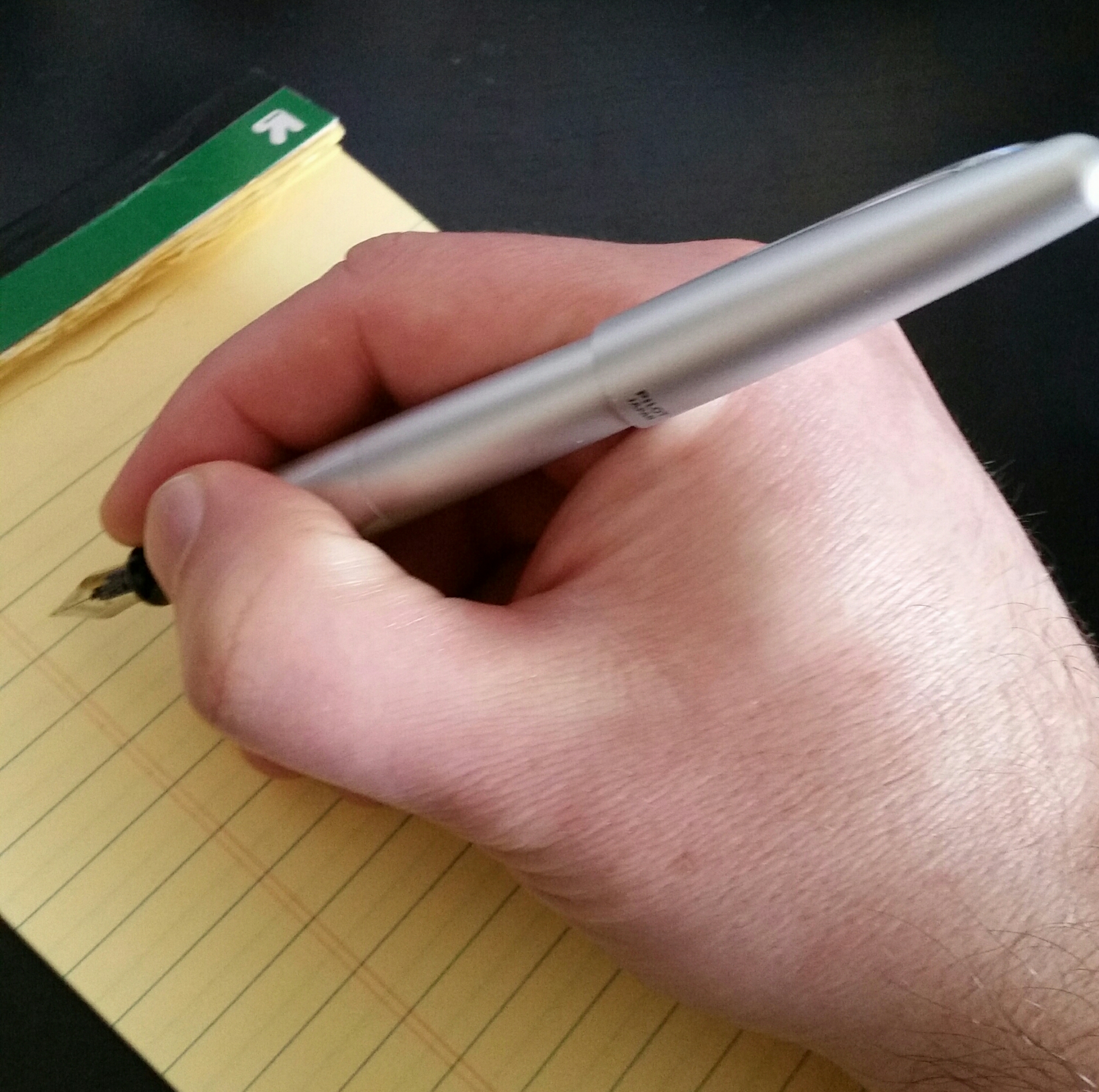
Featuring the Pilot Metropolitan pen that A got me for Christmas. I haven’t used a nib pen in ages!
I’ve been writing and editing via my PC for so long that it still feels weird to be writing new things longhand. The last major project I wrote longhand was The Phoenix Effect; the trilogy was written completely on the computer, using MS Write and MS Word. I still have the 3″ floppies containing all the early .wri files, come to think of it. I did do a lot of the world building and the brainstorming longhand, mostly on scrap paper from work (these were the Yankee Candle years), but the new words were all generated downstairs in the Belfry, tapping away on my PC.
Even later incomplete and/or trunked projects like Love Like Blood, Can’t Find My Way Home and Two Thousand and even the earlier versions of Walk in Silence were started or at least primarily written on the computer. I liked working that way for varying reasons: I could chart my daily word count and my production in general; I could edit while writing when it was clear it was needed; I could open multiple documents for reference use and note taking; and peripherally, I could keep myself amused and entertained with my mp3 collection playing in the background.
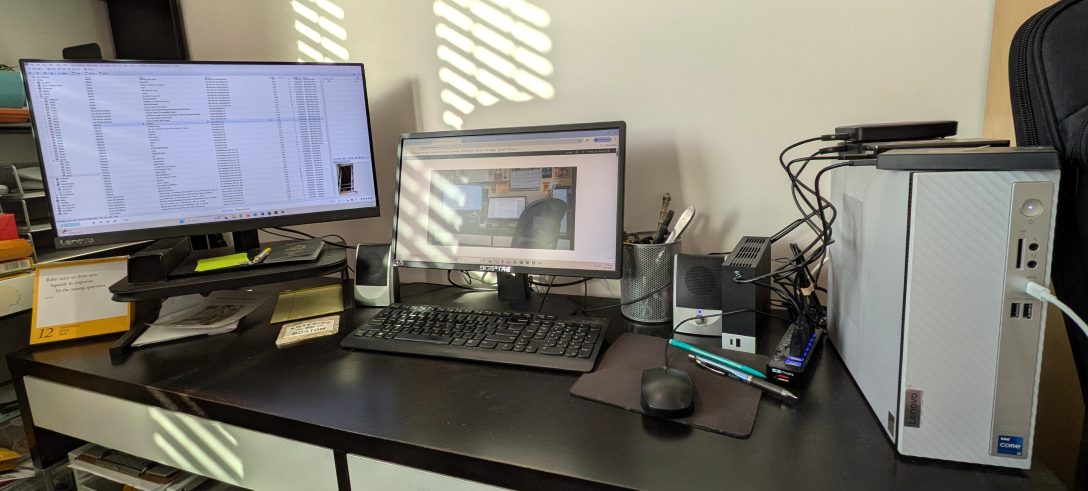
Writing on the PC can be a great thing, and I still enjoy it, but over the years I’ve realized its limitations as well. I have a penchant for distraction, whether it’s multiple games of FreeCell and Solitaire, futzing around with the tags and the arrangement of my mp3 collection, or the continued refreshing of my Twitter feed. I’ve also been hiding myself in Spare Oom far too long. And then there’s the fact that I already work from home, so I’m spending most of the day back there already, sitting on my duff for eight hours. Spare Oom may not be a man cave, but over the years it began to feel like I was using it as a hideaway from the world. It’s the one room in the apartment that has the best view (see the banner picture over at Walk in Silence), but I don’t look out that window nearly as much as I should.
Starting up my personal journal a few years back was my way of combating all this. Its original purpose was to divert my kvetching habits from social media to paper and curtail them somewhat, and it worked almost immediately. I also made it a habit to write its entries away from my desk. For the last year or so I’ve been writing in it during my midmorning break, sitting on the loveseat across the room where I can glance out the window as well. Much to my own surprise, I’ve kept it up consistently since then, skipping only weekends and vacations.
Early last year, when it was clear that I’d be wrapping up the trilogy project by year’s end, I started writing the new Mendaihu Universe story. This was the first new story I’d be starting completely longhand, in a yellow-covered 3-subject spiral notebook I picked up at Target. This too was kept up consistently until late last year when I put it aside to self-release the trilogy. Once that project is finally wrapped, I’ll be able to pick it up again. In the meantime, though, I’ve been starting new projects longhand, such as this latest version of Walk in Silence. My return to artwork and renewed dedication to weekly poetry have finally torn me away from the PC as well. In addition to that, I’ve been trying to make a concerted effort to work more often on my laptop out in the living room (where I am currently typing this) if I need to use MS Word. And yesterday afternoon during the two football playoff games I sat at the dining table, writing a few WiS pages.
I’d commented elsewhere that I don’t plan on turning myself into a Luddite writer; I just feel the need to change up the habits to keep everything fresh. I can view using the PC as a positive work process rather than a distraction or a slog. I’m not chained to it, and shouldn’t be. When I was working on the trilogy back in the early ’00s, working on the PC was something I looked forward to as an evening process, maybe even as ‘going to the office’ for my writing career, and I kept that separate from the rest of my life. Returning to longhand after so long is sort of a return to that.


 Welcome to Bridgetown