Photo courtesy of The American Road Trip Company — yes, rural New England really does look like this!
When it came time to describe Trisanda, first in The Phoenix Effect and then in the Bridgetown Trilogy, I already knew what it would look like: New England in the autumn. Specifically, the area of central and western Massachusetts, where I’d grown up and lived for so many years. Far from most of the big cities, where going somewhere requires a thirty-mile drive which you don’t mind at all, because that means you get to see the foliage and listen to some tunes. There are a hell of a lot more trees and animals than there are people in some of these towns.
I worked for my town’s Public Works back in the summers of 1989 and 1990, which meant spending the entire day pushing a lawn mower up and down and around the gravestones of the dozen or so cemeteries around the town (our town was incorporated in 1762, so there are quite a few generations buried there), or working on the sides of quiet back roads, cleaning overgrowth and collecting litter. Each day I’d be neck deep in nature, watching the seasons and the colors change. Years later, when I’d have to drive those thirty-plus miles to my day job, I’d drive the back roads on purpose just so I could enjoy the views.
Come 1997, I already knew that Trisanda was going to embrace that natural setting, the miles of trees and grassy fields, old farms and whatnot. I wanted a somewhat pristine planet; one that evolved organically and with little outside influence (returning to the theme of emotional/intellectual influence there).
There are towns and cities on Trisanda, of course…the trilogy just doesn’t focus on them. It focuses more on the outpost towns, in particular one named Bann Dassah (pronunciation: bahn DAH-sah), where one particular character, Eprysia Kaalen (aka Ampryss) lives out her life as a Watcher of Earth/Gharra. We’ll see more of Bann Dassah in The Persistence of Memories and especially in The Balance of Light.
When I wrote the scene where Natianos Lehanna and Janoss Miradesi visit Trisanda — the first scene on Trisanda that didn’t involve the Landing Field or the Gathering Table — I wanted to show a world that would be familiar yet somehow alien. The forest would be similar to the above photo; a mix of pines, ashes, maples, birches, and so on to give it color. [I gave names to only a few, however…the pine-like kriosi (kree-OH-see) and the fir-like skrihad (skree-HAHD)…but you get the picture.]
And what does one see in the woods of New England, sometimes to our frustration? Wild animals like deer, wildcats and dogs. Similar creatures would most likely hang out in the wilds of Trisanda as well as part of the ecology. So in comes the wolflike gundaevi (goon-DAY-vee) and the feline jenha (JENN-hah) as background elements to the above scene. There are others that are heard or their shadows seen, but I don’t go into detail.
So is that all there is to worldbuilding? Heh, if only! It really does depend on the situation. Since 90% of the trilogy takes place in Bridgetown, I came up with all kinds of details: communities, neighborhoods, maps, population, and so on. The 10% that takes place on Trisanda is mostly in the woods or in three or four specific places, so I didn’t need to go into too much detail, and focused more on minor details to fill out description. I’m sure if/when Trisanda pops up in future Mendaihu Universe stories, I’ll be more elaborate, depending on the plot.
Q: Denni’s got quite the role in this trilogy as the One of All Sacred. What’s her origin?
A: She was a relatively new character alongside Caren and Poe, but she didn’t really have much of a role until about a quarter of the way into The Phoenix Effect. A proto-Denni popped up in True Faith in a similar role but with vastly different motives and personality. Both versions were pre-teens. When writing the trilogy it made more sense for her to be a teenager and a little closer in age to Caren.
Q: Why the One of All Sacred, anyway? Where did that idea come from?
A: In a way that came from a subplot in TF. I was fascinated by the idea of Chosen One plotlines at the time, especially ones with mundane origins that ascend to deity level, either by a ritual or by outside forces. It was still a subplot in TPE, but by the time of the trilogy reboot it became a major plot point — so much so that her awakening is Chapter 1 of A Division of Souls. She’s one of the major drivers of the plot of the trilogy. [More about the One of All Sacred on 4/18 when we hit ‘O’ on the A to Z Challenge!]
Q: Like her sister, she’s got a Mendaihu name as well. An extended version of it is given in A Division of Souls. What’s the story behind that?
A: She gives her Mendaihu name as Denysia Shalei si Emmadha si Dhumélis. In Anjshé, the ‘si’ is a conjunction — in this sense she’s merely giving multiple clan names that her Trisandi soul is tied to. [Pronunciation: shah-LEY, ey-MADH-ah, and dhoo-MEY-lees. The ‘dh’ is a ‘d’ sound with a very slight lisp.] All three clans are highly regarded on Trisanda as strong in both spirit and in deed. She purposely gave all three names at the Moulding Warehouse to prove a single point: she wasn’t going to take her role as the One of All Sacred lightly, not if she claimed to be from such an honored lineage.
And yes, this is a lineage for her entire family. Caren almost never claims all three names as she rarely sees need for it.
Q: That’s Jena Malone in that picture. Is she the basis for Denni?
A: Yes, she is. I wrote TPE around the same time the movie Contact, where she played the young Ellie Arroway. Spunky, smart and self-reliant, yet still relies on the connection of others. The trilogy version has her somewhat older (maybe her role in Donnie Darko, which was out about the same time I started ADoS).
Q: For a fifteen-year-old girl, she certainly has a hell of a lot of responsibility, doesn’t she?
A: Well, sure, why not? She shares much the same daily responsibilities as her older sister Caren, especially since they’re living on their own. Her parents made sure she was self-reliant, as both they and Caren were ARU agents, and they didn’t want her to completely depend on the help of others. But they also taught her that there’s no fault in asking for it, either. Whenever she’s performing her duties as the One of All Sacred, she always has that in the back of her mind, and that’s why she nearly always encourages community but also reminds her followers to think for themselves instead of following her blindly.
That’s not to say that she immediately becomes a Magical Girl and her real life is conveniently forgotten whenever she’s doing her magic as the One. Now that she’s known as the One by pretty much everyone on Earth, she of course feels a bit self-conscious, not to mention feeling a bit weird about still needing to attend school. She wants to do her best as the One, but she also wants to continue being teenaged Denni. I actually touch on this theme in The Persistence of Memories as well as The Balance of Light.
In short: she’s willing to take all the responsibility that comes with being a deity, but she refuses to let it go to her head.
Q: What is her relationship with Amna Ehramanis?
A: She’s her best bud, they’ve known each other since they were five. Like all lifelong friends, they’ve gone through all kinds of ups and downs, scrapes and japes, and they’re still BFFs. Denni always plays the straight character to Amna’s wackiness. As to why Amna becomes her devoted Protector once she’s fully awakened, well…there are a few reasons for that, which are revealed in TPoM and TBoL. 😉
Q: Anything else?
A: Like Caren, she’s a music fiend and constantly streams stuff from her sister’s collection. She’s a voracious reader. She’s a decent student and gets excellent marks, but she’ll admit she doesn’t see the point in trying to be top student. She loves hanging out with Caren’s fellow agents at the ARU, and thinks of them as an extended family. In particular she looks upon Alec Poe as a big brother. She’s had a few school crushes here and there, but nothing serious, and she’s okay with that. There’s a fifteen-year difference between Caren and Denni, which might lead some to think she was an unplanned pregnancy, but she’s actually not. Aram and Celine deliberately chose to have another child after the previous Season of Embodiment. (As to whether they knew her fate at that time is not known.)
And yes, she too has a theme song, Lamb’s “Small”. This is what she thinks about when she’s up in her nonspace.
A: Caren is actually the first new character I created for the trilogy back in 1997 when I started The Phoenix Effect. I came up with her (as well as Alec Poe) on that first day of writing. I’ll admit there was a slight inspiration from The X-Files which I was a fan of at the time, as I was looking for two investigators who were put into a situation they weren’t exactly comfortable with.
Q: She’s got a Mendaihu name as well. Why is that?
A: Her Mendaihu name is Karinna Shalei. [First name pronounced ka-RINN-nah]. She was given it by her parents, Aram and Celine Johnson, who were high-level Mendaihu adepts as well as agents for the Alien Relations Unit. The Mendaihu blood runs extremely strong in her entire family. She takes this name very seriously, and never uses it frivolously. The same with her sister Denni; she will not call her ‘Denysia’ unless it is warranted.
The giving of Trisandi clan names to those from Earth is not considered appropriation by the Meraladians; they actually consider it a form of incredibly deep respect, as they feel these people are willing to completely embrace their ancient physical and spiritual connections with Trisanda.
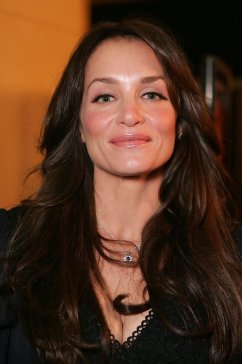
Q: That’s Kristen Cloke up there. Is that who Caren is based on, physically?
A: Yes! In fact, she was inspired by Kristen’s role as Captain Shane Vansen in Space: Above and Beyond (of which I was a HUGE fan). Someone who isn’t entirely happy with the role she’s been given, but that won’t stop her from performing it to the best of her ability. Like Vansen, Caren is also someone who takes her responsibilities very seriously, especially when it comes to those she works with or mentors. Caren connects personally and spiritually with everyone she meets.
I can even tell you the scene where it dawned on me that she’s definitely Caren: it’s a rare and very personal conversation between her and 1st Lt. Cooper Hawkes in the episode ‘Hostile Visit’, which takes place just before they’re about to head out on a dangerous mission. This is definitely a conversation she’d have with Alec Poe.
Q: Her relationship with Anando Shalei seems to be somewhat unique. Has she always questioned her relationships, romantic and otherwise?
A: No, not always. The death of her parents really took a lot out of her emotionally, and because of that she keeps a specific distance from others, for fear of getting too close and then losing them as well. She’s fully aware of this decision, and has never let it completely get to her, knowing full well that she has to move past that.
Caren’s connection with others is definitely unique; it was partly based on a few friendships and relationships I’d had where I simply clicked with the person on a deep level in a very short amount of time. It’s not merely a romantic or sexual attraction she has with Anando, but a spiritual one. And because of that, Caren is nervous at first, wondering how it could possibly work. The longer they’re together, however, the more they learn to rely on each other for comfort, affection, and a firm base of spirit.
Her last serious relationship before Anando was with Agent Sheila Kennedy, though they both decided to end it due to their work situation and remain close friends. They still flirt with each other now and again, mostly for the humor of it.
As for friendships, she is extremely loyal, and will always have your back. She also has a very thin filter, so she’ll often say what’s on her mind, even if it bothers you. She takes every kind of relationship seriously. Especially the one with her sister.
Q: Anything else?
A: She often has trouble falling asleep at night, as she often lets her thoughts run rampant near the end of the day. She’s been trying her best to fix that. She has a scar on her thigh from a bullet grazing it during an investigation. She has exceptionally strong night vision. She can be very impulsive and impatient sometimes, which has gotten her in trouble now and again. She’s got a very snarky sense of humor. She won’t admit it to Poe (who will surely never let her hear the end of it), but she really does enjoy dressing up fancy now and again. She’s an avid music fan and has quite a large collection; her tastes depend on mood and situation, but she has a soft spot for meditative music, especially when she’s had a taxing day at work. She’ll always say her happiest moments are when she’s hanging out with Denni.
And yes, she has a theme song: Lamb’s “Gorecki”. It’s exactly how she feels about Anando, even if she has trouble articulating it to him or anyone else.
Branden Hill Sector is considered the “collegiate” sector of Bridgetown, as it is home to multiple colleges and universities, including Spender College, the arts and architecture campus of Bridgetown University, Kuhlmann University, and Longwood College of Pharmacology. It is also home to a number of museums and cultural centers. Most of its dwellings are relatively small apartment buildings, a handful of SROs, and a small number of apartment complexes. The community of Branden Hill (colloquially called “Brandhillers”) have fully embraced its ‘cozy’ image, and have strived to keep the sector from becoming too gentrified. Most of the towers and high rises are in eastside, which borders Main Street Sector. Due to limited availability of homes and apartments, the cost of living in this sector can be expensive. It is cheaper to live in the more suburban westside (bordering West Brandenville and Swope Heights). Some live in nearby sectors while commuting here for work.
Getting in and around BH is quick and easy; it contains three major subway branches and numerous shuttle paths. A number of major thoroughfares run through the sector, including Baird Avenue, Krieger Avenue, Ormand Street, Shattuck Street, Guyton Street, Jamison Avenue, and Bridgetown Parkway. Interstate 91 runs down its eastern border, with multiple access points. Baird River Park is a greenbelt stretching all the way through the sector and is a local favorite on the weekends. There are many shopping sections within the sector that provide wares and entertainment for its community.
The sector was named for the hill in the center of the sector, where BH Park now sits. It was named after its original landowner, Joseph Branden.
The Branden Hill headquarters of the Alien Relations Unit is situated on the corner of Baird Avenue and Ormand Street, about a mile south of Branden Hill Park. The headquarters building is one of the larger buildings in its neighborhood at eight stories, though its unassuming reniform shape and light color keeps it from being an eyesore. The Unit is well-respected in this community. Reporting here are agents Caren Johnson, Alec Poe, Sheila Kennedy, and Nick Slater; they are all reporting under Chief Inspector Dylan Farraway. Christine Gorecki was a former agent here, though she has taken a leave of absence and is currently a registered soulhealer and private investigator.
[Apologies for the delay…I had quite the full schedule yesterday and was not able to post until today. Thus we’ll have multiple entries today. Woo!]
Welcome to Jonc’s A to Z Challenge! I’ve chosen to have some fun and post about the stuff that goes on behind the scenes in the Mendaihu Universe; character backgrounds, FAQs, behind-the-scenes production, and more. Hope you enjoy!
Q: First off: how do you pronounce their names?
A: Last name first: Shalei is shah-LEY, even if it’s a distant relative that has the extra ‘i’ at the end. It’s an extremely common Meraladian surname, as it’s one of the largest clans to come from Trisanda. They do sometimes get queries about if they’re all related; some do find it irritating, others merely brush it off with a quick answer.
Ashyntoya is ahsh’n-TOY-ah. He’s named after his great-grandfather who was quite the epic Mendaihu, and a major player in the Fifth Season of Embodiment of the One of All Sacred. Someone he feels he’s expected to live up to, but he doubts he’d even be fit to stand in that great man’s shadow. He prefers to be called Ashan (ASH-ahn); he usually explains that it’s just a nickname, but in truth he borrowed it from another less known and much older ancestor who was connected to an uprising at Bann Currin on Trisanda.
Akaina is ah-KAH’ee-nah (although I admit my brain still sometimes reads it as ah-KAY-nah). She understands cultural differences in speech origins, so she’s totally fine with people pronouncing it either way. She prefers people call her Kai (kah’ee, rhymes with ‘sigh’). She’s named after her aunt on her mother’s side; the two sisters were best friends growing up and are still extremely close. Her aunt is one of her favorite relatives; she was the one who first taught her about the Mendaihu and the Shenaihu.
Q:How did you come up with the twin Mendaihu agents for the Bridgetown Trilogy?
A: That’s a good question…they just sort of evolved, really. If I’m not mistaken, Kai originally showed up as a humanoid AI in The Phoenix Effect, and Ashan was one of the background AIs. I dropped nearly all the AI ideas during the 2000 reboot and kept those two, giving them a completely new background and purpose.
They weren’t twins at first; originally I was going to have Ashan as the older brother. However, I realized both characters had an almost exact equal purpose in the story; it made more sense for them to be not just physical twins but spiritual twins as well. There’s no special psionic connection between the two; they merely know each other’s soul so well they work perfectly together as a team. And of course, as siblings, they do get under each other’s skin now and again.
Q: Are they based on anyone in particular?
A: When I create characters, I often picture various actors playing them, just to get an idea of what they might look like or how they’d act. In this case, however, I never really thought about it. I purposely didn’t base them on anyone famous. I wanted their characters to feel like that person you meet where you can’t quite put a finger on who they remind you of, and instead you find yourself attracted to their uniqueness.
Q: What do they look like?
A: In A Division of Souls I described them in general terms as Meraladians; they are human in form, though larger in height and size. Their skin color is a very light brown, which is common for Meraladians. As they are fraternal twins, they look similar to each other in certain ways, though Kai’s face is more oval and Ashan’s is narrower. Ashan is slightly larger in frame. They both have very dark brown eyes; from a distance it looks like their pupils are fully dilated. They have small rounded and smallish noses and wide mouths. They both have long black hair that they tie back in a triple tail, often threaded with small beads near the ends — this is an old cultural practice of the Shalei clan.
Q: Where do they come from?
A: They’ve been NewCanta Province citizens for almost all their lives. [NewCanta Province is northwest of Bridgetown, and is the center of government for the Upper Midlantic Range. Bridgetown is the second largest province in this Range.] Nearly all of their extended family have been lifelong Mendaihu. They have no other siblings, though they have quite a large extended family of relatives and close friends.
Q: What are their personality types?
A: Ashan is often misconstrued as being standoffish, maybe a little arrogant, but in truth he’s just not entirely sure how to act in front of others. That’s not to say he doesn’t understand people, far from it; he’s just a little too self-conscious about whether or not he’s doing the right thing. His anger does get the best of him sometimes, though after the fact he will apologize immediately, even sending out a small sensing thread to invite them closer to his spirit to show his true emotions. He’s truly loyal to his friends, acquaintances and fellow Mendaihu agents.
Akaina is more open with her emotions and thoughts. She has a bright demeanor, but when angered her words can be extremely barbed. She loves meeting new people; she loves getting to know them on multiple levels so she can understand their many quirks and inconsistencies. She’s also quite loyal to her friends, acquaintances and fellow Mendaihu agents. She fully trusts what her soul sings to her, sometimes to a fault, but she understands the problems that might cause, and is willing to work through them.
They both absolutely love a good feast with friends, especially if a warm beverage of tea or coffee is served afterwards.
Q: Anything else?
A: Bits and bobs: Both are often seen in their Mendaihu agency uniforms — long black dusters with a gray patch on their right shoulders, on which is stitched the Mendaihu sigil of two intersecting circles. They choose to do this because they like to show they are always performing their Mendaihu duties at any time of day. Both graduated from their Mendaihu training with very high marks. Ashan has a long thin scar on his right forearm, the result of a training exercise accident. Kai’s night vision is weaker than Ashan’s. During the Bridgetown Trilogy, they share an apartment in the Pullock Street Heights Sector, not that far from Pullock Street Park. Kai won’t tell him, but Ashan snores like a freight train. Neither have ever traveled to Trisanda, though they are well informed of its history and what goes on there.
*
Want to know more about the Mendaihu Universe? Leave a question below in the comments, and I’ll be happy to answer it or expand on it in a future post!
I subscribe to a handful of writing magazines, many that I’ve been picking up for a good few decades. Over the years, they’ve helped me rethink how I look at my stories. Sometimes they’ll point out the blatantly obvious that I’d been ignoring for one reason or another (weak prose and word repetition for a start). Sometimes they’ll provide insight on what agents and publishers are looking for and how to contact them. It’s all helpful, and over the years their advice did help me get a lot farther than just guessing or assuming I was doing it right.
On the other hand, I’ve been quite contrarian lately, and I’m not entirely sure why.
Well, maybe I am sure; I think it has to do with self-publishing my work. Also that I’ve been a nonconformist at heart since I was a kid.
Thing is, lately I’ll read these advice articles and think, ‘well, why can’t I do it that way?’ For example, I saw an article earlier this morning regarding a novel having too much plot. I get where they’re coming from, don’t get me wrong; the example they used was bombastic and ridiculous (some litfic plot regarding way too many characters causing way too many plot twists and coincidences that even reality gave it the side-eye), and in that instance, it’s probably for the best that you back it up a bit and maybe narrow the focus. My reaction, however, was this: well, how is it that apparently readers don’t like way too much plot, and yet we love reading doorstop novels from George RR Martin, Kate Elliott, Neal Stephenson, and so on? How can I write the plot-heavy book and still make it readable and enjoyable? The kind of doorstopper that makes readers go ‘damn, that’s some great world building!’ In other words, the kind of books I love to read.
That’s when it dawned on me: it’s not that the writer of the article is stifling creativity; they’re just trying to keep your novel’s highway from gridlocking. If you’re going to write a doorstopper, just make damn sure it’s navigable.
Getting back to my bit about nonconformity, here’s an ironic admission: I’m also a pathetic conformist as well. Let’s just say that even though I touted my individuality in my high school years – sometimes to annoying extremes – and tended to question authority when needed (again, usually in the form of “well, why can’t we…?”), I also found myself desperately trying to fit into the status quo at the same time. I’m a proud self-contrarian in that respect.*
[* – A good example of my proud self-contrarianism: Yes, I am aware of the irony of using a Psykosonik song in a blog entry about writing my sf trilogy, considering that one of the band’s principal songwriters was one Ted Beale, aka Vox Day. I’m not a fan of his politics in the least, but I did love the Unlearn album when it came out in 1995, so I’m fine with keeping the two separate.]
With regards to my writing, I went through quite a few phases of trying to shape my novels into something that agents and publishers would enjoy. The truth is out: one of the reasons it took me so long to self-release the Bridgetown Trilogy is that I spent a good number of years trying to figure out how to revise it so that it was more commercially acceptable to agents and publishers. Suffice it to say, I never successfully figured out how to do it. I didn’t want to give up on the Mendaihu Universe, I just wanted to make it marketable.
I could never figure out why nobody was biting, though — and that’s the downside to the form rejection letter. No one is telling you why. I understand the reason behind the process…most agencies and publishers are actually quite small in crew and literally can’t respond personally to thousands of submissions. At the same time, though, it doesn’t help the writer one bit. It’s like being trained at your workplace for a new system, and when you’re baffled and stuck and ask for clarification, the trainer responds with “Well, what do you think it does?” My initial response to that kind of question is almost always “How the fuck should I know? That’s why I’m asking you!”** I get that they’re trying to make you think it through, but some need a frame of reference first before they can answer that question. If I’m not doing it right, I want to know how I should be doing it to your specifications. I’m a writer: asking that question of me provokes about 3,425 different responses. I have no idea which one is the right one or which would bring me success. I have nothing to base it on.***
[** – Yes, this has actually happened at one of my day jobs.]
[*** – I am aware that this is what writing groups and beta readers are for, but they’ve never quite worked for me. They’re great for talking out ideas and suggestions and I love the camaraderie, but more often than not they end up doing little more than confirming problems and issues I’ve already noticed and hadn’t yet acted upon. I’ve come to the conclusion that I just happen to work better solo and should trust my instinct more often.]
And the nonconformist in me, after so many years, finally decided that DIY seemed like a more viable and entertaining option. The time was right, the field has been quite strong, and I’d already done my research on it. This time I listened that rebel in me.
I’ve mentioned here before that music is an incredibly huge influence in my life, and I took that to heart this time out when I chose to rethink how I viewed publishing. I’ve read so many music bios about punk bands scraping by on a meager pittance and a beat up van yet absolutely loving the lifestyle; I’ve read about their wonderfully creative ways of getting their singles out to radio stations and audiences. There’s a reason why the image of a telephone pole covered with the bark of a thousand nightclub flyers is so iconic; that was punk’s social media of the time, to let all and sundry know that you were in town and were going to play at some seedy bar close by.
So this is what happened in 2015: I chose to unlearn the process of publication as I knew it. I already understood it all too well…if I want to publish commercially, I already know what steps I need to take, and I think I have a bead on how I can make my lighter stories marketable. What I had to do for my self-published work, though, was think like a nonconformist: what makes sense to me, first and foremost, and be consistent in that belief. I taught myself to react to moments of weak prose and plot. I learned to completely trust my creative instincts. I taught myself the mathematics of creativity (thanks again to music), of being aware of what makes a pleasurable work. And most importantly, I taught myself to ignore any self-doubt that popped up. I’m proud of the creative things I can do; I love writing and drawing and playing music, always have since I was a kid, so it was about damn time I followed through with those long-held dreams and make them realities.
I won’t lie…sometimes the DIY route can be daunting. It can be emotionally nerve-wracking. It can also be expensive. But I really do think unlearning the process of trying to be a commercial writer was one of the best moves I’d ever made. I’ve never been happier and more excited about being a writer.
Okay, actually I blame my ex from ’94 for handing me a copy of The Stand while we were working on True Faith, but the point remains: I blame Stephen King for introducing me to the Large Ensemble novel. I read a wide assortment of his novels in 1993-95, intrigued by his style and his characterizations, and it was The Stand that grabbed me the most. I’m extremely picky when it comes to stories with End of the World themes (they don’t bother me, I just have very little interest in them), but this one fascinated me, because it was such a sprawling piece of work. A doorstop. And the edition I read was the expanded version that had just been released. And I loved it. Still do…specifically that version.
I loved the idea of a large ensemble in a novel, because I was fascinated by how each character’s life intertwined with the others, even if they never met face to face. I loved the idea of each character’s unique development and evolution throughout the course of the novel. I especially like how each evolution had a specific role within the main plot, whether it was a large role or a small one.
That’s one of the reasons the Mendaihu Universe novels are always an ensemble affair. Like the purging and repopulating of the human race in The Stand, I wanted to show that the awakening and ascension of spirits in the Universe weren’t merely relegated to the main characters, but to everyone in the world. Not that future MU stories will also have a large cast; I already have some ideas focusing on a minimal number of characters that we may see down the road, and I’m quite sure I’ll have a Tales from the ARU sequence soon enough.
Writing large ensembles is tricky work, because you need to be a really good note-taker, or at least have it down really solid in your head. Switching from one POV to another is simple enough; you just need to pay attention when you do it. More often than not I kept with a single main POV character throughout an entire chapter to keep it simple — and in the process I got to play with that character’s evolution within that length of time. And on a higher level, I had to make sure the main plot kept moving. It was quite the juggling act, but it was a hell of a lot of fun.
I know a lot of people who aren’t big on ensemble casts, or doorstop novels for that matter. They prefer a slimmer cast (and a slimmer spine!) in their books. Shorter, more concise stories, ones that don’t meander or take forever. Events that affect a small group rather than the entire planet. I tend to switch between the two; one of my favorite novels is Mark Danielewski’s House of Leaves, which essentially has two main characters and about six secondary characters, and the plot mainly focuses on how the house affects the characters. And on the other hand, I also love Masashi Kishimoto’s Naruto manga, which spanned 700 chapters and has an incredible array of main, secondary and tertiary characters who all have unique personalities and play an important part in the overall plot.
I say all this because I know that some readers may find the Bridgetown Trilogy a bit long; A Division of Souls is nearly 150k words, which is quite long even for a genre novel. This made me think about playing with convention, maybe taking the opposite approach that the 1994 edition of The Stand took: what if I created an abridged version of the trilogy, and leave it up to the reader to choose which version they’d like to buy or download? I’m totally fine with taking that step, because I learned from Douglas Adams: there’s always more than one way to tell a story. I could conceivably edit out some minor characters and leave out a few scenes here and there and still have the same story.
Don’t get me wrong; it’s not that I’m refusing to listen to reason by whinging that severely edited versions of the books lead to them being less than pieces of art. Yesterday I bought a copy of one of my favorite 90s movies, Wim Wenders’ Until the End of the World. The original 1991 version Warner Bros released is around two hours long; the director’s cut, which I picked up, is 288 minutes — that’s over four and a half hours long. I get that Hollywood needed a much shorter movie. I was fascinated when I watched the first twenty minutes and noticed something: at the 20 minute mark in the Hollywood version, the main female character (Claire) meets the main male character (Trevor/Sam). In the director’s cut, they haven’t even met yet, let alone Claire getting to the destination where they meet. There are number of short establishing shots, bridging scenes, and emotional moments that are there to show how the world looks and behaves in this fictional 1999. Each version tells the story: one is crisp and concise, the other is slow and deliberate. Both work the way they’re supposed to, and both are enjoyable to watch.
And like any director’s cut of any movie, there are going to be fans and detractors. Some audiences hate long films. Others love the idea of an ‘alternate’ version of their favorite movie. This is where I started thinking: why not alternate versions of my novels? Am I willing to spend all that extra time playing around with different versions of my stories? Am I dithering in wanting it both ways? And realistically, would anyone really care either way? Well, some of those questions really don’t matter all that much in reality. I’m not looking for Hugo nominations here.* I’m not looking for scores of fans; I’m just looking for readers who’ll have fun reading my universe, whichever version they so choose.
* — Yes, as a matter of fact, A Division of Souls can be nominated for a Hugo! Go ahead and nominate if you want, I’m cool with that. 🙂
The problem with going through a major editing/revision/release process is that it eats up quite a lot of time I set aside for my writing. It leaves precious little time for any new work unless I sneak some time in during the day. [Which I’m doing right now…this post is being written in the slow moments of my Day Job.]
This makes me twitchy. I want to write something new, but deadlines loom. I don’t mind the editing/revising part of the job, but the longer it takes, the more I have that itch to pick up a notebook and start working on a new project. Not out of avoiding the revision process, but that I start feeling rusty. I feel the need to write new words somewhere, anywhere. My personal journal entries (which I write during my midmorning break) are getting more verbose, and I’ve been blogging like a fiend lately. My brain is clogged with Future Plans for When I’m Caught Up. I’ve got ideas for the Inktober art meme. I have a few stories simmering and a new MU story in stasis.
I believe it’s time for me to get creative with my writing time again.
Religion can be a very tricky thing to write about in Fantasy and Science Fiction. It has to be done reasonably well and for good reason. It also has to have at most a strong backbone for which to base part (or all) of the plot or a character’s makeup. The writer should not want to overtly use the religion’s place in the story as a soapbox, either, because readers will pick up on that right away. Nor do you want to pick and choose the ideas of well-known established religions and use them without understanding at least some of its already-established rules and tenets.
In creating the ‘spirituality’ of the Mendaihu Universe — I call it such because it’s not so much an established religion as it is a spiritual state of being — I had to create a belief system that had to follow specific rules. The First Rule, as it were, was balance. I had to work within the confines of a yin-yang system, where the Mendaihu and the Shenaihu were not so much mortal enemies as they were parts of a whole. When one takes action, the other one must respond in kind. This alone propels the action in A Division of Souls and drives the plot of all three books in the trilogy; when Nehalé Usarai performs the Awakening ritual in the first chapter, the Shenaihu must respond, and do so fivefold. This will set off even more responding actions from the Mendaihu again, and so on.
This is often where the savior comes in; the character whose life is lived outside of this cycle, who must put a stop to it before both sides utterly destroy each other. In the trilogy, this is the One of All Sacred. He or she is not exactly an established deity (in the Mendaihu Universe, that is the Goddess of All That Is), but an outside player of a religious stature who is tasked with returning everything back into a peaceful balance. The savior often has a somewhat clearer mind than many of the other characters; they’re not wound up in some kind of emotional tailspin or blinded by distraction. [This can often be their own distraction — their distance from the situation sometimes causes them not to fully understand it.] The savior’s own story arc is thus not only to Make Things Right Again, but to spiritually ascend in their own way.
What kind of religions have you seen in genre fiction that fascinate you? If you’ve created your own, how have you worked out the rules?
[One of the best songs about football, hands down.]
The problem with Football Season is that it gives me one more reason to be distracted from my writerly duties. Not that I need more distractions…I already have the music, the social media, the Day Job, and everything else! Still, it’s a pleasurable distraction; as with music, I have it on in the background while I’m working on something else, glancing up at the screen every now and again when someone scores or executes a brilliant play.
Time can be tricky, especially when you’re attempting to balance the finite amount we’re allotted with the infinite number of things you want to use it for. I dedicate eight hours a day to my Day Job (I try to avoid overtime, and for the most part it’s never needed anyway), but during my breaks, I will sneak a few writing things in. During my 9:30am break, I’ll sit on the loveseat across the room and write an entry in my daily personal journal. During lunch I’ll read my writing magazines. During the afternoon break I’ll catch up on emails and whatnot. And on the rare occasion that I have a slow day, I may even work on a blog post. After we both log off, we head to the YMCA and work out on the treadmills for a bit, and have dinner soon after. This gives me a few hours at the end of each day, purely dedicated to my writing.
As said, the tricky part is what I should be working on, and when.
The thing about being a writer is that you most likely have about three or four different projects going on at the same time, each at various levels of completion. My current status involves the following: A Division of Souls is out in the world (yes, even at Amazon now — the physical copies are coming soon!), I’m currently working on the final edit of The Persistence of Memories, I’m writing the new Mendaihu Universe novel longhand, I’m carving out weekend time to pick Walk in Silence up again, and I have a few other fiction and non-fiction projects simmering on low heat in the back of my brain. And that doesn’t include my daily personal journal, weekly blog posting, popping up on social media now and again, and other non-writing things such as guitar noodling and songwriting. And there are things that keep getting put on hold, such as doing the daily 750 Words, my artwork and the Drunken Owl music recording project. So much to do, so little time.
See, this is why I have the whiteboard schedule. I haven’t been following it as of late due to the massive editing sessions for the Bridgetown Trilogy, and I think that’s a fair enough reason for putting everything on hold as of late. I don’t mind, because releasing the trilogy myself demands a lot of time and dedication, and I’m not about to do any of it half-assed. But now that the Big Release date has come and gone and that I’m letting it slow-simmer a bit while I figure out different ways to have fun with its promotion, I find myself with a bit more time on my hands. Which means my week or so of relaxation and mucking about online must come to a close. It’s time to refocus and dedicate the time that I have to what I want to get done.
Still, that’s not to say I’m not about to miss out on watching some football this season! I may be busy, but I’m not about to let that get in the way of having fun as well!


 Q: Denni’s got quite the role in this trilogy as the One of All Sacred. What’s her origin?
 Q: What is Caren’s origin?
 Welcome to Bridgetown