On Life Adjustments and Finding Time to Write

I’ve been thinking a lot lately about how I’d adjust my creative output with possible life and work changes coming in the future. I’m sure every writer, artist and musician has to go through this at some point in their life; it’s rare when they can stay with a creative regimen for years at a time.

I’ve been working from home full time since…2014, I think? That’s five years. That’s a pretty damn impressive run, and I’ve made the best of it any way I could. I revised and self-published the trilogy and wrote three additional novels, hand-wrote a bazillion personal journal entries, and created an impressive blog schedule. And on top of that, I also managed to hit the gym a few times a week as well!

This might change at some future point, and at first it bothered me severely. I’ll readily admit to being extremely fond of habit and schedule — and I’ve mentioned many times that it’s mainly because it keeps me from otherwise wasting my time being unproductive.

But now that I’ve had more time to think about it, I realize that just like any other Day Job, it’s really just a matter of knowing how to rearrange and reorganize.

The one hard and fast rule for me has always been to be extremely protective of my writing time. I won’t budge on that. I can make concessions and figure out how to fit it into any Day Job schedule of course, but I won’t sacrifice it completely. My writing is my long-term career to balance with the Day Job. And I’m always open with managers about that, and thankfully they’ve all be extremely understanding. (In fact, many of them are usually quite impressed when they hear I have multiple books out! Heh.) If the Day Job requires my undivided attention, I’m down with that. But I need to ensure that I have time outside of that job to dedicate to my writing.

So what does this mean, with the future possibility of having to go into the office after five years of my commute being a ten second walk into the other room? Well, this just means that I could use that travel time to read. It means that I could revive the old HMV habit of going in early and spending that time in the break room or the cafeteria doing some longhand work. It means that I can still use my post-dinner time to work on the novels. I’ll certainly miss listening to my music all day long, but I’m sure I can come up with an alternative for that as well.

All I need to do is remember that I’m not giving up any personal time for my writing. I’m just shifting a few things around, is all.

More on going through old writings

I’m still going through a lot of my old writings here in Spare Oom when I can carve out an hour or so here and there. It’s much easier for me to go through a small collection of folders than it is to attempt sorting the entire thing; less of a chance for me to feel overwhelmed, and definitely less clutter.

My trick this time out is that I’ve put each project or creation in its own plastic sheet protector, and labeling them with Post-Its noting the assumed dates. That way if I find the occasional misfiled item, I can pull out that plastic and put them in their proper place. Many of these will eventually be bound into report binders once I’m done.

I’m also doing a lot of shredding. Why save school notes from 1991 when all I really want to save is the original artwork or poem I’d written in the margin? Why save printouts of documents I know I still have in .doc files? Why save rejection letters from 1998? I have absolutely no use for any of it, and looking at them only elicits the reaction ‘why do I still have this…?’ so out they go!

And all those spiral notebooks with seven or eight pages (or surprisingly, sixty or seventy) that I haven’t touched in years? Time to tear those pages out, bind them in the plastic folders, and find a new use for the notebooks — or alternately, throw them in recycling. I think I’ve finally shaken off that habit of buying them and rarely using them, thankfully!

Most of my writing has already been sorted sometime back, but there are folders of randomness, most likely created under the guise of ‘I’ll sort it later’ or ‘etc’. Which of course means I’d never remember where it was. This time out, I’m sorting at the micro level. A map that’s actually part of my Murph Universe or the Mendaihu Universe or whatever writing/artwork project will of course go into those writing project binders.

I already know this is going to take a long time, quite possibly a few more months. I’m not rushing it. Keeping each sorting session – and cleaning up after each one – makes it a lot easier to handle. One section, one pile at a time, that’s all I need to do.

All this while working on the revision of Diwa and Kaffi, you ask? Yes! I can still find a few minutes here and there to sort through things. After I log off for the day but before I head out to meet A at the gym. My afternoon break. Slow Sunday afternoons when all my other errands are done. And I’m not doing this out of a sense of wanting to relive the past, or even because I might be looking for old notes and outtakes for a revived project. This is just part of my Tidying Up project.

That said, if I do happen to find some old and useful notes, I’m not going to complain. Something new might come out of it!

Cross-Post: From Alice Grove to xkcd: A Sampling of Webcomics

Hi, all! Yesterday I moderated a fun panel at BayCon about webcomics, how much fun they are to read, and what a great platform it is for creators. Between myself, Amanda, Ctein and Jacob Fisk, we came up with a great starter list of some of our favorite titles out there.

As my name is probably a little easier to remember than the URL for this one, I told the audience I’d post it over at Walk in Silence. I’m posting the link here just for completeness’ sake. Hope you enjoy! Feel free to add your favorites in the comments!

https://jonchaisson.com/2019/05/27/baycon-from-alice-grove-to-xkcd-a-sampling-of-webcomics/

Repurposing Forgotten Bookshelves

What I’m trying to avoid here in Spare Oom. Image source: Black Clover

I have what I’ve recently been calling The Forgotten Bookshelf here in Spare Oom; it’s hiding in a narrow spot between the far wall and the edge of my new chair. It’s not nearly as obscured as it used to be, so I can access a lot easier.

It was the first section of Spare Oom I chose to clean up in my latest KonMari bout of tidying up, because it had become an area where I stored a large amount of crap, and nearly all of it was contributing to my ‘out of sight, out of mind’ habits. I managed to get rid of about sixty percent of what was there and file the rest elsewhere. After much dusting and vacuuming, it’s now the home of my poetry and journal notebooks, as well as binders of older completed and/or trunked projects, most of which were hiding elsewhere in the room.

This could have easily become yet another Forgotten Bookshelf, if not for two things: my new chair, which I look forward to using multiple times a day for various things; and the fact that my current active journal and poetry notebook are over there as well. And since I make it a point during my morning break to write a journal entry, it’s reminding me every day that there are things over in this corner that I can use.

The other thing that’s working in my favor is that I’m planning out the way I’m sorting and filing ahead of time. I could easily pull out everything in this room and sort it into piles and then go through each one, but that would only add to the clutter. Instead I’m taking one or two piles of documents at a time and sorting through them. Once I’m done with one, then I’ll work on the next one. While I’m working on one section, I’ll make a few mental notes of which section I’ll attack next, once I have the time and the space.

This actually works quite well for a writer like myself, because every now and again I have an urge to look up an old outtake or lyric or what have you, and now it takes me just a few minutes to find it. As an added and unexpected bonus, it also cuts down on the chances of me falling down multiple ‘oh, I forgot about this!’ rabbit hole distractions!

In a way, I’m finally putting Everything In Its Right Place, which is what I’ve been meaning to do all along.

Revisiting old ideas: Two Thousand

Two Thousand was an idea I’d come up with sometime in 1991 while working in the Media Center of the Emerson College Library, back when it was at 150 Beacon. (I still miss that place.) I’d been puttering through our multimedia collection of 16mm films and videotapes in the back office when I stumbled up on our copy of Howard Hawks’ pre-code screwball comedy Twentieth Century. Though the title comes from the train in the film, I kind of liked the idea of a story title evoking a second meaning: the coming of a new era. I thought: in just a few short years we would be sliding into not just a new century but a new millennia. What about a story about a group of people of different ages coming to terms with 2000 being just around the corner? (Yes, yes, I know technically they both start with the year 2001. But I refuse to be a pedantic doofus.)

Originally the idea was to write a handful of intertwined short stories about Gen-Xers of different stripes making their first tentative steps into the real world and moving towards their own personal and career goals. It was a lofty idea and I wrote quite a few short snippets, notes and story arc maps, and though I was never quite able to make any of them work at the time (mainly due to inexperience of writing in particular and life in general), I always thought it was a great basis for a project.

One particular story thread from this project was about a young man with dreams of fame with his band Billow, and what it would take to achieve more than just local success. I was continually drawn to this idea (I had a secret desire to be a busker to make extra change, but I never had the time or the emotional stability then, and felt my guitar work was far from decent) and revived it in 1994 as a new writing project unrelated to any of my much older trunked ideas. I made some rather significant headway with this one, writing perhaps a dozen or so chapters and mapping out nearly the entire story. And yes, I even created a two-cassette mix tape soundtrack for it.

As you may have already guessed, this too fell by the wayside due to the Great Fail of ’95 when I moved back to my hometown, broke and broken. I was not in the best of mindsets to work on the project, and besides; I’d already started working on True Faith with my ex-gf by then, which set me on the very long road of writing science fiction and learning how to actually write.

Neither version of Two Thousand ever really disappeared. Every now and again I’d revive it, if only for a short time, then file it away when a more important project came along. Thankfully, at some point in the late 90s I’d made extremely detailed index cards of the short story ideas, character names, places, quotes, and even soundtracks.

Recently I tried reviving the story about four or five years ago that I trunked almost immediately, as it wasn’t anywhere near what I was trying to achieve with the idea. I did, however, give Billow some page time as guest stars in Meet the Lidwells! as the Lidwells’ favorite Boston band to tour with, and the climactic scene of Thomas performing “Listening” live was borrowed from a similar idea that was to be part of Billow’s story.

Thirty years on, and I still think of this project now and again, especially when I think about my college days in Boston. (And yes, listening to a lot of music from 1991-94, especially early Britpop, brings back the memories as well.) Will I ever revive it? Should I? Some stories should of course stay trunked, but it doesn’t hurt to dust off some of these ideas, especially if I can use them elsewhere or in new ways. Lately I’ve been thinking of playing around with these short stories for my Daily Words, just to keep the writing muscles active. I don’t plan on being too serious about it, but if it ends up being something worth expanding on, then it’s worth a shot, right?

Yet More On Editing and Revision

On average, I say I go through about three to five versions of each novel I write before I call it done or ready for submission. I always write chronologically from start to finish, and only rarely do I write a scene ahead of time. I’ll take each completed version and revise the same way. The only difference here is that I’ll also read the entire thing on my e-reader at night, multiple times, during the revision process. I started doing this with my trilogy for a few reasons: one, to connect with the novel as closely as I can, and to become aware of what works, what doesn’t, what’s fine, and what needs adjustment.

However, one of the more interesting things I’ve noticed while editing and revising Diwa and Kaffi is how often I’ve been shifting scenes. It’s rare for me to take a scene from, say, Chapter Twenty-Two and move it back a month earlier in the story chronology to Chapter Seventeen. And I’ve done this at least three times already this time out! This did not happen with Meet the Lidwells and maybe only once with In My Blue World.

This is the magic of editing, same as with filmmaking; a strong scene that’s out of place in one part of the timeline might fit perfectly (with a few minor changes) somewhere else within the story. It’s the part of storytelling where the writer becomes aware of not just the plot but the pace and the flow. Sometimes it’s better to state my point once, strongly, rather than vaguely and repeatedly. I found these misplaced scenes work better as previous scene extensions, primarily because it makes that previous scene stronger and thus more memorable.

And in turn, this gives me the purpose to reread the whole thing again, once the scenes are in their new places. That particular go-round will not just look for any additional issues I may need to fix, but to make sure the flow and the mood are to my liking.

I suppose this could pull me into a never ending cycle of edit-revise-read-etc., but I think I’ve done this long enough to know when it feels finished to me. When it feels less like a project and more like a book I’m enjoying reading, then I’ve done my job correctly.

On Writing Dialogue

One of my favorite things to do when I’m rewatching movies and tv shows (such as we’re currently doing with Star Wars: Rebels) is to listen to the dialogue. When I watch something for the first time, I’m usually paying more attention to how the plot is unfolding than I am with what’s being said, so I may miss out on a few clues here and there. But that’s okay…the repeated watching is where I pay more attention.

Part of that is because I now know what’s going to happen in the plot. This gives me more time to listen to the nuances of the dialogue. A character that might hint that they’re not who they seem. A line reading that might have been mundane at first listen, but reveals a major clue to a scene that happens later on, maybe even two or three chapters or episodes (or even a full season!) from that point.

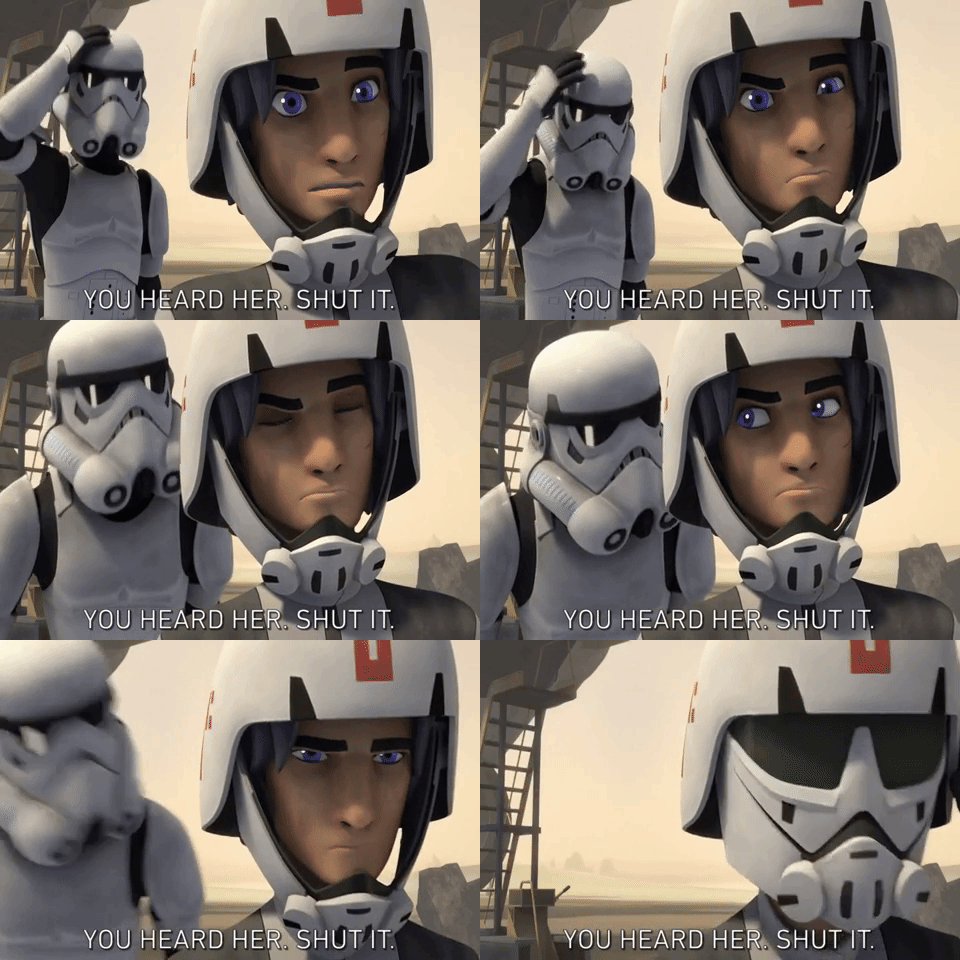
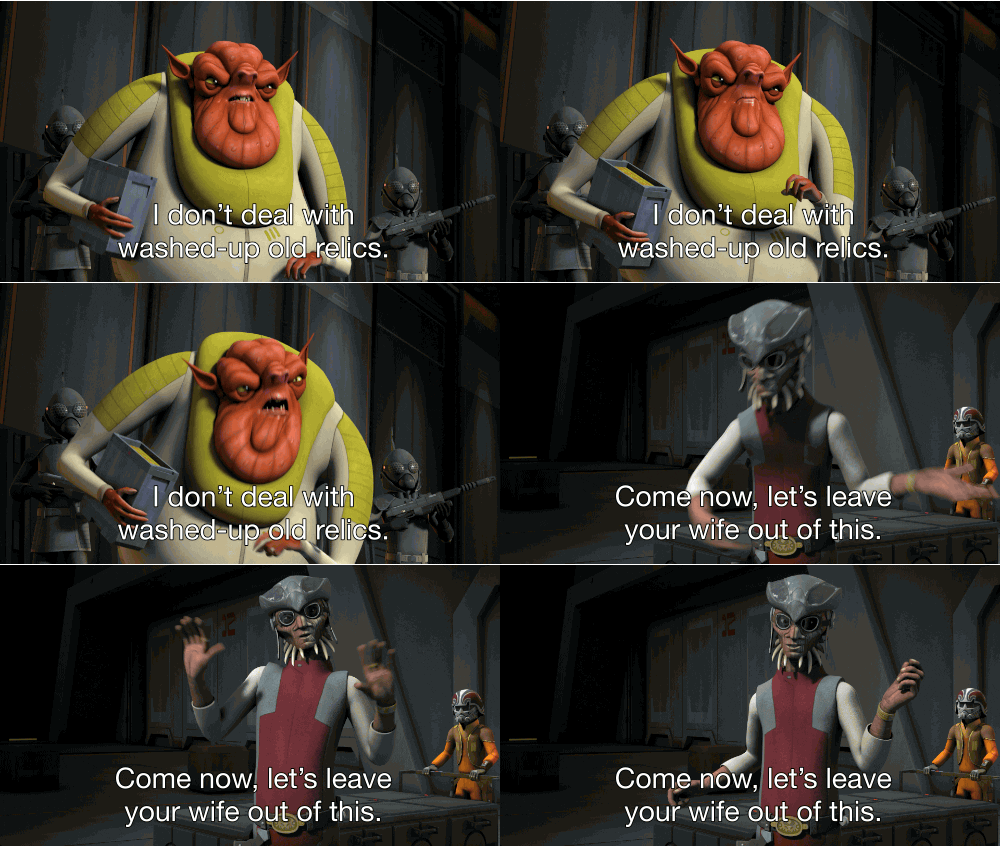
Another part of that is I get to listen to the word choice and the delivery, and how it makes each character unique. As with SW:Rebels, Kanan is often gruff, conservative and overly anxious, especially towards Ezra. Ezra, on the other hand, goes through an interesting metamorphosis from a plucky and erratic kid to a cranky and highly irritable teenager. And my all-time favorite character from the show, the pirate Hondo Ohnaka, has a quick and often hilarious wit that keeps everyone slightly off-course:

It took me several years to figure out how to write dialogue correctly. As with most young writers just starting out, I tended to imprint my own voice and mannerisms onto every character, which meant that there were far too many me-isms like bad puns, music references and wild shifting of subjects. It took me some time to realize I was doing it the wrong way: what I had to do was figure out who that particular character was and make their words unique to them.

Now? It’s one of my favorite parts of writing projects and exercises. One fun 750Words exercise of mine is to tell a short story that consists only of dialogue without any dialogue tags. This forces me to think about the story in a different way: how to evoke action and emotion only using someone’s words. Things like word choice, the flow of the dialogue and the delivery are shifted front and center.

When writing Diwa and Kaffi, I knew that each character had to have a unique voice, not only because they’re different in certain ways, but because they’re all different beings. The human Diwa is part Filipino and slips into Tagalog whenever he’s emotional or with his family. The dragon-like tintrite Kaffi speaks in slow, measured sentences but eases up considerably when he talks with Diwa. The bird/reptilian-like Anna-Nassi is often relentlessly happy and often talks too loud. The psychic-vampire Cole talks quietly but his sentences get choppy when he gets anxious or overexcited.

I wanted to let the characters tell me who they were, and I let a lot of these dialogue tics and come naturally. I would give them just a few rules: Cole, for instance, suffers from a kind of syndrome that occasionally affects his energy consumption and retention. A flare-up would cause his speech patterns to seize up. This, in turn, would inform the direction and the pacing of the plot arcs; Cole’s personal arc in this story becomes his learning how to work past this physical handicap, alone and with the help of his friends.

This is the reason why writing dialogue is so much fun for me: I get to learn who these characters are, quite often without any planning ahead of time. In turn, they give me insight on how they would react when I place them in certain situations important to the overall story arc. I’m always pleasantly surprised when this happens, because it makes the story unique, sometimes unexpectedly so.

Tabula Rasa

Courtesy of The Girl Who Leapt Through Time by Mamoru Hosada

[Previously posted on my Dreamwidth account a few days ago, sharing it here with minor edits.]

I feel like my writing process is in transition again. Maybe it’s because I’m pretty much running on 90% Editor Brain at the moment, focusing on the Diwa and Kaffi rewrite. [It could also be that the Spring Cleaning bug bit me pretty damn hard this year.] Usually when this happens, I’ll still have a serious itch to get some new writing done on the side, even if it’s just exercise. But lately that itch is nowhere to be seen. Not entirely unsettling, as I’ve had this happen before, and I’m not worried that my Writing Chops have deserted me…just that it feels weird to feel this and not worry about it.

I think one of the shifts in the process might be that I feel like I’ve done enough of scheduling. Now, scheduling is never a bad thing, especially for someone like me who doesn’t always remember when an event is coming up (or a vacation, for that matter), but that’s what my regular monthly calendar is for. I’m talking about what I call strict-scheduling — assigning myself a specific time or a certain project for a particular date, for instance. This is what my whiteboard calendar has been for. It’s something I’ve been depending on for quite a few years now, and I put it there to ensure that I’m working every day.

Now, I’m not so sure I need it anymore. I needed it in the past when I was having trouble getting myself back on track after a long dry spell. I needed it when I was updating my blogs. I needed it as a reminder for specific projects. It was something I’d been using for years to inspire me to get working.

I think I’ve gotten past the needing it at this point. It’s served its purpose quite some time ago and now it’s feeling like a bit of a hindrance. It’s no longer inspiring and feels more like a dreaded homework assignment and drained all the fun out of it.  So I’ve gone and cleared it — wiped all the scheduled items on there. It’s a normal calendar now. If I’m going to use it, I think I’ll use it for reminding myself of long-term deadlines and convention reminders.

Will I come back to use it again? Most likely, but I’m not going to worry about it.

As long as I remember to keep working, that’s all that really matters.

Going Online

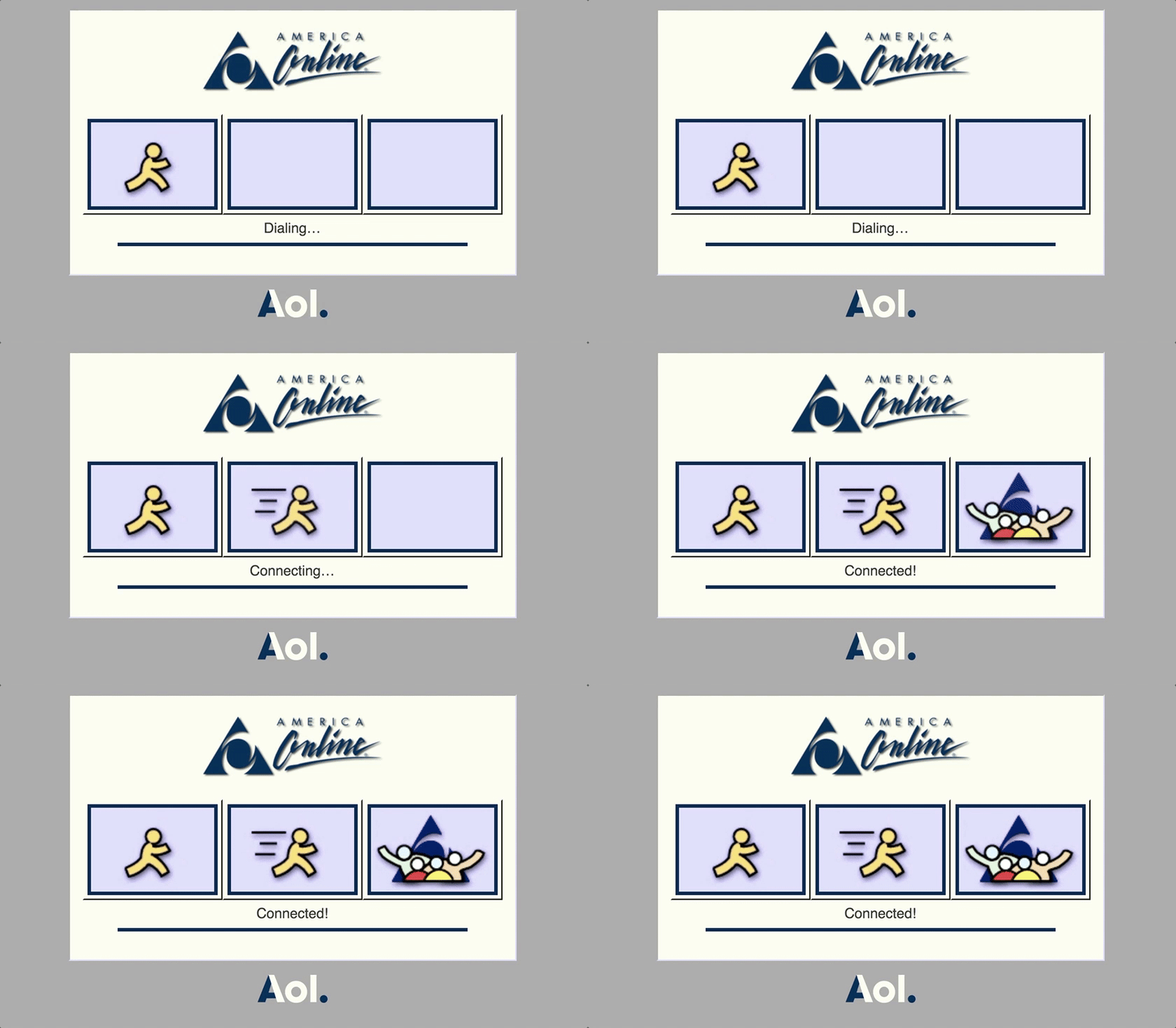
Don’t forget to add *70 to your dial-up settings!

Sometimes it blows my mind that I’ve been connected online for roughly a quarter century. I believe my first AOL account was in the autumn of 1994, using my roommate’s computer, which I used sparingly because I was too damn broke to pay for the subscription or the phone bill half the time. And even then, I mostly stuck to AOL’s chat rooms.

When I moved back home in late ’95 I talked my family into signing up for it. While the subscription and phone bill weren’t as hard to pay, it was reminding my family not to use the phone when I was online. Most of the time they remembered, but every now and again someone would forget, pick up the phone, and start dialing, severing my connection. (Surprisingly, it wouldn’t be until around 2001 or so when we finally got DSL. It just wasn’t available to us out in the sticks of central MA until then.)

I’d had various emails over the years and started the joncwriter one around 2001 (I think?), but it probably wasn’t until 2004 when I finally took the plunge into full-time social media with LiveJournal. And things have grown exponentially since then. So many platforms, websites, browsers, apps, and everything in between. I’m amazed I can remember half my passwords.

Mind you, I’m not complaining about how Kids These Days Are Always Online, or How The Internet Was More Fun In My Day. I’ve got other things to think about most of the time. It’s more about how I’ve eased off using the internet over the years.

Sure, I still use it a ton, more than I really should. I go through spells of overindulgence followed by bouts of internet detox. As a writer, though, I can’t completely disconnect. I rely on a lot of internetty things to keep me going. I stream radio stations during the day for entertainment and background noise. I have multiple links to online dictionaries and thesauruses (that’s a legit plural, I just looked it up on Merriam-Webster’s site). I almost exclusively download all my music now. It’s a vital part of my writing career. [Yes, even the music. Heh.] And most importantly, I save all my writing on Dropbox so I can access them at any time, even on my phone.

The trick is to catch myself when I know I’m just wasting time that could be better used elsewhere. Catch myself when I feel I’m getting worked up and caught up in the latest drama. Catch myself when I’m faffing about on YouTube watching viral videos. Easy enough to do, but sometimes it’s embarrassing when I realize how often I catch myself. I’ve had to figure out ways to keep myself from goofing off.

Lately, though, I’ve been doing a lot of logging off, closing the browsers. Not out of desperation or frustration, but just because I want to. Part of it is inspired by some of my pre-internet high school and college friends out there who are surprisingly impossible to find on social media — it’s like they decided that they’d rather have a real life than a digital one.

It’s also been a mental and physical choice. The longer and later I’m online, the harder it is for me to fall asleep at night. And sometimes I just don’t have all that much to say that I haven’t already written or blogged about already. Sometimes I just need to take a break and just use my PC or my laptop for its intended use: my writing and music.

I just recently bought a new laptop to replace an old one (which was dated 2013!!) and I’m once again out in the living room in the evenings, sitting next to A while we stream whatever movie or show we’re currently into, and I can focus on the revision for Diwa and Kaffi. I might pop online and check my email or the latest webcomic update or Twitter, but I’m doing that much less nowadays. And I kind of like that.

I’m not nearly as addicted to the internet as I used to be, which is always a good thing. Life goes on both digitally and IRL, and it’s up to me to find that balance that works best for me.

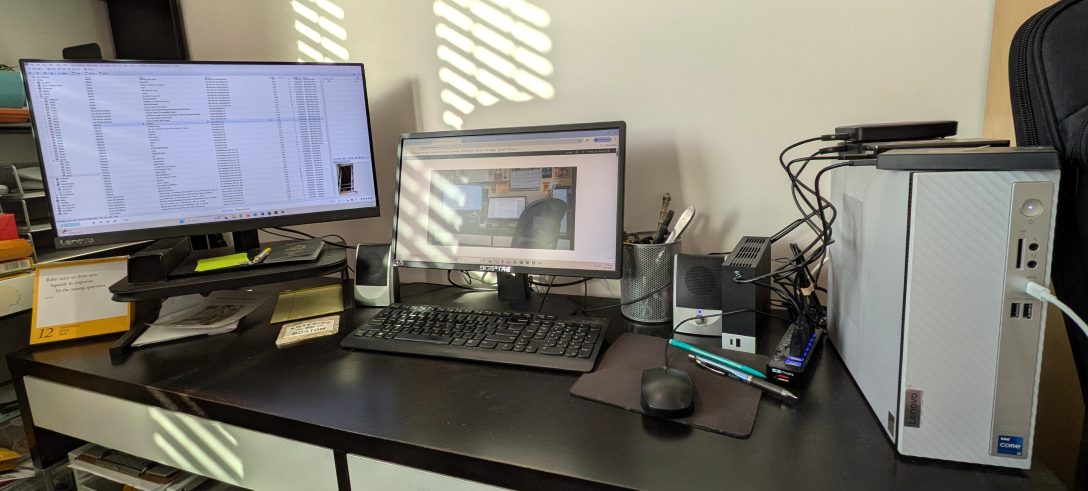
Something I should probably do more often with my desk PC…

[PS: This entry was partly inspired by a panel I’ll be running at BayCon this year: Strange Days: Hollywood’s Take on the Internet, Hacking, and the Digital World in the 90s. I’m looking forward to this particular one!]

The Magic of Tidying Up Spare Oom

KonMari would be proud.

It’s not as if Spare Oom is a disorganized mess, far from it. I pride myself for trying to keep as much floor space open as I can in here. But there are little nooks and crannies here and there that have accumulated years of forgotten collectibles, documents past usefulness, and all sorts of other things collecting dust.

I made some headway last week by thinning out a massive amount of those old documents (including the 2003 online receipt for my first all-new, not-a-hand-me-down PC through Dell!!) and readying them for shredding. [Note: our local restaurant supply store up the way, Kamei, came in very handy for buying shopping bags in bulk to use for shredding disposal.]

Last night I also ordered a new chair to replace the very old love seat here. We’re getting it from Home Reserve, the same place where we ordered our living room couch. They’re sort of similar to Ikea in that your furniture is delivered in pieces and you put it together yourself, but instead of fiddling with screws and allen wrenches and whatnot, it’s all put together like a giant three-dimensional jigsaw puzzle. The end result is surprisingly durable, nice to look at, and very comfortable. Plus storage areas under the seat cushions! Always a win.

Anyway! This is part of the Spare Oom Tidy-Up, sort of influenced by KonMari, so I can better utilize the space back here. My writing shelves are so disorganized they’re partly the inspiration for Samuel’s messy office in Diwa & Kaffi. I’d like to be more on top of the documents I no longer need. I’d even like to clean up the rear closet so there’s more room back there for long-term storage.

Why the cleaning? Because frankly, I’m kind of sick of finding corners with a year’s worth of dust, or having to move twenty different things and spend an hour routing through papers and boxes to find something for reference that I might be working on. And a VERY big reason: I have an extremely bad habit of being an “out of sight, out of mind” sort of person, putting things aside “for later” and never getting to them. And also, why the hell not? You know how it is…we all have that resolution to stay on top of these sorts of things but never follow through.

Now if I can manage to get the old love seat out of the room with minimal struggle…