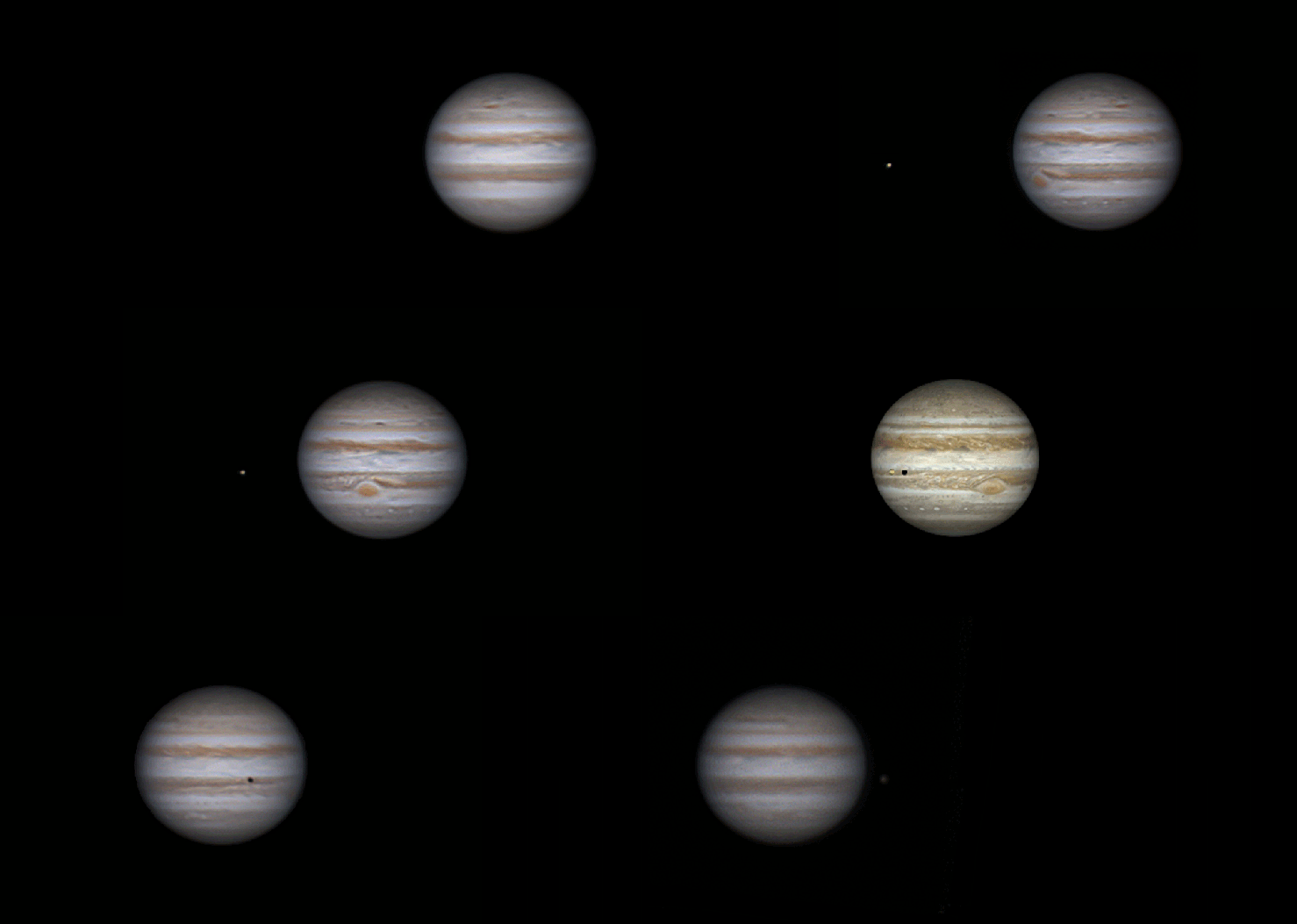
Timelapse of Jupiter from Io’s POV, December 2013. Credit: user ‘bubbleweed’ on Reddit
Recently I’ve hit a few tough patches in Meet the Lidwells, where it just feels like I’ve slowed to a crawl and the story’s not going anywhere. I know what story I need to tell, but for some reason it’s been like slogging through mud trying to get there. I know this is a problem because when I as an author feel the sluggishness, I know my readers will feel the same thing. And I don’t want to do that.
So in this instance, I decided that maybe someone else’s point of view would be worth investigating. Instead of the kids in the band talking through their attempts on a comeback album after taking a much-needed hiatus, I realized that it might be a bit more interesting to tell this struggle from their manager’s point of view.
Why? I felt their story would be more interesting. The kids in the band have mostly grown up (the youngest is now 16 and the others are in or approaching their 20s), and from their view, they’re just hoping that the Big Comeback will work out. On the other hand, their manager has the thankless job of Making That Happen. Once I got started on that, everything was smooth sailing again.
*
Over the years, changing the POV when I’m stuck has definitely helped when I’m stuck. More often than not a different witness to the story will bring in a fresh take on the situation, maybe even create some needed conflict in the process by going against what the main characters want and expect. Even if I end up not using it, or rewriting it again from someone else’s point of view, at least I’ve managed to get myself out of that sluggish spot and back on track.
For me, it’s yet another way to work outside expectations. Forcing myself to think about something from a different angle almost always produces sometimes helpful but always interesting results.
In a perfect world, writers, artists and musicians would be thrilled to be able to put their creation out there into the world, and have a positive (or at least constructive) response. It’s not a perfect world, so we’re reasonably okay with whatever we get, be it a bunch of lukewarm responses, very small but amazingly positive responses, or, if we’re really lucky, a snowball effect of growing positive responses. So we at least owe them something they’ll enjoy.
Do we owe our fans perfection? Well, that depends on who’s defining ‘perfection’ here. In normal situations, the writer defines it as ‘the best damn version of my creation that I can give to you, to the best of my ability.’ In this case, yes: we owe our fans our best work. Anything less than that, and we’re phoning it in. And fans can see phoning it in a lot more clearly than we as creators can. You don’t want to cut corners, say ‘fuck it, it’s done’ or ‘…oh HEY LOOK OVER THERE’ [whoosh of handwavium]. And if our creation is in an extended universe, the last things we want to do is kludge it with a bit of poorly applied spackle or reckless retconning, or worse, not even bother with the continuity.
However, we don’t owe our fans what they would consider a Perfect Story.
We do not owe them their perceived headcanon. Yes, our fans have invested time and care in our creations, and that’s really cool! But they’re not the ones driving this bus. The creator is the one dedicating a hell of a lot of personal and creative time planning how each intricate bit of action is going to unfold. If the creator decides to do or not do something in the story, I can pretty much guarantee that 99% of the time, the creators have a reason for it. We especially don’t owe them an explanation when we go against their perceived headcanon.
*
So why do I bring this up? Well, part of it is due to Sunday’s reaction to the unveiling of the thirteenth Doctor Who, Jodie Whittaker — the first female to play the role. It’s an awesome decision and for the most part everyone is thrilled by it. It’s the usual small-yet-vocal male contingent that are having issues with it. How dare they mess with an always-male institution?, they cry.
But it’s also partly due to frequent conversations I see between webcomic artists (frequently female) and their fans, where the reader (frequently male) has ragequit the series or released a Twitter tirade — or worse, harassed the creator through the comments sections of their work — due to their headcanon not actually being canon. And I’ve also seen it in a lot of anime and manga fandoms; for example, the ending of the Naruto manga series (and in effect its anime) was faced with a bizarrely antagonistic American backlash due to certain characters ending up romantically linked and others not linked. It was weird, a bit unsettling, and completely uncalled for.
I admit I haven’t had this kind of response to my books as of yet. That’s partly due to my relative obscurity at this point in my career, but I would not be surprised if it was because I was a male writer, either. That said, though, I still think about it. I write knowing that I’m probably going to piss someone off for one reason or another. I won’t let that stop me writing what I want to write, though. I can deal with that if need be. But it still baffles the hell out of me. It’s fandom expanded to bizarre extremes. It’s an extreme emotional reaction to something harmless and fictitious. It’s reactions unchecked.
I don’t owe anything to fans with that kind of reaction.
I just owe them a damn good story that I hope they’ll enjoy reading. That’s all.
Feeling frustrated by my less than stellar output lately. It’s the same damn thing, too…distraction and procrastination. A tiny bit of it is a not-high-but-consistent volume of work for the Day Job, which I can deal with. What’s annoying me is that I’ll have few spare moments to breathe and realign myself, and waste those moments my fucking around online.
Even more frustrating is that I’m even doing that off the Day Job clock. Time for my nightly writing session! Woohoo! Let’s go check Twitter first.
NO. NO NO NO NO. STOP THAT, DAMMIT.
I swear, if this keeps up I’m going to have to enforce another internet hiatus. Mind you, I’ll sort of be having one in a few weeks anyway, while we’re on vacation. It’ll be mostly fly-by blog entries and Instagram posts. Writing will most likely be a bit of longhand work on the Secret New Project, as I don’t plan on bringing a laptop. Hopefully I’ll get all this frustration out of my system and start anew upon return.
So! Let’s just get this all behind us and soldier on, shall we?
I’ve been meaning to scan my longhand writing for quite some time. For one reason or another, however, I’ve barely gotten around to it. The Great Trilogy Revision Project took up a hell of a lot of my time, enough where I couldn’t squeeze any of that in. Now that my work volume isn’t nearly as large as it once was, I believe I should be able to squeeze a little bit in now and again.
I used to be a pack rat with my writing, to the point where I had multiple copies of the same printed documents. I also had a lot of spiral notebooks that only contained maybe a few dozen pages’ worth of work. One of my first projects when we moved out here to San Francisco in late 2005 — mainly to keep myself busy while I waited for job openings — was to go through these countless printouts and shred what wasn’t needed. I had two large storage tubs, a few milk crates and two wooden boxes full of stuff when I started. As of today, I have everything in manila folders on two shelves of the bookshelf next to my desk, plus a few straggler folders elsewhere.
Over the years I’ve been meaning to create pdfs or something similar so I at least have a digital image of my work. The most obvious reasons are the security and the ease of access: I save all my writing-related things on a cloud already, so this would put everything in one place for reference, and so I wouldn’t have to worry about losing it. And if the apartment went up in smoke, the only thing I’d have to grab is my external drives where my music collection is!
I’ve attempted it a few times in the past, of course. The only failure those times was due to a low-end scanning device that took one look at the amount I wanted to scan, LOL’d at me, and decided not to work anymore. I now have a much higher-grade printer/scanner/copier — not to mention a lot more time to work with — so I have no excuse to put it off any longer.
So is any of this writing worth the work? On a personal note, sure. I have mostly fond memories of writing most of this stuff, even if I did end up trunking a high percentage of it. It’s part of what made me the writer I am now. You can definitely see the evolution of my writing style, the themes I often revisit, the imagery I like to use to tell my stories. My own writing also shows where my mind and emotions were at the time, and my attempts to make sense of them. I’ve even come back to a few of these trunked works to steal a scene or two for one of my successful books and stories.
Is any of it worth saving on a ‘donate my papers to a public/college library’ level? Maybe not, but it’s worth saving for my own reasons. It’s not just my stories, it’s the story of me as well.
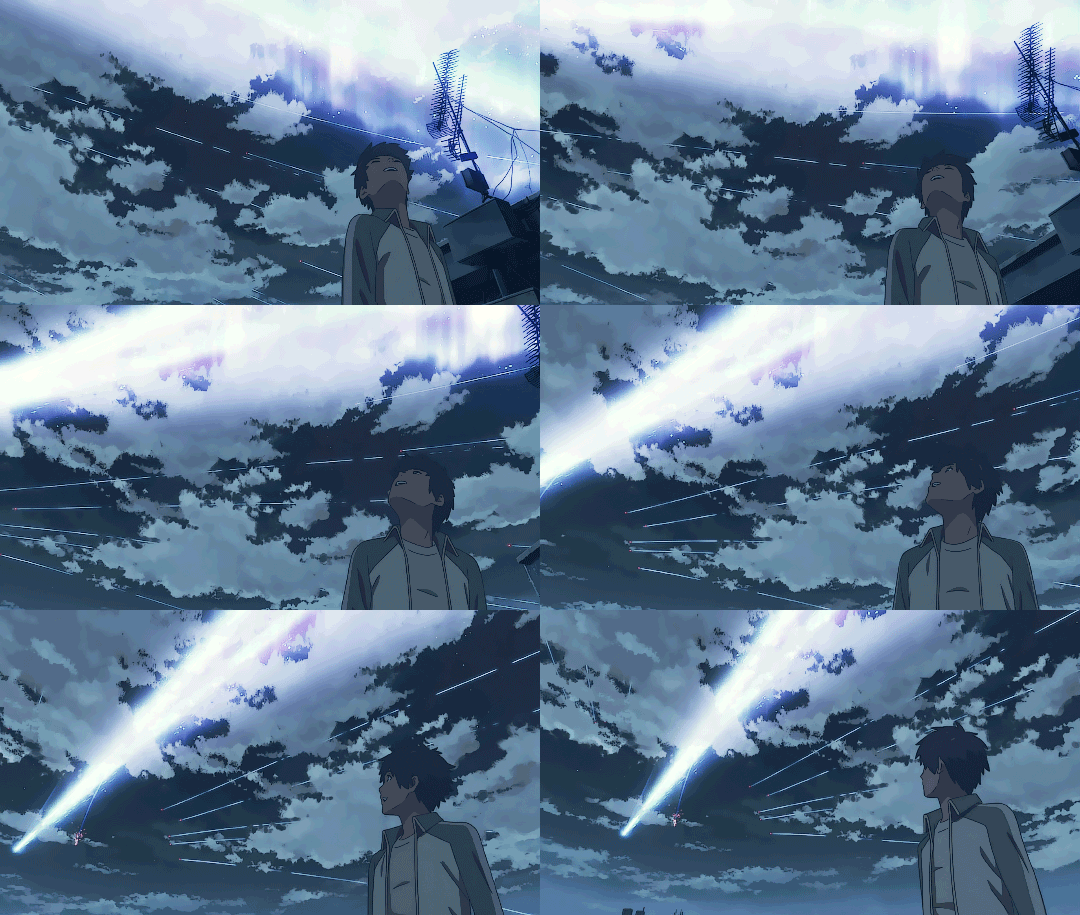
Still from the anime Your Name, which you should definitely watch.
Yes, yes, I know. I love talking about world building. It’s one of my favorite parts of the whole process. And one of the reasons I love it is because it’s always ongoing. Rarely do writers come up with a complete history of the characters and the world they live in. And conversely, quite often writers are thrown for a loop when an unplanned but much needed figment of a character’s personality shines through.
Recently while doing some work on the Secret Next Project, one of my main characters suddenly decided to change from snarky and a bit wild, to moody, highly intelligent and deeply caring. Part of this was due to a later outtake where I had him working with another main character (specifically a moment where they had to trust each other completely) and instead of trying to shoehorn him into my original idea of him, I ran with the new idea instead. Their connection with each other suddenly became an extremely important plot point, especially as it mirrors their fathers’ history.
I love it when a major plot line pops out of nowhere like that. It’s that moment where the larger story as a whole suddenly starts falling into place. [Mind you, my reaction to this is usually not an emphatic “YES!” but more of a smile, a nod, and a thoughtful yes, that should do nicely. Then I’ll spend the rest of the evening secretly squeeing on the inside.]
One rule I’ve given myself for Secret Next Project is to not dismiss ideas out of hand. If I come up with an unexpected leftfield idea, I’ll think it through and see if it’ll fit within the context of the larger picture. So far it’s worked quite nicely, as the story has taken at least four unexpected turns and has evolved into something much deeper and more complex than I expected. More to the point, it surprised me that it happened so quickly; I’ve only worked on this for less than a month and already I’ve got almost a full storyline idea. That never happens that quickly for me.
This also means that it’s clearer and more complete quite early on in the game; another thing that almost never happens for me. The same thing happened for Meet the Lidwells, to be honest; I already had a pretty solid idea of the entire story by the time I actually started writing it. I’m not feeling my way in the dark nearly as often as I did with the trilogy. With the Secret Next Project, I’m yet to work out the complete plot, but I’ve got nearly all the important beats I have to hit already.
To be honest, world building really is a game of balances. Elaborating versus using what you already have; choosing which fate works best for the character; creating enough to make it realistic but not getting bogged down with details.
There’s more to come, of course, but learning how to balance it all is the best part. That’s what makes the story, and the storytelling process, interesting.
It wasn’t as if I’d had an energy-draining day at the Day Job on Friday. In fact, it was smooth sailing for most of the afternoon. I kept myself busy by catching up on personal emails and listening to some new release tunage. After work we went for a walk to the Legion of Honor Museum up on the hill (it’s just a little over a mile from our house by foot, uphill 98% of the way) for a sneak preview of their Degas, Impressionism and the Paris Millenery Trade exhibit. A bit tired from the walk but otherwise just fine.
Did I get any writing work done, though? Not a word.
Nor did I get any work done Saturday, when we went to see a movie at the Opera Plaza (the documentary Letters from Baghdad) and afterwards stopped by Green Apple to buy a few books I’d been looking for. I did turn on the PC to update a few drivers and software, but spent the rest of the day catching up on webcomics that I’d been backed up on. [I’m a big fan of webcomics for multiple reasons and will most likely have a future post on them at some point!]
Sunday was shopping day, so hopefully some time tonight I’ll be able to squeeze in some Lidwells work. If I’m not distracted by other things! Heh.
It’s not all that often that I’ll take a day or two off without feeling some sort of guilt. I’m at that point in my writing career where I’m once again comfortable with my processes, that I don’t feel the need to rush to get things done. [I’ll still kick myself for procrastinating, but that’s more about getting my daily processes started in the first place.] I can afford a few days off where I’m living a normal life, watching TV and going out into the world and whatnot.
It’s a struggle of many writers, considering many of them are like me, juggling their writing career with their Day Job. You can’t really decide ‘I’m gonna play hooky from my Day Job, I deserve to do it now and again’, at least not without consequences and/or lost pay. On the same token, you don’t want to do that with your writing either, because a) that’s admitting your writing is less important (which you do NOT want to admit), and b) that’s one less day you’re moving forward, one more day your story is just sitting there, doing nothing. It’s also why, when writers do take a day off from writing AND their Day Job, it’s usually for vacation purposes and purposely doing nothing, and STILL feel guilty about it.
Still, it’s a struggle I’ve gotten under control. I’ve been hitting over 2000 words daily, between blog posts, personal journalling and occasional poetry writing, the 750 practice words on Secret Next Project, and Lidwells. My deadline stress is light. My near-future plans are clear. The docket is a hell of a lot clearer than it was just a few years earlier. I can afford to take a writing day off…especially if that day is spent reading and watching other people’s creations with an eye on what their own processes were! [See what I mean about Writer Brain never being completely turned off?]
I can afford to be lazy every now and again, and not feel the least bit guilty. I just need to remember to enjoy it!
Somehow I found myself listening to 1984 the last few days. It may have been sparked by hearing my favorite song by The Fixx, “Deeper and Deeper” (the end credits song to the movie Streets of Fire from that year) on an 80s Sirius XM channel. This in turn influenced yesterday’s Walk in Silence, with the various songs that I was listening to at the time. And as is my wont, I’ve gone down the rabbit hole and am listening to various songs and albums from oh so long ago.
I was thirteen at the time, seeing the back end of junior high and entering high school as a freshman, hoping that life would be a bit more exciting and less drama-filled. [Seriously, what is it about middle school and everything in life sucking?] I’d just started focusing seriously on writing, to the point where I probably spent more time on the Infamous War Novel project than I did on my homework. It just seemed a hell of a lot more exciting to me.
Thinking about it now, I’m fascinated by the parallels between then and now. A resurgence of ultra-conservatism, American exceptionalism, international terrorism, sexism, ism ism ism. I’m even a bit weirded out that we could fit Russia into this equation again.
With the current administration doing whatever it thinks it’s doing, I’ve been sort of preparing myself mentally to get through it. I could easily fall down the other rabbit hole — the one where I fall prey to the doom and gloom and feel like shit until it’s over and done with — or I can learn from the past and know that there will indeed be a light at the end of this tunnel soon enough. [Granted, this tunnel is a detour that we really truly did NOT need to take and it’s a big pain in the ass for all involved.]
Personal point being — to get through the troubles and frustrations of today, I’m thankful to have a decent memory of the past. It helps me to stay one step ahead of the beast.
In the context of writing: this is part of why world-building is so important to me, and it’s also why I’ve been working on future projects with the 750 over the last few years. When I was first starting out way back in the 80s, figuring out how it all works, I just sort of made up the scenes as I went along, with a somewhat vague overall plot line being nudged ever so slowly forward. The end result was patchy and inconsistent at best. Writing these practice words for a project I haven’t even started yet gives me just enough of a world and a plot to base it all in. It helps me to stay one step ahead of that beast.
It’s tricky, and you really need to know yourself and your own thought processes, but it’s worth it in the end. It’ll keep you sane, that’s for sure.
With my Sort of Secret Next Project taking up my daily practice words, I’ve been tearing down some of the boundaries I’ve had set up for ages. I suppose you could say it’s part of the ‘own it’ mantra I’ve been using lately…instead of trying to find reasons not to write a certain scene for whatever reason, I’m forging ahead and writing it anyway.
These are passages that work within the context of Secret Next Project, of course. It’s not so much about pantsing the writing as I’m letting myself come up with things that I would normally not write. Here’s the thing: when I’m writing a character, I have to have at least some connection with them, whether mentally or emotionally. I get inside their head and see how they tick. This is all well and good, but there is the tendency to write samey characters, or worse, write Jonc Personality #483.
I tried (and I think mostly succeeded) writing this way for the trilogy, especially when I had to get inside the head of characters like Denni and Amna, who were major players with a hell of a lot of stressful issues going on. I think this is also partly why I trunked some of my earlier novels, because I’d failed.
The Secret Next Project involves quite the menagerie of characters, so I definitely need to stretch my boundaries there. In writing my daily practice words, I’ve been doing my best to set as few boundaries as possible. In the process, over the last couple of days I found myself writing some passages that surprised even me! And I like that feeling. It means I’m doing something right.
…That said, it also means I still need to focus mostly on Meet the Lidwells. Which means the Secret Next Project is currently also the I’d Rather Be Working On This Fun New Project Instead Project.
This is what being a writer feels like sometimes, folks.
Another thing about perseverance, especially when you want to be a writer, is knowing full well that you’re going to face-plant into that next tree, but you go ahead anyway, scream “Yoiks, and away!” and make the jump.
It took me a long time to figure that out. I’d say most of my 90s output was really just about fostering the writing habit, getting used to it, getting better at it, little by little. Sure, I had delusions of grandeur that I’d be able to sell what I was writing, but there was always a small part of me that knew those delusions were exactly that. My attempts at submission then were during a time when I had no idea if I was any good. If they’d get accepted, then I’d figure I was on the right path and doing something right. If they didn’t, well…at least I knew that I still had some ways to go.
I still metaphorically face-plant into trees on a regular basis, of course. This time it’s less about quality or submission success, and more about dedication and time management. On Wednesday I wasted too much time doing other things that I didn’t give myself enough time for my daily practice words. I only got a few hundred down before I had to log off of that and get some Lidwells work done. I made up for it Thursday by avoiding Twitter* and making a point to get the practice words (and a few other creative things) out of the way early.
(* – Well, given that it was filled with comments, hot takes and livetweeting of the James Comey hearing, I had good reason.)
That’s the thing, really…despite the face-plants, I still have to shake it off and jump again at the next opportunity. Maybe one of these days I’ll clear all those obstacles.
When I’m pantsing my writing…which I’m trying not to do this time out.
I supposed you could call my preferred style of prose ‘character-driven’. The way I often create stories is to put characters in a scene and try to figure out how they react — to the situation, as well as to those around them. This reaction often drives where I’ll go with the plot next.
Noted: it’s not as if I let them run rampant in the scene to the point where I have no idea what comes next until I get there. I just have them going from Plot Point A to Plot Point B and I pay attention to their movements and emotions. There’s a few reasons I do it this way:
–The character is always evolving. One of my worst errors in a lot of my early attempts at writing was that the characters had style, but they were static; they never changed. And when they did, it felt forced. I don’t always expect each one to change completely and irrevocably…more that I just want them to evolve in some way.
–I pay attention to how they interact with other characters and use that as part of their evolution. A good example is Christine Gorecki from my trilogy: originally she was a one-off character, but her initial single walk-on part with Sheila and Nick worked so well that I had to expand her role considerably. She was obviously well-loved by all the main characters that she needed an important role as well as her own personal story.
–Quite often, the interaction between the various characters gives me more background, more grist for the mill. One character’s personality will irritate the hell out of his brother after a while, which in turn gives me a subplot dealing with the two brothers not talking to each other for a year, which in turn gives me a scene where they have to sit in the same room and talk to each other and behave.
In a way, my writing process is a mash-up of half-pantsing and half-outlining. I have a solid (if vague) idea of where the story is supposed to head. Lately I’ve been calling that the backbone or the spine of the story. But I keep the movement of the story fluid, keeping it open for change and unexpected inspiration.
In the process, any major arcs in the story feel less action-driven and more personal. The action moments end up being there for a reason; it’s less about playing plot point bingo or trying to Save the Cat and more about how life puts unexpected hurdles in our path, and how we respond to that. Personally, I find that a MUCH more fulfilling story.