Writing the End

the end

The beginnings of my novels and stories usually get the most revision, mainly due to the fact that there’s a bit of flailing involved.  I’m still trying to figure out the voice and the focus of the story, so there’s going to be a lot of dead-ends and extraneous filler that gets cut out, once I find my footing.

The endings, on the other hand, can go either way.  Usually I know exactly where I want to stop; it’s just a matter of laying out how I’m going to get there.  It’s a balancing game at that point…I don’t want to rush it, nor do I want to pad it out with unnecessary rambling.

I’ve made all kinds of errors in my years of learning how to write stories. I’ve written corny cliffhangers, implausible wrap-ups, unimportant ‘where are they now’ passages, and everything in between.  [I can proudly say I have yet to write an ‘…and then he woke up, and it was all a dream” ending.  Even I have my standards!]  I usually spend as much time focusing on nailing the end as I do nailing the most important climactic scenes that come before it.  I want to do it just right.  Or right enough, where it can be fine-tuned in revision.

With Meet the Lidwells — I’m currently writing the last chapter at this time, and I should be done most likely this week or next — the ending has definitely been a tough one.  As this is a story written in the format of a music biography, I can’t give it a nice poetic ending, or a roll-credits ending.  Those books tend to resolve themselves in a slightly different way.  The focus characters go on with their lives and careers, so this ending has to be more of an emotional closure.  That part of their lives is over now, and they’ve moved on.  And that’s been a hell of a tough one to capture just right.

I’m not looking to nail the ending perfectly, at least not right now.  But when revision comes along, hopefully I’ll be able to do it justice.
Anime Nights

A. and I decided to restart our Anime Nights, something we used to do at our old place in North Beach but hadn’t done in ages since.  I’ve always been a huge fan of anime since the mid-90s, though my watching habits always tend to come and go, depending on how much time I can devote to it and when it’s available. I was a huge fan of Cartoon Network’s Toonami back in the ’00s, and it introduced me to some great titles like Naruto (of which I’m still a fan), One Piece and more. We would also rent out anime through Netflix, checking up on some great titles like Haibane Renmei, Ergo Proxy and Trigun.

I kind of let it go for the last few years, mainly due to wanting to focus on finishing and publishing the trilogy, and also needing to get myself back into a consistent writing habit.  But lately I’ve come to realize that maybe I should at least take a night off and watch more of the things that inspire my writing in the first place.  Maybe in the process I’ll be inspired once more by newer, different stories.

Last night’s viewing, courtesy of Funimation, was finally catching up with Yuri!!! on Ice, which I believe all of our otaku friends have already seen when it was first released not that long ago.  It’s a lot of fun to watch (and I now understand the plentiful shipping that went on back then).

I should also point out this was a great example (one of many) of why I love anime so much: it’s a cartoon series about competitive figure skating. It proves you can write a compelling story about pretty much anything, whether it’s about sports or cooking or high school girls starting a rock group. As a writer, it reminds me that no idea is too weird or too corny or too goofy.  It really is the storytelling that counts.

It’s also made me think about finite serial storytelling. For instance, something like Cowboy Bebop. It tells a specific story over the course of its twenty some-odd episodes and its film, but it also has many shorter stories within the span of each episode. That gave me a lot to think about as a writer; it made me rethink how to interweave the main story arc around several smaller subplot arcs.

[I should add that I recently rewatched an episode while on our flight home from Boston, and realized just how great that show really is; I definitely need to watch it again.]

Then of course there’s my favorite movie of this year, hands down: your name.

I’m totally a fanboy for this film, because a) it’s beautifully made with some absolutely stunning shots, and b) its storytelling is amazingly detailed (I pick up more bits the more I watch it) and woven together in a really creative way. On the surface it looks like a girly ‘star-crossed lovers’ story but it’s not. I’ve watched it three times already this year (twice during our UK trip earlier this year) and I’m pretty sure I’ll watch it again before the year is over, just to study the storytelling.

So yeah…I’m looking forward to watching more anime in the coming months again.  It’s not only fun, it almost always inspires me to come up with new story ideas and storytelling styles.

Writing Econo

The great 80s punk band Minutemen from San Pedro, CA had a wonderful motto: “we jam econo.”  Tight playing, minimalist lyrics, dispensing with frivolous musical wankery.  Economical writing, playing and touring, in other words. Their songs rarely hit the two minute mark; many were even under the one minute mark.  [Despite the brevity of their songs, they state their name was actually making fun of the 60s rightwing fringe group of the same name.]

I wrote Meet the Lidwells with the same idea in mind; after the sprawl of the trilogy, I wanted to ‘write econo’ — dispense with as much subplotting as I could, tighter writing, constantly pushing the story along.  As of this post, I’m writing the last chapter of the first draft.  It looks like I may even complete the novel within the next week or so.

I started it on 28 April (not including a few weeks’ worth of outlining on index cards, as well as outtakes on 750 Words), and if I end it by the end of October, that’ll be exactly six months.  Its word count is around 75k, and by the time I revise it, it’ll probably be just a little higher.  If I play my cards right I might even be able to have it up on Smashwords and Amazon by the end of the year.

Those are new records for me, I think.

As I’ve said before, one of the reasons I wanted to try writing econo is to see if I could do it.  And if that worked out, then maybe I could continue with it.  I love writing sprawling genre fiction, don’t get me wrong…just that sprawl doesn’t always work with some of my ideas.  [Another reason of course was that after working on the trilogy for so damn long, I wanted to work on shorter, quicker projects where I could turn it around in a year or less.]  Sure, I did waste some time in between with distraction and procrastination, but still…six months ain’t bad at all.

I still have to revise Meet the Lidwells once I’m done with it, but at this point I’m thrilled that I was able to pull this off as quickly and as smoothly as I have.


Behind the Scenes

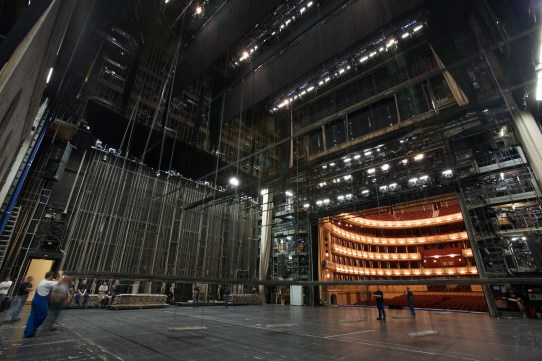
Vienna Opera Backstage, Austria
Vienna Opera House pic courtesy of Wikimedia Commons

Every now and again I think of how fans see their favorite writers or musicians or performers when they’re not center stage with a new project.  I get to thinking, this band has finished their tour, they’ve already released all the singles from their latest album, and they’re out of the limelight.  So what are they doing at that point?

Well, the 80s told us that all the bands were hanging out on the Sunset Strip and getting completely shitfaced and taking an apothecary full of drugs and partying until it was time to start the whole album-tour rollercoaster again.  Or something other ridiculous, overblown stereotype of some sort.

The era of social media shows it differently.  Nowadays, we find that artists are working at their day job or completing freelance projects and selling their own wares at conventions.  Musicians are bringing up a family or helping out a friend at a recording session.  Writers are slogging away, trying to make deadlines and heading out on book tours and conventions.  Any one of them might be taking a breather so they can just be regular non-famous people.

I think about something Paul McCartney once said about the length of time it took for the Beatles to record Sgt Pepper’s Lonely Hearts Club Band: “Because we were done touring, people in the media were starting to sense that there was too much of a lull, which created a vacuum, so they could bitch about us now. They’d say, ‘Oh, they’ve dried up.'”

I sometimes also think about the time it takes from a writer saying ‘I’m working on a new project’, maybe giving out vague details about it, to the time they tweet ‘YAY!  It’s done!  Off to my agent/editor!’, to the time they announce that it’s being released.  Back in the internet age you were never sure how long it took, especially when some writers like Stephen King could have multiple books and stories out within the span of a year, while other writers might not see publication until a decade after their last release.  Nowadays you can follow your favorite author In Real Time.

I think this might be one of the reasons why some writers are always pleasantly surprised when their book gets a positive response.  They’ve lived with that book for anywhere from six months to a few years, and it’s all their own creation.  They wrote the score, they built the sets, they sang the arias endlessly to get them just right.  Perhaps maybe a few lucky backstage friends got to beta read.  They or their production crew (their agent and/or publisher) may have even done the artwork for the program.  They put it in the hands of their agent, in hopes that someone will be interested.  For all intents and purposes, it’s a one-person show almost all the way to the end.  And when they get there, they’re so immersed in their story that they’re really not entirely sure how the public will react.

It’s one of the most interesting paradoxes in the creative arts; you create something for the public to enjoy, and yet you’re never completely certain if you’ve done it right until they see it.  But if you’re lucky, you have, and all that work will have been worth it.

Let’s Try That Again, Shall We?

high fidelity bruce

Best Laid Plans were once again thwarted, and I’m pretty sure it was because they weren’t Best Laid after all.  I seem to have forgotten to take into account vacation days off, busy Day Job days, and other events.  But that’s okay!  I’m back, we have nothing of import on the schedule for the next few weeks — in fact, I have today off and other than going around the corner to go see Napping Princess at the 4-Star, I have the entire day to get caught up on things.  Sounds good to me!

[Update: My movie plan was not so much thwarted but delayed today.  As you may have heard, there are currently some nasty wildfires burning north of us, and late last night much smoke drifted our way.  This caused me to barely get any sleep, so I wasn’t really up to seeing a film today.  Perhaps next weekend if it’s still there!]

One good thing that’s come out of this sort of thing is that I no longer feel like a failure.  Sure, the frustration of going past deadline and not hitting my goals as quickly as I’d like is still there, but Everything Is Not Ruined Forever.  Just gotta get up, brush myself off, and start again.

I’m nearing the end of the first draft of Meet the Lidwells and I hope to get it done by the end of this month, at which time I’ll start revisions.  I’m not sure how long that’ll be, but hopefully I can give it a quick turnaround (there won’t be nearly as much triage as I had with the trilogy) and get it out by the end of the year.  Here’s to hoping!

Onward and upward.  Only way to go!

On the Road

fall-leaves-autumn-gif-7

I’m writing this a few days in advance, but by the time you read this, I shall be on the other side of the country, back in my old stomping grounds of western Massachusetts, visiting friends and family.  And if we timed it right, I should be there just as the fall foliage is in full bloom.

I’ll be honest, I always lay down Best Laid Plans when it comes to writing while on vacation.  Sometimes I’ll get a goodly amount done, but other times I won’t even touch the notebook or the Word file except on the plane.  I don’t really mind, though.  Sometimes I gotta look up from the page and talk to real people instead of the characters in my head!

I guess it really depends on how much work I’m willing to dedicate to it, where I’m at in the project, and what platform I happen to be using.  I most likely won’t get any work done on the Lidwells project aside from maybe a bit of line reading.  I might do some plotting and note-making for the Next Project, as I’m still in the index card phase there.  And I most likely won’t do any work for Future Project, as that’s not even to the outline phase yet.

I can certainly write while on the road. I’ve always been able to do it.  Thing is, I’m not always at the right spot in the project where it’s feasible.  I can write on a laptop, but I don’t always bring it with.  I’ve done some editing on my tablet, but writing is quite awkward.  I do kind of miss the days of dragging a notebook around and winging it longhand…maybe I’ll start the first draft of the Next Project longhand, just for the fun of it.

That is, if I can find the time in between all the visiting and road tripping!

Schedule Shuffling

shuffling cards a
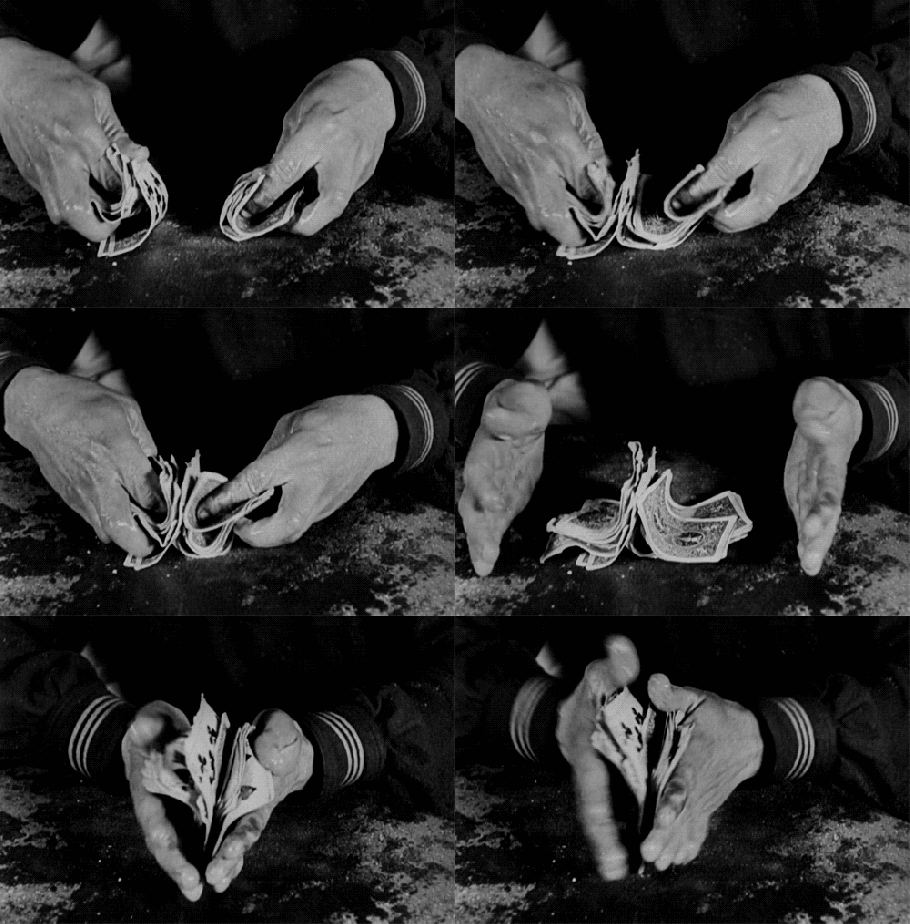
Just for the record, I have never been able to successfully shuffle a pack of cards like this.

For the first couple of days this week, I’ll be heading into the office across the Bay, as we’ll be rolling out a new platform that should (hopefully) make our work just that little bit easier.  I’m not exactly holding my breath, but we shall see.  And next week (the first week of October) we’ll be on the other side of the country visiting friends and family.

Which means that my writing schedule is going to be all kinds of wonky.

BUT FEAR NOT!  Because this time out I’m attempting something new and unexpected: I’m doing a bit of shuffling to prepare for this time when I’m afk.  One thing I’ve been doing is creating a backlog of blog entries so I won’t be posting fly-bys or skipping it altogether.  I’d like to keep y’all educated and entertained.

Anyway!  My point here is that lately I’ve been looking into how I can get more out of my writing time.  One of my worst habits when I was a teenager was doing my homework the night before it was due.  [And yes, this included writing term papers.  I was an epic procrastinator.]  The downside was that I knew I was a good writer, I just never let myself have enough time for it.  I’ve learned to get better at that in my adult years, but there are still moments when I feel like I’m squeezing out the last drops of creativity at the end of the day after doing a billion other things.

This is where the backlog come in.  I can get away with it because I’m not going out of my way to write blog posts that are up-to-the-minute.  So instead of writing the posts the night before like I’ve been doing, I’ll write them when I have a few spare minutes during the day, and especially when the inspiration hits.  And on top of all that, I can look at the calendar and see that a blog entry is due, and breathe easy knowing that it’s already been done.

Whatever works, right?

shuffling cards b
Also for the record, this is what it looks like when I *do* attempt to shuffle them in that manner.

On Writing ‘Regular’ (non-genre) Fiction

snoopy short and to the point

I’ve been writing genre fiction — that is, some kind of science fiction, fantasy, or one of its many mutations — so consistently and for so long that writing non-genre fiction (or as I’ve been calling it, “regular fiction”, no snarky meaning intended) feels a bit weird to me.

This is the issue I’ve been having with writing Meet the Lidwells over the last few months.  It’s still a made-up world that I’m writing about, but I’m trying not to confuse ‘bad writing’ with ‘a style I’m not used to’.  I don’t think MtL is a bad piece of work, even at this rough draft level.  It’s just that my creative brain keeps complaining that there’s no epicness or high drama going on.

But this is not a Michael Bay action film.  This isn’t the novel for that.  It’s a simple story about a family of musicians.  Their epic moments are about topping the charts, going on tour, and recording a new album.  Their high drama is having to deal with family to such a close extent both in private and public life.

To be honest, this is exactly one of the many reasons I chose to write this novel.  After finishing off the epic drama of the Bridgetown trilogy, I wanted — no, I needed to dial it back.  I wanted to make sure I could still write a story with a much lower volume, so to speak.  I needed to know I could write a story that resonated on a personal level rather than on a visceral one.  And lastly, I needed to know I could write something short and concise, perhaps closer to 70k words rather than the 100k-plus of the trilogy books.

So far I think I’ve pulled it off.  In fact, in the process I’ve figured out how I can write further non-genre novels, if I choose to.  My reading habits have definitely helped me figure most of it out, as has the daily practice words.  Will I write more non-genre in the future?  I’m pretty sure I will, given the subject and inclination.  It’s already affected my SFF writing style in positive ways, to be honest.  It’s the kind of ongoing metamorphosis that I believe is not only healthy but vital.

Once I’m finished with MtL, I’ll be jumping into the Secret Next Project (aka the Apartment Complex story), so it’ll be back to genre…and now I’m curious to see how MtL‘s style affects that one.  We shall see…!

Questionable Writing Advice

nathan fillion nope
Me too, Nathan.  Me too.

In a recent issue of one of the few writing magazines I subscribe to, they provide a multi-page article (in garish school-bus yellow, I should add) of “what agents hate.”  I only briefly skimmed it, having had the sense that this was going to be little more than a list of personal irritations that may or may not be helpful to the writers reading it.  I found it more annoying and self-important than helpful to be honest, but that’s just me.

One that did kind of rub me the wrong way was one in which said, and I quote:  If you don’t know how to write a compelling pitch for yourself, you probably should not pursue being a writer.

I mean, I get the context:  this agent has a personal issue with writers who fail at trying to sell themselves.

On the other hand, I personally know a hell of a lot of writers and artists out there who can write phenomenal prose or brilliant dialogue or draw beautiful sequences…yet doing something so compact and microscopic as a one-page advertisement for yourself is a fucking nightmare.  Trying to distill a hundred-thousand-word story that you’ve worked on for lord knows how many months into twenty sentences is a hell of a lot harder than it looks.  It’s two completely different types of creative thinking, and it’s hard as hell to switch easily from one to the other.   Some writers/artists just aren’t as good at the elevator pitch as they are at telling the story.  [Speaking from experience, I should add.]

If anything, I’m thinking they should have maybe rephrased that to be a little less, I don’t know…snobbish?  Soul-crushing?  I’m not sure what word to use here, other than they’re an agent I will most likely not submit to, just on attitude alone.  You’re an agent, you’re supposed to help the writer, not chase them away with Fame platitudes about ‘only the best survive’ and turn them away before they even start.  Yeah, I know, it’s a small field with a crapton of wannabes.  I’m still not a fan of that kind of thinking.

Anyway.  There were also your usual bingo-card points of advice:  kill the adverbs, kill the non-‘said’ dialogue tags, don’t self-edit, farm it out to your writing group, submit only your best work, follow submission directions on the website, don’t hassle the agent/publisher, etc.  Be gracious.  Be patient.  A lot of it does make sense, of course.  YMMV, as they say.

And as I’ve mentioned plenty of times before, some of these are reasons why I’m a self-published author.  I want to be able to successfully edit my own work.  I want to go against the grain.  I’ve gotten better with the pitch.  I don’t think I’m at pro-level yet, but I’ll get there eventually.  I like working on my terms instead of shoehorning myself into everyone else’s.


So.  Anyone else come across some questionable writing advice lately?


Current Status: Almost There

sw almost there
TFW you’re writing Act III of your novel.

As I may have mentioned earlier, I’ve just started Act III of Meet the Lidwells.  This of course means that it’s that point of the story where I start bringing all the plot threads together, winding up the tale I’ve been telling, and wrapping everything up at the end.

Having either written novels piecemeal over the course of a long spread of time (thanks to homework, social life, or other priorities), or working on the same project for years on end (the trilogy), it feels quite strange to be completing a novel in roughly a half a year.  I’m not used to this speed.  There’s also the fact that this is a relatively short novel for me — I’m currently at 55k, and I’m expecting the finished project to be around 70k.

Still, there’s something to be said about reaching the home stretch. I felt this when I picked up The Balance of Light again in 2009-10 to finish it off.  It’s exciting to be wrapping up a story, my writer brain going at a hundred miles an hour as it tries to weave everything together into a coherent ending for me to write, and balancing that with the knowledge that I need to make that ending smooth and well-paced.  No rushing to the last page here, kids.  Even if I know exactly how to finish it, I have to make sure I don’t make a chaotic mad dash to get there.

My original deadline was going to be mid-September (I had a general deadline, not a specific one), and it looks like it might be more like late October, given that I still need to revise it, clean it up, and get it ready for uploading.  I’m fine with that; my ultimate goal here was to write something fast and light — a complete opposite to the trilogy, to be honest — to see if I could do it, and to see if it was something I could be proud of.

So far, so good.  I’m almost there.