On Not Writing: Trying Not to Feel Guilty for Taking Days Off

DSC02114b
In which I am the 1,459,476,874,686th person to take this picture in San Francisco.

After so many years at my day jobs, I was finally able to take my birthday off (January 22nd), so I decided to give myself a nice long four-day weekend.  We both had that Thursday off, so we decided to go out and about and have fun.  We hit a few of our favorite spots (bookstores, a yarn store, our local sushi boat restaurant) as well as visit a few new ones (Alamo Square, Bi-Rite Creamery and Brenda’s Meat & Three on Divisadero).  We even watched some anime that evening.  All in all it was a nice relaxing day, and the weather was perfect for it.  I spent most of Friday afternoon in the dusty dollar bins of Amoeba Records as a birthday present to myself. Yesterday we went to see a Tom Stoppard play (one of my favorite writers) and went out for dinner afterwards.  And today has been for cleaning and shopping.  Only now, at 3pm on Sunday, am I finally making an attempt to get some writing done.

Aside from a few blog posts and one day of daily words, my output these past few days has been pathetic.

Thing is, I hardly made an attempt.  There were a few moments there where I felt the pull of my daily words or my personal journal, but I chose against it.  It wasn’t a decision made out of being lazy–it was one made on purpose.  This was a way for me to remind myself that it’s okay to take a day off every now and again.  Even if there’s work to be done, sometimes it’s better to stop and smell the roses instead.

We writers often pride ourselves on being able to write whenever and wherever and for ridiculously long bursts at that, but we’re also our own worst enemies when it comes to deciding not to write.  Sometimes we must because of deadlines, or because it’s the only way to get any work done at all, but other times we don’t know when to quit for the day.  Yes, we could be out there watching a football game or walking around the neighborhood, or even sitting on our butts for six hours playing video games, but too often we deny ourselves that moment of entertainment.  Every moment without pen in hand or fingers on keyboard is a moment wasted.

That bit of guilt is still there, days later.  I only managed the daily words on Friday, breaking a 23-day streak, and I haven’t written in my journal since Wednesday.  I didn’t write any new words for Walk in Silence, but I did reread a few passages just to remind myself where I was.  The only thing I’ve done that remotely involves writing lately is read Steven Pinker’s The Sense of Style as part of my self-assigned homework.  After years of avoiding active study of style manuals and books on how to write well (caused by a tenth grade English teacher who tried to teach me how to analyze prose within an inch of its life), I thought it was high time to face that demon once and for all.

I know I’m still going to feel guilty that I squandered all these days off and broke that streak, but life goes on.  I truly enjoyed the days off.  I got errands done that needed doing.  I let myself spend a bit of coin on one of my favorite hobbies.  I shot some pretty decent photos of the local scenery.  And I got to spend some serious facetime with my wife, who usually finds me hiding up back in Spare Oom instead, nose at the grindstone.

Besides, my writing time will be back to normal come tomorrow.

On Writing: Stealth Mode

I had another crazy idea the other day.  You know how it is…when I really should be working on my main project (in this case, the book Walk in Silence), my brain decides it wants to try writing a new, exciting story idea.  Equal parts Ooh Shiny and No I’m Not Procrastinating Really I’m Not, to be honest.

This crazy idea was to unconsciously write a novel.

Here’s the thing–my daily non-project words as of late usually end up being 750 to 1000-word passages of one ongoing theme or another.  I’d done this previously, last year (it’s the cat-and-crow idea I mentioned in this blog previoiusly), and it’s a good way for me to keep in the practice of figuring out the theme and plot of a story.

So as usual when I’m on the treadmill at the Y, listening to my mp3 player and contemplating my next writing moves (yes, that is really what I do when I’m at the gym), I started doing a bit of math in my head.  If my daily words at 750Words.com are hit every day, and I write something with the same theme each time, I’ll have a full novel of around 70 to 90k words by March.  Sort of like an extended NaNo project, only instead of trying to shoehorn around 2k words in one of the worst months for productivity, it’s a more leisurely three-month workout during the slowest business quarter.

So what is this about writing unconsciously?  Well, it’s not like I’m trying to write something without paying attention…it’s more of an attempt to write something organically, letting it expand on its own.  But more to the point, this would be about writing a novel without really planning to.  Writing a novel just for the hell of it, instead of trying to write my next attempt at publication.  I have no idea if it’ll pan out, or even if it does, whether it’ll be publishable after revision.  I don’t do that all that often–let’s be honest, a lot of writers just don’t have the time to do such a thing in the first place–but considering my daily 750 is non-project, non-serious writing, it would be interesting to see if I can pull this off.  Thus the stealth mode–writing but not paying that much attention to it.

I may fail miserably on this, or it may be my unexpected heartbreaking work of staggering genius.  Won’t know unless I write the damn thing, yes?

On Writing: Dead Letter Office

I know I’m not the only writer who comes up with more ideas than they can possibly work with. Just today I’ve seen at least three Tweets from published writers opining on ideas they would love to work on, but alas time is short and other projects loom. These possible ideas may never come to light. And the thought of orphaned ideas kills us every time.

This popped into my mind the other day while I was doing some playing around with a possible future project. I use my daily practice words as a Word Playground just to give my brain a stretch (and to prime the pump, if need be). I had a peculiar waking dream the other morning that I was part of a musical family band — sort of like the Osmonds, only set in the 80s-90s — and thought I’d riff on that. The practice words turned into a ‘Where Are They Now?’ story, in which each member would tell the same part of their shared history, only their views were vastly different. The words came quick and easy, as did the separate character voices.

So, you’re asking. When the hell are you going to get around to writing that, when you’ve already got a bajillion other things going on? That is a very good question. I may get to it, I may not. I really don’t know. Does that bother me? It used to in the past, a bit. But since I’ve been writing for most of my adult life and have worked on a large number of projects over the years that have seen various states of completion, I’m not too worried about it.

It also got me thinking–what about the ideas I like, that I may not ever get around to working on? The ones that sing to me, but not enough for them to take precedence? Are they going to languish in my PC and Dropbox folders and on various scraps of paper, gathering dust until the end of time? I’m not talking about my trunked ideas and novels, the ones I know aren’t going anywhere anytime soon…I’m talking about the Word Playground ideas, the ideas that have merit and have been plotted out to some extent.

I had this crazy idea that, if I was going to sign off on an idea I knew I’d never get to, why let it die in my own imagination? Why not let someone borrow it? And then I started thinking about it more: what if I created these miniature worlds, laid the barest of rules and outlines, and shared them with other writers? It made sense in an odd way–there are countless fanfic writers out there who love coming up with their own stories based in someone else’s created world. Why not donate these orphaned ideas to someone who’ll give them more love than I could?

Of course reality always sneaks in on crazy ideas like this, bringing me back to earth. I wouldn’t be making a dime. I probably wouldn’t even be getting credit. I’d be building the framework, but the creator would change it into something not even remotely me. And so on.

Sure, it’s a wacky batshit idea that I probably should not entertain, especially at my point in my publishing career (read: yeah, yeah, I’ll get a book out eventually). Still…it’s a thought I’ll keep in the back of my mind anyway, just so I don’t feel too guilty about all those story ideas I have that’ll never get written.

On Writing: A Room of One’s Own

20150111_161009a

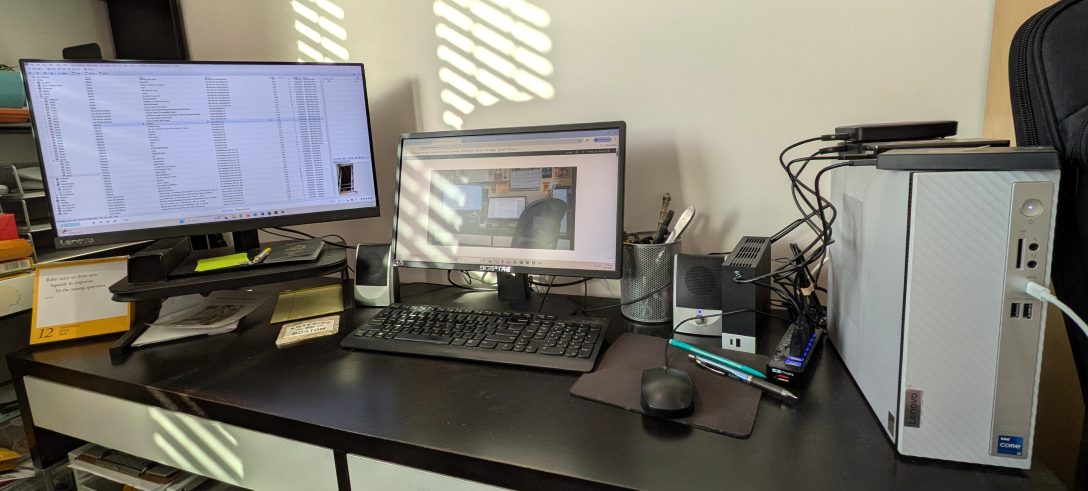
When we moved out here to the Richmond District of San Francisco, we ended up with a second bedroom, which has since been turned into an all purpose room: it’s my day job/writing office, our hardcover and trade fiction library, my music studio, and A’s knitting and canning stashery.  It’s a mite bit crowded in here, but I’m not complaining.  I’ve got my computer for my writing and my mp3 collection to entertain me.

Today was a day for cleaning and rearranging.  I’d just recently bought a new printer–specifically, a three-in-one printer-scanner-copier–and was in need of putting it somewhere central where A. could get at it if necessary.  Which meant getting rid of the old trusty printer I’d had since our last apartment (and still working fine, though the power button’s a bit wonky) and the scanner that for some reason no longer worked.  Which also meant finding a new spot for this new one, because it’s much bigger.  Which means I have to find something stable to put it on.  Which means a filing cabinet.  Which means getting rid of the filing boxes currently on the floor (or repurposing them for other things elsewhere). And the filing cabinet needs to mobile or at least on legs so the heater it’ll partially be blocking will have some place to push the heat directly without blockage.

And so on and so forth.  I had to think about five to ten steps ahead while planning out how to move everything around without cluttering up the room.  This is what happens when you have a finite amount of space to work with.  As you can see above, there’s a lot going in a small area.  A. pointed out last night that a goodly amount of the stuff in this room is indeed mine, and that, sadly, is the truth.  But from past experience I’m quite adept at getting maximum use out of minimum space.

The desk is a long and narrow one acquired from Ikea.  The left side is my home PC and other bits and bots, and the phone and laptop to the right is my Day Job stuff.  This works out perfectly as I get to focus on my job during the day but still get to listen to my music and take an internet break every once in a while.  And in the evening, my focus is on the left side of the desk, where I do all my writing.  And off to the far right of the picture, you can see the new cabinet and printer.  I still need to refile a number of things and move those file boxes in front of the bookshelf, but other than that I’m happy how it looks.  It took a good number of days and a lot of cleaning, but it worked out well, and no extra floor space was taken up.

It’s a small room, but it gets the job done.

On Worldbuilding: Down the Rabbit Hole Willingly

It’s often said that the downside to worldbuilding is that sometimes we writers get caught up in it, to the detriment of the actual writing.  I’ll freely admit that creating a fictitious world is a never-ending source of fun.  The Mendaihu Universe has grown and evolved over the course of two decades, and even as the Bridgetown trilogy enters Submission Phase this year, I’m still coming up with new avenues, new details for it.  Just yesterday I started playing around with another MU story set on Mannaka, an outpost world mentioned on the periphery in the BTown trilogy.  For the love of my own sanity, why am I doing this?

Short and most obvious reason?  More stories!  Ever since the aborted True Faith novel, I’ve always planned on setting a number of books in the same universe.  Not always in the same fixed spot in the timeline, of course…the timeline for yesterday’s brainstorming is up to question, but it would be a few millennia either before or after the BTown events.  This was partially inspired by Anne McCaffrey’s Pern universe–I liked the idea of writing multiple stories in my own created universe.  Each story would stand on its own, but there would always be a reminder somewhere (either up front or in the periphery) of the spiritual evolution story that’s central to the Mendaihu Universe.

And I spent a lot of time between 1994 and 1997, the years before I started The Phoenix Effect, just playing around with the universe, coming up with various story ideas and plot points in the timeline.  I remember a lot of slow afternoons in the ticket booth at the theater (and later at the radio station) where I’d lay the ground rules for my universe, such as major world events, evolutionary steps, and so on.  Just enough to give me anchors for future projects.

I can understand when worldbuilding can be a writer’s downfall, of course; spending too much time on the minutiae and not enough on the prose, focusing too much on the history and not enough on the present.  Or worse, giving into the joy of worldbuilding so completely that doing the actual writing becomes less than exciting.  It becomes like Charles Foster Kane, focusing on building the empire and home, changing it and morphing it as time and whim permits, but never quite finishing it.

The trick is to balance it out…I can have a lush background history, but I have to do something with it.  I can create a sprawling city-province like Bridgetown, but I have to have something happen there in particular.  I can create various characters to act out my story, but I have to have them do something inherently them in the process.   And after all of that, while I’m writing the story, I have a background I can work with–I can put these characters through a historical event that will affect them in one way or another, which will in turn cause them to evolve somehow.

I learned this when I realized I could no longer get away with ‘making it up as I go along’.  I learned it with The Phoenix Effect, when I realized that there were way too many divergent plot points and “I’ll revise it later” moments caused by immediate worldbuilding, all of which caused the story to be full of holes and inconsistencies.  When I restarted with A Division of Souls I forced myself to focus on the created history I had, and if new points of reference came up I would make a concerted effort to ensure they made sense in the overall story.  [A great example of this is in Chapter 2, when Assistant Director Dylan Farraway states “…this certainly isn’t a Second Coming…” to which Alec Poe responds with an offhanded “Ninth, sir.”  It was a complete throwaway line at the time I wrote it, but as I continued writing, the Ninth Coming of the One of All Sacred became the most important plot point of the entire trilogy.]

Working with your worldbuilding is definitely a tricky business.  You have to make copious notes.  You have to have a very sharp memory of what you’ve written.  You have to make sure you don’t get lost in it.  But once you’ve found a way to successfully manage it and make your way through it, it’s quite possibly the most enjoyable part of the writing process.

On Writing in 2015: Schedules, Projects, and All Sorts of Things

20150101_160447a
The new whiteboard and my 2015 moleskine calendar notebook, hanging out with my Squier P-Bass.

I’ve been hinting at a new and improved writing process for a while now.  Taking a hard left and going in a completely different direction.  Looking at my creativity from a vastly different perspective.  Working with a new whiteboard schedule.  Being more consistent with updating my WordPress blogs.  Starting totally new projects, and seeing old ones off.

Well, it’s a little bit of everything, really.  Let’s just say I have a very busy 2015 ahead of me, in a positive way.

*  *  *

Let’s start with the new whiteboard.  [For those not too interested, scroll down to the next break for some fun news!]  Each day has something to do, as you can see from the picture…but noticeably missing is any mention of a main project.  This is a continuation from what I’d been doing with the previous whiteboard the last few months.  I know what main project I’m supposed to be working on, so I don’t feel I need to put add it to the board.  Also, I’ve decided that this is not going to be a “this is what I’m doing today” to-do schedule but a “this is due by today” deadline schedule.  This gives me more freedom to create something when I feel like it, and also gives me the impetus to create a surplus if need be (more on that in a few moments).  Here’s what I have set up:

Sunday: Welcome to Bridgetown blog.  Even though this blog is dedicated to the stories within the Mendaihu Universe that I’m writing, I will also be featuring more entries about the writing craft.  My weekend blog entries (such as on the good old LJ) tend to be longer and more contemplative, and channeling that into writing thoughts and MU extras seems like a good idea.

Monday: Storyboarding.  What is this, you say?  Am I thinking of going into film or animation?  Well, no, not as such, but this is something new I’d like to try out.  It’s an exercise in brainstorming.  It can be anything from brief outlining of a current work in progress to playing around with new ideas.  But yes, it could even include art!

Tuesday: Art.  Doing the Inktober meme last year definitely inspired me to start drawing again, so this is a reminder to keep that alive.  This will also serve as reminder to post any ongoing or finished artwork up on the Tumblr site.

Wednesday: Poetry.  I’m starting to be more consistent about this one lately, as I’ve often been using my daily word run on 750 Words as a playground for poetry ideas.  It might be just a few stanzas, or it might be epic in length, depending on the subject and what I want to write about.  These will most likely remain offline for now, although if I’m particularly proud of the end result, I may post it somewhere.

Thursday: Walk in Silence blog.  This one remains my all-purpose blog to write about music, and I felt that moving this to Thursday would be perfect, for two reasons:  One, new releases come out on Tuesdays and it sometimes takes me a day or so to connect with the ones I buy or download.  Two, because in my aim to become more consistent in my blogging, I’m going to be posting micro-reviews of new releases, alongside other music-related subjects I may want to talk about.  As with this blog, I’m planning on writing more entries than releasing them so I can create a backlog, and therefore have a more consistent release schedule.

Friday: Photos.  I’m continuing to get better at my photography, learning more how to tweak pictures using Photoshop, and so on, and I’d like to feature more pictures on my Tumblr.  Taking inspiration from a photographer I follow here on WP, I’d like to challenge myself by taking things other than panoramas or architecture; I’d like to try still life and nature, turn it more artistic, even if it’s just for practice.

Saturday: Music.  One major project for 2015: start recording!  I’ve got feasible software on my computer (Audacity), a small microphone, and a handful of song and melody ideas, so I think it’s high time I reignited the Drunken Owl project by making demos here in Spare Oom Studio.  I’m not planning on anything big, so it could be anything from short snippets to revisiting old Flying Bohemians tracks, and playing around with them.  I’d also like to do more research into more extensive software that could possibly let me record and mix multiple tracks.

*   *   *

I should also add that a good portion of this  year will also be spent submitting A Division of Souls to agents and publishers.  I’m hoping to get the Mendaihu Universe out into the wild within the next year or so.

All this, in conjunction to whatever main writing project I have going on.  And my day job.  And a personal journal.  And my daily words.  Did I manage to leave some time for eating and sleeping, and hanging out with Amanda?  Let’s hope so.

But wait, there’s more!

I’m proud to announce that I have not one but two self-published projects I’m planning on releasing into the world sometime this year as well!  I’m thinking epub at this point, although print could be involved, depending on which self-publishing company I end up working with to produce and release it.  These are two projects I’ve been working on over the last few years; one is complete and the other is about three-quarters of the way done.

The first will be a book version of Blogging the Beatles, the series I started over at the WiS blog a few years back, in which I listened and talked about the Beatles’ discography in chronological release order.  I had so much fun writing it, and learned so much musically as I studied the songs, that I felt it would be perfect for an ebook.  I’ll be revising it and adding new items as I do so, and hope to have this one out at least by midyear.

The second will be Walk in Silence itself.  This one’s the biggie.  I’m about three quarters of the way done on the more personal side of the story, with revision number two to add in more about the music.  This one may roll into 2016 if other issues pop up, but the aim is to get it out into the wild by autumn 2015.

Of course, releasing books about popular music could be tricky considering the rights involved, but since I’m not directly quoting the music but only commenting on it, I think I should be okay.  These are both books focusing on my love of music, in particular about a band and a genre that inspired me and shaped who I am.


So yeah…you should be seeing more of me here at Welcome to Bridgetown and elsewhere, so stick around–it’s gonna be a fun ride!

On Peace, Love and Light

In the Mendaihu Universe, a very common greeting between spiritual-minded people is “Peace, Love and Light to you.” It’s meant purely as a blessing of good will and open mind and heart. Depending on the situation in which it’s said, it can either be a blessing (“I wish you the best of worlds”) or as an honoring, such as a follower to an Elder. Its creation was inspired by a similar phrase used in certain new age beliefs I read up on during the creation of the Mendaihu Universe, and its meaning is quite similar. The three elements of this greeting are considered strong energies present in universal life–peace is the balance of energy, love is its strength, and light is its physical and ephemeral existence that feeds us.

Peace is quite possibly the most important in the Mendaihu Universe.  Our alien kin are highly spiritual–that is, their connection to the universe is not just an understanding of their physical place within it, but an understanding of their soul’s ties to it.  Their extrasensory abilities have given them a keen awareness of balance and imbalance within themselves and within others, and as a result they are drawn to maintaining balance.  This is not to say that they avoid wars, far from it; they have had many civil and multi-world wars during their long history.  Additionally, there has always been a tenuous relationship between the two major factions of the Meraladhza…the Mendaihu and the Shenaihu.  There will occasionally be a civil war between the two (the latest of which is part of the main plot of the Bridgetown Trilogy), which has long been thought of as a spiritual imbalance within the Meraladzha race, and these wars are often seen as an attempt to regain this balance.

Love is used as a strength or a source of power in many stories, and it’s seen in many different forms.  I find the most interesting use of love is when it’s used for compassion and strength instead of romanticism. This kind often takes a familial form. At the end of Harry Potter and the Sorcerer’s Stone, Dumbledore mentions that it’s “love” that kept Harry safe from Voldemort’s touch; it was his mother’s selfless protection that formed not just a bond but a barrier. In Naruto, it’s in the form of the title character’s parents Kushina and Minato; their love not only protects him from the Nine-Tailed Fox, it also serves as part of the lock that keeps the unwieldy spirit deep within his body, keeping it safe from everyone. In A Division of Souls, this is seen very early on when Caren’s first reaction to an unsanctioned city-wide ritual is to protect her younger sister Denni from its backlash.  Love is also a driving force within the Mendaihu Universe novels.  The relationships of family, friendship and partnership are strong and important, and serve as the backbone for the Bridgetown Trilogy.  It is often seen and utilized as a spiritual anchor, a reminder of the connection between all living things.

Light is the power itself, and it takes many forms and levels.  Using Naruto as an example again, this could be the use of chakra for offensive and defensive purposes.  In the Mendaihu Universe, it is used both as a tool and as a destination.  As a tool, it’s thought of as the energy behind the Meraladhza abilities such as soulhealing and innerspeak.  It’s also used in forced-extraction form known as Lightwork; both creative (healing, cleansing and moving) and destructive (fighting and shielding).  As a destination it’s the non-space or “Null” between two fixed points.  Only the strongest of Mendaihu and Shenaihu (both Meraladhza and human) have the ability to move in this manner.  The movement entails gathering Light energy to one fixed point–say, the space in front of you–and stepping into the Light.  The sensation is very much like stepping into complete whiteness (usually Mendaihu) or blackness (usually Shenaihu) (I say “usually” because cho-nyhndah–those who are both–can move either way).  The exit point is the reverse–knowing the fixed point one wants to get to, and releasing the same Light energy at that point.

When awakening as a Mendaihu or a Shenaihu, knowledge and use of these powers are essential, and are part of the training soon after the awakening ritual has been performed.  It is not exactly dangerous to avoid or prolong getting trained, but the longer one waits, the harder it is to learn how to wield these powers, and using them without proper training can prove dangerous, even fatal.

Granting or wishing “Peace, Love and Light” to others is considered one of the highest forms of praise, but it’s also a high form of compassion as well.  In giving Peace, Love and Light, one gives a part of their own spirit; one offers spiritual balance, spiritual strength, and spiritual being.

On Writing: Rejection Isn’t Always a Bad Thing

For those of you that have been following along for the last few years (or decade or so) with my grand scheme of getting the Bridgetown Trilogy published, today was an interesting day.

Angry Robot Books has had some kind of “Open Door” special event over the past few years in which they would accept unsolicited submissions* until a set date. As it so happened, I had just finished up a major revision of A Division of Souls, and thought this would be a perfect opportunity. I speedily worked through the rest of the revision and sent it in with about two weeks left to go before the December 31 deadline. You may have heard they had a bit of a business shake-up a few months ago**, which caused a significant delay in the reading and accepting process. I’m fine with that, especially as they took the time to follow up with an email informing us they would still read all the submissions.

This morning, I received an email stating that they have decided to pass on the novel.

Now, I’m well aware that this would most likely be the case, for a few reasons: a) they had over a thousand entries this time out (MUCH higher than previous Open Doors), b) digging through a high number of entries to find that one shining piece of gold is normal in the publishing biz, and c) I’ll readily admit that it could still use work. More on that in a few. The long and short of it is, this is not my first rejection, and will most likely not be my last. This is just part of the game.

Am I bummed? Of course, but not overly so. You might say I’m actually a bit relieved, as this gives me the freedom to tidy it up a bit more and shop it elsewhere now.*** Given that I’ve been working on this project off and on for way too long (twenty, seventeen, fourteen, or seven years, depending on the version you ask about and whether or not you count interim years of stasis), I’ve also been doing a lot of thinking about how I would want to see this book out in the wild. Between those years in the early 00’s where I sent it out to various agents and publishers, and now, where self-publishing has become a viable, more professional and accessible option, my options have actually expanded.

I’m actually kind of happy that Angry Robot took the time not only to read the first four chapters of A Division of Souls, but upon rejection went so far to state that they felt “the dialogue could use work, as it reads as too artificial, not natural enough” as part of the reason.

Honestly? That’s the best thing a publisher has ever said to me in all my years of being a writer.

In all the rejection letters I’ve ever received from both publishers and agents, I’ve only received the variation of the “not for us” form letter. Which is all well and good–I’m okay with those too, because I’m pretty sure they at least took a cursory look at it. But this is the first time I’ve actually received something that says “hey, it’s not for us…but here’s what you might want to fix/focus on in the future.”

To me, that means two things: they took my submission seriously, and that they took the time to let me know what didn’t work, even if it was one out of many possible issues that could be wrong with it. And that makes all the difference.

So what are my future plans for the Bridgetown Trilogy? Am I going to make good with the fake cover I made on the previous post and go self-pub? Am I going to be the stubborn bastard that I am, revise AGAIN and find a new home for it? It’s up in the air, really. I’m keeping my options open. Yet another recent reread has shown that some of the dialogue and prose is indeed a bit stiff, and oddly about halfway through, the default reaction for many characters seem to be that of sighing in frustration. Eesh!

One thing’s for sure, I’m not going to ragequit this writing life. I love it too damn much to give up now.

Learn from mistakes. Listen and process the critiques. And make the best damn piece of art you can.


* – For those unaware, ‘unsolicited submissions’ means that the publisher would accept manuscripts cold, rather than through agents or an agreed-upon offer. I highly suggest studying up on the submission guidelines of various publishers and agents to understand what’s needed–some want specific things and/or in specific formats, others will take printed copies, etc. Following their guidelines makes them happy and makes you look like a pro.

** – Short version: They closed down their YA and Mystery imprints earlier this year, and changed ownership last month. Not holding this against them, and I hope for the best, as they have quite a number of great titles out there that are definitely worth checking out.

*** – I would love to go into detail here about multiple submissions, but I’ll save it for a future entry. Suffice it to say, I purposely waited on this one to force myself to start working on other projects on the interim, which has worked out well so far.

On Covers: And now for something fun…

Credit: http://all-that-is-interesting.com/fog-over-dubai
Credit: Daniel Cheong Photography.  Source: http://all-that-is-interesting.com/fog-over-dubai

Thought I’d have a little fun with Photoshop and a picture found via Google that pretty much fits the feel of A Division of Souls, and created a quick mock-up cover for it. All told it took me just over an hour, a bit of cropping, playing around with fonts, and rewording the back cover copy from previous query synopses I’d written. Tell me what you think! Note: If you’re curious, that’s Dubai. I picture the Mirades Tower being very similar to the Burj Khalifa. Note: Yeah, I know the copy on the back cover gets a bit screwy when white letters overlap shiny blue lights of that skyscraper. Like I said, this is just a mockup. 🙂

EDIT: I finally just recently discovered that this picture was most likely taken by Dubai resident Daniel Cheong, so proper credit where credit’s due.  Check his stuff out at Daniel Cheong Photography, it’s well worth it.

On Writing: Printouts, Notebooks, Scraps, and Everything Else Behind the Scenes

This seemed like a good idea at the time...
This seemed like a good idea at the time…

Back in mid-July, I’d looked at the tall black bookshelf I have next to my desk and realized that the bottom two shelves were woefully out of order. The bottom shelf was full of bound manuscript printouts of my writing output thus far; I had complete then-up-to-date prints of the trilogy, prints of the Great Pre-PC Writing Transcription Project of 1995-96, the many versions of the Infamous War Novel, and so on. And on the shelf above were three piles of unbound printouts from various other projects (finished and unfinished), notes hastily scribbled on scrap paper, a relatively large collection of my drawn maps from over the decades, lyrics for both jeb! and the Flying Bohemians, and the ridiculous pile of notes hastily scribbled for the trilogy over the course of five years.

With the best of intentions, I chose to clean it up, or at least put it in some semblance of order. Part of this was due to the fact that I’d been looking for a Mendaihu Universe outtake I’d written around 2001, as well as the 1994 version of my current WiP Two Thousand, and I couldn’t find either of them easily, not without spending a good hour digging through things. So without further ado, I pulled everything out and set to work.

This soon led to me digging through other areas of Spare Oom, as I realized I had the file box that contained various personal effects, four file boxes that carried smaller bits and bobs, and the short and partially obscured bookcase next to the loveseat. Oh, and maybe some random papers sitting in with my CDs and tapes in the Spare Oom closet. And maybe one or two things stuffed in the night table drawer next to the bed. And and (! fookin) and…

The above picture was taken once I got it all sorted. Sort of. It took an extra day for me to finish the sorting, and in the end I had not one but two boxes of stuff to throw away. It was a mix of paper and detritus, stuff I had little or no use for. One box would be shredded and/or put down in the recycling, the other put in the trash. This would soon include about a dozen or so spiral notebooks of varying use and age. They all had something written within, but hadn’t been used since then. Many of these ended up being recycled, many of the useless notes shredded and the useable ones added to the sorting.

Two days later, and things were somewhat cleaner, but I started thinking…there’s got to be a better way for writers to save their works in progress, their dead-end projects, and pretty much any piece of created prose or related notes. Do I really need to save Craptastic Revision #4, in which the novel is complete but I desperately need to fix about twenty scenes that fall utterly flat? Do I need to save this printout of the only five pages I wrote of this incomplete story, even though I have it saved on my hard drive, copied on one of the externals, and is also on my Dropbox cloud?

Let’s be honest, it’s fun for a writer-in-training to hoard every single tidbit even remotely related to any of their projects, perhaps on the offchance that they make it big and these become “behind the scenes” and “outtakes” documents like a collector’s edition DVD, or even better, on the offchance that they make it big and decide to donate their papers to a local library, like some well-established writers have. Or like me, saving every version I print out, just in case I want to refer back to an earlier version for ideas or reference material.

And then there’s reality.

Before I moved out of the family house in early 2005, my dad gave me use of a three-drawer filing cabinet, which I had next to my desk in the Belfry. This was in addition to two milk crates under the desk. The milk crates carried printouts of the various novels I’d worked on and were not presently using; the filing cabinet held the various poetry notebooks, unbound printouts, spiral notebooks big and small, and other pre-PC writings that I hadn’t scanned or transcribed. I think it even contained personal paperwork like paychecks and bills. They remained there for the most part until our final trip up to Massachusetts before we had to pack everything for our move to San Francisco; at that point in late autumn I had to spend a good couple of hours going through it all. Save? Throw away? Shred? One of the first things I did was take all the spiral bound notebooks and debate what I could save. That’s when I found at least 15 or 20 of them in there, with about twenty or so pages used, the rest blank. Well, I realized. That’s a waste. I ripped out the used pages and put them in manila folders, and donated the notebooks to one of my cousins, who could put them to good use. By the time we moved out in December, I’d gone from multiple storage containers to two large plastic storage tubs, and over the course of 2006 and 2007 I sorted through them, keeping some and shredding others. And as of today, nearly all that’s left is on those two bottom shelves of that black bookshelf. There’s another pile of printouts over on the bottom shelf of the semi-obscured bookshelf, prints I know I won’t need any time soon.

I think this is partly why most of my writing is nearly all on PC now–it’s just easier to save the various versions of my Word documents than to waste toner and paper (and space) with the various versions. I’m only using about five notebooks on a consistent basis at present:

1. College-ruled softcover moleskine: personal journal
2. Composition book with the black and white mottled cover: poetry (some habits die hard)
3. Small hardcover moleskine A: artwork
4. Small hardcover moleskine B: calendar notebook to keep track of word count and project movement
5. Small spiral notebook: notes on music and stuff I hear on the radio

I have a few other notebooks lying around that I don’t use nearly as often, but they also have specific uses. I don’t use the printer all that often as I used to…in fact, it’s been at least a few years since I last put toner in there. [I’m even contemplating replacing this one with a three-in-one so I can rescan a lot of my stuff.] I’m often tempted to pick up a new notebook here and there whenever we pass the stationery section of Target or happen into an OfficeMax, but I keep myself in check. If I do buy something, there’s usually a reason for it now, and not “just in case I need it down the road”. I did save a few from this recent culling, so I can use those first before going out to buy more.

Do I miss hoarding new notebooks? The feel of fresh pages, the excitement of writing that first page of that new project? Well, not entirely. What I do miss actually is the hoarding of snacks and 12-pack cans of Mountain Dew in my desk like I did in the Belfry, but I think I can look past that. I still hoard my writing, but it’s all digital now, saving the various versions in multiple folders and putting them on my Dropbox so I can access them anywhere. [And I mean anywhere–the other weekend I accessed my shopping list from my phone in an aisle of Amoeba.] It’s much easier to handle.

The only downside to that, of course, is that I now have multiple folders with multiple copies of multiple projects. I may need to do a bit of reorganization and culling there at some point…

[Thanks to Meagan H for the inspiration for this entry, as well as passing on this great article about notebook clearing!]