On Worldbuilding: Fluid History

John: “Hey there, Jeremy, what do you know about holes?”

Jeremy HIllary Boob, PhD: “There are simply no holes in my education.”

–Yellow Submarine

If you’ve ever watched any kind of documentary or series, there’s always some element of “we’re not entirely sure what happened at this point in time, but we can make an educated guess by looking at the following clues” or some such.  The further back we go in time, the harder it is to pinpoint the date of an event; eventually the most we can say is “sometime during the [x] Era.”   Those are extreme examples, though.  Sometimes our view of history changes within a few decades, when we look at the events of a specific time with the eyes of a different generation, maybe even a different culture.

I started thinking about this sometime ago when I started writing the new Mendaihu Universe story.  One of the subplots deals with the events that took place in the original Bridgetown Trilogy, though this new story takes place about seventy years later. Without going into too much detail, our histories of our heroes in that trilogy have become somewhat embellished, even after so short a time.  Denni Johnson, the teenager who had ascended as the earthbound deity the One of All Sacred, is now viewed as a saint, complete with a marble statue that thousands flock to and pray at.  Her sister Caren and Caren’s ARU partner Alec Poe, who never ascended as far as Denni did, are seen as more than human; Caren is believed to be an angelic protector, and Poe is seen as a Mighty Warrior.

And yet, all three were merely human.  Gifted with psionic abilities, just like anyone else in the Mendaihu Universe who have gone through an awakening ritual, but still — they were just as human as the rest of us.

Part of the focus on this new story is how certain people and events in history get changed over the years.  We may have documents, we may have databases and videos, but it still boils down to how the person or event is seen by the viewer.  We put amazing people on pedestals, even if their personalities were less than stellar, because regardless of their infallibility, they changed the world in some way.  The same could be said of horrible people as well; their vileness goes down in history as a grim reminder (even if, on a personal level, they weren’t one hundred percent vile).  We rarely look at these things objectively; we always have some emotional attachment to them, however big or small.

The evolution of historical accuracy fluctuates a lot more than we’d like it to, quite often because of this emotional attachment.  In this new story, the views of the new devout (those who follow the steps of the One of All Sacred — that is, Denni — and hope to find clarity in their lives) have become reasonably established.  However, schisms have already broken out; there are those who see Denni as a savior, and others who see her as an ascended but flawed human.  There are the Elders, the spiritual leaders who have been around for centuries, who are also splitting: those who have embraced the evolution of belief, and those who want to retain the status quo.

It’s a bit of a mess, but that’s the fascinating part of history as it happens.  No one really knows what the hell is going to happen next until it does.
 

A Division of Souls: Character Sketch!

image

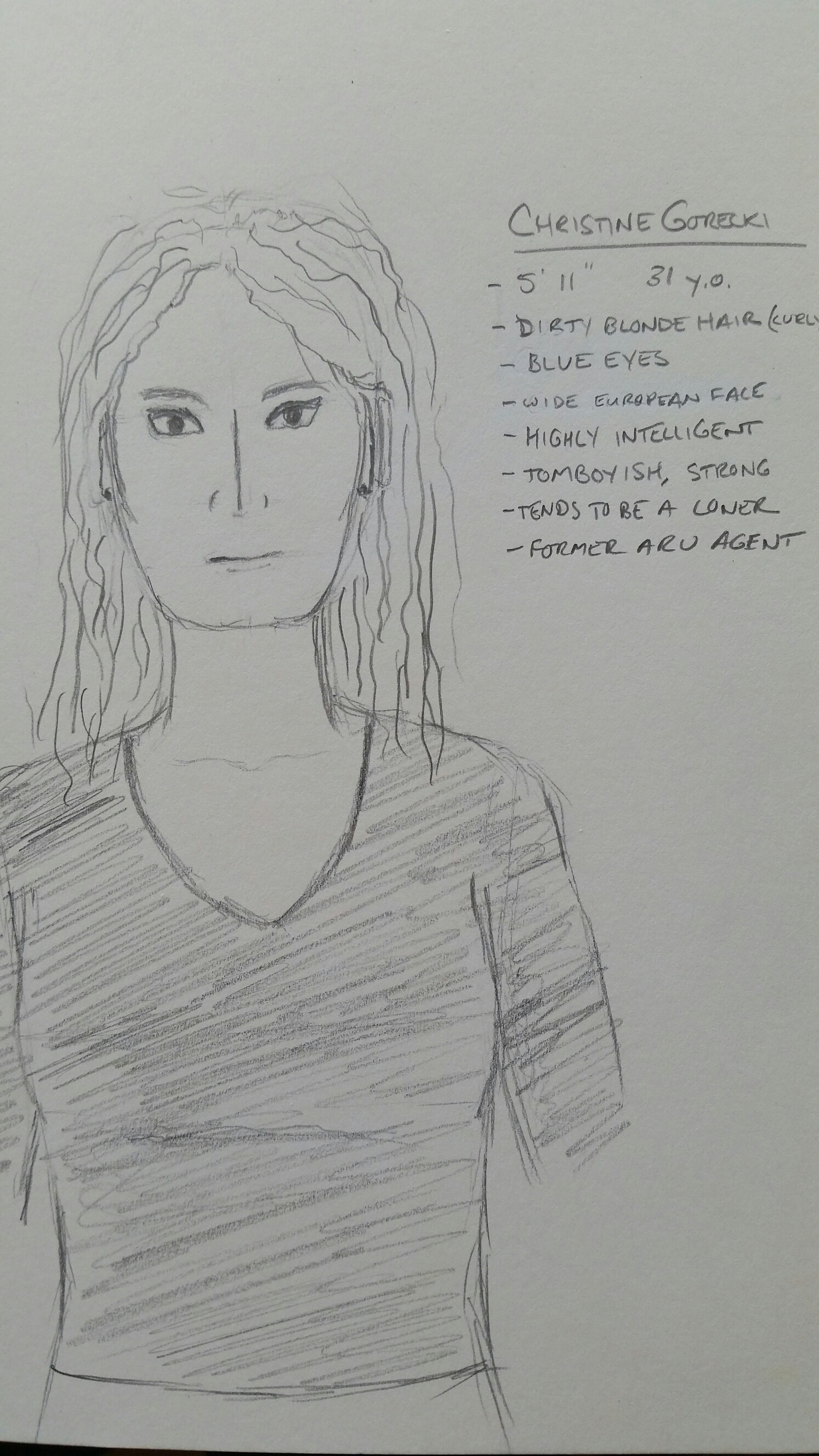
And we’re back! My first bit of artwork now that I’m back on the whiteboard schedule is another character sketch for the Bridgetown Trilogy gang.

Christine Gorecki has an interesting background, as she was originally a tertiary character when I created her late in the ADoS story; she shows up in person in the last third of the novel when I needed to have someone ARU-related meet up with Sheila and Nick during a specific point in the plot.  I ended up really liking her and gave her a major role in the trilogy.

She’s somewhat of a lone wolf.  She’s highly intelligent and resourceful and originally used that to her advantage while she was part of the Alien Relations Unit.  She’d decided about six months previous to the events in ADoS to take a temporary leave of absence to clear her head and deal with some very personal issues, and in the meantime she’d started freelancing as a detective as well as a low-level healer, which she runs out of a storefront on the ground level of the apartment building she owns.

Christine shares a very close friendship with Alec Poe; she is often the first person he thinks of when he needs outside (non-Vigil) help, and trusts her completely, and the feeling is mutual.  She’s also close friends with Caren Johnson and her sister Denni, and looks after them from a distance.

On Selling the Book: Who Is My Audience?

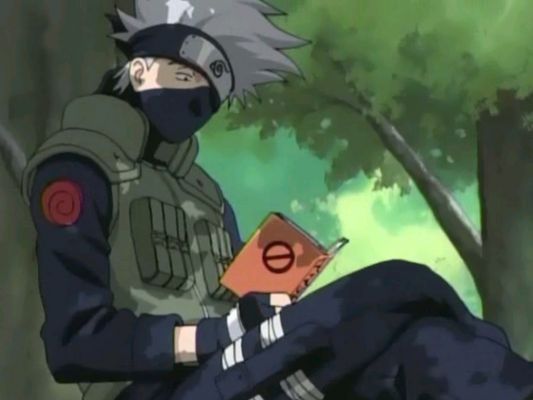
Kakashi from Naruto, @Masashi Kishimoto
Kakashi from Naruto, ©Masashi Kishimoto

It’s come to that point, and I don’t think I can avoid it anymore.

Who is my audience for the Mendaihu Universe novels? I admit it’s something I never really took took seriously while writing the Bridgetown Trilogy in the first place.  Sure, I bashed some of my ideas out with my coworkers while working at Yankee Candle, and I know a few of them have been waiting way too long for me to release these damn things.  I’ve talked about this universe here and there online for years.  I’ve had a small handful of beta readers over the years.  And then there’s me, the one who create the series, who loves writing within it.

And thinking about how to sell the thing to potential publishers, agents or readers is something I haven’t exactly wanted to think about too often, because I hate dealing in sales.  I had a telemarketing job back in ’93 and it was soul-sucking, and I lasted all of three months before I left.  Not that I can’t sell things I’m interested in — as mentioned earlier, I could upsell you records like no tomorrow — but it’s just not something I enjoy doing.  And come to find out, a lot of writers I know are in the same boat.

But seriously — who is the target audience for this universe, anyway?

I have a few ideas on who might enjoy reading this series, and though I’ll be shamelessly upselling to everyone in general, I know there are a few subsets of genre readers out there who might really enjoy the books, and I’ll be giving extra focus to those readers when the time comes.  [The actual upselling can be pretty tricky as well…there’s a fine line between selling it to a potential audience and billboarding yourself everywhere.  Something to think about.]

But who should I sell it to?

Well, that’s a good question.  I consider myself lucky that I’ve gone to various sff conventions, and that I have a reasonably large group of online friends and acquaintances so I’m familiar with what kind of readers are out there.  There are those who’ll read anything.  There are those who will only read military sf, or hard sf, or sword and sorcery, or paranormal romance, or what have you.  There are slow readers, speed readers, those who love short stories and those who love doorstop novels.  If I had to narrow it down, I would say my potential readers would be a mix of general genre readers, urban fantasy, and future sf, with a bit of fantasy realism in there as well.  [I think some manga readers/anime watchers would also enjoy the series, and that’s why you see Kakashi up there.]

Part of the trick is not so much to say “I want to sell to manga/fantasy/future sf readers” but to say “How can I capture the interest of this particular fantasy reader?” and adjust accordingly.  That’s part of what ‘knowing your audience’ is about: understand who it is you’re showing your wares to, and speak with them, not at them.  That’s something I learned in my day job, actually…don’t demand their attention, but pique their interest.  Your pitch will be a lot less stressful that way.

I’ve been thinking about this over the last few months — mind you, I’ve been doing a lot of research on this, not just hemming and hawing (although there’s been some of that as well).  I don’t want to do this half-assed.  I know if the response to the initial launch is crickets, thankfully I should be able to pick myself up, dust myself off, and launch it again, the right way.  There are way too many moving parts in this game, and I can totally understand that it can be frustrating, and one missed part can send the whole contraption falling down in an avalanche.  I’m hoping all this homework paid off, however, because it’s almost high time to get these things out in the world.

On Writing: Coming Back to Music

One thing I didn’t expect to revisit while writing the new MU story is to visualize the scenes I’m writing based on a specific song.

I used that sparingly during the original writing of the Bridgetown Trilogy; there are very few scenes where, at least in my mind, a specific track should be playing.  The final scene of A Division of Souls having Failure’s “Daylight” playing.  A scene of Alec Poe driving down a highway with Supreme Beings of Leisure’s “Strangelove Addiction” playing.  And so on.  I never mentioned them in the book outright, of course.  The scene was never based specifically on the song, it was only background that happened to fit.

Come 2015, I’m writing the second chapter of the new story, in which a character has stepped into Light and is soaring over the extended metropolitan sprawl of Bridgetown, sensing the presence of everyone he flies past as he heads towards Mirades Tower.  I’m about a page in, when Dot Allison’s “Message Personnel” pops into my head.  I play the song through with its peaks and valleys of psychedelic ambiance, and the next thing I know…the entire rest of the scene plays out crystal clear in my head, just waiting to be written.

I haven’t written a scene in that manner since…well, since I wrote the Infamous War Novel almost entirely in that fashion, nearly thirty years ago.

I found myself doing it again just the other day, as I was writing the start of the new chapter while flying home from London.  The in-flight music selection happened to include Led Zeppelin’s recent remaster of Physical Graffiti, which meant I got to listen to my favorite LZ track, “Kashmir”, in all its epic glory.  I’d used the song in the IWN, so it was to some surprise that the lurching bombast of the track somehow lent itself to the scene I was writing that moment, in which another character has ascended towards a higher aspect of the kiralla (a dragonlike form meant to be one of the highest forms of spirit in physical form), and she’s reveling in the fact that she’d ascended all on her own without training or ritual.  The track screams BIG, and so does the scene.

It’s kind of weird to revisit this old writing process of mine that helped me finish my very first novel when I was a teenager, especially when I wasn’t expecting it.  I’m not planning to lean on this style exclusively, though now that I know it still works to some extent, I’m not exactly going to avoid it either.  Whatever works to get the scene done how I’m visualizing it.

Back to the Grind

Spare Oom awaits.
Spare Oom awaits.

It’s been a crazy couple of months.

Between the trips to New York City and London, the weekend plans, multiple work-related issues and everything else, I’ve been so full up that I’d made the decision to clear the whiteboard schedule, temporarily stop work on a lot of creative projects, and focus only on the most important ones.  That meant that I focused almost all my creative juices on the new Mendaihu Universe story.  Little by little, I let a few things in as time permitted, such as guitar practice and photography.

Now that all the major events are out of the way for the time being, it’s time to get back to the grind and open up the floodgates a bit more.  I’ve replanned the whiteboard schedule again; I’m not filling it up too much just yet, but I’ve added art, music and work on the Walk in Silence book back into the mix, and moved the updating of the WtBT blog to Mondays.  I may revisit the daily 750 Words if time permits.  And musically, I have a few ideas I’d like to record in demo form as part of the Drunken Owl project.

The temporary hiatus did have its positives, as I was able to provide better focus on what needed it, and still have time to relax.  I was also able to recalibrate how I viewed my writing — not just the output but the style, and looking at what can be adjusted — to the point that I should also be able to do the same with my other writing projects that I put aside.  Long story short, I’ve realized that the best practice (to borrow an annoying work-related phrase) for me is to do most of my writing longhand and use my PC time for revision and rewriting, and that’s how I plan to work from here on in.

These last few months have been a relaxing reprieve, but I’ll say this:  it’s great to be back on schedule again.

Fly-By: London Calling

image

Oh, hi there! Yes, I am still here among the living. We’re currently staying in a nice quiet hotel in the Earl’s Court neighborhood of London, and we’ve been doing all sorts of sightseeing, museum visiting, and pub crawling the last few days.

I admit I don’t currently have any new posts at the moment other than this fly-by, but I have some things going in the background that I shall share soon enough. I’ve also been getting a decent amount of page count for the new MU story as of late.  It’s been a busy but fun vacation so far!

Talk to you soon, yeah?

In a Room Other Than One’s Own

Calvin & Hobbes @Bill Watterson
Calvin & Hobbes ©Bill Watterson

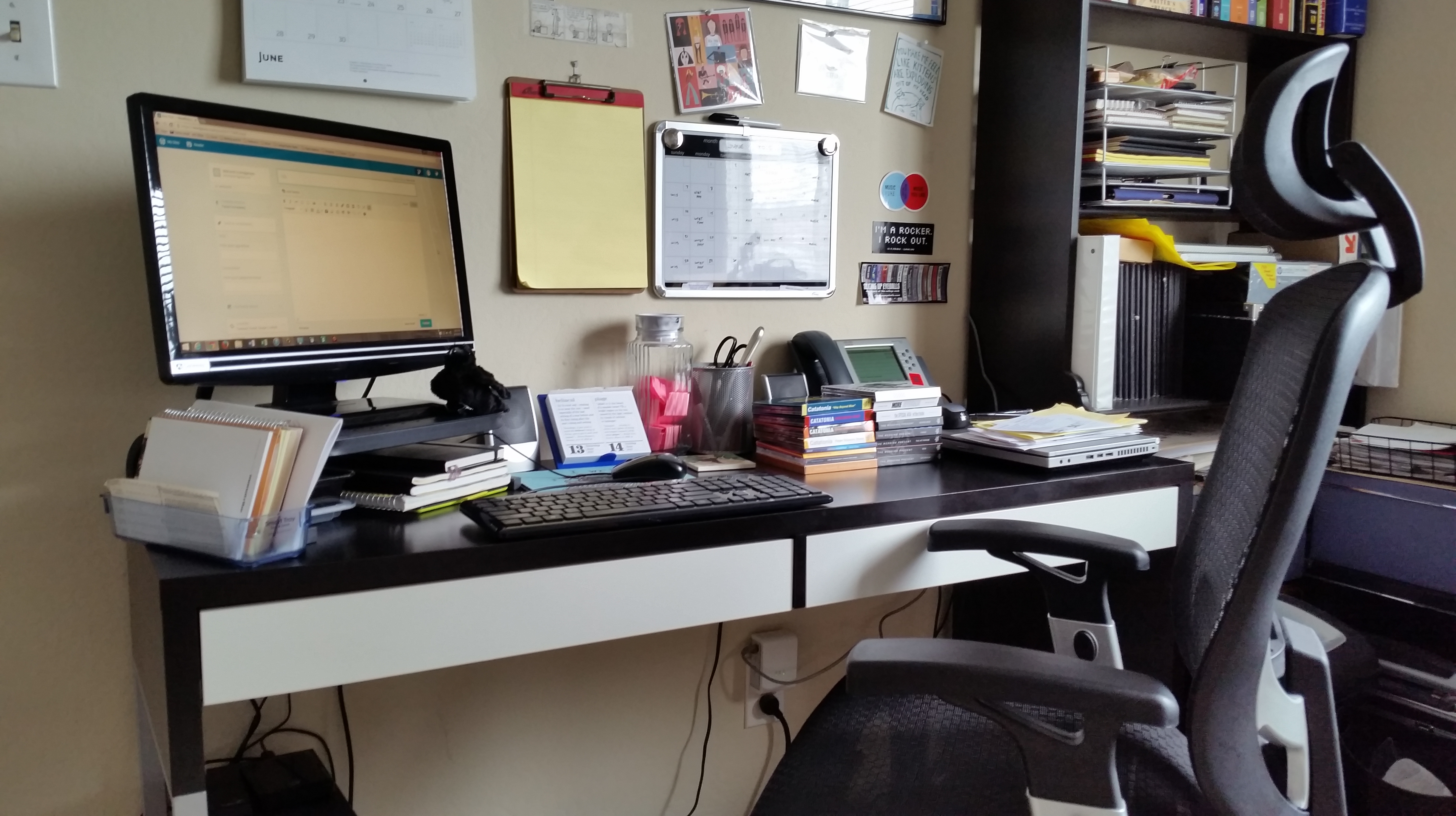
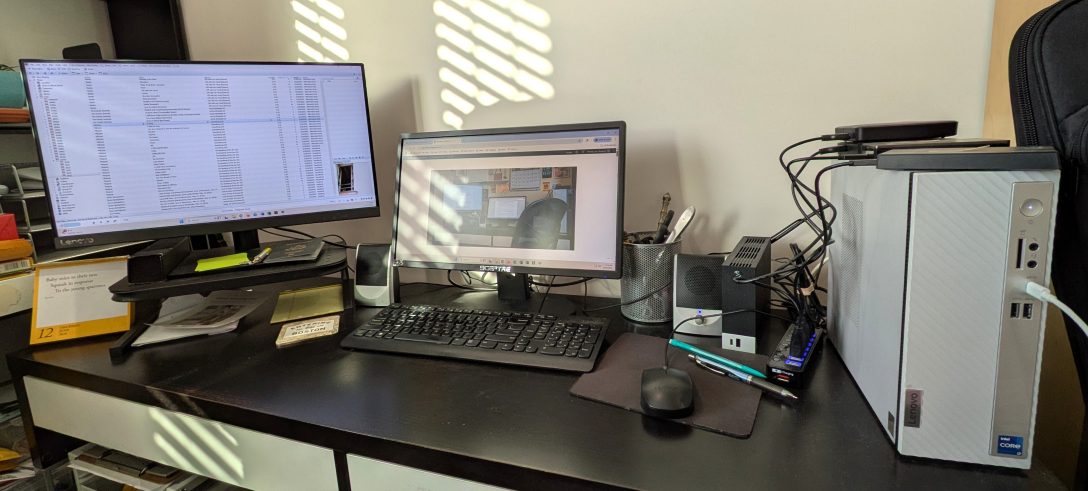
I’ve gotten pretty comfy writing back here in Spare Oom.  I’ve got my PC for goofing off online research and music soundtracks.  I’ve got our old love seat back here, which I’ve been using for my longhand writing.  I keep the window slightly ajar and the blinds open to remind me there’s a world outside.  I’m just down the hall from the living room so if A needs me, she only needs to call out.

But what about writing elsewhere?

I’ve worked elsewhere in the apartment over the years.  I restarted the last chapters of The Process of Belief back when my computer was in the living room.  I’d sit next to A on the couch and work on the Bridgetown Trilogy revision while we had something going on the TV.  I’ve worked at the kitchen table while A and one of her friends watched a movie.  And recently I’ve done some longhand out there as well.

Writing elsewhere can definitely be a great exercise, especially if you’re someone who doesn’t want to miss out on deadlines, self-imposed or otherwise.

During our trip to Manhattan a short while ago, I managed a few pages during the flights, and I got a few more at the end of the day in our hotel room.  And over the years, I’ve written in all sorts of places.  There’s a passage in A Division of Souls that was written in a cheap hotel where I decided to stay rather than drive home during a snowstorm.  I’ve worked on the Bridgetown Trilogy revision in hotels in Portland, Cambridge, Seattle, and even Paris.  A number of scenes, notes, and brainstorming ideas for all three Bridgetown books were written during SF cons.  And I almost always get a good portion done during vacations.

writers_on_vacation

It can definitely be done, if you’re willing to work.  That’s not to say that you should abstain from having fun during your vacations.  By all means, go out and see the world!  Do some people-watching.  Pick up on localisms, regional cultures, things otherwise mundane that would actually brighten up your characters.  Listen to how they speak, check out what music they listen to.  But at the same time, feel absolutely free to sit down at that sidewalk café, drink your coffee and eat your beignet, and think about nothing else but being in the moment and enjoying it.

We’ll be heading out to London in a few days, and I plan on getting a lot of writing done while we’re there.  I have notebooks at the ready, my camera for reference shots, a shopping list of books and cds to look for.  But this will also be a continuation of our previous trip there last fall for Worldcon.  That trip turned into a long bucket list of music-related places to visit (Abbey Road, Baker Street, Berwick Street, Savile Row, etc.), historic museums (Tate Modern, Victoria & Albert, Portrait Gallery, etc.), and points of interest (St Paul’s, Waterstone’s, Whitehall/Westminster).  This is going to be the Extended Remix, in which we’ll hit all those places again as well as those we missed the last time, this time at our leisure. [Yes, I just pronounced that as “lezh-err” instead of “lee-zhur” in my head.  I’m totally ready for this trip.]

Point being:  By all means, if you want to get some writing done while on vacation, even and especially if you don’t exactly need to, go nuts!  Go for it!  Write like the mad, crazed weirdo that you are!  It’s well worth it if you decide to make it enjoyable.  Don’t worry about perfection, just have fun with it!  Play with a subplot.  Come up with an outtake that you can share online with your blog followers.  Play around with character development.

Just be sure to balance it with just having fun in the real world!

A Bit More About Day-to-Day Balance of Work, Writing, and Play

Some of us writers tend to think of writing as separate from work and play, like it’s a third piece of the balancing-your-life puzzle rather than filing it under one or the other.  I’m one of those, purely out of semantics.  I think of ‘work’ as my day job.  I think of ‘play’ as goofing around online, watching TV or going somewhere with A., or some form of entertainment.  Writing?

Well, writing, at least for me, is a synergy between the two.  It’s work — hella hard work sometimes — because my brain isn’t just thinking about the part of the story I’m telling at that very moment, but also thinking about the story’s end result so many as-yet-unwritten pages in the future.  At the same time it’s an incredibly fun process, because I’m creating something and I’m proud of my ability to do so, especially after all these years of practice.  To that end, I end up thinking of it almost as a second job, albeit one that I enjoy doing.

The trick, at least lately, is to remind myself not to sit on my ass all day long, sun up to sun down.  There’s a life out there, outside of the nonstop chugging of my mind gears.  That’s why we make it a point to hit the local YMCA a few times a week and take long walks on weekends.  But I also need to remember that not everything on TV is crap.  We’ve been really enjoying Wolf Hall on PBS the last few weeks, there’s always another Attenborough or Burns documentary to watch, and Canada and the UK seem to have a wealth of great mystery shows that we can stream.

Back in the early 00s (aka the Belfry Years), I had to remind myself to put down the writing and go out and play now and again.  This is why I went on road trips to Boston and elsewhere, took the occasional night off to watch The X-Files, check out my current stash of comics, or read that new novel I’d just picked up.  Still a bit sedentary to be sure, and I was still working out plot ideas in the back of my brain, but I made sure I didn’t become a hermit.

Nowadays I’ve made it a point to get up during break times at work; I’ll walk down to the lobby to check the mail or get that load of laundry.  I’ll watch an episode of Murdoch Mysteries with A before heading up back to write for an hour or so.  I’ll listen to my mp3 player and think about plot ideas while walking a half hour on the treadmill at the Y.  I’ll still sneak in some writing whenever I can, but not entirely at the expense of living a life outside of writing.

It’s a tricky balance to maintain, and as always, there’s no set-in-stone way to go about it.  It’s all about whatever works for you personally.

New MU Story Update: Where I Am and Where I’m Going

It’s a silly milestone, but a milestone nonetheless:  I’ve been writing this new story in a wide-ruled three-subject spiral bound notebook, and a short time ago I just hit the first of two subject tabs, which means I’m a third of the way through the notebook already.  With 120 pages in the notebook, this means I’ve used 40 of them so far, which means I’ve written at least 80 pages.  Woo! Go me!

Still no title for it yet, either, which is totally not me.  Usually I give a new project a temporary title soon after starting it — either a borrowed song title or a boring phrase as a placeholder — but at this point it’s still known as “New MU Story.”  And you know what?  I’m okay with that.  It means I’m focusing on the right things.

At this time it’s still longhand as well…I haven’t started with the transcription to Word yet.  I suppose I’ll do that soon, when the time comes for me to expand the initial first draft.  From past experience, that usually ends up being somewhere around halfway through Act II, when things start to get complicated plot-wise.  I do that for two reasons:  one, by that time I have a firmer grasp of the story as a whole and what may need adjustment; and two, the revisiting of the Story So Far gives me a good idea of where I need to go from there.  At this time I’m going to assume that I’ll start on the transcription sometime next month.

Is this going to be a single book, or will it be another trilogy?  That’s a good question, and one I’m not going to answer right away, not even to myself.  It’s definitely one of many in this universe, that’s for sure.  I’m not even sure when I’ll be finished. I’m just happy that it’s still going strong, and that’s good enough for me right now.

On Writing: Point of Viewpoint, Or Different Mindsets for Different Styles

You’ve heard me (and other writers) talk about being ‘in the mood’ or ‘in the right mindset’ to write whatever projects they’re working on.  In the past it’s ended up being a crutch; I’d waste a good twenty minutes digging through my music collection trying to find the perfect album to listen to for a particular writing session.  I used to be really bad with that, but I’ve gotten better.  Most of the time now I listen to whatever newer release I happen to have close at hand, or if a specific album if I want to give that one another listen.

Actually, this post isn’t about that.  It’s about something I was subconsciously aware of for years, but just recently started monitoring, and it’s kind of interesting.  At least to me, anyway.

This one’s about where my mind is while working on whatever project I have in front of me.  At present I’m letting my imagination run rampant within the confines of my created world for the new Mendaihu Universe story…I picture novels as one long story of character evolution, where the the only rules are that nothing remains static and that consequences just as important as the actions.  I tend to let myself get well and truly lost in my created world; that is, ‘lost’ in the sense that if my brain suddenly and unexpectedly comes up with a doozy of a plot twist and I know it’ll work as part of the whole, I’ll let it take center stage and not hold back.  I think of it as writing for an audience of myself, though with full expectation that others will want to read and understand it as well.

Writing nonfiction is somewhat similar, only the boundaries are much tighter…at least that’s been my experience with Walk in Silence.  The focus is on the subject matter’s evolution within the confines of reality…thus imagination is reined in considerably, only given to the prose itself.  This is also true with my blog posts.  Not counting the more personal entries over at my LJ where my writing is more freestyle, I try to give my writing at least a little bit of professionalism.  When I’m writing nonfiction, I’m writing for an audience other than myself.

Poetry and song lyrics are a different beast, where I tend to be more emotional with my style.  I started writing poetry and songs back in my late teens as a release, but also as a playground for words, where I’d let myself come up with odd metaphors and weird imagery.  There’s really no rules here…I just riff it from start to finish.  This stuff is totally a personal indulgence, though I’ve been told by listeners that my Flying Bohemians and jeb! lyrics were pretty cool, so I’m fine with that.

The fascinating thing is that, now that I’m working on the new MU story, writing blog entries and (soon) working on Walk in Silence again, I find myself conscious of how my mind will shift from one style to another.  It can be tricky, especially if you have a lot of disparate writing ideas milling about in your head, but after all these years I’ve managed to make it work.  I think part of it is what I call the ‘going in’ phase of the session.  For instance, if I’m about to write the MU story, even before I put pen to paper I’ll start thinking about the characters, get in their heads and emotions for a few minutes to remember where I was.

[Noted, this is where the writing session soundtrack often comes in, and why I’m often a sucker for a certain mood in the songs.  The music helps me set the tone of the section I’m writing.  This is also true for nonfiction, or at least with Walk in Silence; for that I’m actually listening to the music I’m writing about so I can connect with the subject more clearly and emotionally.]

I think now that I’ve made sense of how my creative mind shifts from project to project, I’ve become better at giving each project a tighter focus.  I know how I’m doing it, so I’m less worried about whether or not I’m doing it right…as long as I’m doing it my own logical way, then that’s all that matters.