On Writing: Entr’acte

doot doot doot...
doot doot doot…

I’ve said it before, I’ll say it again.  When a writer purposely decides to take time off and not write, it definitely feels weird.  On the one hand you’re enjoying some mental time off, watching movies or catching up on tv shows, or reading that book you put aside a few months previous, or maybe even just goofing off on the internet for hours at a time.  On the other hand, you’re itching to get back to work as soon as possible and work on that next project.

So what have I been doing all week?  I mean, aside from goofing off on the internets?

A lot of offline stuff, really.  Cleaning the apartment.  Doing some shopping.  Practicing a bit of guitar playing.  Continuing on my daily personal journal.  In short, living life outside the Next Book.  I even skipped out on updating this blog.  Okay, I may have browsed over at Shutterstock to decide on my next cover, but no real work was done.  I purposely gave myself a week off to unwind from that crazy five-week blitz of line editing and doing all the backstage work for A Division of Souls, before I jumped in on the probably-longer blitz of line editing and backstage work for The Persistence of Memories.  [And there’s also the fact that I will need to continue paying attention to the release of ADoS so I can figure out various ways to promote it.]

It’s not to say I never take an evening off…I definitely have, here and there.  A day where I’m feeling under the weather, or just had a shitty day at the Day Job, or whatever.  I’m not chained to the writing, I’ve just turned it into a healthy addiction.  When I first wrote TPoM back in 2002-3, I was dedicating two hours daily (including weekends, when I’d dedicate more) to writing at least a thousand pages a day.  The words just flowed, I was in a good frame of mind, and I wasn’t about to let that pass me by.  But I did take a few days off here and there, either to sickness or personal plans, or just plain wanting to take a day off and read comics instead.  Sure, it felt odd, but I wasn’t feeling guilty about it.

That said…I’m going to be jumping back into the fire tomorrow.  TPoM is nagging at me to be edited (this current version clocks in at 180k words, so I’m sure there’s going to be some serious deletion going on).  Added to the ADoS promotion, the cover art, this blog, the Day Job, and maybe even other non-Mendaihu Universe related writing work, I’m going to be a busy little worker bee for the next few months.

Wish me luck!
Adventures in Self-Publishing: Waiting for the Drop Date

The waiting is the hardest part...
The waiting is the hardest part…

On the plus side, I am ecstatic that I was able to get this all done well under deadline — and almost a full week early at that.  I can calm my nerves a bit, catch my breath.  Maybe pick up some of the other minor projects that fell by the wayside.  Relax, play a few games of FreeCell, goof off with my mp3 collection for a bit.

Or, y’know, I can spend my time figuring out how the heck I’m going to promote the book.  There’s always that.  I’ve already made a few strides on that.

Or start working on the Final Edit and cover for The Persistence of Memories.  It’s a toss-up.

Seriously, right now I feel guilty for taking a break.  I’ve put so much energy and time into getting ADoS out on time that I’m not quite sure what to do with myself.  Part of me is still wound up and wants to jump headlong into editing the next book (which probably won’t be available for at least a few months at most anyway).  There’s also the voice in the back of my head quietly reminding me that I still have to continue work on the new Mendaihu book, because it ain’t gonna finish itself.  And lastly, there’s the voice of reason humbly requesting that I take a break for once in my damn life an not feel guilty about it.

And lastly, I have fifteen days before the drop date of 3 September, in which I have to resist temptation to edit the book even more, even though technically it’s out of my hands now.

All I can really do is wait at this point.

[NOTE: For those playing along, yes, I would totally want Fleur & Manu, the directors of this video, to direct the film version of the book.]

Adventures in Self-Publishing: Seeing the Final Result

image
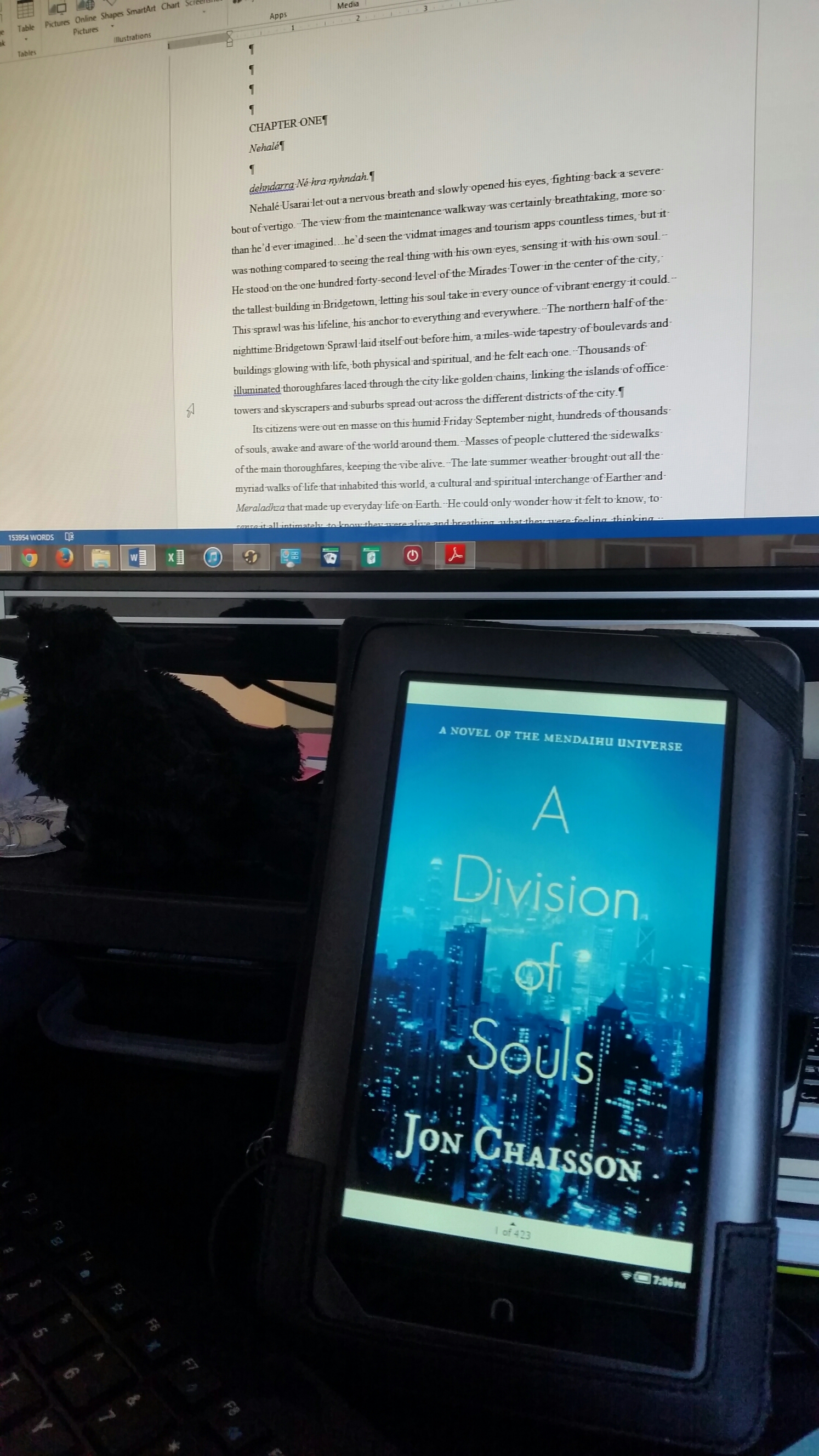
Above: the MS Word document I’ve been carving away at for the last two months. Below: the final result in EPUB format on my Nook.  Lon Dubh the blackbird approves.

Two things that are Totally True when an author sees the galley/ARC/final result of their book:

–A mixture of elation and pride.  More often than not this is a project that has taken far too long for our liking, but still the author has a bit of a squee when they see it all bound in paper or in final ebook form.  Look at that!  I made a thing!  A professional thing!  A thing others will (hopefully) enjoy!

–The turnaround time from the above excitement to worry and mortification when typos and other mistakes reveal themselves when you’re checking out how pretty it all is:  +/- two hours.


Most of this weekend was spent working on the formatting of A Division of Souls, which was easier than I’d expected it to be.  Come to find out, most of it entailed highlighting blocks of text and adjusting a lot of Settings, which I do all the time anyway.  Saturday afternoon I cleaned up the end matter (glossary, acknowledgements, etc) and other easy bits.

Sunday was spent doing a lot of Style changing — primarily my old habit of hitting Tab at the start of every paragraph to a permanent 0.3″ paragraph start instead.  Ctrl+A was my best friend through most of this.

Creating a table of contents was shockingly easy.  Just a bit of bookmarking and hyperlinking, et voila!  I’m done.

There was also a good half hour of dithering about line spacing…single, 1.15, or 1.5?  Single looked too crowded to me, and though I liked 1.15 myself, A. (who reads more ebooks than I do) felt otherwise.  So 1.5 it was.

So by late afternoon, I was ready.  It was time.

Uploaded the file to the Meatgrinder at Smashwords (their quite apt name for the software that checks for errors and also translates it into multiple formats).  Waited for the scanning and the translating.  Waited for the email letting me know if there were any errors.

At 6:52pm PT, I got the email; no errors, everything was groovy, and it was now on its way to being available at all fine ebook retailers.  I’ve also added a ‘Buy Stuff’ tab up at the top of this blog to make it all official and stuff.

So yeah.  I can now finally say I’m a pro.  Go me!


Oh, and the typos and mistakes?  Thankfully just a few:
–Apparently epub doesn’t like accentuation marks in the glossary, so I’ll have to use caps instead.
–An event I’d decided to rename, that got missed a total of three times.  A bit of Find/Replace did the job.
–A few places where the carriage returns didn’t take.  Easy enough to clean up.

Yo ho ho, it’s a writer’s life for me. 🙂

Adventures in Self-Publishing: The Myth of the One Chance for Success

One of the things I’ve been thinking about during this self-publishing project is that time-honored maxim, ‘You only have one chance to make a first impression.’  Okay, that might be true if you’re trying to, y’know, impress someone on the spot.  A potential date, a possible future boss, the audience watching your first stage performance.  It also sounds like you need to do it right the first time, or it’s going to be black mark on your cv and you’ll forever be labeled a hack.

I agree with that maxim when it refers to getting your book out there (especially your first one)…to an extent.  I agree when it pertains to making sure you’re providing the best work you’ve ever done.  No ‘there-I-fixed-it’ kludge editing, no relying blindly on spellcheck, no half-assed cover thrown together in a five minutes, and especially no ‘meh, they won’t notice’ rookie mistakes.  On that level, you want your book to be the most professional thing you’ve ever done to that date.

On the other hand, I’ve come to think that, even if my book is the best thing I’ve done, and that I’ve cleaned it up, spitshined it, formatted it, taken the steps to promote it, gave it a fifteen-point inspection and even rotated the tires, and led the call for all and sundry to come and bask in its awesomeness (or at least beg everyone buy the damn thing), I still might hear crickets upon the book’s arrival.

In this case, I still don’t think it’s necessarily true that I’ve spoiled that One Chance.

See, with my music obsession, I have a particular affinity for sleeper hits.  The ones that might not be a big hit right out of the gate, but still manage to attract a decent following.  The ones that the mainstream might not pay attention to right away, but will eventually.  Like Loveless or Fantastic Planet or The La’s or any one of those brilliant albums that took a long time to show up on everyone’s Best Ever lists.  They may have been minor hits at the time, but they didn’t get too far, at least not right away.  They had to grow on people.

This is how I’ve been looking at getting A Division of Souls out to the masses, really.  The most important thing, at least for me, is to get it out there first.  I’ve not done too much promotion as of yet, other than tweeting pictures and emailing links whenever I see it in the wild.  [The giddiness hasn’t abated, I admit.]  Reason being, I’m about sixty pages away from finishing the final edit, plus I’m going to need to format it as well before I can upload.  But once it’s up, it’s up and it’s live.  And I’m going to need to promote it at that point.

Which begs the question:  how to promote it?

Well, that’s the tricky part.  And I’ll be going into that in future posts, once I get to that level.  I’m still figuring it out right now.

Point being, part of the trick here is to avoid promoting it by making a huge pre-release scene over multiple platforms, like it’s a big Hollywood film.  I know from personal experience that no one likes to have a product jammed down their throats, even if it is something they’ve been waiting a long time for.  I’m taking the quieter route:  magazine reviews, word of mouth, reader contact, freebies, consistent blogging, and so on.  And a little further down the line, perhaps sitting in on a panel or two at a convention, limited release of physical copies, and so on.  It’ll be a much longer route to take, of course, but in the end it should pay off because I’d be keeping the book visible for a longer amount of time.

At that point I’ll make a good first impression on a new reader, even if it takes a while.  I’m in for the long haul.

*

If you would like to be one of the first to say “I was into his stuff before it was cool,” by all means!  Here’s some linkage for you!
 Barnes & Noble (Nook)
 Smashwords
 Kobo
Good Reads

I’ll of course add more as I find them.  [Apparently I need to jump a few hurdles in order to have it available on Kindle…more on that when I get to that point.]


Adventures in Self-Publishing: Juggling the Writing Career and the Day Job

The perils of balancing a writing career and a day job.
The perils of balancing a writing career and a day job, courtesy of Naruto.

Why did I think preparing my first book for release in the middle of Third Quarter would be a good idea, again?  *DED*

Don’t fret…I’m not about to give up, not just yet.  I may be a walking zombie by the end of this, but I have my cups of coffee and tea, my sugar boosters (read: Pocky), and a stubborn will to see this through, completed and to my satisfaction, and ON TIME.

I tell you, though…this past month and a half, I’m convinced my day job has caught wind of my extracurricular activities and has piled on the extra work accordingly.  The volume has quadrupled for some reason, and I’m also getting hit by ‘where’s my two dollars’ queries left and right.  It’s not pretty.

But I’m still on target.  I have less than a hundred pages to go on this final edit, and I just have the formatting and the uploading to do, and I’m done.  I have a week and a half to do it (really, two weeks but I gave myself a buffer in case there are any hitches).  I CAN DO THIS.

Really, I can.  I’m just really going to feel it afterwards.

*

I’ve been saying it for years: the day job is my paycheck, but my writing is my career.  I do okay at my day job, and I’m even an SME (subject matter expert) on a few things we do.  But come four o’clock in the afternoon, I log off and completely forget about it.  My bosses know I only dedicate myself to the job within the hours I’m assigned and no more, because I have this writing gig going on.  I told them that up front when they hired me, so they understand if I don’t really plan on expanding my resume there any time soon.

Still, it can get pretty crazy, balancing between the job and the writing. One often drains you of the other, so it’s up to you to decide which deserves your stubborn refusal to give up and which one falls by the wayside.  Sometimes it’s the day job (if you can swing it), and sometimes it’s the book.  It’s frustrating when you have to decide on one or the other.  I’ve always tried my best to stay with both for as long as I can, or at least until I need a physical and mental break, mainly to avoid having to make that choice.  Sometimes that comes back to bite me in the butt in the form of illness or exhaustion.  Is it worth it, though?  That’s up to personal choice.  It’s worth it for me, at any rate.

Going the indie route has put an interesting spin on it, however.  Not only am I balancing an unexpectedly heavy workload at the day job, I’m doing pretty much everything that goes into making a self-published book, both before and after the drop date.  The release date is only one of many goals; once it’s out there, I have to start nudging it in various directions to promote it.  That’s going to be a bit of a long-term job…alongside starting the process all over again for The Persistence of Memories.

It’s not for everyone, I’ll tell you that.  There are a lot of moving parts, a lot of things to pay attention to, a lot of things that could go wrong…and the temptation to kludge one or the other and call it done.  And you don’t want to do that for either one.  I’m only doing this because I want to, and I know exactly what I’m doing this time out.

Still…tell me again why I thought this was going to be a good idea during the one of the busiest times of the year at my day job…?

Adventures in Self-Publishing: Editing

PeanutsEditing

Yeah, I know.  The author really shouldn’t be the editor of their own work, for many reasons.  We’re so deeply entrenched in our own stories that when it comes time to edit the story, it’s often hard (if not impossible) for us to detach ourselves.

Yes, I’m familiar with Arthur Quiller-Couch’s “murder your darlings” maxim.  But I’ve never been a big fan of the pithy writing quote (Ray Bradbury is an exception), so I usually tend to respond to those with a “yes, that’s nice” and move on.

Don’t get me wrong, I’m not an auteur or an artiste in that respect.  I’m totally open to comments and suggestions from beta readers, and I’m perfectly willing to delete something that is in dire need of deletion.

This current editing session, which I’ve been referring to as the Final Line Edit, has been fast and furious.  I’ve deleted dozens of weak lines, removed filler dialogue, reworded sentences to make them shorter and stronger, and rearranged paragraphs to maximize the flow.  I’ve used the Find feature a handful of times to fix continuity.  This is how I work when I actually give myself a strict deadline with a specific date: I get my ass in gear.  The “I’ll fix it later” becomes “let’s fix this now”.  I become super-vigilant about anything that doesn’t feel right, and think of a way to make it better.  I’m about halfway through this edit, and I’m already seeing progress.  I’ve lost at least ten pages worth of chaff, and I’ll probably see another ten disappear by the time I’m done.

[The irony is that I was hopeless at deadlines during my school days.  My essays and term papers were decent but always late.  Go figure.]

So what have I learned this time out?

I’ve learned that self-editing can be done, if you’re up to it, know how to do it, and give yourself a plan of attack.  I’ve kinda-sorta cheated because I’ve reread the entire trilogy enough times that I’ve lost count.  It’s made me become ever so slightly detached from the story, becoming more its Reader than its Author.  And the more I read it, I become less its Reader than its Editor.  I can now see it with enough detachment that I can clearly see what needs work and what doesn’t.

That’s the trickiest part.  Does this mean I’ll never enjoy my own writing?  Far from it — just last night I just passed one of my favorite scenes and still got chills.  I was amazed that I had written this!  Me, the goofball who often trips up on his own words as he’s talking and gets brainfarts when trying to think of a word or a name.  And that’s when I realized I was doing it right, at least in my own haphazard but ultimately successful way.

I’m sure I’ll have a lot more to say about this, but alas, I have editing to do before night falls!

Adventures in Self-Publishing: Cover Art

Almost-official cover, take two.

Today’s work included taking the step of buying a stock photo and finally utilizing my sort of decent art skills for future profit. I used the most basic plan on Shutterstock: $41 for five downloads, four of which I’ll use at a later time for the other two books in the trilogy, and maybe a future project or two.  That was the easy part.

The hard part was thinking three or four steps ahead before I even started. There are a few things that I had to keep in mind before I went anywhere with this.

Image Resolution. Many places like Smashwords and BookBaby require high resolution of the finished product. This is so your potential readers will see a nice clear picture on their e-reader, and won’t cause pixelation (i.e., it won’t look all blotchy and fuzzy if you blow up the picture larger than necessary).  Thus I downloaded the highest resolution, which I believe was 3400 x 3400 pixels. Much higher than necessary, but after cropping, it still looks good.

Cropping ratio.  This is something that is actually pretty important yet not too many people think about.  The most common ratio for e-book covers, I’ve read, is 1:1.33.  That is, 1.33 times taller than it is wide.  And looking at this cover take, that makes sense, because it’s roughly the same shape as most tablet and e-reader screens.  I admit I went a bit lo-fi here to figure it out:  I took a ruler and measured the picture on the screen.  In the above thumbnail here, it’s 2.5″ wide.  If you multiply that by 1.33, you’ll get 3.325″, which is very close to the height I ended with.

Fonts: color and placement.  I have to thank album covers for being able to understand this one.  For my example, the most important part of the cover, aside from the visual, is the title, right?  So in this version, instead of bannering it up on top like the previous attempt, I chose to spread it down the entire center.  The font had to be larger than the other two lines I’d be adding (the subtitle and my name).  BUT — it also had to stand out.  In this case, I asked for assistance from one of my artist friends: since I knew I’d be using this photo and that its primary color was blue, what is the opposite of blue?  [This is actually pretty easy to figure out: here’s a color wheel chart you should save for reference!]  In this case, it’s yellow, so I used a very light shade of it for the title, to make it stand out, even more than the subtitle or my name (both in standard white).  The fonts themselves were provided on the free version of PicMonkey.com…the title is Geo Sans Light and the other two are De Walpergen Pica.  All three were placed with a bit of ingenuity:  I aligned the sides of the text blocks with the sides of the picture, and had everything center-aligned.

Clarity.  My original outtake in the previous post used the Edo font on PicMonkey, but here my wife suggested a different, plainer font.  It’s a bit unexpected to be sure, because it doesn’t look like a genre font.  It’s classic and plain, but it still looks professional.  The trick here was to ensure that none of the words vanished in the white spots of the picture behind it; yellow stands out well against blue, but gets lost against white.  Everything is readable, and that’s the most important part.

Viewing it in different sizes.  This is another thing that sometimes gets glossed over or forgotten, but it’s actually quite important, and ties in with everything else.  Think of it this way — say you’re looking for that new book you know has just come out, but you need to scan the New Release shelves and the endcaps in order to do it.  Chances are when you see it, you’ll be at least a good ten or twenty feet away.  Same goes with e-books: when you’re browsing online, you’re not looking at the actual-size cover, you’re looking at a thumbnail cover.  This is another reason I downloaded the high-res version: the picture itself doesn’t look too sketchy, but more importantly, the fonts are still readable.  It’s okay if the subtitle is fuzzy; it’s not important.  What is important is the title and my name, so I had to make sure they were large enough to be read.  This is why I’d tweeted it right after I’d completed it:  I wanted to take a look at it on my phone, to see how it looked on a much smaller screen, plus I’d get feedback from my friends as well.

*

Granted, I already own Photoshop (a birthday present from a few years back), and I’m kind of lucky that I have a lifelong interest in art and a passable ability for it, so I’m able to do most of this myself, which is exactly what I wanted to do.  Some of you may want to hire out a professional cover artist instead.  There are many out there — The Creative Penn has some good links to a few out there, for instance.  And many of them are quite affordable.

In the end, the cover still remains one of the most important parts of the book (or e-book), because it’s the first thing every reader sees.  You can let the pros take control of the cover creation, and all you’ll need to do is explain the images you’d like to see.  But if you have the ability and want to go it alone, definitely keep the above in mind.  Don’t just throw something together and call it done, either; just like musicians, save a small handful of differing takes and use the one that works best.

And One Giant Leap…

First mock-up cover, thanks to Shutterstock and a half hour on PicMonkey.
First mock-up cover, with help from a Shutterstock sample and a half hour on PicMonkey. NOT THE FINAL VERSION.

Small steps.  That’s what writing novels has been about for me.  On the surface it may look like I’m one big mess of contradictions: deep focus on ideas but extremely haphazard drafts; some really tight writing balanced out with a handful of ‘screw it, I’ll fix it later’ placeholders; things that pretty much every writer needs to go through.  We create a hell of a lot more than what ends up in the final version, and a lot of it does tend to be directionless wriggling, trying to figure out where the hell we want the story to go.  A lot of small steps.  Missteps, steps into slippery mud, and blind kicks into the air, with the hopes that the end result is instead a well-choreographed saunter down a red carpet, fans cheering at the sidelines.

And one giant leap, making the decision to publish.

Last week, I made the decision that I was going to work with one of the indie self-publishers and finally release the Bridgetown Trilogy into the big bad world.

This past week I’ve begun preparing myself for an early September drop date.  Starting one final line edit of A Division of Souls, making various business decisions, starting a detailed spreadsheet for the accounting…and everything else that goes into releasing a book on one’s own.  I’m even making my own covers, with the help and feedback from others.

The one thing I did not expect during this process?  I’m enjoying the hell out of it.

The research into what publishing services would work for me?  The images I’d want for the covers?  What kind of expenses I’d be expecting to shoulder?  That is, the business side of all of this?  I’m really enjoying this part of it.  Never thought I’d admit that.  Certainly back in my early writing days, I was that writer who was all about the creative spark and saw the economic side of it as the death knell to creativity.  [Thankfully I got rid of that mindset right quick.]  Now?  I’m finding the ‘behind-the-scenes’ work just as fascinating as the writing.

I think it’s because I’ve made myself see it similar to the music business, of which I have a decent basic knowledge and a keen interest.  Bands rarely if ever go into the studio and slap down a perfect and complete album straight out.  There’s a lot of working parts, a lot of outtakes, presales boosting, word of mouth and other bits and bobs that may not be obvious to the passive listener, but are quite important to the end result.  Writing and publishing is very similar in that respect.  I’m fascinated not just by the creative process, but the amount of work it takes to make it professional level, making all the pieces fit perfectly.  I’ve not only been actively participating in all the levels, but I’m learning from them.

Am I going to be blogging about it as I go?  Of course I am!

This is the part of the business not many writers and blog readers get to see…and more often than not, this is also part of the business that writers tend to want to ignore (often for good and legitimate reasons).  In the process I hope these upcoming posts will also help others who are thinking of following a similar path.

So yeah.  Here we go.  One Giant Leap.

Character Sketch in progress

image

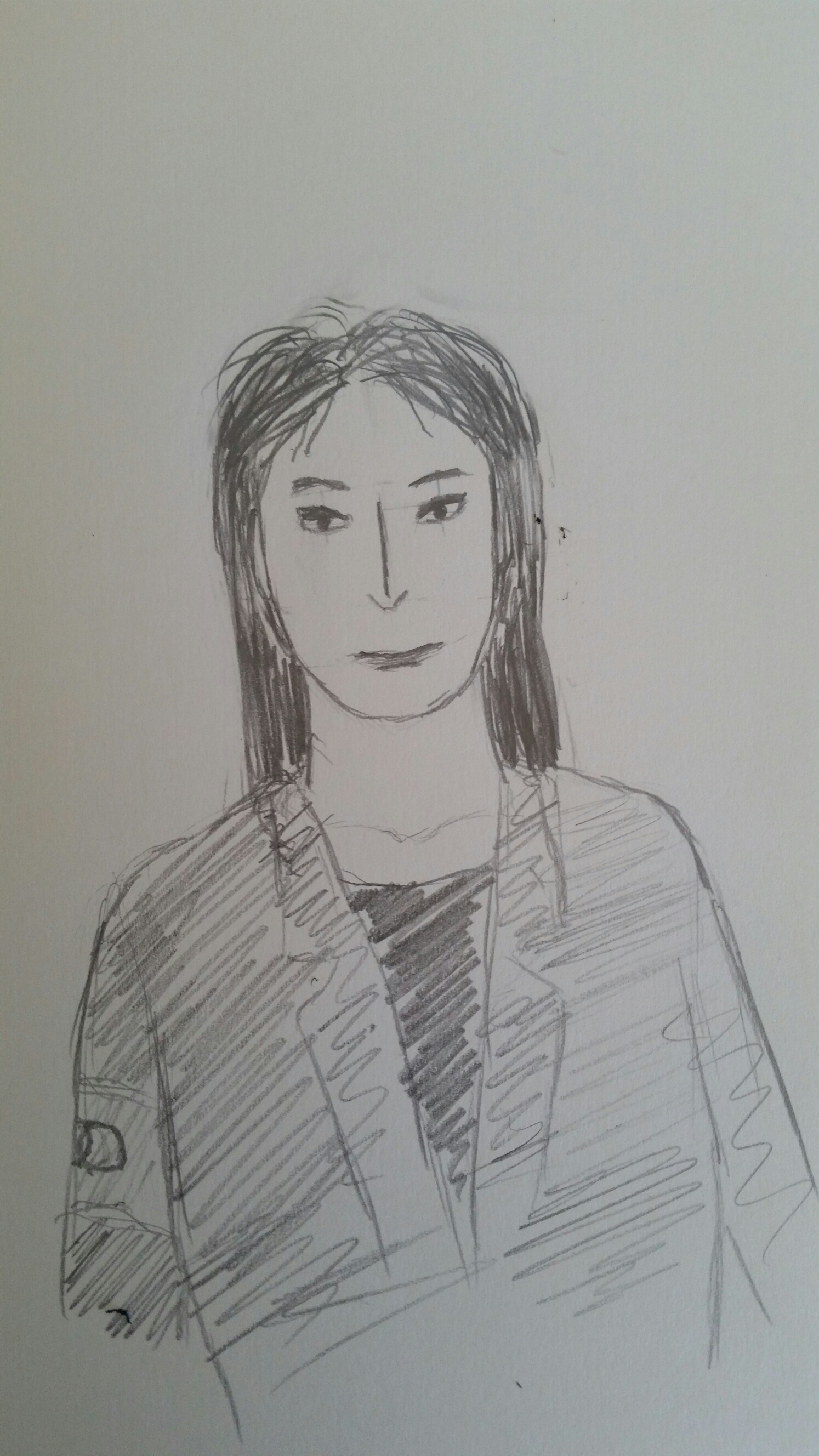
I’m not entirely happy with this one, though I do kind of like how it came out. I’m a bit frustrated because I wanted to draw Amna Ehramanis (Denni’s best friend), but realized the person was looking more like an adult than a teenager, and Amna is supposed to be very petite. So halfway through I made some changes and kinda sorta drew Akaina Shalei instead. Although I think I got the face close, she’s actually much more muscular, and is supposed to have the Meraladian wide face that Caren and Denni inherited.

[Short version: Akaina Shalei is one of two Mendaihu adepts who offer assistance to Caren and Poe, right after the Awakening ritual. She and her brother Ashyntoya have worked together as adepts for years and are highly respected. I will most likely redraw her and add Ashyntoya as a double sketch next time out.  Also, the patch you see on her right arm is the Shalei clan sigil of two intersecting circles, which is also used by the Mendaihu to signify Lightwalking, or dual realities.]