#atozchallenge: D is for Denni Johnson

Denni Johnson - Jena MaloneQ: Denni’s got quite the role in this trilogy as the One of All Sacred.  What’s her origin?

A: She was a relatively new character alongside Caren and Poe, but she didn’t really have much of a role until about a quarter of the way into The Phoenix Effect.  A proto-Denni popped up in True Faith in a similar role but with vastly different motives and personality.  Both versions were pre-teens.  When writing the trilogy it made more sense for her to be a teenager and a little closer in age to Caren.

Q: Why the One of All Sacred, anyway?  Where did that idea come from?

A: In a way that came from a subplot in TF.  I was fascinated by the idea of Chosen One plotlines at the time, especially ones with mundane origins that ascend to deity level, either by a ritual or by outside forces.  It was still a subplot in TPE, but by the time of the trilogy reboot it became a major plot point — so much so that her awakening is Chapter 1 of A Division of Souls.  She’s one of the major drivers of the plot of the trilogy.  [More about the One of All Sacred on 4/18 when we hit ‘O’ on the A to Z Challenge!]

Q: Like her sister, she’s got a Mendaihu name as well.  An extended version of it is given in A Division of Souls.  What’s the story behind that?

A: She gives her Mendaihu name as Denysia Shalei si Emmadha si Dhumélis.  In Anjshé, the ‘si’ is a conjunction — in this sense she’s merely giving multiple clan names that her Trisandi soul is tied to.  [Pronunciation: shah-LEYey-MADH-ah, and dhoo-MEY-lees.  The ‘dh’ is a ‘d’ sound with a very slight lisp.]  All three clans are highly regarded on Trisanda as strong in both spirit and in deed.  She purposely gave all three names at the Moulding Warehouse to prove a single point: she wasn’t going to take her role as the One of All Sacred lightly, not if she claimed to be from such an honored lineage.
And yes, this is a lineage for her entire family.  Caren almost never claims all three names as she rarely sees need for it.

Q: That’s Jena Malone in that picture.  Is she the basis for Denni?

A: Yes, she is.  I wrote TPE around the same time the movie Contact, where she played the young Ellie Arroway.  Spunky, smart and self-reliant, yet still relies on the connection of others.  The trilogy version has her somewhat older (maybe her role in Donnie Darko, which was out about the same time I started ADoS).

Q: For a fifteen-year-old girl, she certainly has a hell of a lot of responsibility, doesn’t she?

A: Well, sure, why not?  She shares much the same daily responsibilities as her older sister Caren, especially since they’re living on their own.  Her parents made sure she was self-reliant, as both they and Caren were ARU agents, and they didn’t want her to completely depend on the help of others.  But they also taught her that there’s no fault in asking for it, either.  Whenever she’s performing her duties as the One of All Sacred, she always has that in the back of her mind, and that’s why she nearly always encourages community but also reminds her followers to think for themselves instead of following her blindly.
That’s not to say that she immediately becomes a Magical Girl and her real life is conveniently forgotten whenever she’s doing her magic as the One.  Now that she’s known as the One by pretty much everyone on Earth, she of course feels a bit self-conscious, not to mention feeling a bit weird about still needing to attend school.  She wants to do her best as the One, but she also wants to continue being teenaged Denni.  I actually touch on this theme in The Persistence of Memories as well as The Balance of Light.
In short: she’s willing to take all the responsibility that comes with being a deity, but she refuses to let it go to her head.

Q: What is her relationship with Amna Ehramanis?

A: She’s her best bud, they’ve known each other since they were five.  Like all lifelong friends, they’ve gone through all kinds of ups and downs, scrapes and japes, and they’re still BFFs.  Denni always plays the straight character to Amna’s wackiness.  As to why Amna becomes her devoted Protector once she’s fully awakened, well…there are a few reasons for that, which are revealed in TPoM and TBoL.  😉

Q: Anything else?

A: Like Caren, she’s a music fiend and constantly streams stuff from her sister’s collection.  She’s a voracious reader.  She’s a decent student and gets excellent marks, but she’ll admit she doesn’t see the point in trying to be top student.  She loves hanging out with Caren’s fellow agents at the ARU, and thinks of them as an extended family.  In particular she looks upon Alec Poe as a big brother.  She’s had a few school crushes here and there, but nothing serious, and she’s okay with that.  There’s a fifteen-year difference between Caren and Denni, which might lead some to think she was an unplanned pregnancy, but she’s actually not.  Aram and Celine deliberately chose to have another child after the previous Season of Embodiment.  (As to whether they knew her fate at that time is not known.)

And yes, she too has a theme song, Lamb’s “Small”. This is what she thinks about when she’s up in her nonspace.
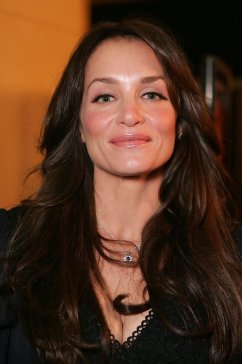
#atozchallenge: C is for Caren Johnson

Caren Johnson - Kristen ClokeQ:  What is Caren’s origin?

A:  Caren is actually the first new character I created for the trilogy back in 1997 when I started The Phoenix Effect.  I came up with her (as well as Alec Poe) on that first day of writing.  I’ll admit there was a slight inspiration from The X-Files which I was a fan of at the time, as I was looking for two investigators who were put into a situation they weren’t exactly comfortable with.

Q: She’s got a Mendaihu name as well.  Why is that?

A: Her Mendaihu name is Karinna Shalei.  [First name pronounced ka-RINN-nah].  She was given it by her parents, Aram and Celine Johnson, who were high-level Mendaihu adepts as well as agents for the Alien Relations Unit.  The Mendaihu blood runs extremely strong in her entire family.  She takes this name very seriously, and never uses it frivolously.  The same with her sister Denni; she will not call her ‘Denysia’ unless it is warranted.
The giving of Trisandi clan names to those from Earth is not considered appropriation by the Meraladians; they actually consider it a form of incredibly deep respect, as they feel these people are willing to completely embrace their ancient physical and spiritual connections with Trisanda.

Q: That’s Kristen Cloke up there.  Is that who Caren is based on, physically?

A: Yes!  In fact, she was inspired by Kristen’s role as Captain Shane Vansen in Space: Above and Beyond (of which I was a HUGE fan).  Someone who isn’t entirely happy with the role she’s been given, but that won’t stop her from performing it to the best of her ability.  Like Vansen, Caren is also someone who takes her responsibilities very seriously, especially when it comes to those she works with or mentors.  Caren connects personally and spiritually with everyone she meets.
I can even tell you the scene where it dawned on me that she’s definitely Caren: it’s a rare and very personal conversation between her and 1st Lt. Cooper Hawkes in the episode ‘Hostile Visit’, which takes place just before they’re about to head out on a dangerous mission.  This is definitely a conversation she’d have with Alec Poe.

Q: Her relationship with Anando Shalei seems to be somewhat unique.  Has she always questioned her relationships, romantic and otherwise?

A: No, not always.  The death of her parents really took a lot out of her emotionally, and because of that she keeps a specific distance from others, for fear of getting too close and then losing them as well.  She’s fully aware of this decision, and has never let it completely get to her, knowing full well that she has to move past that.
Caren’s connection with others is definitely unique; it was partly based on a few friendships and relationships I’d had where I simply clicked with the person on a deep level in a very short amount of time.  It’s not merely a romantic or sexual attraction she has with Anando, but a spiritual one.  And because of that, Caren is nervous at first, wondering how it could possibly work.  The longer they’re together, however, the more they learn to rely on each other for comfort, affection, and a firm base of spirit.
Her last serious relationship before Anando was with Agent Sheila Kennedy, though they both decided to end it due to their work situation and remain close friends.  They still flirt with each other now and again, mostly for the humor of it.
As for friendships, she is extremely loyal, and will always have your back.  She also has a very thin filter, so she’ll often say what’s on her mind, even if it bothers you.  She takes every kind of relationship seriously.  Especially the one with her sister.

Q: Anything else?

A: She often has trouble falling asleep at night, as she often lets her thoughts run rampant near the end of the day.  She’s been trying her best to fix that.  She has a scar on her thigh from a bullet grazing it during an investigation.  She has exceptionally strong night vision.  She can be very impulsive and impatient sometimes, which has gotten her in trouble now and again.  She’s got a very snarky sense of humor.  She won’t admit it to Poe (who will surely never let her hear the end of it), but she really does enjoy dressing up fancy now and again.  She’s an avid music fan and has quite a large collection; her tastes depend on mood and situation, but she has a soft spot for meditative music, especially when she’s had a taxing day at work.  She’ll always say her happiest moments are when she’s hanging out with Denni.

And yes, she has a theme song:  Lamb’s “Gorecki”.  It’s exactly how she feels about Anando, even if she has trouble articulating it to him or anyone else.

Lamb ‘Gorecki’ from Luke Copeland on Vimeo.

#atozchallenge: A is for Akaina and Ashyntoya Shalei

[Apologies for the delay…I had quite the full schedule yesterday and was not able to post until today.  Thus we’ll have multiple entries today.  Woo!]

Welcome to Jonc’s A to Z Challenge!   I’ve chosen to have some fun and post about the stuff that goes on behind the scenes in the Mendaihu Universe; character backgrounds, FAQs, behind-the-scenes production, and more.  Hope you enjoy!

Q: First off:  how do you pronounce their names?

A: Last name first:  Shalei is shah-LEY, even if it’s a distant relative that has the extra ‘i’ at the end.  It’s an extremely common Meraladian surname, as it’s one of the largest clans to come from Trisanda.  They do sometimes get queries about if they’re all related; some do find it irritating, others merely brush it off with a quick answer.
Ashyntoya is ahsh’n-TOY-ah.  He’s named after his great-grandfather who was quite the epic Mendaihu, and a major player in the Fifth Season of Embodiment of the One of All Sacred.  Someone he feels he’s expected to live up to, but he doubts he’d even be fit to stand in that great man’s shadow.  He prefers to be called Ashan (ASH-ahn); he usually explains that it’s just a nickname, but in truth he borrowed it from another less known and much older ancestor who was connected to an uprising at Bann Currin on Trisanda.
Akaina is ah-KAH’ee-nah (although I admit my brain still sometimes reads it as ah-KAY-nah).  She understands cultural differences in speech origins, so she’s totally fine with people pronouncing it either way.  She prefers people call her Kai (kah’ee, rhymes with ‘sigh’).  She’s named after her aunt on her mother’s side; the two sisters were best friends growing up and are still extremely close.  Her aunt is one of her favorite relatives; she was the one who first taught her about the Mendaihu and the Shenaihu.

Q: How did you come up with the twin Mendaihu agents for the Bridgetown Trilogy?

A: That’s a good question…they just sort of evolved, really.  If I’m not mistaken, Kai originally showed up as a humanoid AI in The Phoenix Effect, and Ashan was one of the background AIs.  I dropped nearly all the AI ideas during the 2000 reboot and kept those two, giving them a completely new background and purpose.
They weren’t twins at first; originally I was going to have Ashan as the older brother.  However, I realized both characters had an almost exact equal purpose in the story; it made more sense for them to be not just physical twins but spiritual twins as well.  There’s no special psionic connection between the two; they merely know each other’s soul so well they work perfectly together as a team.  And of course, as siblings, they do get under each other’s skin now and again.

Q: Are they based on anyone in particular?

A: When I create characters, I often picture various actors playing them, just to get an idea of what they might look like or how they’d act.  In this case, however, I never really thought about it.  I purposely didn’t base them on anyone famous.  I wanted their characters to feel like that person you meet where you can’t quite put a finger on who they remind you of, and instead you find yourself attracted to their uniqueness.

Q: What do they look like?

A: In A Division of Souls I described them in general terms as Meraladians; they are human in form, though larger in height and size.  Their skin color is a very light brown, which is common for Meraladians.  As they are fraternal twins, they look similar to each other in certain ways, though Kai’s face is more oval and Ashan’s is narrower.  Ashan is slightly larger in frame.  They both have very dark brown eyes; from a distance it looks like their pupils are fully dilated.  They have small rounded and smallish noses and wide mouths.  They both have long black hair that they tie back in a triple tail, often threaded with small beads near the ends — this is an old cultural practice of the Shalei clan.

Q: Where do they come from?

A: They’ve been NewCanta Province citizens for almost all their lives.  [NewCanta Province is northwest of Bridgetown, and is the center of government for the Upper Midlantic Range.  Bridgetown is the second largest province in this Range.]  Nearly all of their extended family have been lifelong Mendaihu.  They have no other siblings, though they have quite a large extended family of relatives and close friends.

Q: What are their personality types?

A: Ashan is often misconstrued as being standoffish, maybe a little arrogant, but in truth he’s just not entirely sure how to act in front of others.  That’s not to say he doesn’t understand people, far from it; he’s just a little too self-conscious about whether or not he’s doing the right thing.  His anger does get the best of him sometimes, though after the fact he will apologize immediately, even sending out a small sensing thread to invite them closer to his spirit to show his true emotions.  He’s truly loyal to his friends, acquaintances and fellow Mendaihu agents.
Akaina is more open with her emotions and thoughts.  She has a bright demeanor, but when angered her words can be extremely barbed.  She loves meeting new people; she loves getting to know them on multiple levels so she can understand their many quirks and inconsistencies.  She’s also quite loyal to her friends, acquaintances and fellow Mendaihu agents.  She fully trusts what her soul sings to her, sometimes to a fault, but she understands the problems that might cause, and is willing to work through them.
They both absolutely love a good feast with friends, especially if a warm beverage of tea or coffee is served afterwards.

Q: Anything else?

A: Bits and bobs:  Both are often seen in their Mendaihu agency uniforms — long black dusters with a gray patch on their right shoulders, on which is stitched the Mendaihu sigil of two intersecting circles.  They choose to do this because they like to show they are always performing their Mendaihu duties at any time of day.  Both graduated from their Mendaihu training with very high marks.  Ashan has a long thin scar on his right forearm, the result of a training exercise accident.  Kai’s night vision is weaker than Ashan’s.   During the Bridgetown Trilogy, they share an apartment in the Pullock Street Heights Sector, not that far from Pullock Street Park.  Kai won’t tell him, but Ashan snores like a freight train.  Neither have ever traveled to Trisanda, though they are well informed of its history and what goes on there.

*

Want to know more about the Mendaihu Universe?  Leave a question below in the comments, and I’ll be happy to answer it or expand on it in a future post!

Returning Back to the Fold!

naruto dive
My life over the last month and a half.

FINALLY!

Yes, I have returned from the shadows and back to the land of the living!  I’ve been so busy as of late, it took me a few days to realize that I didn’t have any pressing OMG deadlines weighing me down!

The last few days have been spent mostly doing project clean-up and getting everything back to some semblance of order.  This meant an often precarious balance of Day Jobbery-related fires to put out (and there were many), doing the post-production and release prep for The Persistence of Memories, and generally just taking time to BREATHE again.

So now that it’s midweek and my brain has stopped spinning some, what do I have on tap for the close future?

Glad you asked!  A partial list:

The Persistence of Memories to be released in ebook on 4/15!  WOO!  It’s available directly from Smashwords in all kinds of formats, including Kindle, for $4.99.  And for a brief time, you can buy the first book ABSOLUTELY FREE!  Two for the price of one!  [Note: As before, since the formatting of the physical book takes more time, I’ll let you know as soon as I can when it’ll be available through CreateSpace/Amazon.]

— I shall be taking part in the Blogging from A to Z April Challenge this year, here at WtBT!  It’s a fun blogging exercise that I’ve done a few years in the past on my LJ, and thought I’d give it a go here.  I was thinking of doing an A-to-Z of the Mendaihu Universe, partly to get me to talk about it more (as I’m sure you’re all wondering, what the hells is he talking about in these books?), and partly to get me back into the blogging habit.  Hope you enjoy what I have in store!

— And speaking of blogging, I’m still planning making good with my ‘alternate plan’ for the Walk in Silence project by turning it into an ongoing series over at the WiS blog.  This series will start the third full week of April (around the 20th or so).  Stay tuned!

— Returning to the whiteboard schedule.  I purposely put it aside a few months ago when I chose to focus solely on the TPoM revision/edit/remaster/release, and now it’s high time to return to it.  Which means more practice words at 750 Words, more WiS entries, and maybe even some words and music elsewhere.  Truly looking forward to that.


So yes!  Definitely looking forward to returning back to the writing and the other projects.  It’s going to be a fun and creative summer, that’s for sure!

naruto ramen
Ahh…now that everything’s back to nor–

Adventures in Self-Publishing: The Myth of the One Chance for Success

One of the things I’ve been thinking about during this self-publishing project is that time-honored maxim, ‘You only have one chance to make a first impression.’  Okay, that might be true if you’re trying to, y’know, impress someone on the spot.  A potential date, a possible future boss, the audience watching your first stage performance.  It also sounds like you need to do it right the first time, or it’s going to be black mark on your cv and you’ll forever be labeled a hack.

I agree with that maxim when it refers to getting your book out there (especially your first one)…to an extent.  I agree when it pertains to making sure you’re providing the best work you’ve ever done.  No ‘there-I-fixed-it’ kludge editing, no relying blindly on spellcheck, no half-assed cover thrown together in a five minutes, and especially no ‘meh, they won’t notice’ rookie mistakes.  On that level, you want your book to be the most professional thing you’ve ever done to that date.

On the other hand, I’ve come to think that, even if my book is the best thing I’ve done, and that I’ve cleaned it up, spitshined it, formatted it, taken the steps to promote it, gave it a fifteen-point inspection and even rotated the tires, and led the call for all and sundry to come and bask in its awesomeness (or at least beg everyone buy the damn thing), I still might hear crickets upon the book’s arrival.

In this case, I still don’t think it’s necessarily true that I’ve spoiled that One Chance.

See, with my music obsession, I have a particular affinity for sleeper hits.  The ones that might not be a big hit right out of the gate, but still manage to attract a decent following.  The ones that the mainstream might not pay attention to right away, but will eventually.  Like Loveless or Fantastic Planet or The La’s or any one of those brilliant albums that took a long time to show up on everyone’s Best Ever lists.  They may have been minor hits at the time, but they didn’t get too far, at least not right away.  They had to grow on people.

This is how I’ve been looking at getting A Division of Souls out to the masses, really.  The most important thing, at least for me, is to get it out there first.  I’ve not done too much promotion as of yet, other than tweeting pictures and emailing links whenever I see it in the wild.  [The giddiness hasn’t abated, I admit.]  Reason being, I’m about sixty pages away from finishing the final edit, plus I’m going to need to format it as well before I can upload.  But once it’s up, it’s up and it’s live.  And I’m going to need to promote it at that point.

Which begs the question:  how to promote it?

Well, that’s the tricky part.  And I’ll be going into that in future posts, once I get to that level.  I’m still figuring it out right now.

Point being, part of the trick here is to avoid promoting it by making a huge pre-release scene over multiple platforms, like it’s a big Hollywood film.  I know from personal experience that no one likes to have a product jammed down their throats, even if it is something they’ve been waiting a long time for.  I’m taking the quieter route:  magazine reviews, word of mouth, reader contact, freebies, consistent blogging, and so on.  And a little further down the line, perhaps sitting in on a panel or two at a convention, limited release of physical copies, and so on.  It’ll be a much longer route to take, of course, but in the end it should pay off because I’d be keeping the book visible for a longer amount of time.

At that point I’ll make a good first impression on a new reader, even if it takes a while.  I’m in for the long haul.

*

If you would like to be one of the first to say “I was into his stuff before it was cool,” by all means!  Here’s some linkage for you!
 Barnes & Noble (Nook)
 Smashwords
 Kobo
Good Reads

I’ll of course add more as I find them.  [Apparently I need to jump a few hurdles in order to have it available on Kindle…more on that when I get to that point.]


And One Giant Leap…

First mock-up cover, thanks to Shutterstock and a half hour on PicMonkey.
First mock-up cover, with help from a Shutterstock sample and a half hour on PicMonkey. NOT THE FINAL VERSION.

Small steps.  That’s what writing novels has been about for me.  On the surface it may look like I’m one big mess of contradictions: deep focus on ideas but extremely haphazard drafts; some really tight writing balanced out with a handful of ‘screw it, I’ll fix it later’ placeholders; things that pretty much every writer needs to go through.  We create a hell of a lot more than what ends up in the final version, and a lot of it does tend to be directionless wriggling, trying to figure out where the hell we want the story to go.  A lot of small steps.  Missteps, steps into slippery mud, and blind kicks into the air, with the hopes that the end result is instead a well-choreographed saunter down a red carpet, fans cheering at the sidelines.

And one giant leap, making the decision to publish.

Last week, I made the decision that I was going to work with one of the indie self-publishers and finally release the Bridgetown Trilogy into the big bad world.

This past week I’ve begun preparing myself for an early September drop date.  Starting one final line edit of A Division of Souls, making various business decisions, starting a detailed spreadsheet for the accounting…and everything else that goes into releasing a book on one’s own.  I’m even making my own covers, with the help and feedback from others.

The one thing I did not expect during this process?  I’m enjoying the hell out of it.

The research into what publishing services would work for me?  The images I’d want for the covers?  What kind of expenses I’d be expecting to shoulder?  That is, the business side of all of this?  I’m really enjoying this part of it.  Never thought I’d admit that.  Certainly back in my early writing days, I was that writer who was all about the creative spark and saw the economic side of it as the death knell to creativity.  [Thankfully I got rid of that mindset right quick.]  Now?  I’m finding the ‘behind-the-scenes’ work just as fascinating as the writing.

I think it’s because I’ve made myself see it similar to the music business, of which I have a decent basic knowledge and a keen interest.  Bands rarely if ever go into the studio and slap down a perfect and complete album straight out.  There’s a lot of working parts, a lot of outtakes, presales boosting, word of mouth and other bits and bobs that may not be obvious to the passive listener, but are quite important to the end result.  Writing and publishing is very similar in that respect.  I’m fascinated not just by the creative process, but the amount of work it takes to make it professional level, making all the pieces fit perfectly.  I’ve not only been actively participating in all the levels, but I’m learning from them.

Am I going to be blogging about it as I go?  Of course I am!

This is the part of the business not many writers and blog readers get to see…and more often than not, this is also part of the business that writers tend to want to ignore (often for good and legitimate reasons).  In the process I hope these upcoming posts will also help others who are thinking of following a similar path.

So yeah.  Here we go.  One Giant Leap.

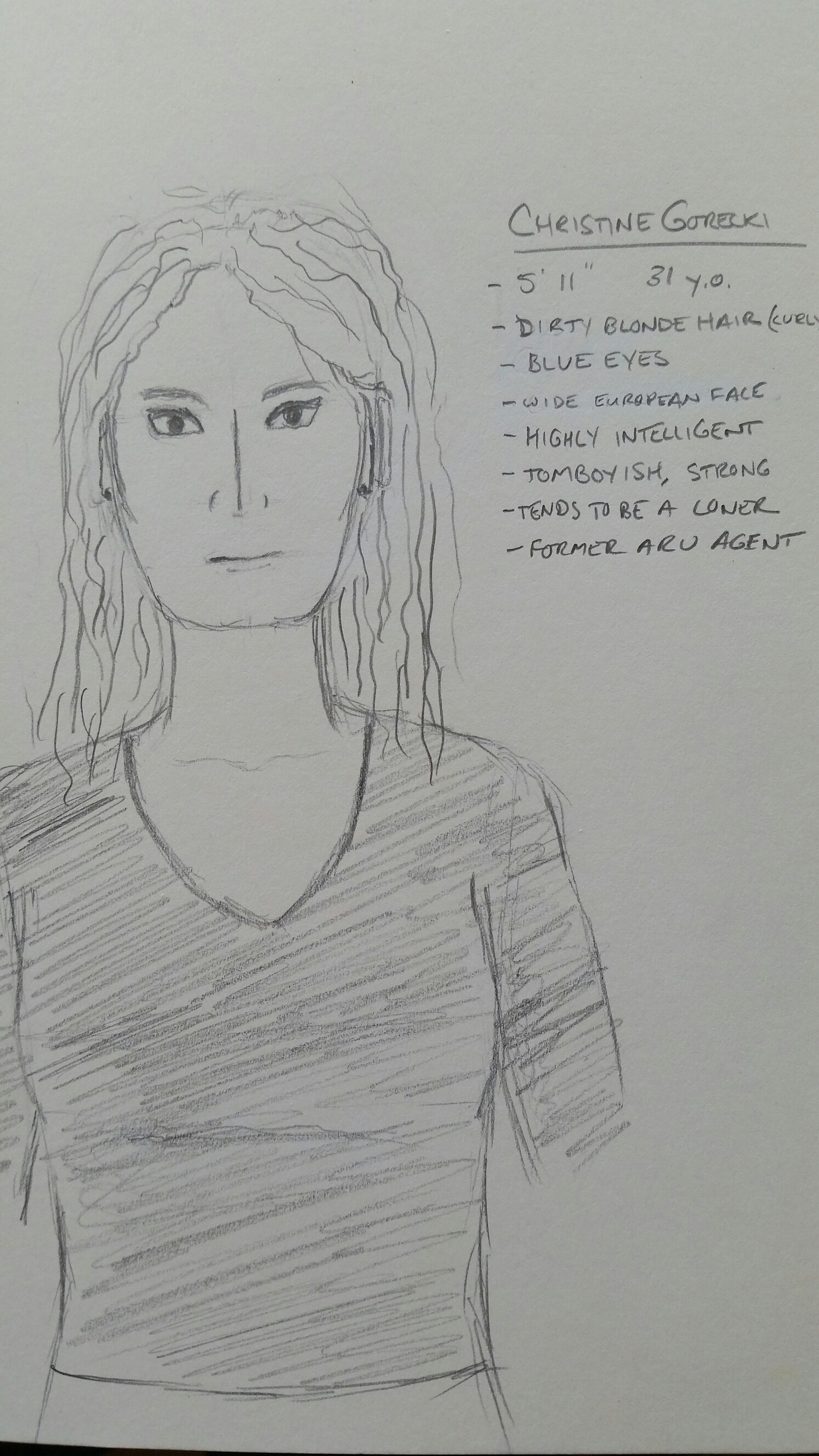
A Division of Souls: Character Sketch!

image

And we’re back! My first bit of artwork now that I’m back on the whiteboard schedule is another character sketch for the Bridgetown Trilogy gang.

Christine Gorecki has an interesting background, as she was originally a tertiary character when I created her late in the ADoS story; she shows up in person in the last third of the novel when I needed to have someone ARU-related meet up with Sheila and Nick during a specific point in the plot.  I ended up really liking her and gave her a major role in the trilogy.

She’s somewhat of a lone wolf.  She’s highly intelligent and resourceful and originally used that to her advantage while she was part of the Alien Relations Unit.  She’d decided about six months previous to the events in ADoS to take a temporary leave of absence to clear her head and deal with some very personal issues, and in the meantime she’d started freelancing as a detective as well as a low-level healer, which she runs out of a storefront on the ground level of the apartment building she owns.

Christine shares a very close friendship with Alec Poe; she is often the first person he thinks of when he needs outside (non-Vigil) help, and trusts her completely, and the feeling is mutual.  She’s also close friends with Caren Johnson and her sister Denni, and looks after them from a distance.

On Writing, Revision, and Recording Music

[Note: I posted this at my LJ back in September 2013, and thought it would be worth reposting here.  Enjoy!]

A short time ago I tweeted something that came to me about the writing and revising processes, and partly how I was finally able to understand what I needed to improve my writing, and also made me understand just how to write and record a song correctly. This came to me while I was doing my Blogging the Beatles posts a few weekends ago, and I’d like to expand on it a bit here.

In short, it occurred to me that revision, for the most part, is very much like how many rock bands record their music. The listener–and with books, the reader–are only given the finished piece: the end result of a long process of composing, noodling, demoing, recording, overdubbing, and final mixing. What the public often does not hear/see is all that work as it unfolds. You don’t hear/see the alternate words, the alternate melodies/plots, the mistakes and the other bits and bobs. And if all this is done correctly, you hardly notice all the tiny flourishes as separate entities of the whole, because you’re not supposed to; they’re supposed to be part of the entire, much larger experience.

For the longest time–probably up until the last two years or so–my writing process has been extremely slipshod and make-it-up-as-I-go-along, and giving myself subconscious reminders for things that would need revising later. I’m lucky in that I’ve been able to remember the story arcs and the random plot twists that I would need to expand on later on in the story, and I’ve made copious notes on the esoterica of my created world. I may have crowed about outlines in the past, but I’ve used them, or at least planned out the plot a few chapters ahead of where I was at that time. Still, after all these years, I’ve come to the realization that while this process may work, it’s time consuming and unorganized.

In the last few years, I’ve been working primarily on the revision of the Bridgetown Trilogy, rarely writing anything completely new. That’s not to say I’m not writing anything at all; there are several passages in this revision project that are either total rewrites of older scenes, or are brand new scenes that replace old ones that don’t work. I’ve been writing a few other things here and there, outtakes for Walk in Silence, posts for Blogging the Beatles, and making notes for both new and old ideas. It may look like I’m getting nothing done, but trust me–I’m doing all the background work right now.

Again–it’s like recording a song.

Over the course of the Blogging the Beatles posts, I’ve done a lot of reading of Mark Lewisohn’s book The Beatles Recording Sessions, which goes into fascinating detail as to when, how, and where their songs were recorded. I’ve read this book countless times in the past, but in the context of my blog series I’ve begun appreciating the crafting of the music, listening to the songs and trying to understand exactly what they did to make it sound that way. In the end it’s also made me think more about my own creative processes, both in writing and music.

The beginning always starts with an idea. It might be something obtuse: John Lennon came up with the vocal melody for “I Am the Walrus” from the up-down tones of police sirens as they passed by his home. It might be something coming from out of nowhere: Paul McCartney was convinced he’d copped the melody to “Yesterday” from somewhere, but it was his own creation. It might be inspired by life: George Harrison wrote “Savoy Truffle” about Eric Clapton’s addiction to sweets. The point being: this is where the idea takes hold. I’ve mentioned in the past that my trilogy came from watching the Gall Force animes.

The next step is the rough draft, the demo. Here’s where a band gets together at someone’s house and hashes out a few ideas that have been brewing over the last few weeks. The Beatles did this in early 1968 when they came back from India, gathering at George’s house for a few days and hammering out a few rough drafts of songs that would eventually show up on The Beatles (aka The White Album), as well as Abbey Road. In writing, this is where you’re writing longhand, maybe doing a bit of outlining and/or plotting, drawing maps, putting up that wall of Post-Its. In essence: here’s where you sit down and riff it, build on that one idea (or multiple ideas) and see what unfolds.

Next is the first draft, Take 1. It’s going to be rough, there are going to be dozens of mistakes and wrong notes and flubbed lyrics. If the demo contains enough ideas that you can continue fleshing out, this is where you start adding a few things here and there, perhaps fleshing out a melody or two that you found captivating. You may even find that a bit that worked in the demo sounds horribly out of place here, and you drop that. Now, unless you’ve been practicing and rehearsing that one demo for quite a long time, you have to remember that this first take is going to sound like crap, no matter what you may think. Rarely does one get a complete finished song at this point. In writing? Same exact points. You’ve got the idea, now it’s time to start molding and shaping it into something better.

Next is the following drafts, the continuous takes. However long it takes to get that one passage right, to fix that lyric or bum note that’s been bugging you all this time. You may even resort to outside influence–your bandmates/your writing group–and ask them to take a listen/read and see if they find something you’ve overlooked. This is the longest and the most frustrating part, because you’re focusing mostly on building the song/plot. You may even drop it for a time and work on something else so you can return to it later, listen/read it with a clear mind.

Eventually, you’ll hit that last draft, that last take of the song. There will be a point, if you’re paying attention, where everything will just click. The song might not be the most perfect one in existence, but it’s exactly how you want it to sound. You’ve fixed those bum notes, you’ve cleaned up the lyrics. You’re at a point where you’re happy with it, maybe even a bit proud of it. In writing, this is where you’ve pretty much tied up all the loose ends of the plots, fixed the grammar and spelling mistakes, gotten it to the point where it looks clean.

This, of course, is not the final result. Not yet. And this is where, for years, I’d stop. I thought I’d be done with the book and send it out to agents and publishers, thinking I had a good shot at getting accepted. This is where I’d also get rejected, of course. There are many and countless reasons for that, which I won’t go into at this time. The point is, it’s not quite finished yet.

This is where the overdubs, the final mixing, and the running order come in. There’s that one point in the middle-eight that sounds just a bit too sparse, so you decide to throw a bit of horns or a solo in there. The vocals are weak here, so you overdub yourself to punch up the strength of the sound. This song sounds quite out of place as the third track on the album, but would sound so much better as the second-to-last track. Translated: this is the final read-through, the point where you pick up the novel as a whole, read it as you would a potential reader instead of its author. This is where you pay attention to how you react to the story. This is where you notice that one character needs more description or action. Where you notice that this subplot leads nowhere. Where you feel that Chapter 5 would make so much more sense chronologically as Chapter 8 instead. Where you threw a deus ex machina or something in there out of laziness, or as an “I’ll fix it later” and promptly forgot about it.

THIS is the final draft: this is where you make the song sound seamless, like you and the band recorded it in one go, without a single blemish. This is where your audience will not see the work you put into it, but only the end result.

Once you hit that point, then it’s time to send it out to the agent and/or publisher.

Writing Soundtracks

Most of you out there know that, aside from being a writer, I’m an incurable music fan.  Not a day goes by where I’m not listening to some radio station or some new album I downloaded that week.  I laugh at polls that ask if I listen to music more than a few hours a day–it’s more like all day long.

This includes my writing time.  I’m one of those writers who prefers to have some sort of music going while I’m writing.  What I listen to actually boils down to whatever project I happen to be working on.  I’m currently working on Walk in Silence, so the music of choice has been strictly 80s alternative.  For the most part I’ve been listening to the 1st Wave channel on our Sirius XM setup, where Swedish Egil and Dave Kendall have been providing me with tasty retro goodness for the last few months.  This is perfect for this first draft, as I’m not focusing too much on specific albums and songs at this time.  The second draft will focus more on that, so my soundtrack will focus more on my own mp3 collection.

The evening writing sessions down in the Belfry that produced The Phoenix Effect from 1997 to 1999 and the Bridgetown Trilogy from 2000 to 2004 had their own expanding soundtrack; the former contained a high amount of the free cds I got when I worked at HMV, and the later contained many of the titles I bought during my weekly journeys to Newbury Comics back when it was in Amherst.

Was the writing influenced by the music I bought?  Well, yes and no.  I didn’t go out of my way to look for the perfect song that would fit a specific scene, nor was I writing and editing a scene to a specific song in a Miami Vice-like manner.  I’d grown out of that habit a long time ago.  I merely found myself gravitating towards the moods the music created when I listened to them, and used that as a mental anchor when I needed it.

When I was writing a number of scenes that needed personal and emotional tension, I would often throw on Dishwalla’s And You Think You Know What Life’s About.  If it was an epic action scene, it would be Failure’s Fantastic Planet.  Global Communication’s two albums 76:14 and Pentamerous Metamorphosis fit the bill perfectly when I was writing about the world of Trisanda.  Trip-hop like Massive Attack and Sneaker Pimps worked good when I was writing about the seedier areas of Bridgetown.  I also had certain go-to bands whose entire discography worked, like Porcupine Tree.

I always made a conscious effort never to let the music interfere with the story; I tried not to write scenes that lost their energy when the music wasn’t playing.  If anything, the music served as an anchor, giving  me something to focus on, something to aim for.  Failure’s epic album closer “Daylight” served as the audio anchor for the final scene in A Division of Souls–I needed something desperate and angry and with a hint of fear that would mirror what was going on during those final pages, and I think that it paid off.

Now that I’m working on a project that’s specifically about music, I have every reason to listen to whatever I like.  Whatever my next writing project is, will I have the same listening habits during my writing sessions?  Who knows, but I’m pretty sure something will be playing.

On Conlangs in Science Fiction: When Should a Writer Use It?

As you have seen here and here, the Mendaihu Universe has its own constructed language, or conlang. which I’ve chosen to use for the alien Meraladhza race.  Creating this ersatz language was not just a hella nerdy thing to do, but it was a lot of nerdy fun as well.  As noted in that previous blog post, there were two reasons for doing so:

1. To give the aliens their own language, pure and simple.  Once you read Douglas Adams’ The Hitchhiker’s Guide to the Galaxy, as a writer you can’t help but feel super-conscious about aliens being able to speak your native tongue so easily, and sometimes fluently to the point of using localisms, without thinking it’s a cop-out.  It’s a silly worry, as it’s widely accepted in the genre, expected even, for aliens from other worlds to be able to speak your language, or at least to have some sort of translating device.  Thus Adams’ brilliant sendup using the babel fish–it’s a brilliant satire of the old-school science fiction stories where the aliens somehow knew the Queen’s English upon first contact.

2. What if I wanted them to use their language?  In a way, I wanted to play around with the idea that our languages have permeated Anjshé, just as it has permeated ours–which is how a lot of real languages have evolved on Earth, anyway.  This is another reason I chose the aliens to have been among us for at least a few hundred years before the trilogy’s timeline; this would have given time for a bit of cultural bleedover to take place, including language.  The Meraladh would have picked up on various languages, and the Earth humans would have picked up on Anjshé, and both sides would have appropriated a few phrases into their own language at that point.

So if you’ve created a conlang for your novel or your created world, you may need to ask yourself: when is it needed?   In my opinion: when it’s needed within the context of the story.  Think about why you want to use the alien language–I mean, aside from “because it’s cool”, of course.  Give the language a reason for being there.

Say your main character is meeting up with your aliens for the first time, and he or she doesn’t know the language, or doesn’t have a translating device on them.  You could play up the tense moments by having them attempt to converse, never quite sure if they’re being friendly or aggressive.  Some writers have used this as an ongoing plot device, such as CJ Cherryh whenever she has the alien kif speak in her Chanur books.  Even Adams used this idea to amusing effect, having Arthur Dent hear a few moments of the Vogon language before Ford Prefect slams a babel fish into his ear; in the process, we find that the Vogons are not just horrible amoral aliens in general, but their language is so hard on the ears that it has literally caused other aliens to kill themselves rather than listen any further.

Within the trilogy, I use the Anjshé language only where it’s truly needed, specifically when a character is having an extremely emotional or spiritual moment.  It could be passive, such as when Alec Poe spits out the word pashyo (a general exclamation of surprise or frustration) whenever he’s annoyed with the situation.  Or it could be when Caren Johnson humbly apologizes to a Meraladian character with nyhnd’aladh…I am sorry, when she speaks out of turn and inadvertently says something hurtful.  I also use it whenever a character is performing some kind of spiritual action; just before a major ritual begins, I have Denni Johnson speak an entire introduction completely in Anjshé before she repeats it in English.  All these moments not just utilize the conlang to give the moment realism, but I’ve also given it a reason for being there:  as the Meraladians are a very spiritual people, so is their language, which they deem just as important as their actions.

*

As always, one major thing to remember about creating a conlang is to make it pronounceable to the reader.  Unless you’re creating a language that’s deliberately hard on the tongue and/or ears, such as Adams for his Vogons or Cherryh for her kif, you’ll want to voice them out as you create them.  If you can’t pronounce it without tripping over your tongue or your throat seizing on you, chances are good that your reader will have the same problem.

A few other hints to think about:

–Make some ground rules to keep it consistent.  As stated in a previous entry, the most common sounds in Anjshé are “mmh” and “aah”, as they are the sounds of the spirit at rest.  Creating these kinds of rules will show that you put effort into this conlang, that you’re not just making it up as you go along.

–Study up on real foreign languages–or even your own native tongue–as a way to see how and why that culture created its vocabulary.  Anjshé is partly inspired by real languages that create new words through existing shorter words, like some Japanese and German; it’s also partly inspired by the aural flow of Gaelic.  In this process, keep in mind how these new words will affect your characters:  how would they deliver them, and is there a specific reason why they are saying them?

–Create a primer or a glossary that you can always refer to while writing to help you remain consistent in usage as well as in spelling.  You may even want to add these words to your word processor’s dictionary to avoid the auto-correct kicking in.  Additionally, you can use this glossary as part of your novel’s endnotes so the reader can refer to it when necessary.

–Have fun with it and see where it leads you!  Don’t think of it as your boring homework from high school–you’re creating not just new words here, but a new created culture, which you can then integrate into the novel itself.  This  will give your story more depth in the process, even if it’s just a short passage.  Readers will pick up on this and enjoy the reaction it causes.


Creating a conlang can be as detailed or as vague as you want and need it to be.  On the whole I believe I only have about seventy or so Anjshé words I created and added to the Bridgetown Trilogy, and used them only when necessary.  I left the door wide open for expansion, of course, and if that is part of your long-term goal, then by all means, go for it!