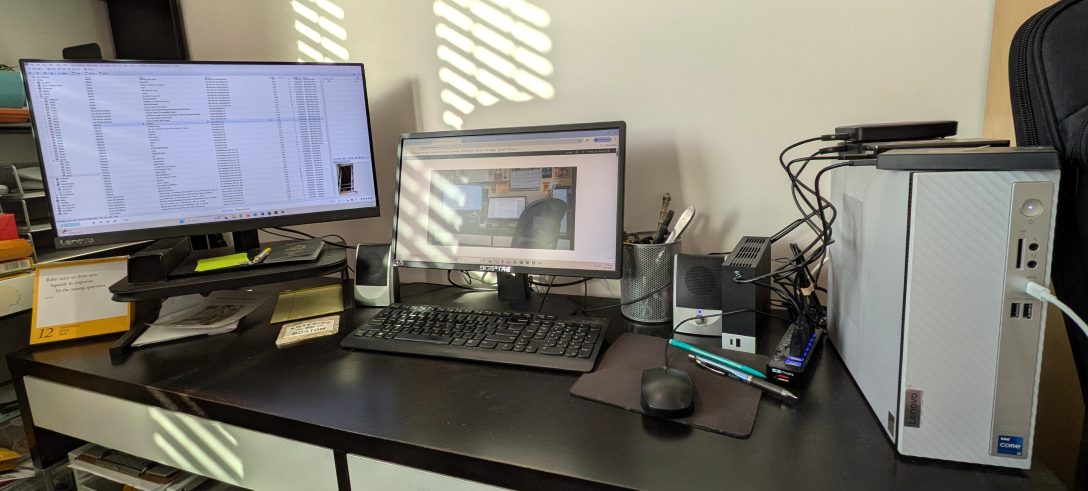

I have about five more chapters’ worth of revision to go before I can call this second go-round of Diwa & Kaffi done. I’m still on schedule, hitting about one chapter per evening while we watch British gardening shows. [They’re quite soothing after a long day at work, and perfect background noise for my writing sessions…although I do get occasionally distracted!]
I know I’ve talked about what The Next Project will be, but right now I’m not thinking too much about it. All my focus has been on revision, and the next step will be submission research. Right now if feels right for me to dedicated as much time and attention on this project.
In the past this would have bothered me…the fears of running out of ideas and falling out of practice, mainly. Over the years, though, I’ve realized that these fears will only manifest if I let them. I’ve cleared the table of nearly every story I’d put in backburner status, holding onto maybe two or three. They’ll be there when I come back to them. And if they no longer hold my interest, well…I’ll come up with something else eventually. I’m not worried.
Part of this comes with having done a reread of My Work to Date. I’ve reread all three books in the Bridgetown Trilogy as well as Meet the Lidwells over the last few months. It does kind of blow my mind that I’ve already self-published five books and I’m about to submit my sixth to a publisher, all within the space of four years. That’s a hell of a lot more productivity than I ever thought I’d have, to be honest.
So if I have a bit of a dry spell after D&K is out and away, I’m not going to worry too much. As long as I practice.
We just returned from an extremely busy weekend at Outside Lands and all that entails: multiple band performances, vague attempts at eating healthy, walking all over Golden Gate Park, braving the questionable porta-loos, and trying to ignore the more performative extroverts and drunk frat bros. And walking back home six long blocks away at the end of the night. It was a blast and I’m always excited that we have this incredibly cool music festival less than a mile from our apartment, but I am now tired and sore and a nap sounds like a great idea.
And yet somehow I’ve decided that doing my Daily Words, posting an entry here, and working on revision for Diwa & Kaffi later tonight is a good idea. Sometimes I just don’t know when to stop and take the day off.
I used to do this all the time down in the Belfry, back when I was writing the trilogy. I’ve spoken many a time about coming home from a ten-hour day during fourth quarter at the candle factory (when I used to have to go in for 4am in the winter, meaning I had to get up at 2am to get ready and brave the unplowed roads). And yet somehow I’d still decide to do my comic and cd run in Amherst, and spend an hour or so working on the novel. Granted, some days I’d get as far as playing a few hands of FreeCell, write a few hundred words, and call it done.
But other days I’d actually soldier through, fueled by snacks and Mountain Dew, and managed to hit my thousand-word goal for the day. Tired or not, sometimes these writing sessions were fruitful and enjoyable. As long as my brain wasn’t too loopy, I could pull it off.
I’m of course years older now, I eat healthier and go to bed at a decent hour, and thankfully my Day Job doesn’t demand ridiculous hours and overtime, but I don’t plan on pushing myself if I don’t have to.
It’s the question that nags at every writer at some point: what should I write next?
I’ve got two, maybe three projects idling in the background, and I’m not entirely sure which ones I want to start first. I’m not making a solid decision just yet, as I’m still heavily focused on this current revision phase of Diwa & Kaffi. If I’m going to do any prep work for any of these at this time, it’ll just be a few notes here and there or some practice words.
Each new project starts off a bit differently from the previous one, I’ve noticed. Meet the Lidwells started out as an enjoyable diversion while trudging through the massive prep work for the Bridgetown Trilogy releases. In My Blue World started out as a light adventure, and Diwa & Kaffi started as a serious approach at YA. I really have no idea how these two or three possibles are going to kick off.
And once I start them, who knows if they’ll see completion? Between the those three books and the Trilogy, there are at least three or four more projects that I’d started but eventually trunked. That’s always a frustrating decision, but sometimes it’s got to be done. [There are many red flags that will tell me when a story needs trunking, but the biggest one for me is when it truly feels like I’m wasting my time.]
The most I can do as a writer is just DO it, and hope for the best. I doubt I’ll ever truly run out of ideas. I might have a dry spell, sure — I had one of those about ten years ago — but something else will come along eventually. And when it does, I’ll do my best to see it through. And if that fails, well…onto the next project.
I’ve been thinking a lot lately about how I’d adjust my creative output with possible life and work changes coming in the future. I’m sure every writer, artist and musician has to go through this at some point in their life; it’s rare when they can stay with a creative regimen for years at a time.
I’ve been working from home full time since…2014, I think? That’s five years. That’s a pretty damn impressive run, and I’ve made the best of it any way I could. I revised and self-published the trilogy and wrote three additional novels, hand-wrote a bazillion personal journal entries, and created an impressive blog schedule. And on top of that, I also managed to hit the gym a few times a week as well!
This might change at some future point, and at first it bothered me severely. I’ll readily admit to being extremely fond of habit and schedule — and I’ve mentioned many times that it’s mainly because it keeps me from otherwise wasting my time being unproductive.
But now that I’ve had more time to think about it, I realize that just like any other Day Job, it’s really just a matter of knowing how to rearrange and reorganize.
The one hard and fast rule for me has always been to be extremely protective of my writing time. I won’t budge on that. I can make concessions and figure out how to fit it into any Day Job schedule of course, but I won’t sacrifice it completely. My writing is my long-term career to balance with the Day Job. And I’m always open with managers about that, and thankfully they’ve all be extremely understanding. (In fact, many of them are usually quite impressed when they hear I have multiple books out! Heh.) If the Day Job requires my undivided attention, I’m down with that. But I need to ensure that I have time outside of that job to dedicate to my writing.
So what does this mean, with the future possibility of having to go into the office after five years of my commute being a ten second walk into the other room? Well, this just means that I could use that travel time to read. It means that I could revive the old HMV habit of going in early and spending that time in the break room or the cafeteria doing some longhand work. It means that I can still use my post-dinner time to work on the novels. I’ll certainly miss listening to my music all day long, but I’m sure I can come up with an alternative for that as well.
All I need to do is remember that I’m not giving up any personal time for my writing. I’m just shifting a few things around, is all.
On average, I say I go through about three to five versions of each novel I write before I call it done or ready for submission. I always write chronologically from start to finish, and only rarely do I write a scene ahead of time. I’ll take each completed version and revise the same way. The only difference here is that I’ll also read the entire thing on my e-reader at night, multiple times, during the revision process. I started doing this with my trilogy for a few reasons: one, to connect with the novel as closely as I can, and to become aware of what works, what doesn’t, what’s fine, and what needs adjustment.
However, one of the more interesting things I’ve noticed while editing and revising Diwa and Kaffi is how often I’ve been shifting scenes. It’s rare for me to take a scene from, say, Chapter Twenty-Two and move it back a month earlier in the story chronology to Chapter Seventeen. And I’ve done this at least three times already this time out! This did not happen with Meet the Lidwells and maybe only once with In My Blue World.
This is the magic of editing, same as with filmmaking; a strong scene that’s out of place in one part of the timeline might fit perfectly (with a few minor changes) somewhere else within the story. It’s the part of storytelling where the writer becomes aware of not just the plot but the pace and the flow. Sometimes it’s better to state my point once, strongly, rather than vaguely and repeatedly. I found these misplaced scenes work better as previous scene extensions, primarily because it makes that previous scene stronger and thus more memorable.
And in turn, this gives me the purpose to reread the whole thing again, once the scenes are in their new places. That particular go-round will not just look for any additional issues I may need to fix, but to make sure the flow and the mood are to my liking.
I suppose this could pull me into a never ending cycle of edit-revise-read-etc., but I think I’ve done this long enough to know when it feels finished to me. When it feels less like a project and more like a book I’m enjoying reading, then I’ve done my job correctly.
One of my favorite things to do when I’m rewatching movies and tv shows (such as we’re currently doing with Star Wars: Rebels) is to listen to the dialogue. When I watch something for the first time, I’m usually paying more attention to how the plot is unfolding than I am with what’s being said, so I may miss out on a few clues here and there. But that’s okay…the repeated watching is where I pay more attention.
Part of that is because I now know what’s going to happen in the plot. This gives me more time to listen to the nuances of the dialogue. A character that might hint that they’re not who they seem. A line reading that might have been mundane at first listen, but reveals a major clue to a scene that happens later on, maybe even two or three chapters or episodes (or even a full season!) from that point.
Another part of that is I get to listen to the word choice and the delivery, and how it makes each character unique. As with SW:Rebels, Kanan is often gruff, conservative and overly anxious, especially towards Ezra. Ezra, on the other hand, goes through an interesting metamorphosis from a plucky and erratic kid to a cranky and highly irritable teenager. And my all-time favorite character from the show, the pirate Hondo Ohnaka, has a quick and often hilarious wit that keeps everyone slightly off-course:
It took me several years to figure out how to write dialogue correctly. As with most young writers just starting out, I tended to imprint my own voice and mannerisms onto every character, which meant that there were far too many me-isms like bad puns, music references and wild shifting of subjects. It took me some time to realize I was doing it the wrong way: what I had to do was figure out who that particular character was and make their words unique to them.
Now? It’s one of my favorite parts of writing projects and exercises. One fun 750Words exercise of mine is to tell a short story that consists only of dialogue without any dialogue tags. This forces me to think about the story in a different way: how to evoke action and emotion only using someone’s words. Things like word choice, the flow of the dialogue and the delivery are shifted front and center.
When writing Diwa and Kaffi, I knew that each character had to have a unique voice, not only because they’re different in certain ways, but because they’re all different beings. The human Diwa is part Filipino and slips into Tagalog whenever he’s emotional or with his family. The dragon-like tintrite Kaffi speaks in slow, measured sentences but eases up considerably when he talks with Diwa. The bird/reptilian-like Anna-Nassi is often relentlessly happy and often talks too loud. The psychic-vampire Cole talks quietly but his sentences get choppy when he gets anxious or overexcited.
I wanted to let the characters tell me who they were, and I let a lot of these dialogue tics and come naturally. I would give them just a few rules: Cole, for instance, suffers from a kind of syndrome that occasionally affects his energy consumption and retention. A flare-up would cause his speech patterns to seize up. This, in turn, would inform the direction and the pacing of the plot arcs; Cole’s personal arc in this story becomes his learning how to work past this physical handicap, alone and with the help of his friends.
This is the reason why writing dialogue is so much fun for me: I get to learn who these characters are, quite often without any planning ahead of time. In turn, they give me insight on how they would react when I place them in certain situations important to the overall story arc. I’m always pleasantly surprised when this happens, because it makes the story unique, sometimes unexpectedly so.
More on the upcoming year, in regards to writing. I’ve been thinking a lot lately about voices in my stories. It’s a tough subject to tackle, especially in a short-form blog like this, because there’s so much nuance packed in there. What kinds of voices? Whose voices? Am I talking inclusiveness of characters, or am I talking about the style of storytelling I happen to be using? Am I talking about dialogue or am I talking about language? All of the above or something else entirely?
Sometimes I feel as though I keep writing the same story over and over again, just using different backdrops. Granted, I’m reading and rereading and revising my own words over and over again for so long, to the point where it all starts to blend together and I can’t help but see all the similarities between a character in A Division of Souls and a character in Meet the Lidwells, two completely different stories with completely different settings and styles. What I have to remind myself is that I’m not hearing the different characters…I’m hearing me writing those characters.
This was one of the reasons I was thinking of taking some time off in 2019 before embarking on another novel project. I want to find a new voice within myself. I want to continue to tell my stories, but I feel like I’ve written everything I wanted to write with my current voice. And that voice has changed over the years, but my stories haven’t. It’s time to get realigned and bring that new voice to the forefront.
Over the next few weeks, I’ll be working out how I’ll do this and start fresh on January 1, like I always do. I’ve already done my Year End/Year Ahead post the other day, so I can just post my whiteboard schedule plans and call that done.
I do still love the holiday season, despite the weather and the crowds and the heightened insanity. The only thing I don’t love is not being able to provide enough energy for my writing. I wish I could be as productive at this time of year as I am, say, during the slow spring and summer seasons. I can still do it, but each year I wonder if I shouldn’t be reviewing my schedule and figuring out a new way to get those words out.
There’s also the unexpected distractions that usually make me irritable for the rest of the day; for instance, I’ll be reporting for jury duty today and thus providing zero productivity until I get home. [Well, that’s not entirely true. I usually bring something writing related to jury duty for reading material. Otherwise I’d be goofing off on my phone while I wait to be called.] It’s not that I can’t handle distractions or multitasking, it’s the “drop everything and do this instead” mindset that bothers me. I can’t stand having to completely stop a process to complete a different and unrelated process and then finally go back to the original process if I have time for it, while trying to figure out where the hell I left off. I say all this because that’s been my Day Job situation for the last couple of months and let me tell you, IT GETS TIRING VERY QUICKLY.
Anyway. As a writer, I still run on dogged determination and personal priority. I need to give myself at least two hours for writing projects — this can mean anything from the daily words to whatever major project I’m working on, and it can be split into all kinds of available time throughout the day. I can usually squeeze in more than that, but my hard fast rule is Two Hours.
It can be tough to work through it all at this time of year, so one does tend to need a bit of determination and a whole lot of stubborn will. Some days it’ll be fun, but other days it will be a slog. Some days I’ll push through and get more done than I’d planned, and other days I just want to log off and go read a book instead.
All that said, I also need to remember not to overdo it. If I truly am exhausted and don’t have the focus (or the mental acuity or the spoons or the energy, etc.), it’s okay to skip a day. It annoys me when I have to, but I have to give myself that time off to recharge.
I mean, back in my Belfry days, I’d been known to zonk out in my chair after staying up far too late working on stuff. I don’t think I need to do that anymore. Just get the rest when needed, and start fresh the next day. Everything will still be there when I log back on.
TFW you plan on getting a lot of work done today. Source: Nichijou.
I’m still not entirely sure how I pulled it off, but I pulled it off. I managed to write In My Blue World (and start in on its revision) while writing the Apartment Complex story at the same time. Each book hovers around 75k words, give or take a few thousand, and each book in its first draft completed form took around six or seven months.
If you’d asked me about ten years ago if I could write two full novels in a year that quickly, I probably would have answered ‘only in my dreams’.
So how did I do it, anyway? Well, the short and boring version is this: two daily sessions at 750Words (one during Day Job breaks and the other in the evening), five days a week. Simple as that. [This is not a paid commercial for that site, by the way — I just happen to love using it for my projects.]
Going into more detail, I’d say that it was a bit of a trick. First of all, I had to make sure I had the drive and the willingness (and the time!) to dedicate to it, and that is a lot harder to achieve in reality. I had to set up a concrete plan — the 2-entry/5-day I just mentioned — and I had to make sure I followed through. Granted, working from home did help matters considerably, as I had immediate access to the site during my morning and afternoon breaks. So did providing myself a concrete schedule that never wavered: the morning break at 9:30am and the afternoon break at 2:30pm, plus the evening writing sessions that start roughly around 7pm. It’s the same reason I managed to write The Persistence of Memories so quickly.
Secondly, I had to ensure that I dedicated the same amount of energy and time to each project, and make sure they stayed separate. In My Blue World was written during the evening, and the Apartment Complex story was written during the day. This worked out well, as my mind was on one story during the afternoon, and I could momentarily forget about it and focus on the other one in the evening. It helped that the two stories are not related in any way so there was no potential confusion!
And third, I treated every session as a way to write a complete and self-contained scene, or alternately, a segment of a much larger scene I’d already planned out that would take a few sessions to write. I’d always think these out ahead of time, maybe one or two scenes ahead, so I knew which direction I should be headed. (Knowing what to write and how to start it was another issue altogether, of course, but once I got into the groove it worked out!) I didn’t worry too much about the scene feeling too short, or incomplete; all I needed to do is just get the basics down, and the rest I can fix in revision.
I hadn’t planned on writing both novels at the same time, but I had invested in both of them to some degree and didn’t want them to stagnate without ever being worked on. As long as I kept both projects separate and consistent, I thought I could at least give it the old college try. The fact that I actually did it still surprises me, to be honest!
Writing multiple projects in tandem does require a lot of patience and dedication, so I’m sure it’s not for everyone. But it can be done. A lot of writers do in fact work on multiple projects that are at various points of completion. It’s good business sense to have something new going while your recently completed project is doing the submission rounds. (There’s also the fact that some writers may also be working on some short-term freelance work as well. There’s good grocery money in that.) Now that I know I can do it, I’m more inclined to believe that I could make a habit out of it.
If there’s one bit of writing advice I’ve taken to heart and follow religiously — and will give it to every other aspiring writer — it would be this:
Write every day.
Three simple words, but so much nuance.
I’m not saying to drive yourself into exhaustion and illness by forcing yourself to get those five hundred pitch-perfect words down on paper or screen. I’m not even saying you must sit down and make the effort at all.
I’m saying this: think about what you write, every day. Writing does in fact include the process of thinking and plotting and letting the idea percolate for a while. Sometimes that’s all you need to do: just…think about your current project. Untangle that stubborn mass of threads and let it play out.
It took me a long time to learn this, to be honest. When I first vowed to write every day, I took it literally. I tried to write something creative and new every day, whether it was for my work in progress or a new story idea or a poem or song. That drove me to frustration pretty damn quick, and the resulting lack of any work at all only made it worse.
I soon chose to reinterpret that bit of advice: Do something writing-related every day. I started this by starting a year-long transcription project of my old writing. I’d wanted to do that anyway to have it in digital form, but it also let me evaluate what I’d done over the last ten or so years since I was a teenager. It let me see how far I’d come, what worked and what didn’t, and gave me ideas where to go next. And eventually I made it a point to sit down at the PC and work on something, whether it was a journal entry or a blog post or project notes or what have you.
And eventually I got to where I really did want to be: writing something new every day.
Presently I’m doing the same exact thing with my artwork. I’m currently working on a personal project that involves some drawing of self-portraits and other people and things alongside blocks of text. I started this a few weeks ago and I’m drawing at least one page a day. I’m reminding myself that these are pencil sketches and don’t have to be perfect. Sometimes I’ll get a page done in fifteen minutes, other days I’ll do a bit throughout the day before it’s done. I’m definitely seeing a marked difference in quality, which surprised me at first, because while I think I’m a decent artist, I’m nowhere near my top potential. This is mainly due to the fact that I haven’t done any daily drawings for years and I’m woefully out of practice…but occasionally I’ll do a sketch that surprises me and makes me proud.
It’s all about practice, really. You don’t have to be perfect every time you get a pen in hand or start tapping away at the keyboard, or even when you pick up that guitar or those drumsticks. Hardly anyone is a genius from the get-go. [If you doubt me, listen to some Beatles bootlegs, especially where John Lennon is involved. He flubs guitar licks and vocals something fierce.]
Practicing every day doesn’t make you a perfect writer or musician or artist either. But it definitely helps you get closer to that point. So write every day, even if it’s just a rough sketch of your character’s neighborhood. Even if it’s just to kvetch about your Day Job in your journal. Even if it’s to animate a BongoCat. Even if it’s to play that twelve-bar blues one more time.