First Chapter Flailing

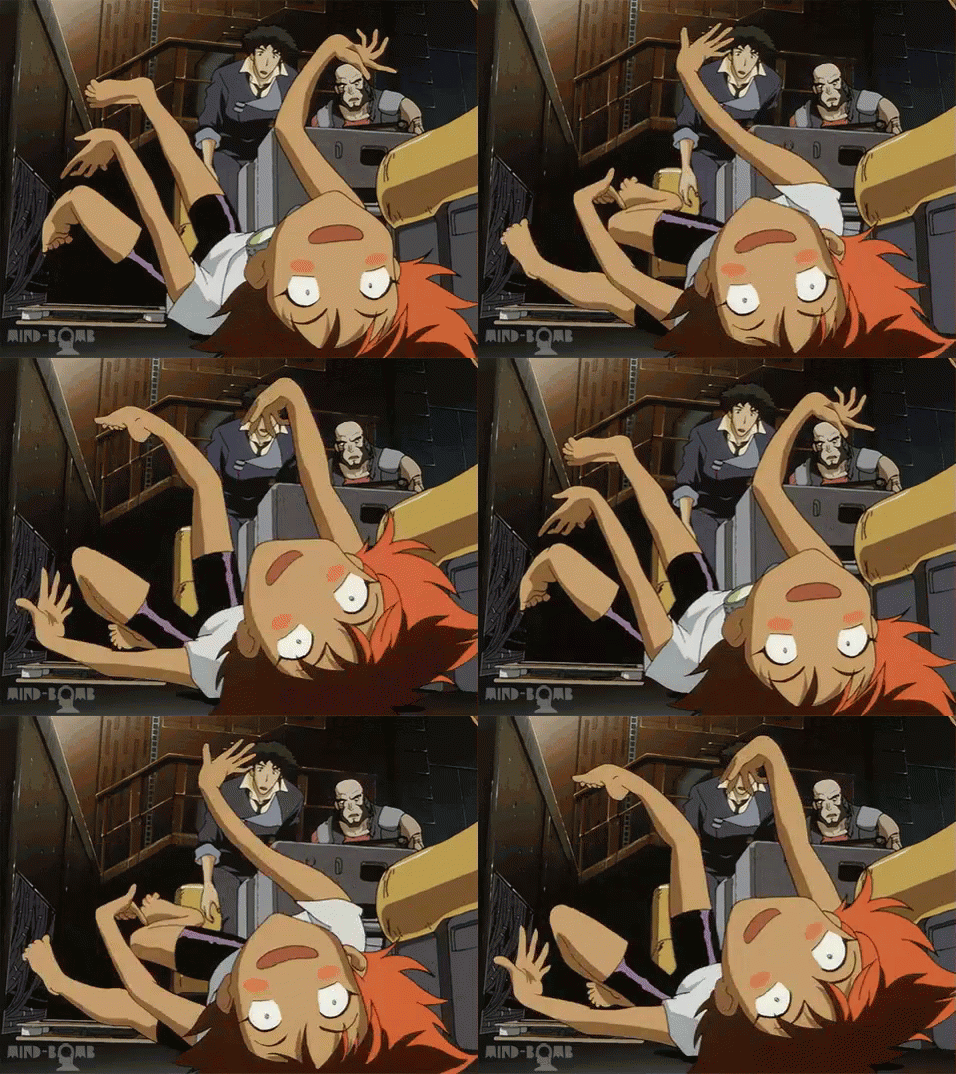
Image courtesy of Cowboy Bebop.

What I want to do is write a perfect opening when I start a new project. A great powerhouse opening that reels you in, or alternately, a poetic entrance that captures your interest. Opening scenes that get stuck in your memory.

More often than not, however, what I get instead is rambling and flailing crap. And each time, I need to remind myself that it’s okay to write a terrible opening. Or no opening at all.

In My Blue World, I think, is the only novel I’ve written where the original opening is the one you see in the end result, but that’s because I knew exactly how to open up that story as soon as I started it. I knew that Zuzannah had to enter the world of the Meeks sisters very unconventionally, literally ripping the fabric of space and time in front of their eyes. It’s been revised of course, but for the most part it remained very close to the original attempt.

Meet the Lidwells, on the other hand, started out as a series of Q&A sessions between the band and the unnamed interviewer, whom I later completely edited out, leaving their voice only as section headers and side notes. A Division of Souls had three completely different and unrelated opening attempts before I returned to the original idea of Nehalé’s awakening ritual. The other two Bridgetown books also started off slightly differently. And nearly all of my trunked stories had alternate openings.

With my two latest projects, I’ve had to remind myself, again, that the only way I can really start these novels is to just WRITE THE DAMN THINGS and not worry too much about how the first chapter sounds. I’m sure I’ll be rewriting or at least revising them in the future, once I have a stronger grasp on what they’re about and what the story needs.

Which is why I call it First Chapter Flailing. I’m still trying to discover all the important parts of the story. What kind of tone do I want to set for the rest of the novel? Who is involved in the first scene, and why? What kind of setting am I looking at? How is this going to tie in with the novel as a whole? The problem is not that I don’t know how to write it, it’s that I’m trying to stick the landing the first time out, and I almost always fail in the process. I either start it too early or too late in the story’s timeline. And then I get frustrated and want to start over. I don’t mind wasting a bit of time trying to write a good story, but I hate wasting words and scenes I won’t use. I know it sounds weird, but it happens.

So how to combat this? Well, like I said: just write the damn thing. Don’t be perfect about it. Just have a vague idea of where this particular first scene is going and what I want it to achieve, and run with it. Have a mental short list of points I want to hit right away. Don’t worry about giant infodumps. And by all means, go ahead and give those characters a somewhat mundane conversation, because that’s the perfect place to drop hints on what will come later on.

There are a lot of moving parts in a novel, especially at the beginning, where it sets everything else in motion. Of course the first draft is going to be messy as hell. It’s always going to be crap. Maybe you’ll luck out and nail it first try, but more often than not you’ll be doing a lot of revision and rewriting in a month or two once you have a much better handle on the story.

And that’s okay! It’s all part of the job of writing. You can always forgive yourself afterwards for all that First Chapter Flailing.

Updates and Processes

I took an extra week off from blogging, as you may have noticed, as I felt the need to give my creative processes another rethink. Long story short, I’ll be updating this blog once a week until further notice, and will be posting them on Mondays only. [As for Walk in Silence, those will appear on Thursdays only.] I’ve decided I need to give a lot more focus on the two novels I’m working on.

Yes, I’m doing the dual-project thing again. Not on the 750Words site, mind you — I’m actually putting that on pause as well — but straight into Word. It seems to be working out well so far, even despite the usual First Chapter Flailings I often have to contend with when starting a new work. The trick, I often have to remind myself, is to just keep writing, regardless of any concern that I’m getting nowhere or writing crap that won’t survive the final draft. There are a few reasons for this:

One, this is a good way for me to get to know the characters a bit more. This is where I’m still feeling my way, so I’m giving them a bit of free rein to move around a bit to let them figure out who they are, and in the process give me an idea how the story will revolve around them. I did this with In My Blue World when I gave each of the Meeks sisters specific personalities (the concerned Diana, the curious Katie and the rambunctious Allie) right from the beginning, which in turn created their own plot arcs and character evolutions.

Two, this keeps me from overthinking it. Seriously, I have a terrible habit of overthinking my stories when I start them out. Overthinking creates too many boundaries that keep me from expanding on anything. I figure if I’m going to overwrite any part of these works, it may as well be the beginning. I can edit them out and reinsert the basic points of reference later on. I did this a ton in the Bridgetown Trilogy.

And finally, it creates an output flow that, after a while, can (and often does) become habit. After a few chapters I can usually nail that day’s work in less time and with higher word count because I’m used to reaching for that flow now, and I can easily pick up where I left off. This worked beautifully for the tandem-written In My Blue World and Diwa & Kaffi.

And in order to do all this, I need to give myself a bit more room to maneuver. Writing five blog entries a week (two here, two at WIS and one at Dreamwidth) plus Daily Words just isn’t working for me this time out, so something’s got to go on hiatus, or at least get cut down. I’ll still be practicing my music and my art, since that’s something I can do a half hour a day without providing too much brain power at this point. And besides, they’re great mini-distractions that are fun and relaxing.

I’m not entirely sure how long this change will last or if it will be permanent, but we shall see in a month or three, once I’ve been immersed in it a while. Thanks for your understanding!

Numbers

I’ve always tried not to focus too much on hitting a specific word count, though it doesn’t always work out that way.

Back in my Belfry days, I’d assigned myself a daily word count of 500, if only to ensure that I wasn’t just turning on the computer, typing a paragraph, and spending the rest of the time playing FreeCell and faffing about with my music library. Once I got into the groove, however, the daily word count goal shifted to 1000. This was around the time I was writing The Persistence of Memories and I knew that with the schedule I had, I could hit it easily.

The downside to that run, which lasted until 2004 while writing The Balance of Light, was that hitting word count started becoming a sport. I’d been so excited by that incessant creative drive that I was pushing 1200 on a daily basis, even weekends. So when the Day Job was getting to me mentally and physically (not to mention a budding long-distance relationship that would soon change my life significantly), I was burning out. And that caused my productivity to suffer.

Nowadays I keep tabs on my word count, but I no longer see it as a sport. I see it more a series of small achievements, like the KonMari cleaning system: a little at a time adds up to quality work as a whole. I keep tabs on the numbers in a little calendar notebook, purely for reference and curiosity. Between the 750 Words site, revision work, and new words for new projects over the course of a day, it adds up. I could hit a few thousand pretty easily on any given day, but I rarely think about it.

For a while I used to take these numbers and crunch them on a spreadsheet, but I soon realized that the actual numbers didn’t interest me in that format. While it was interesting to see how productive I could get during various parts of the year, I’d also get frustrated because I knew I wouldn’t be able to hit the same numbers during a heavy fourth quarter. Besides, I’d completely forget to update the spreadsheet for months on end, so I figured…maybe recording metrics is not what’s needed here.

I just want to write, and enjoy the process. I love having a busy and extremely productive day, especially when I finish off a chapter or a major scene. Adding metrics to my productivity only causes me to think maybe I’m not doing enough. [The Former Day Job may also have something to do with that.] It’s not how my brain works, because numbers don’t mean all that much to me in that context. I’m more focused on schedules anyway. It’s why I have my whiteboard, why I have those ‘assignments’ I hit every day. It all adds up to the same productivity goal I want to hit.

I don’t focus on the solid numbers; I just focus on getting it done.

More on focusing smaller

Yet another gif courtesy of Makoto Shinkai

It’s been a week since my previous post about focusing smaller when it comes to writing, and so far this process seems to be working well for me. Every time I started overthinking the idea I’d been working on that particular day, I stopped myself with the reminder: patience, you’ll get there. The biggest problem I’d been having with Theadia and MU4 over the last few months wasn’t that I was writing crap, it was that I was too eager to get to the goal. And the worst thing I can do is write impatiently.

Some people can write novels out of order. I’ve done it myself a few times…for instance, some of the scenes from Meet the Lidwells were written well in advance as practice sessions at 750Words. And that’s just fine! I’ve been doing precisely that with Theadia lately, just to get the words out and get my brain in the proper mindset for that story. But in the bigger picture, I tend and prefer to write chronologically. I’m a big fan of keeping the Big Story Arc clear in my head so I’m better able to pull all the smaller arcs and characters in the right directions. Thing is, sometimes I let the Big Story Arc thoughts take over, and that’s not good for my writing process.

So what I’ve been doing all this week is focusing on one scene in each project. (As it happens, it’s the opening scene in MU4 and a mid-book scene in Theadia. Perfect example of my occasionally writing out of order.) The main purpose for these exercises was not to convince myself that I was FINALLY working on a new project… it was just to get the creative juices flowing, that’s all.

What’s helping me refocus? Music, of course! Just like the trilogy mixtapes, I’ve been throwing together some interesting mixes for both of the new projects. Theadia‘s mixes have been especially interesting as I’m going out of my way to pick songs I wouldn’t normally choose for this kind of thing. MU4‘s mixes have been similar to the early Eden Cycle mixes of ’97-’98, collecting songs from different genres that evoke a particular mood. I suppose in a way I’m revisiting my old Miami Vice soundtrack style of writing. Hey, whatever works, right?

Another way I’ve been training myself to achieve this new focus is actually a fun project that takes no more than maybe a half hour a day but it’s like a treat for me: storyboarding Diwa & Kaffi! I do one page of six squares a day, just rough visualization sketches in pencil. It’s doing two things for me: One, it’s super fun and something I’ve always wanted to do with my novels, and Two, the daily exercise is helping me get better.

And that, really, is the whole point of this exercise in narrowing focus: getting better.

On Focusing Smaller

Source: Paprika (Satoshi Kon)

I’ve often said that I tend to be a pantser rather than an outliner, but that isn’t entirely true. I’ve done complete outlines before. For example, the outline for Meet the Lidwells! was more or less complete because it was focused on the band’s discography.

On the other hand, I have a few complete outlines for books that I’ve backburnered or trunked. For years I thought the reason for the story’s failure was because I was too hyper-focused on it and gave myself far too many rules and limitations. I’d lose interest because I was trying too hard to make this rigid plan work, even when I constantly told myself it was never set in stone.

A few days ago I was reading someone’s Twitter feed and they happened to mention how, with some creatives with ADHD, they sometimes lose interest in a big project once their brain has solved the problem. That is, they’ve run the whole idea through their head and completed the plot before any work has even been done, leaving the person unable to maintain interest in the creative part of the work.

Suddenly it made sense to me: why do I still feel the pull of some of these backburnered and trunked projects but can never get far with them? Why am I having issues getting anywhere with Theadia and the fourth Mendaihu Universe novel? For years I thought it was because it just wasn’t resonating with me. But why wasn’t it? Disinterest and personal issues don’t seem to be the complete answer, because I’ve felt that with far too many of my completed projects at one point or another.

I had to put it in perspective. Again, with the Bridgetown Trilogy: why did I have almost no problems with that (not including the end of Book 3)? Easy: it was because the bulk of those books — and In My Blue World, Diwa & Kaffi and Lidwells — were written with me only focusing ahead maybe one or two scenes at most. I wrote most of that by sketching out a few ideas during the day job and expanding on those when I got home. [I’ve talked about this process plenty of times, of course.]

There was a reason I kept wanting to get back to that particular process, and for years I misunderstood that yearning as reminiscence and a longing for how enjoyable that process was.

But once I saw those tweets the other day, it occurred to me that maybe there’s more to it than that. Maybe my brain really is telling me that this particular process worked for me, and worked well at that, and maybe it’s time to return to it. I was looking at it wrong; I needed to understand this longing in a clinical sense. I can have a long-term goal with my writing — knowing the direction and final destination of the story — but I have to maintain a much sharper and smaller focus on the scenes in front of me at almost all times.

The reason for that is because when I work out all the moving parts of the entire story and plan it all out ahead of time, I lose interest in it. I’ve already done the brain work and now I’m bored with it. The fact that I keep thinking about these projects, especially when I read older blog posts, notes and outtakes, is because it’s not the story that bores me, but my brain reacting to the idea of the work it involves.

This, by the way, is most likely why my academic years were so damn scattershot.

SO. What this means is that I’ve started adjusting accordingly. My daily words are now focusing on writing short outtakes again. My plans for Theadia, MU4 and other projects are to work on them a little at a time, chapter by chapter, scene by scene. Referring to those outlines only as a road map, and only when needed.

I’m very curious to see where this will take me.

Yeah, no.

If I’ve learned anything about being a writer over the last few decades, I’ve learned to notice when I’m bored with my own work. And unfortunately, Theadia is heading in that direction almost directly out of the gate.

BUT! I’ve also learned that this is a good sign. What this really means is that I’ve just gone in the wrong direction, which is completely normal for me when I start a new project. It almost always takes me three or four tries before I get it right. I just have to keep at it.

Why does this happen so often? Good question. I think it’s because so often I start with a pretty sturdy long-game story arc, but I don’t put enough thought into the short-game subplots as I should. This was exactly why Diwa & Kaffi stuttered to a halt a few times. It’s all part of the process.

So what do I need to do to fix this? Simple: start over. Think of the short-term goals and story arcs that I need to hit first before I can introduce the long-game arc. And if it doesn’t work the second time, try it again from a different angle. Start in medias res if I have to. Effectively what I need to do is raise the stakes a lot more than they’re currently at.

Recently I started thinking about why I’d suffered the same fate with Mendaihu Universe book four, and I can see I made the same mistake there as well. It had nothing to do with the story idea itself…it was that I started it wrong. And I think I know what I can do with that particular project as well, so who knows…maybe I’ll be writing more tandem projects again soon? Heh.

Onward and upward.

Another day, another few hundred or so words

Courtesy of Makoto Shinkai, of course.

Starting a new project can often provide its own set of obstacles and trip-ups. My first few chapters are always a hot mess, primarily because I’m still feeling my way through it all. There’s the fear that I won’t be able to expand on this new idea past a couple of flashy scenes. There’s the reminder that I’m proud of my last project and that I really want this new one to be just as great. There’s the nagging reminder of past goals I’ve reached, such as hitting over a thousand words a day, every day, or writing two novels in tandem, and wanting to immediately recapture those goals again with the new project.

Instead what I’m doing is ignoring those trip-ups. It’s hard sometimes, but it’s doable. I remind myself that this is a Brand New Project that can’t and shouldn’t be personally compared to anything I’ve done in the past. If that means that I’m only hitting maybe two or three hundred words a day instead of eight hundred or a thousand, so be it. I gently remind myself that I’ll get back up to that count soon enough, once I feel more secure and confident about the project.

Each project creates its own mood, its own set of habits and goals, which are different from those of the past. Because of that, and unless I’m writing a sequel or a story in an already created world, I have to treat this new project as its own entity. It’s part of why I make mixtape soundtracks for them. It’s also why I’m my own worst enemy when I feel like I’m not writing enough or as strongly and fall into the trap of “why can’t this be as fun as Lidwells or as easy as In My Blue World?” Those are questions I should not be asking myself.

I should be asking better questions: Who are these new characters? What are their strengths and weaknesses? What would they do in this particular scene I’m about to write? And once they do it, what are the consequences? And instead of focusing on the word count, I should be focusing on nailing the arc of the scene I have in my head. I have to relearn the process every single time, because the process is different for each story I write.

It surprises me how often I need to remind myself of all this, every single time I start a new project. I understand that it’s part of wanting to repeat a personal success, and sometimes that’s the right way to go, but not always. Every project starts off with its own unique rules and creates its own paths to completion.

If that means I’m only hitting a few hundred words instead of a thousand or more for the time being, so be it. As long as it gets done.

Writing in Spare Oom

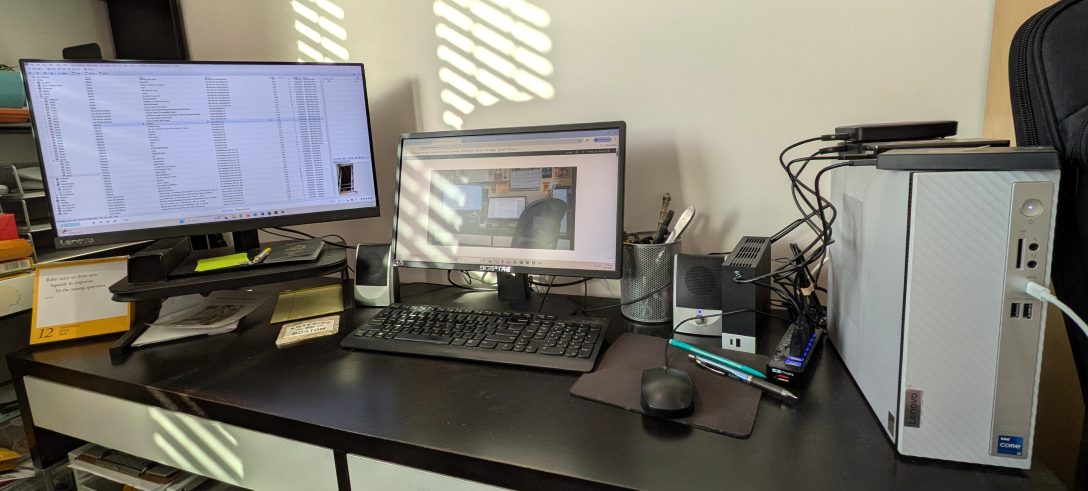
The current look of Spare Oom hasn’t really changed all that much over the years, other than an upgrade in PCs, desk, and so on. I got rid of the Former Day Job laptop and phone, and the current PC (a Lenovo ideacentre 720) has been moved from the floor (where it was attracted a hell of a lot more dust) to the far right side of the desk. Most of the wall decoration remains the same, with the addition of multiple “I power KEXP” stickers scotch-taped in various places. A few toys like Chopper, a burger-shaped eraser, and a Yuri Plisetsky miniature. You’ll most likely find a mug of coffee and a snack nearby as well. And always, always some music playing.

The monitor, as you can see, stays over on the left side at an angle, a leftover from my Former Day Job remote days. It’s a comfortable setup because I get to put the wireless keyboard on my lap while I type away. (It’s similar to the setup during the Belfry days in that respect, and why I don’t suffer nearly as much from carpal tunnel as I normally would.) The angle also faces the door so I’m not ignoring A when she comes in to visit.

The rest of the room is…currently a bit of a mess. We have multiple months’ worth of read books piled up against the loveseat, awaiting donation. There’s also a few boxes and bags worth of donatable stuff waiting for Goodwill to reopen (or alternately, for me to get off my butt and get over to the one donation place that’s open down in the Mission). Eventually I’ll have a clearer floor again…

I try not to spend too much time in here. I’ll do all my work and writing here during the day, and join A in the evening for dinner and a bit of tv streaming. We’ll both visit each other at various times throughout the day as well, just to get up and stretch. At the end of the work day, we’ll both go out for a mile or so stroll around the neighborhood.

I also try not to think of this as a ‘man cave’ because it really isn’t. It’s more like a combination office / storage room / library / studio, and while a lot of things in here are mine, there are a lot of A’s things in here as well, including her yarn and jarring stashes. I think the only sports-related thing in here is a dust-covered Niners ball cap that I got for Christmas who knows when.

Sure, I sometimes get distracted here in Spare Oom. If I turn 180 degrees from where I’m sitting right this moment, I’ll be looking out the room’s one window at the rooftops of the neighborhood, the western hill of the Presidio, and the very smoke-and-fog laden southern tower of Golden Gate Bridge. It’s a great view on a clear day (and one of the big selling points when we first moved in). Sometimes I’ll pick up one of my guitars and practice for a while, playing along with music or just noodling around on a riff or two. And yes, there are a few word search magazines underneath the monitor there — don’t laugh, those are a perfect way for me to unwind when my brain is getting frazzled!

But other than that, I do get a lot more done than I sometimes expect. Once I get into the groove of a project, sometimes I don’t notice that it’s an hour and a half later and the KEXP DJs have switched and it’s nearly time for lunch. I’m not writing dual novels at the moment, though I am working on multiple things. The quick things — the blog entries, the personal journal writing, the daily 750Words entry, and so on — I can finish up quickly, leaving the rest of the time for me to focus on novel writing.

Theadia is being written directly on MS Word, something I haven’t done in quite some time. It felt right to return to a classic process this time out rather than trying to prove something to myself with longhand or using 750. I’m not overplanning it this time, other than a vague outline and some story notes. (And yes, I’ve already made a mixtape soundtrack for it.) No big plans other than just wanting to rediscover the joy of writing.

It’s not a flashy life, but it’s a life I enjoy, and that’s all that really matters!

Starting a New Project

I’m happy to say that I’ve been consistent on the Daily Words all week so far, and I’m hoping to keep it up until further notice. I’m super excited to return to it! After backing away for a good number of months and for varying reasons (most of which I’ve already explained in previous posts), I felt I was more than ready to get back to what I’d like to think I do best.

What am I writing, you ask? It’s a new-ish project, something I’d been playing around with during the waning days of my Former Day Job. Right now it’s going under the project name of Theadia. It’s about two best friends who find themselves in intrigue much bigger than their immediate surroundings. I’d say it’s a mix of the lighthearted approach of Diwa & Kaffi and the immersive world of the Bridgetown Trilogy. Best of both created worlds! Heh.

This is the second new project of mine where I’m following my new and improved approach to writing. A lot of the processes are still the same — I’m still a bit of a pantser with minimal outlining, and yes there is already a playlist/mixtape in the works — but like D&K, I’m approaching the story organically by letting the characters tell me what the story is. With the Trilogy (and to some degree, both Meet the Lidwells and In My Blue World), there was a set universe and I had to ensure the characters worked within its confines. This time out, I’m letting the two main characters discover themselves as well as the bigger story that surrounds them.

Is this a sane way to write a novel? Sure, if one remembers to set up certain rules and boundaries, as well as a final goal. Yesterday I wrote up some rules and regs of the place where a good portion of the story takes place. I also started building up the framework of The Long Term Plotline. This is the plot that I’ve borrowed from anime shows for the last few projects: the one that’s only hinted at near the beginning (which, on the other hand, focuses mostly on character development and single episode arcs) but grows and expands as the overall story goes on, until it becomes the main plot that drives the rest of the novel.

Am I worried it’ll crash and burn? Sure, I always feel that way at the start of every project. It’s either that, or I’m so excited by it that I crash and burn before it’s finished. But if I have faith in the story, I’m willing to see it through. I’ll know if it’s a success once I’m done.

Writing in the time of viruses

Everything is still groovy here in the northwest corner of San Francisco. A and I have a well-stocked fridge (thanks to multiple weeks’ worth of shopping instead of panic buying), the only thing bothering our health at the moment is allergies from the airborne pollen, and we know well enough to was our hands thoroughly and frequently.

While I’m still concerned about having to continue going into the office at this time (as Sunday evening I have not heard any updates from the Day Job), I’m not overly worried. I sit somewhat away from a lot of other people — purely by chance — so my social distancing has been working out reasonably well so far. If they finally call it and we end up working remotely, I am totes fine with that.

I’m still working on my writing, regardless. I’m doing an edit of the Diwa & Kaffi synopsis that should be done by the end of next week, and I’m hoping to squeeze in some new words or at least new ideas for the possible new story ideas I have milling about in my head. My writing schedule is continuing as normal.

I do, however, remember the occasional winter evenings back in my Belfry days when I felt annoyed and frustrated when I was too sick to be productive. This was the end result of trying to hit a deadline, continue my streak of writing a thousand words every day, having a smoking habit, downing multiple Mountain Dews daily, and working extended hours during fourth quarter at a shipping warehouse. Guaranteed by late December my immune system was shot, my sciatica kicked in, my head was spinning, and my sinuses were pounding. The most I could do is play a game or two of FreeCell and call it done.

I know better now. I try to be creative about my writing time (read: I take it where and when I can get it, including slow moments at work), not give myself deadlines I can’t possibly keep, and I’m a hell of a lot healthier. I’m okay if the only writing I can manage is a paragraph or two in my personal journal. I’m annoyed, but I’m not hung up about it. I write when I can write.

Being healthy is just a tad bit more important, especially right now.

And yes, I time my hand washing via running through the twenty-seven seconds of The Beatles’ “Her Majesty.”