On Writing, Revision, and Recording Music

[Note: I posted this at my LJ back in September 2013, and thought it would be worth reposting here.  Enjoy!]

A short time ago I tweeted something that came to me about the writing and revising processes, and partly how I was finally able to understand what I needed to improve my writing, and also made me understand just how to write and record a song correctly. This came to me while I was doing my Blogging the Beatles posts a few weekends ago, and I’d like to expand on it a bit here.

In short, it occurred to me that revision, for the most part, is very much like how many rock bands record their music. The listener–and with books, the reader–are only given the finished piece: the end result of a long process of composing, noodling, demoing, recording, overdubbing, and final mixing. What the public often does not hear/see is all that work as it unfolds. You don’t hear/see the alternate words, the alternate melodies/plots, the mistakes and the other bits and bobs. And if all this is done correctly, you hardly notice all the tiny flourishes as separate entities of the whole, because you’re not supposed to; they’re supposed to be part of the entire, much larger experience.

For the longest time–probably up until the last two years or so–my writing process has been extremely slipshod and make-it-up-as-I-go-along, and giving myself subconscious reminders for things that would need revising later. I’m lucky in that I’ve been able to remember the story arcs and the random plot twists that I would need to expand on later on in the story, and I’ve made copious notes on the esoterica of my created world. I may have crowed about outlines in the past, but I’ve used them, or at least planned out the plot a few chapters ahead of where I was at that time. Still, after all these years, I’ve come to the realization that while this process may work, it’s time consuming and unorganized.

In the last few years, I’ve been working primarily on the revision of the Bridgetown Trilogy, rarely writing anything completely new. That’s not to say I’m not writing anything at all; there are several passages in this revision project that are either total rewrites of older scenes, or are brand new scenes that replace old ones that don’t work. I’ve been writing a few other things here and there, outtakes for Walk in Silence, posts for Blogging the Beatles, and making notes for both new and old ideas. It may look like I’m getting nothing done, but trust me–I’m doing all the background work right now.

Again–it’s like recording a song.

Over the course of the Blogging the Beatles posts, I’ve done a lot of reading of Mark Lewisohn’s book The Beatles Recording Sessions, which goes into fascinating detail as to when, how, and where their songs were recorded. I’ve read this book countless times in the past, but in the context of my blog series I’ve begun appreciating the crafting of the music, listening to the songs and trying to understand exactly what they did to make it sound that way. In the end it’s also made me think more about my own creative processes, both in writing and music.

The beginning always starts with an idea. It might be something obtuse: John Lennon came up with the vocal melody for “I Am the Walrus” from the up-down tones of police sirens as they passed by his home. It might be something coming from out of nowhere: Paul McCartney was convinced he’d copped the melody to “Yesterday” from somewhere, but it was his own creation. It might be inspired by life: George Harrison wrote “Savoy Truffle” about Eric Clapton’s addiction to sweets. The point being: this is where the idea takes hold. I’ve mentioned in the past that my trilogy came from watching the Gall Force animes.

The next step is the rough draft, the demo. Here’s where a band gets together at someone’s house and hashes out a few ideas that have been brewing over the last few weeks. The Beatles did this in early 1968 when they came back from India, gathering at George’s house for a few days and hammering out a few rough drafts of songs that would eventually show up on The Beatles (aka The White Album), as well as Abbey Road. In writing, this is where you’re writing longhand, maybe doing a bit of outlining and/or plotting, drawing maps, putting up that wall of Post-Its. In essence: here’s where you sit down and riff it, build on that one idea (or multiple ideas) and see what unfolds.

Next is the first draft, Take 1. It’s going to be rough, there are going to be dozens of mistakes and wrong notes and flubbed lyrics. If the demo contains enough ideas that you can continue fleshing out, this is where you start adding a few things here and there, perhaps fleshing out a melody or two that you found captivating. You may even find that a bit that worked in the demo sounds horribly out of place here, and you drop that. Now, unless you’ve been practicing and rehearsing that one demo for quite a long time, you have to remember that this first take is going to sound like crap, no matter what you may think. Rarely does one get a complete finished song at this point. In writing? Same exact points. You’ve got the idea, now it’s time to start molding and shaping it into something better.

Next is the following drafts, the continuous takes. However long it takes to get that one passage right, to fix that lyric or bum note that’s been bugging you all this time. You may even resort to outside influence–your bandmates/your writing group–and ask them to take a listen/read and see if they find something you’ve overlooked. This is the longest and the most frustrating part, because you’re focusing mostly on building the song/plot. You may even drop it for a time and work on something else so you can return to it later, listen/read it with a clear mind.

Eventually, you’ll hit that last draft, that last take of the song. There will be a point, if you’re paying attention, where everything will just click. The song might not be the most perfect one in existence, but it’s exactly how you want it to sound. You’ve fixed those bum notes, you’ve cleaned up the lyrics. You’re at a point where you’re happy with it, maybe even a bit proud of it. In writing, this is where you’ve pretty much tied up all the loose ends of the plots, fixed the grammar and spelling mistakes, gotten it to the point where it looks clean.

This, of course, is not the final result. Not yet. And this is where, for years, I’d stop. I thought I’d be done with the book and send it out to agents and publishers, thinking I had a good shot at getting accepted. This is where I’d also get rejected, of course. There are many and countless reasons for that, which I won’t go into at this time. The point is, it’s not quite finished yet.

This is where the overdubs, the final mixing, and the running order come in. There’s that one point in the middle-eight that sounds just a bit too sparse, so you decide to throw a bit of horns or a solo in there. The vocals are weak here, so you overdub yourself to punch up the strength of the sound. This song sounds quite out of place as the third track on the album, but would sound so much better as the second-to-last track. Translated: this is the final read-through, the point where you pick up the novel as a whole, read it as you would a potential reader instead of its author. This is where you pay attention to how you react to the story. This is where you notice that one character needs more description or action. Where you notice that this subplot leads nowhere. Where you feel that Chapter 5 would make so much more sense chronologically as Chapter 8 instead. Where you threw a deus ex machina or something in there out of laziness, or as an “I’ll fix it later” and promptly forgot about it.

THIS is the final draft: this is where you make the song sound seamless, like you and the band recorded it in one go, without a single blemish. This is where your audience will not see the work you put into it, but only the end result.

Once you hit that point, then it’s time to send it out to the agent and/or publisher.
Writing Soundtracks

Most of you out there know that, aside from being a writer, I’m an incurable music fan.  Not a day goes by where I’m not listening to some radio station or some new album I downloaded that week.  I laugh at polls that ask if I listen to music more than a few hours a day–it’s more like all day long.

This includes my writing time.  I’m one of those writers who prefers to have some sort of music going while I’m writing.  What I listen to actually boils down to whatever project I happen to be working on.  I’m currently working on Walk in Silence, so the music of choice has been strictly 80s alternative.  For the most part I’ve been listening to the 1st Wave channel on our Sirius XM setup, where Swedish Egil and Dave Kendall have been providing me with tasty retro goodness for the last few months.  This is perfect for this first draft, as I’m not focusing too much on specific albums and songs at this time.  The second draft will focus more on that, so my soundtrack will focus more on my own mp3 collection.

The evening writing sessions down in the Belfry that produced The Phoenix Effect from 1997 to 1999 and the Bridgetown Trilogy from 2000 to 2004 had their own expanding soundtrack; the former contained a high amount of the free cds I got when I worked at HMV, and the later contained many of the titles I bought during my weekly journeys to Newbury Comics back when it was in Amherst.

Was the writing influenced by the music I bought?  Well, yes and no.  I didn’t go out of my way to look for the perfect song that would fit a specific scene, nor was I writing and editing a scene to a specific song in a Miami Vice-like manner.  I’d grown out of that habit a long time ago.  I merely found myself gravitating towards the moods the music created when I listened to them, and used that as a mental anchor when I needed it.

When I was writing a number of scenes that needed personal and emotional tension, I would often throw on Dishwalla’s And You Think You Know What Life’s About.  If it was an epic action scene, it would be Failure’s Fantastic Planet.  Global Communication’s two albums 76:14 and Pentamerous Metamorphosis fit the bill perfectly when I was writing about the world of Trisanda.  Trip-hop like Massive Attack and Sneaker Pimps worked good when I was writing about the seedier areas of Bridgetown.  I also had certain go-to bands whose entire discography worked, like Porcupine Tree.

I always made a conscious effort never to let the music interfere with the story; I tried not to write scenes that lost their energy when the music wasn’t playing.  If anything, the music served as an anchor, giving  me something to focus on, something to aim for.  Failure’s epic album closer “Daylight” served as the audio anchor for the final scene in A Division of Souls–I needed something desperate and angry and with a hint of fear that would mirror what was going on during those final pages, and I think that it paid off.

Now that I’m working on a project that’s specifically about music, I have every reason to listen to whatever I like.  Whatever my next writing project is, will I have the same listening habits during my writing sessions?  Who knows, but I’m pretty sure something will be playing.

On Conlangs in Science Fiction: When Should a Writer Use It?

As you have seen here and here, the Mendaihu Universe has its own constructed language, or conlang. which I’ve chosen to use for the alien Meraladhza race.  Creating this ersatz language was not just a hella nerdy thing to do, but it was a lot of nerdy fun as well.  As noted in that previous blog post, there were two reasons for doing so:

1. To give the aliens their own language, pure and simple.  Once you read Douglas Adams’ The Hitchhiker’s Guide to the Galaxy, as a writer you can’t help but feel super-conscious about aliens being able to speak your native tongue so easily, and sometimes fluently to the point of using localisms, without thinking it’s a cop-out.  It’s a silly worry, as it’s widely accepted in the genre, expected even, for aliens from other worlds to be able to speak your language, or at least to have some sort of translating device.  Thus Adams’ brilliant sendup using the babel fish–it’s a brilliant satire of the old-school science fiction stories where the aliens somehow knew the Queen’s English upon first contact.

2. What if I wanted them to use their language?  In a way, I wanted to play around with the idea that our languages have permeated Anjshé, just as it has permeated ours–which is how a lot of real languages have evolved on Earth, anyway.  This is another reason I chose the aliens to have been among us for at least a few hundred years before the trilogy’s timeline; this would have given time for a bit of cultural bleedover to take place, including language.  The Meraladh would have picked up on various languages, and the Earth humans would have picked up on Anjshé, and both sides would have appropriated a few phrases into their own language at that point.

So if you’ve created a conlang for your novel or your created world, you may need to ask yourself: when is it needed?   In my opinion: when it’s needed within the context of the story.  Think about why you want to use the alien language–I mean, aside from “because it’s cool”, of course.  Give the language a reason for being there.

Say your main character is meeting up with your aliens for the first time, and he or she doesn’t know the language, or doesn’t have a translating device on them.  You could play up the tense moments by having them attempt to converse, never quite sure if they’re being friendly or aggressive.  Some writers have used this as an ongoing plot device, such as CJ Cherryh whenever she has the alien kif speak in her Chanur books.  Even Adams used this idea to amusing effect, having Arthur Dent hear a few moments of the Vogon language before Ford Prefect slams a babel fish into his ear; in the process, we find that the Vogons are not just horrible amoral aliens in general, but their language is so hard on the ears that it has literally caused other aliens to kill themselves rather than listen any further.

Within the trilogy, I use the Anjshé language only where it’s truly needed, specifically when a character is having an extremely emotional or spiritual moment.  It could be passive, such as when Alec Poe spits out the word pashyo (a general exclamation of surprise or frustration) whenever he’s annoyed with the situation.  Or it could be when Caren Johnson humbly apologizes to a Meraladian character with nyhnd’aladh…I am sorry, when she speaks out of turn and inadvertently says something hurtful.  I also use it whenever a character is performing some kind of spiritual action; just before a major ritual begins, I have Denni Johnson speak an entire introduction completely in Anjshé before she repeats it in English.  All these moments not just utilize the conlang to give the moment realism, but I’ve also given it a reason for being there:  as the Meraladians are a very spiritual people, so is their language, which they deem just as important as their actions.

*

As always, one major thing to remember about creating a conlang is to make it pronounceable to the reader.  Unless you’re creating a language that’s deliberately hard on the tongue and/or ears, such as Adams for his Vogons or Cherryh for her kif, you’ll want to voice them out as you create them.  If you can’t pronounce it without tripping over your tongue or your throat seizing on you, chances are good that your reader will have the same problem.

A few other hints to think about:

–Make some ground rules to keep it consistent.  As stated in a previous entry, the most common sounds in Anjshé are “mmh” and “aah”, as they are the sounds of the spirit at rest.  Creating these kinds of rules will show that you put effort into this conlang, that you’re not just making it up as you go along.

–Study up on real foreign languages–or even your own native tongue–as a way to see how and why that culture created its vocabulary.  Anjshé is partly inspired by real languages that create new words through existing shorter words, like some Japanese and German; it’s also partly inspired by the aural flow of Gaelic.  In this process, keep in mind how these new words will affect your characters:  how would they deliver them, and is there a specific reason why they are saying them?

–Create a primer or a glossary that you can always refer to while writing to help you remain consistent in usage as well as in spelling.  You may even want to add these words to your word processor’s dictionary to avoid the auto-correct kicking in.  Additionally, you can use this glossary as part of your novel’s endnotes so the reader can refer to it when necessary.

–Have fun with it and see where it leads you!  Don’t think of it as your boring homework from high school–you’re creating not just new words here, but a new created culture, which you can then integrate into the novel itself.  This  will give your story more depth in the process, even if it’s just a short passage.  Readers will pick up on this and enjoy the reaction it causes.


Creating a conlang can be as detailed or as vague as you want and need it to be.  On the whole I believe I only have about seventy or so Anjshé words I created and added to the Bridgetown Trilogy, and used them only when necessary.  I left the door wide open for expansion, of course, and if that is part of your long-term goal, then by all means, go for it!

An Introduction to the Bridgetown Trilogy

Hi there, and thanks for sticking around!  And hello if you’re a new visitor!  Welcome to Bridgetown!

So…what is The Bridgetown Trilogy, you say? Where is this mythical B-Town?  And why does the banner picture of the city look suspiciously like downtown Los Angeles as seen from the Getty Museum?  What is this trilogy all about anyway?

Well–it’s high time I give you the rundown.  The one-sentence pitch that I’d come up with, which I’m currently using:

Caren Johnson’s younger sister has been forcefully awakened as a powerful and supernatural deity, revered by multiple worlds…and a war has just been declared in her name.

Nice kicker, eh?  I’d like to think so.  [Mind you, that was probably the hardest damn thing to create.  I’m not one for brevity.]

So let me give you the situation:  Caren Johnson is an elite member of a special branch of the Bridgetown Metro Police called the Alien Relations Unit.  With the humanoid Meraladzha living among us, the ARU has been tasked with keeping the peace between aliens and humans.   She’s proud of her work; she’s followed the career paths of her parents, Aram and Celine, both highly revered and decorated ARU agents.  They were both killed in the line of duty five years before the events that take place in the trilogy.  She’s become the legal guardian of her younger sister Denni, a precocious and very intelligent fifteen year-old, and she loves her dearly.  Caren does her best to balance life and work, but because of her parents’ history, they sometimes blur…

Aram and Celine were also a part of an elite force called the Mendaihu–a collection of supernaturally strong and highly spiritual people whose primary goal is to protect the planet…not just the humans and the aliens, but their souls within as well.  The reasons for their deaths had never been officially released publicly, but Caren knows why; they were protecting their daughters from a potential evil that had come to kill them.

Caren fears she will become Mendaihu as well, for it’s in her soul and in her blood.  But what she fears most is when Denni ‘awakens’ to her own Mendaihu powers.   Her one wish is to let Denni live a normal life without such heavy responsibility.

Nehalé Usarai, a rebel Meraladian and an one of the strongest Mendaihu in the province, has other plans.  He knows Denni’s fate…but he also knows that she’s the current incarnation of the One of All Sacred, one of the highest revered deities in Meraladh history.  He performs a dangerous and potentially lethal Awakening ritual, and in the process not only awakens Denni, but a large swath of Bridgetown as well.  He knows this is dangerous, but he fully believes that she will bring peace and balance to the world.

The only thing that could stop her is an equally strong and formidable force called the Shenaihu; they are the yang to the Mendaihu yin, their spiritual opposite.  When one acts, the other must act in kind to retain the balance, or the both the physical and the spiritual world could spiral out of control.

Both sides have other plans, despite the balance.  It will be up to Denni, Caren, and a host of others, both awakened and not, to ensure that the balance returns.

The story takes place over three books:  A Division of Souls, The Persistence of Memories, and The Process of Belief.   It’s about many things: belief, patience, clarity, and love.  It’s about physical and spiritual evolution.  It’s about family.  If I had to whittle it down to a single sentence, I would say this: it’s about devotion to oneself despite outside influence.


*   *   *

At this time, the first book has been submitted to a potential publisher, and I’m currently awaiting a response.  I’m keeping my options open, but my aim is to have the trilogy published by a professional house.

Here’s to hoping!

On Dialogue: Realism, Conversation and How to Get It

I admit, I love writing dialogue.  To me, that’s where the characters really blossom and show their true colors, even if they’re speaking evasively.  They can’t help but reveal parts of themselves.  I actually enjoy passages in books where there’s a heavy conversation going on.  If it’s done well, it’s like the story has just decided to shift gears and rev the engine a little, show off a bit, and lets us see how characters interact.  And if it’s done really well, the writer can even get away with a bit of exposition while they’re at it.

It does take practice to write good dialogue, though.  You have to be a good listener of course, but you also need to be able to know what you’re listening for.  For example:

1.  You don’t want them to sound like you.

I fell prey to this quite often when I was starting out.  All my characters sounded like townies from central Massachusetts, quick with a smartass remark or a localism, generally friendly to everyone, and so on.  I grew out of that when I learned how to create unique characters.  I kind of cheated on this while writing True Faith, basing many characters off of real actors and actresses of the time.  One character was based on Denis Leary, so he was often abrasive and unafraid to say questionable things; another on Christian Slater’s Heathers character so he often sounded slimy and untrustworthy. That was the only project where I went out of my way to create a cast list like that, but it definitely made me listen closer to actual conversation.

2. Don’t just listen to the words.

That was also in 1995, the year I worked at a theater chain, so I was able to watch pretty much all the blockbusters that year for free, and that’s where I really started focusing on dialogue.  Movies can often be a great study guide.  You don’t always need to watch the classics repeatedly like I did in college; pick out your favorite movies and study them.  And don’t just listen to the words; listen to the pacing, the delivery, the intent.  Listen to the way someone evades answering a question, or the reason why they’ve raised their voice.  They’re not just throwing words at us, there’s meaning behind them.  Dialogue can help drive the story just as well as prose can; find out how your characters can do that for you.

3. Be realistic, but not too realistic.

One of the most irritating things I’ve seen over the last decade or so is the literal quote in news stories.  Say you’re reading coverage about a congressman explaining why they voted as they did; what we’d like to see is an easy-to-read quote: “We deliberated long and hard on this issue, and to tell the truth, we almost couldn’t make it pass…but we were relieved when it did.”

But what we’ll sometimes get in the coverage is this:  “We, uh. We deliberated long and hard, you know, on this, the issue.  We–to tell the truth, I’ll say this, we almost couldn’t–it nearly didn’t pass.  But we were relieved when it, when it did.”

Sure, if you want to quote a person exactly and without edits, by all means, go right ahead.  I understand that you may be doing so to avoid any possible misquotation.  But as you can see from the previous paragraph, it’s hard as hell to read.  Your brain gets impatient because you already know what they’re going to say before they said it, and you lose interest before you’re even done.

Some writers can get away with that kind of dialogue, especially in film, and depending on your tastes, it works or it doesn’t.  It really does depend on the story, because the dialogue needs to flow just as smoothly as the prose does.

Let’s highlight that: the dialogue needs to flow just as smoothly as the prose does.

The reason for this is that, more than anything else, you’re telling a story, and nothing takes you out of a story quicker than a passage that feels desperately out of place, yes?  It can be tricky sometimes, especially if you’re writing jerky dialogue on purpose (say, the character has a stutter or is too nervous around others), but at the same time, it needs to be able to sustain the interest.

Of course, there’s always the caveat: if the dialogue is being used as a plot device–say, the character says something shocking and unexpected–if you can pull it off, go for it.

That said, dialogue can be just as tricky as prose, but at the same time, it can be a lot of fun.  Experiment with it, figure out how it best works for you and your stories.

*    *    *

Here’s a few of my personal exercises on learning how to write dialogue:

1.  Watch movies and certain television shows.  I’ve already talked about movies, but some tv shows work too.  I’m talking about mysteries, dramas, finite series; shows that not just tell a half-hour or hour long story, but have an arc that ties the whole season or series together.  Listen to how the characters speak to each other over the course of the series.  Does their friendship deteriorate or grow stronger?  Why are they growing nervous around them when they speak?

2. Try writing a short story with nothing but dialogue–no dialogue tags, no description, nothing, just the characters speaking.  Trust me, it can work.  I tried it a few times for my daily words exercise some time ago and posted an example at my LiveJournal, and I had a hell of a fun time writing it.  By limiting the extremities, I forced myself to tell the story through what the two characters were saying.  A few hints at the setting, who they were, what kind of society they lived in, just by having them talk to each other.  It’s not nearly as hard as you think–in fact, it was a hell of a lot of fun to do, and well worth trying.

3. Real life listening.  My wife and I do a lot of walking and taking the bus around our city, and we both have a habit of catching snippets of other peoples’ conversations.  We’re not spying or being rude; we’re simply catching some of what they say to their friends as they pass by.  We’ve heard all sorts of great gems from tourists and locals alike, especially if they’re heard out of context.  Not only are they great for story prompts, they may influence how you see the characters speaking such things.

Fly-by post – Yes, I’m still here!

My apologies for not updating here over the last few weeks!  It’s been a crazy couple of weeks, between work-related issues and deadlines as well as getting some serious work done on my Walk in Silence book outline, so I’m afraid I haven’t had the time to keep this updated.

As of now, I’m where I want to be with the WiS work at the moment, and things should quiet down considerably on the work end of things.  Which means I have absolutely no reason not to be updating these more often.

SO!

Starting now, I’m hoping to have at least one update a week here, and perhaps update even more once soon after.  I still have quite the backlog of posts I have planned–they’re staring me in the face on a clipboard above my desk as we speak–so I hope to get these out to you as soon as I can.

I appreciate your patience–I’ll be back soon!

20 years 5 months 18 days (give or take)

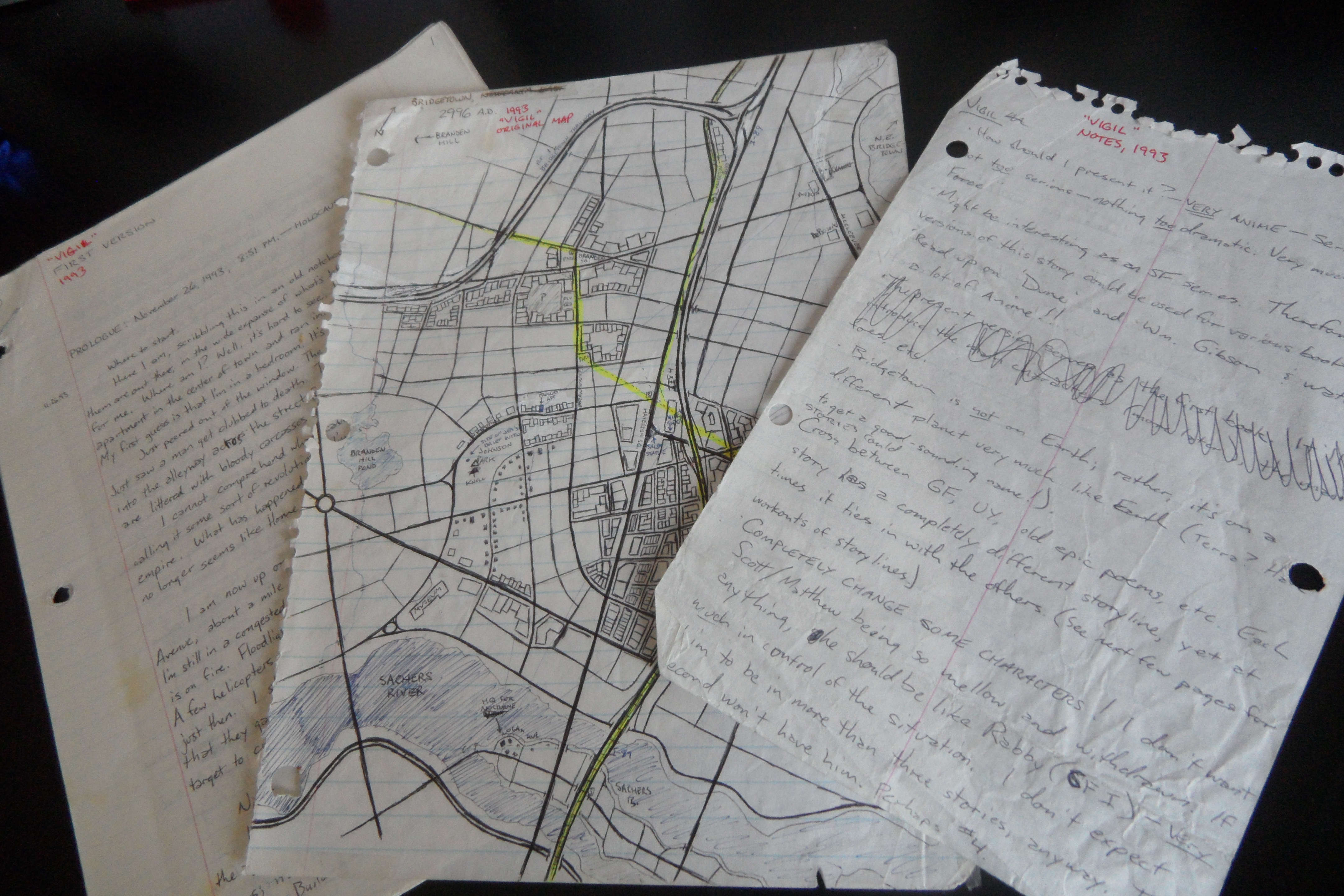
Some of the original notes from 1993.

That’s a hell of a long time to be working on a novel, don’t you think?

At 11:18pm PT last night, I completed what I call the Great Trilogy Revision Project, a major overhaul of all three novels in the Mendaihu Trilogy.  Entire scenes were rewritten, edited mercilessly, tightened up, names changed and characters strengthened.  It took the better part of fourteen months and I kicked my own ass numerous times to avoid laziness and weak prose; I read, reread, re-reread, and re-re-reread (sometimes while at the gym!) until I knew the story, its history and its cast inside and out.  And I read it again to make sure I knew where it worked and where it didn’t.

Today marks the first day in probably a decade or so where I have no plans to work on the existing novels or work on anything related.  [Mind you, I definitely have plans to work on future Mendaihu Universe stories, just not at the moment.]  In my mind, this epic project is DONE.

Notes made while doing laundry, October 1993.

In late 1993, I’d just watched the first two Gall Force animes (I’d find the third movie a short time later) and found inspiration to write what I often call my Infamous War Novel, or IWN–my first novel from my high school years–in a completely new style I hadn’t tried before: science fiction.  I wrote a few notes in a steno notebook while waiting for my clothes to dry at the Charles Street Laundry, and came up with a number of ideas that I could work with.  I’m amused by the first line saying “VERY ANIME”, as well as the consistent anime references on that one page.  As if I knew what the hell anime was at that point in time, other than my latest obsession!  All I wanted to do was write something that was totally unlike American SF at the time.

Did I know what the hell I was doing?  Probably not.  I was woefully ignorant of genre fiction other than through movies, comic books and Japanese animation.  But I was willing to learn along the way.  I understood right away that storytelling in Japan is significantly different than storytelling in America, and I wanted to try my hand at writing that way.

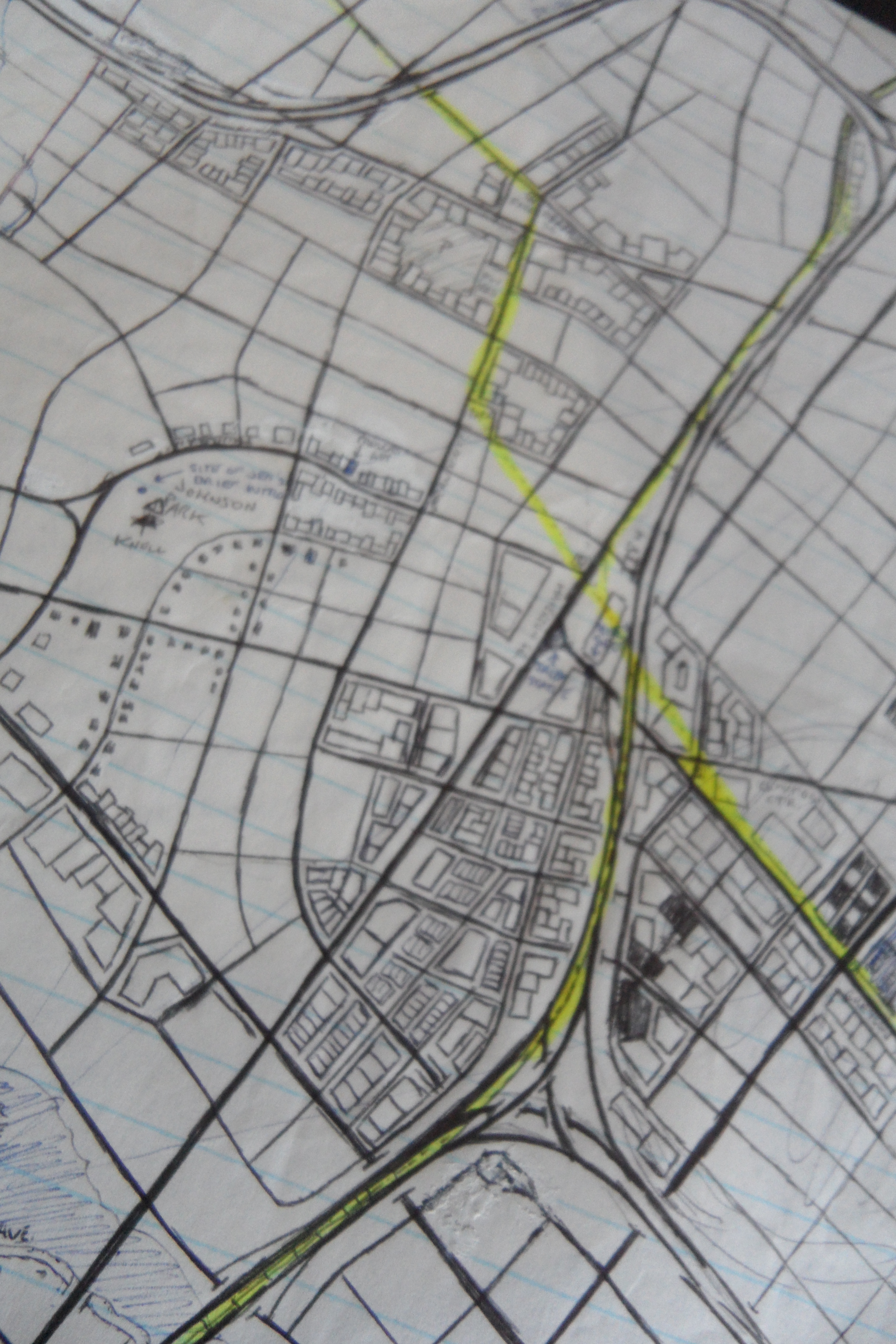
Soon after, I did what I normally do when I come up with story ideas: I draw maps.

The original Bridgetown Sprawl as of November 1993

I knew I wanted a few things: a sprawling metropolis, a giant tower (hints of the GENOM Tower from Bubblegum Crisis), and a megacity so packed with different places and cultures that I knew I’d be able to use the setting for multiple story arcs.  Bridgetown morphed and grew considerably and exponentially over the years, but there are points here that made it all the way to the finished product in one form or another.  Sachers Island, Branden Hill Park (named Johnson Park here, but pretty much in the same shape), the warehouse district,  and the dirty and dangerous strip of McCleever Street were there from the start.

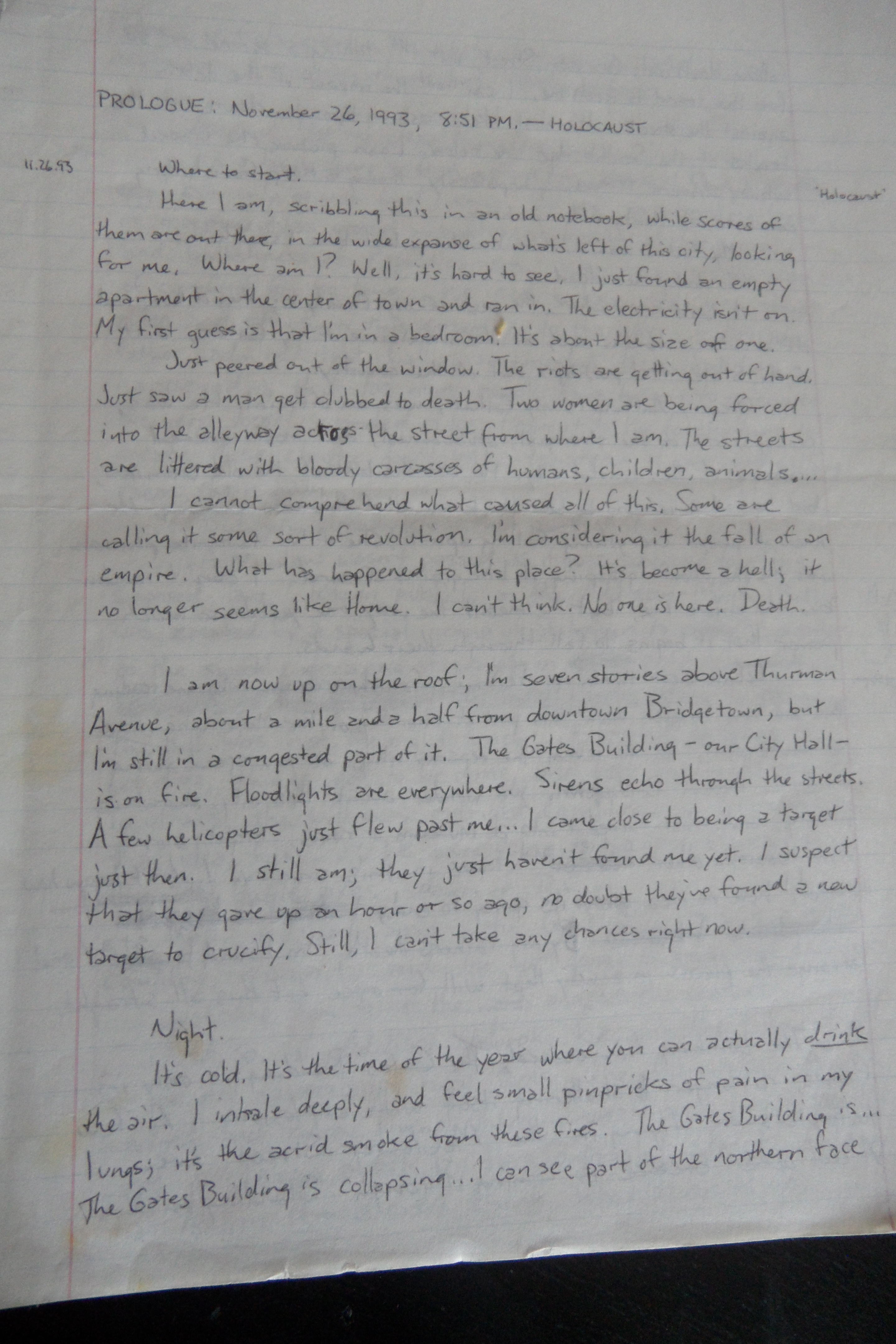
Vigil, Take One.  Started 26 November 1993, 8:51pm ET in my shoebox apartment.
Vigil, Take One. Started 26 November 1993, 8:51pm ET in my shoebox apartment.

Where to start, indeed.

My primary aim when I first started this novel was to write something totally unlike anything I’d written before.  I wanted everything about this project to be completely new for me–an untried style, a setting I’d never ventured through, a plot that challenged me to work it through to the best of my ability.

Granted, I was far from perfecting that, but I was going to try anyway.  Vigil–so named after this band of rebellious misfits bent on saving the world from corruption–was started on the Friday after Thanksgiving 1993, after getting off work.  I’d had a few ideas written out here and there, but this was where it all started.

True Faith–the aborted rewrite from summer 1994–would grow out of this, introducing the spiritual background.  The Phoenix Effect, the project from 1997-1998, grew out of TF and introduced the alien races. TPE in turn became the trilogy after a complete restart from scratch.

So for all intents and purposes, Vigil was the version that started it all.  And now it’s done.

Any author will tell you that they have a hard time letting go of their projects, even once they’re completely finished and on their way to publication, and I am no different.  I’m sure I’ll want to pick these three books up again and tinker with them some more.  I’ve already got Book 1 out to a publisher, and am ready to take the next steps to shop it around and even get an agent if need be.  I’ve also debated self-publication as an alternative.   It’s a wide world out there, and I’d like to introduce you all to the Mendaihu Universe someday.  On this evening, I’m finally that much closer to doing so.

But for now?  I think I’ll do what I haven’t done since I started writing the trilogy proper, way back in 2000:  I think I’ll let it sit awhile, and let it age gracefully.

Fly-By: Coming Soon

Hey there!  Sorry to keep you all waiting for new entries here at Welcome to Bridgetown…I’ve been busy with a number of things both personal and otherwise, so I haven’t had the time to sit down and do some serious writing about the Mendaihu Universe, or about writing in general.

That said, after the Easter holiday, I plan on getting back on the high horse and posting new entries here and at Walk in Silence as well.  Here’s a few offerings I have in store:

–On Spiritualism: the One of All Sacred and other deities in the Mendaihu Universe

–On Language in the Mendaihu Universe:  speaking and innerspeak

–On Faith in the Mendaihu Universe: the Personal and the Religious

–On Dialogue:  Realism versus conversation

–On Conlangs in Fiction: When should a writer use it?


Stay tuned! 🙂

On Writing: Letting Ideas Percolate

I’ll be truthful–the Mendaihu Universe has been percolating in my brain for at least twenty years this past winter.

Twenty years. Isn’t that a bit long for me to be sitting on these novels? Shouldn’t they have all been written, published and made into movies by now? Shouldn’t I already be working on the next trilogy in the universe? Well, in a perfect world–yes, of course! And with that, I’d have some nice cash in the bank as well. This, however, is not that perfect world. There are reasons it’s taken me so long to get those beginning scraps of ideas into the shape they’re in now. For one, back in winter 1993-94, I only had the gung-ho to write them but the barest of plots. For another, I had to do more homework in the genre, learn what makes a good SF/F novel that people would enjoy.

But a very large portion of it was the fact that I had to learn how to write in the first place.

I’d been toying with writing science fiction during most of fall 1993, just after I’d graduated college. There were a few pieces of inspiration: Akira, the Gall Force OVAs, other SF/F-themed anime, Orson Scott Card’s How to Write Science Fiction & Fantasy and Ray Bradbury’s Zen in the Art of Writing. And there was my music collection as well, to inspire me and keep me company.

The first few ideas popped up most likely that December–I’d finally given up on trying to resurrect one of my earlier novel ideas, and scrapped nearly everything except a single idea: an underground gang who broke the all the rules, but for the right reasons. From there I played around with a few tropes: a multi-planetary setting (created while doing laundry one afternoon on Charles Street), a giant sprawling city (part of my lifelong compulsive habit of map drawing), cyberterrorism (Hi, CompuServe and AOL! Glad to have you around!), politics (Clinton had just entered office) and so on. I hadn’t quite latched onto cyberpunk yet, though I had read a bit of Gibson by then, and within a few years we’d get a short but interesting wave of internet-themed movies (The Net, Hackers, Strange Days, and Johnny Mnemonic for example) that would add fuel to this idea. I was pretty much open to anything at that point.

A number of months later I was writing the first attempt, True Faith. [To spare you the story some of you already know, here’s the short version: TF was an extension of the “Vigil” underground gang idea with all the other inspirations I noted above, plus a twist: I added a bit of spiritual enlightenment, inspired by my then-recent foray into Wicca. It was co-written with my then-girlfriend Diana; it was mostly my idea and my writing, but she came up with a few of the character backgrounds, plot twists and wrote a few passages as well.] This version lasted from summer 1994 to probably late 1996 and was never completed, for various reasons. One of the most important being I just was not happy with the prose.

What was wrong with it, anyway? Well, for one, I think I was focused too much on inner dialogue.  The characters did a lot of thinking and contemplating and not much doing anything afterwards. For another, I’d written a lot of scenes starting something but never quite completing them. And worse, I had a habit of writing what I call “stage directions”: the character did this, he went over there, he got up and tapped a code, he did that, he went there. The end result was that I’d come up with a lot of interesting ideas and scenes, but the execution lacked any kind of oomph.

Come 1997, I chose to start again, almost completely from scratch. This was The Phoenix Effect; it retained the spiritual bent, the underground gang and the cyberpunk ideas, but the focus was now on two new characters, investigators hired to figure out why certain AI units were now becoming more human. That last idea was inspired by my 1996-8 foray into New Age spirituality, infusing the idea that the soul came from elsewhere other than Earth. This novel did get finished, and I even attempted to submit it to a few places, but I was still unhappy with it.

I toned down the stage directions, I followed through on the action, and I had the characters doing things instead of just thinking about them. What was wrong this time?

Two further problems: quantity and delivery. The description of scenes and characters was slim to nil, as I’d focused too much on getting the story out on paper. Who were these people in my novel, anyway? Why were they there? Where were they? In my head, to be honest. I had them up here in my cranium–I knew exactly what they looked like, where they were, what they sounded like…but I’d put none of that on paper. I realized part of this was due to having written this longhand–I was focusing on keeping the story moving that pausing for a few seconds to describe something felt like I’d tripped up. I’d expand on these things a little when I transferred it computer, but there was still a lot missing.

Cue the third attempt, right around 2000-1, with A Division of Souls. This would be the first novel I’d write completely on the PC. Fully-expanded, complete scenes? Check. Expanded description of characters and scenery? Check. Expansion of the characters’ backstories? BIG check. Expansion of plot? BIG check. Scenes and plot points were completely rewritten and others totally new. I even plotted ahead a few chapters before writing them, something I rarely did before then. The outcome worked so well that I ended up with not one but three novels, which I wrote well into 2004. I was quite proud of this trilogy. And yet…

What was the problem this time? Well, aside from burning out in late 2004 and never finishing Book 3, I still didn’t quite get what I was doing wrong. I had a great story idea, an extended universe to play in, well-crafted characters, and description galore. So why was I still not quite there yet?

Again: the writing. It took me a long time to figure this part out, and only recently, in the last year or so, did I finally get it. You could see the choppy edits, the “screw it, I’ll fix it later” passages, the subplots that went nowhere. In other words, I had an extremely rough draft, and I’d said “good enough”, and that was the killer. I had the finished product, but I just hadn’t bothered to polish it at all. You see, I wasn’t quite there yet. I still had that final hurdle.

This meant some major review and revision. And I mean major review. So how did I go about it this time? Well, this time out I took all three books (I’d finally finished Book 3 in January of 2010) and put them on my Nook, and proceeded to read them. And read them. And read them. AND READ THEM.

I immersed myself in these three books to the point that I had the entire trilogy arc in my head. Over the course of six months or so, I must have read all three books from start to finish through at least three or four cycles, and each time I made a mental note of what needed fixing, from big things like story arcs to miniscule things like dialogue tags. And starting in 2012, I started the biggest revision I’d ever gone through in my life. I painstakingly went through each chapter and worked the hell out of each one. Some chapters were relatively quick to work through, but those first six or seven chapters in Book 1 were almost completely rewritten from scratch–a lot of those passages hadn’t been properly revised since their 2001 inception.

As of today, I’m on Chapter 10 of Book 3. It’s been one hell of a long trip, but it’s been worth it. I learned a hell of a lot in these past few months, possibly more than I’ve ever done in the last ten years combined, about what makes a decent manuscript and what doesn’t. And most important, I finally learned how to write.

*

Now, should this have taken twenty years?  Who knows. I’ve got other interests aside from writing science fiction, and I’ve had day jobs that took precedence. I’ve had personal events intervene. And yes, just like any other writer, I get distracted easily. Am I fine that it’s taken two decades to get where I am, and I still haven’t gotten these things published? Yes, I am. I’d rather have a complete and professional product out there that I’m proud of, rather than release a half-assed, phoned-in book that I wouldn’t be able to resell, at least not to any publisher. I’ve learned other things on the way too, come up with new ideas for the Mendaihu Universe. I’m not about to write this world off just yet, not when I have more to say about it. As soon as I’m done with this major revision of the first trilogy, I’m going to start working on the next one.

So yes, sometimes it’s a good idea to let ideas percolate. Sometimes the end result is worth the wait.

On Writing: Originality vs. Trope

As writers, we’ve had these conversations with our friends, family, readers, even other writers:

(1) Schenectady *
Me: “I’ve got an idea! I’ll write about werewolves.”
Them: “Yeah! That sounds cool! I love werewolf stories!”
Me: “Cool, I’ve got a potential reader!” (runs to office and starts typing away)
Me: (thinking) Hmm. I like this story…but I can’t help but feel it’s been done before…

(2) Bandwagonesque ***
Me: (thinking) Hmm. Wolf Children^ was a really cool anime. It’s given me some inspiration…
Me: (aloud) “I’d like to write a story like that.”
Them: “You mean fanfic?”
Me: “No, my own story. I’ve got a few ideas milling about.”
Me: (later, while writing) “Oh dear. This is a fanfic, isn’t it…?”

(3) I’m a Loner, Dottie, a Rebel ****
Me: “I want to write about werewolves.”
Them: “Oh GOD not another one. They’ve been done to death.”
Me: “They’re a trope, and they still sell. They’ve been written since…well, when was the first werewolf story, anyway?” **
Them: “Yes, but you’re not going to get it published. There’s a glut.”
Me: “There’s always been a glut. I have a few ideas–”
Them: “It’s never going to sell. Agents don’t want it, they have enough of them.”
Me: “Are you an agent?”
Them: “…”
Me: “Then shut up.” (hides in office to scribble in notebook–that’ll show ’em!)
Me: (later, while writing) “Shit. They’re right. Damn it.”

(4) Sell Out *****
Me: “I’m going to write a werewolf story!”
Them: “YES!”
Me: “It’ll be about love, about loving the enemy, about realizing who you really are despite everyone’s expectations.”
Them: “I’LL BUY IT!”
Me: “Hollywood will LOVE this.”
Them: “WE’LL GO SEE IT!”
Me: (wakes up from dream) “Well, hell.”

So yes…my point being, sometimes you come up with an idea where you just can’t win. You can come up with something you think is original, but there’s always something or someone in the background reminding you of those four dreaded words: it’s been done before. Of course, it’s already been proven time and again that your supposed original idea has been written by someone somewhere, either past or present. I’ve done it myself–I wrote my vampire novel Love Like Blood some years back. I didn’t consciously decide to write my own Twilight pastiche, far from it. My novel was taking the idea that the goth music genre really was infested by vampires, and riffing off that. Granted, the end result was far from perfect, and I’m sure it’s going to remain trunked, but the point is that I wrote it despite the dissenting voices.

Recently for my morning words I’ve been toying with a few characters that came to me just last week. I don’t know too much about them just yet, so I’ve been playing around with them, trying to get them to tell me their secrets. They’re being pretty stubborn about it, let me tell you. They definitely have a dark secret, and they’ve repeatedly come out and said they wouldn’t tell me what it was. Not just yet. All I know is that they’re hiding something, partly for their own safety, but possibly for everyone else’s as well. I’ve been building up who they are, little by little, throwing a lot of false hints in there. Were they related to my Mendaihu Universe? Were they something completely new? Were they inspired by the the fact that I’m reading Ransom Rigg’s second Peculiar Children book at the moment? Were they inspired by the fact that I’d just bought (but not yet watched) Wolf Children?

Then, last night, I came up with an image: a black bird, possibly a crow, tussling in the fallen autumn leaves with a black cat. It looks like they’re playfighting, taunting each other.

Could this image be related to the possible dark secret my new characters have been keeping from me?

And it dawns on me–I could very easily turn this into an animorph^^ story. Humans who turn into animals…or the other way around, animals who take on human form. It’s a trope that’s been used in multiple genres, from anime to horror to romance and back again. As they say, “it’s already been done.”

So how to make it original, then? The quick and simple answer, as always, is “make it your own story”. But what does that mean, really? Does that mean I’m using my own words and making up my own plot as I go, therefore it’s my own story? That certainly runs the risk of borrowing already-used (and often overused) ideas, especially if I don’t make myself aware that I’m doing so. No, there’s more to it than that. Could it mean that I took a well-told story and put it in a new setting, like all those fairy tale retellings we often see in Hollywood movies? That’s all well and good, but that runs the risk of being derivative and unoriginal.

So where does that leave us?

Character.

Many writers, agents and publishers will often say “make it your own” when talking about writing a new story in an old trope, but I’d like to think that what they’re really trying to say is to make the characters original, and the originality of the plot and the setting will follow. Create an original character and find out how he or she (or it) fits into your potential story universe. Come up with a character that fascinates you, build on their background, find out what makes them tick, and at the same time, think about their place in your created universe. Why do they feel out of place? Why do they think they’re better than others? Who or what is threatening them?  Why are they threatening others?

My new characters are definitely hiding something, and if my vision from the other night is anything to go by, then I’ve created two further ideas: they’re hiding their animorphism for a good reason, and they’re possibly hiding it from people (or things!) that could cause them harm if others knew about it. But I’ve also created further depth apart from these two points by building character–I’ve created a few individuals who, in their everyday human lives, are deeply creative, have close ties with their community, and upon first glance would be considered your typical townies in a small New England town. They fit in with their surroundings rather than being the weird outsiders, and no one’s the wiser. It’s not until an as-yet-unplanned outside influence potentially threatens their lives. Thus: I have possibly decided to write a story about animorphic people–itself a trope as old as the hills–but I’ve made it my own because I’m focusing on the characters with animorphism, not the ability itself.

Lastly, I rarely think about trying to avoid or follow tropes while I’m writing the story, because that really isn’t something I should be focusing on at that point. Sure, I have it in the back of my mind, but I only consciously think about it when I’m venturing too close to predictability. Otherwise, I’m quite aware that I’m writing in trope. The trick is to see how my characters react within this trope. Therein lies the originality.

– – –


Notes:
* – Reference to Harlan Ellison’s famous answer to questions about where he gets his ideas.
** – Werewolf lore popped up sometime in Europe around the 15th century.
*** – Teenage Fanclub album, 1991. Infamously known for being Spin magazine’s best album of 1991 over Nirvana’s Nevermind.
**** – Song from the Get Up Kids off their 1999 album Something to Write Home About.
***** – Song from Reel Big Fish off their 1996 album Turn the Radio Off.
^ – Really, it’s a lovely-looking anime. We haven’t watched it yet, but it’s won all sorts of awards and just recently came out on dvd. Check out the trailer here.
^^ – That’s animorph–humans with the ability to change to a different animal. Anamorphic deals with widescreen film ratio and how it’s shot.